Liquid Cooling vs Phase Change Cooling: Which Battery Thermal Management Sensor Performs Better?

Global electric vehicle adoption is accelerating at an unprecedented pace, with industry studies projecting the EV battery thermal management market to cross multi-billion-dollar valuations within the next few years. As battery energy density increases, overheating risks rise dramatically, making accurate sensing technology one of the most critical safety requirements in modern EV platforms. This is where advanced battery thermal management sensors become indispensable for battery protection, operational efficiency, and thermal stability.

The debate between liquid cooling and phase change cooling has intensified because automotive manufacturers, battery pack integrators, and industrial OEMs are under pressure to deliver safer, lighter, faster-charging, and longer-lasting battery systems. While cooling technologies continue to evolve, the performance of the sensing architecture behind them often determines whether a battery system succeeds or fails under real-world operating conditions.

Heatcon Sensors is a specialized manufacturer of customized temperature sensing solutions for industrial and automotive applications. The company manufactures precision-engineered RTDs, thermocouples, EV BTMS sensors, and industrial thermal monitoring solutions designed for harsh operating environments. Heatcon Sensors also manufactures industrial heating equipment including furnaces, electric furnaces, ovens, hot air blowers, tubular heaters, immersion heaters, ceramic heaters, infrared heaters, and high density cartridge heaters for demanding industrial processes across India and international markets.

What is the role of battery thermal management sensors in EV applications?

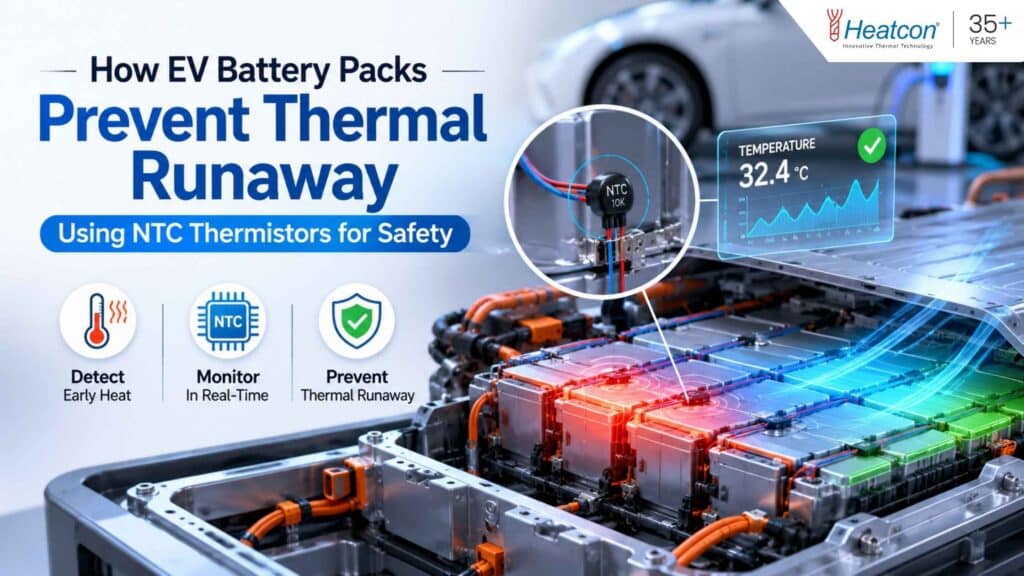
Battery thermal control systems rely on highly accurate temperature measurements to prevent thermal runaway, uneven cell degradation, charging inefficiencies, and catastrophic battery failures. Without reliable battery thermal management sensors, even the most advanced cooling system may fail to detect dangerous temperature spikes in time.

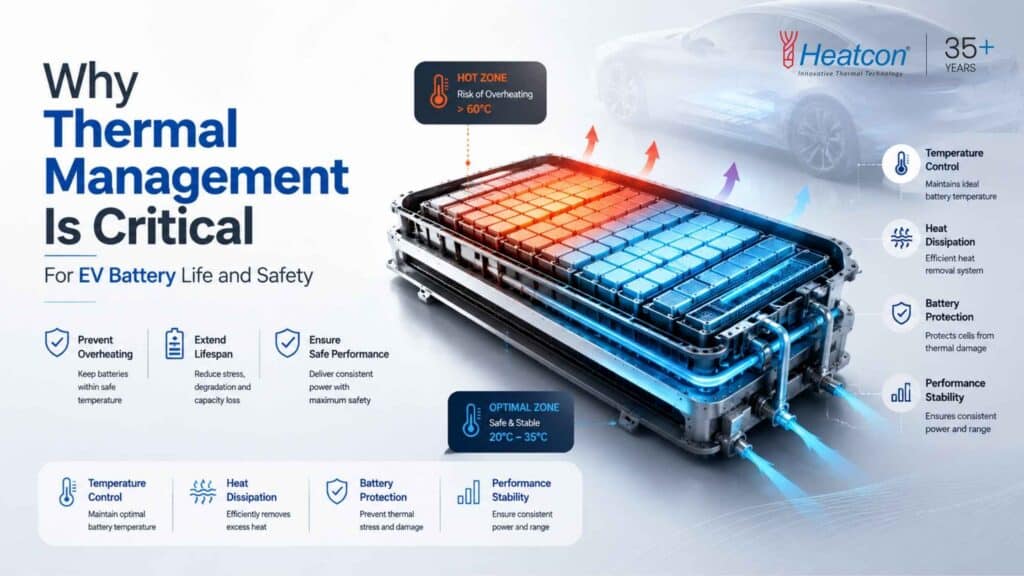
Modern lithium-ion battery packs generate significant heat during charging and discharging cycles. High-performance EVs, energy storage systems, and fast-charging infrastructures can expose battery modules to extreme thermal stress. In such conditions, precision temperature monitoring becomes essential for:

  • Maintaining uniform battery cell temperatures
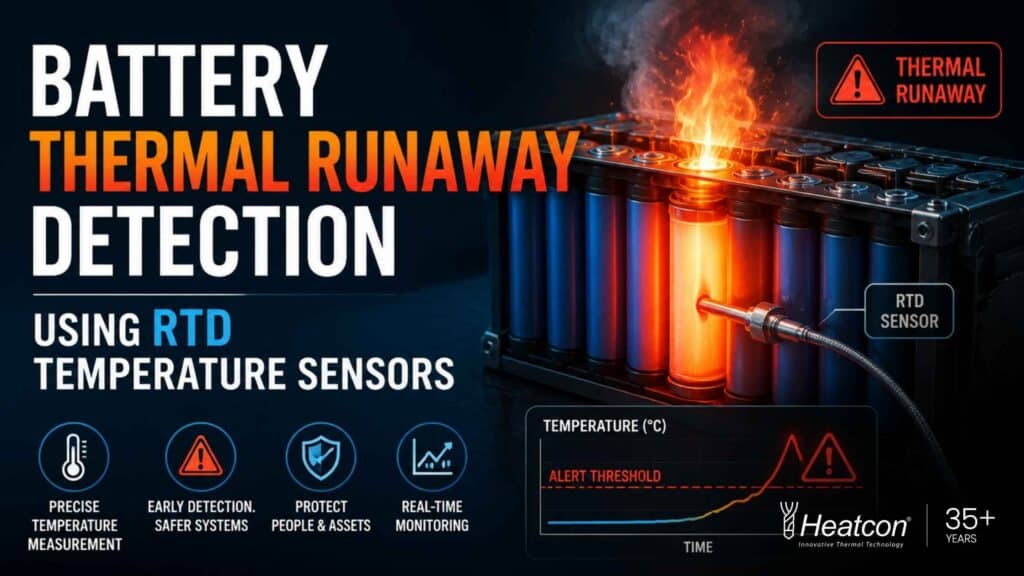
  • Preventing thermal runaway events
  • Improving battery lifespan
  • Enhancing charging efficiency
  • Supporting predictive maintenance
  • Reducing safety risks in EV systems
  • Optimizing thermal management systems

The increasing complexity of EV platforms has made EV cooling sensors a foundational requirement in modern automotive engineering. Manufacturers today are no longer searching for standard off-the-shelf components alone. Instead, they require customized sensing configurations capable of operating under demanding thermal, vibration, and humidity conditions.

How does liquid cooling work in EV battery packs?

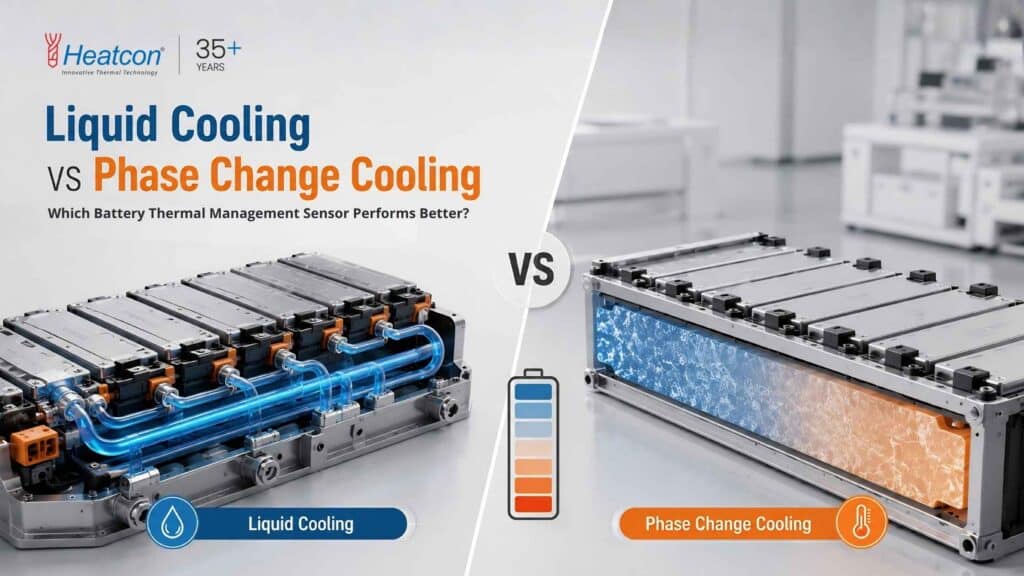
Liquid cooling uses circulating coolant channels placed near battery cells or modules to absorb and dissipate heat. The coolant transfers heat away from the battery pack toward a heat exchanger or radiator system, maintaining stable operating temperatures during charging and vehicle operation.

Liquid cooling has become one of the most widely adopted cooling strategies in premium EV platforms because it provides:

  • Efficient heat transfer capabilities
  • Improved thermal uniformity across battery cells
  • Enhanced support for fast charging
  • Reduced thermal hotspots
  • Higher energy density compatibility
  • Better performance under extreme climates

However, liquid cooling systems also introduce engineering complexities. These include coolant leakage risks, pump failures, maintenance requirements, additional weight, and increased manufacturing costs. This is precisely why high-accuracy battery cooling monitoring becomes essential in liquid-cooled systems.

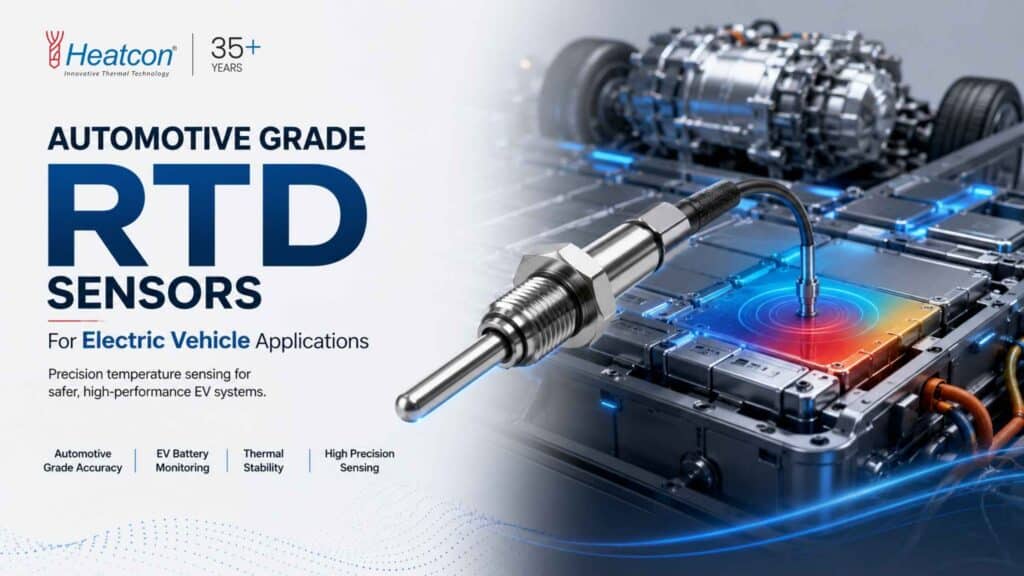
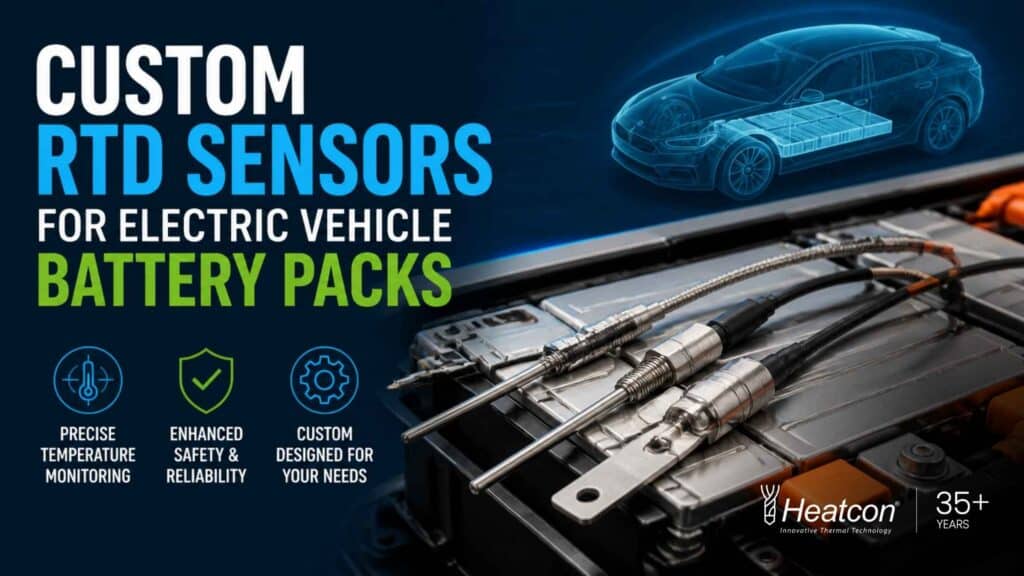
Heatcon Sensors manufactures customized RTD PT100 sensors specifically designed for liquid-cooled battery packs. These sensors provide stable and repeatable temperature readings even in environments exposed to vibration, moisture, and continuous thermal cycling.

What is phase change cooling in EV batteries?

Phase change cooling relies on materials that absorb large amounts of heat while changing state, such as from solid to liquid. These phase change materials help regulate battery temperatures by storing thermal energy during peak operating conditions.

Unlike traditional liquid cooling, phase change cooling can operate passively without requiring continuous pumping systems. This provides several advantages:

  • Reduced mechanical complexity
  • Lower maintenance requirements
  • Compact system design
  • Silent operation
  • Potential weight reduction

Despite these advantages, phase change cooling systems also face challenges in maintaining consistent thermal performance during prolonged high-load conditions. Once the phase change material becomes saturated, thermal management effectiveness can decline significantly.

This creates a major requirement for highly responsive EV BTMS sensors capable of detecting rapid thermal fluctuations before dangerous operating conditions emerge.

Liquid cooling vs phase change cooling: Which performs better?

Liquid cooling generally delivers superior thermal consistency for high-performance EVs, while phase change cooling offers simplified passive cooling benefits for compact or lower-demand systems. However, the overall performance of either solution heavily depends on the quality and responsiveness of the sensing network integrated into the battery architecture.

Parameter Liquid cooling Phase change cooling
Cooling efficiency Very high Moderate to high
System complexity Higher Lower
Maintenance requirements Moderate Low
Fast charging support Excellent Limited in extended loads
Weight considerations Higher Lower
Sensor dependency Extremely high Very high
Thermal stability Excellent Good

For ultra-fast charging EVs, commercial electric fleets, aerospace battery systems, and heavy-duty industrial battery packs, liquid cooling currently maintains a technological advantage. However, even the most advanced cooling design cannot function effectively without reliable battery thermal management sensors integrated throughout the battery pack.

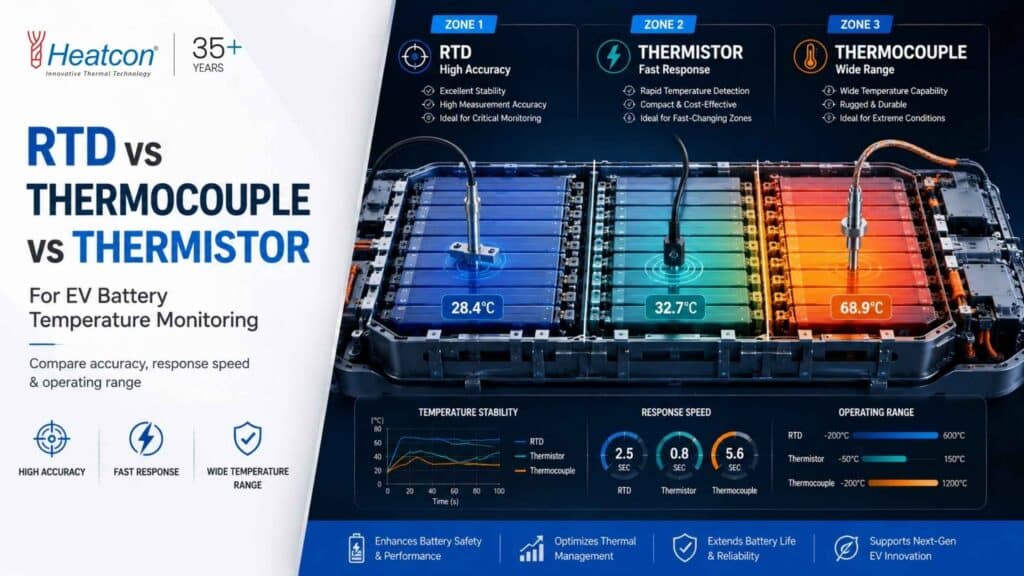
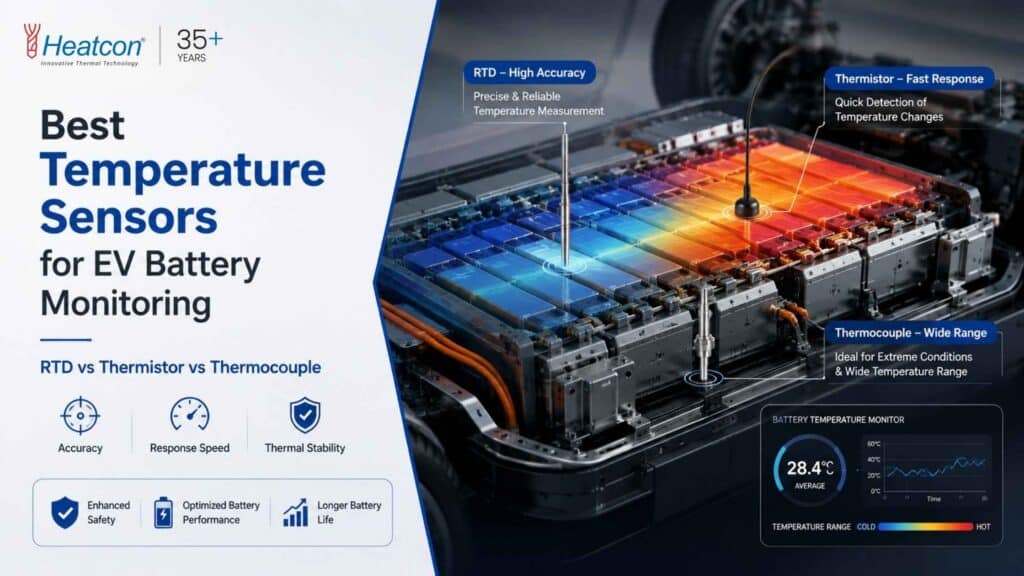
Why are RTD PT100 sensors preferred for EV thermal applications?

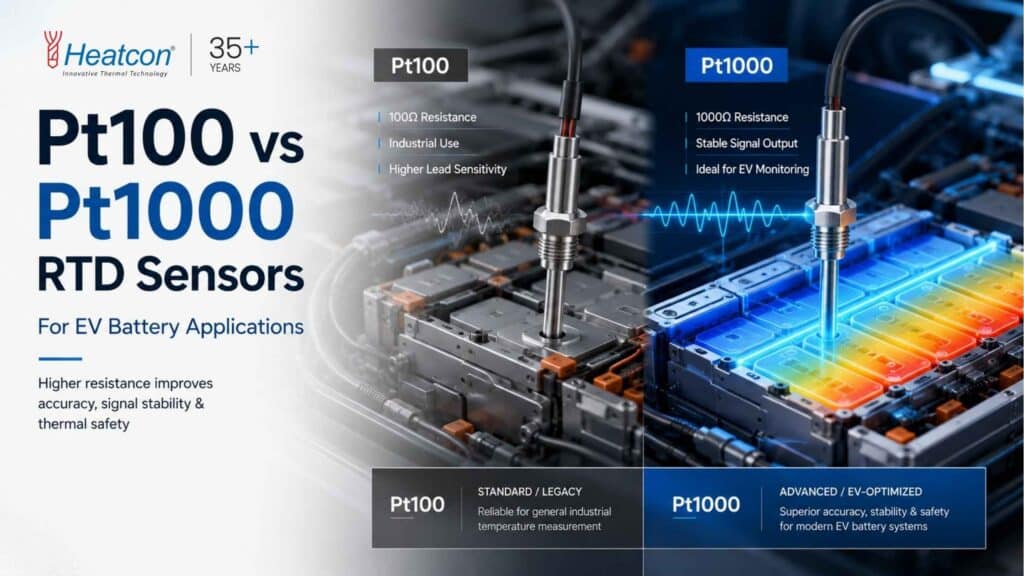
RTD PT100 sensors are widely preferred because they provide exceptional accuracy, long-term stability, repeatability, and wide operating temperature capabilities. In EV battery systems where even slight temperature variations can impact battery safety and efficiency, precision becomes non-negotiable.

Heatcon Sensors manufactures customized RTD PT100 sensors engineered for:

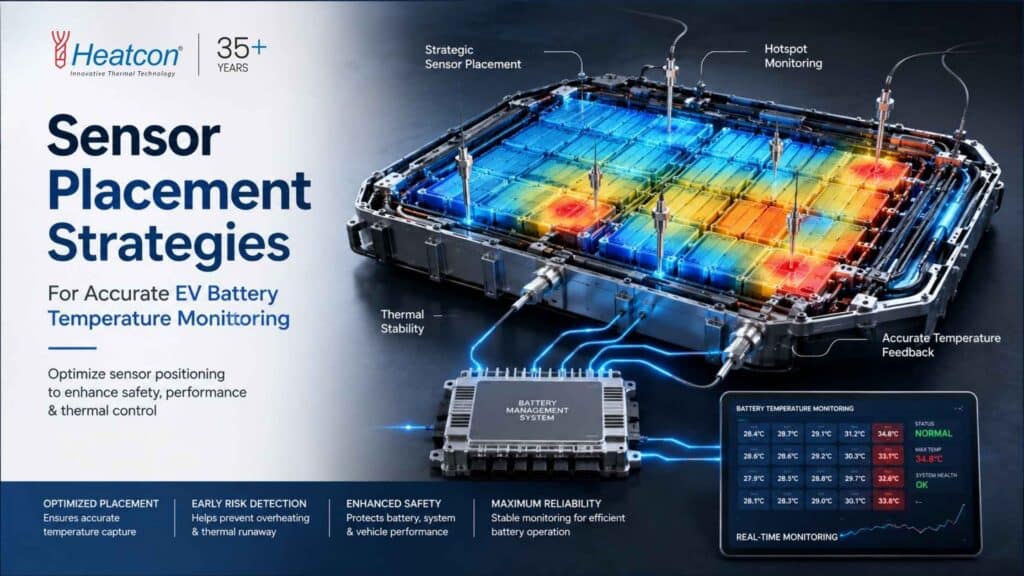
  • Battery module integration
  • Cell-level thermal sensing
  • Liquid-cooled battery systems
  • Phase change thermal systems
  • High vibration industrial environments
  • Fast response automotive applications
  • Compact battery pack designs

These sensing solutions are manufactured according to specific industrial requirements and can be customized for sheath material, cable insulation, probe dimensions, connector compatibility, and response time specifications.

How do EV cooling sensors improve battery safety?

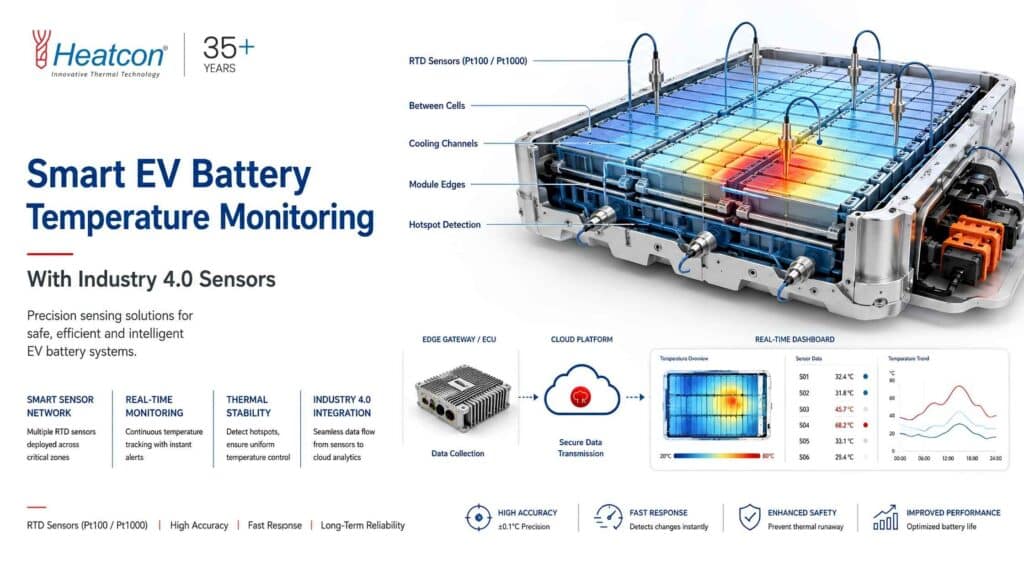
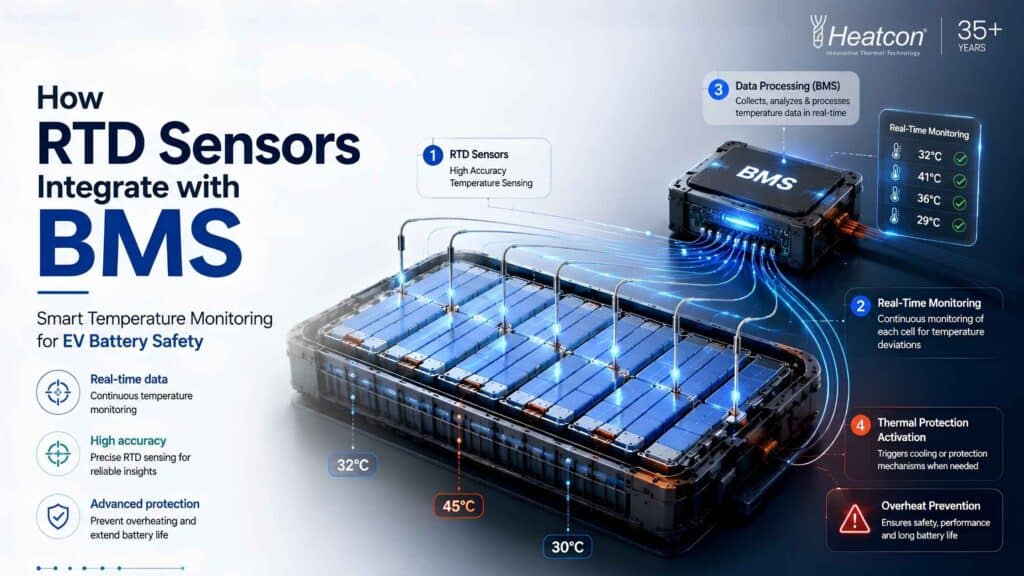
Accurate EV cooling sensors help prevent dangerous thermal conditions before they escalate into catastrophic failures. Modern EV platforms use sophisticated sensor networks to continuously monitor cell temperatures, coolant temperatures, ambient conditions, and battery module heat distribution.

Benefits of advanced sensing integration include:

  • Real-time thermal diagnostics
  • Improved battery balancing
  • Enhanced charging safety
  • Reduced degradation rates
  • Lower warranty risks
  • Improved energy efficiency
  • Extended battery life

Poor-quality sensing solutions can lead to inaccurate readings, delayed responses, and unsafe operating conditions. This is why leading manufacturers increasingly seek customized sensor partners rather than relying solely on mass-market generic components.

Why does battery cooling monitoring matter in next-generation EVs?

Battery cooling monitoring is becoming more important as EV battery capacities continue increasing. Higher energy density creates greater thermal concentration, especially during rapid acceleration and ultra-fast charging cycles.

Future EV architectures require monitoring systems capable of:

  • Detecting microscopic temperature deviations
  • Supporting AI-driven thermal prediction
  • Enabling adaptive cooling control
  • Managing thermal runaway risks
  • Supporting solid-state battery technologies
  • Improving fleet-level diagnostics

The transition toward autonomous mobility and connected electric fleets will further increase dependence on intelligent thermal management systems and high-reliability sensor technologies.

How does Heatcon Sensors support global industrial requirements?

Heatcon Sensors is an Indian manufacturer specializing in custom temperature sensors for industrial and automotive applications. The company serves OEMs, process industries, EV manufacturers, research facilities, renewable energy companies, and industrial heating system integrators.

The company manufactures:

  • RTDs and thermocouples
  • Customized EV BTMS sensors
  • Battery thermal management sensors
  • Industrial thermocouples
  • Mineral insulated sensors
  • Surface temperature probes
  • Temperature transmitters
  • Industrial ovens
  • Electric furnaces
  • Hot air blowers
  • High density cartridge heaters
  • Ceramic heaters
  • Infrared heating systems
  • Industrial process heaters

Heatcon Sensors can custom manufacture and supply products across India and worldwide, including the United States, UAE, Indonesia, Germany, South Korea, Saudi Arabia, Russia, Bahrain, Kuwait, and multiple international industrial markets.

What should manufacturers look for in thermal management systems?

Selecting the right thermal management systems requires evaluating both cooling performance and sensing reliability. Manufacturers should prioritize:

  1. Sensor accuracy and response time
  2. Long-term thermal stability
  3. Resistance to vibration and moisture
  4. Customization capabilities
  5. Integration compatibility
  6. Scalability for future EV platforms
  7. Supplier manufacturing expertise

A weak sensing infrastructure can compromise even the most advanced cooling platform. This is why experienced manufacturers increasingly partner with specialized sensor companies capable of delivering application-specific engineering support.

About Heatcon Sensors

Heatcon Sensors is a specialized manufacturer of industrial temperature sensing solutions and heating equipment based in India. The company designs and manufactures customized RTDs, thermocouples, EV cooling sensors, battery thermal management sensors, and industrial thermal solutions for demanding operating environments.

With growing demand for safer EV battery technologies, Heatcon Sensors continues supporting industries with precision-engineered sensing systems designed for modern thermal management systems. Whether the requirement involves automotive batteries, aerospace systems, industrial process heating, renewable energy storage, or advanced manufacturing applications, Heatcon Sensors delivers customized engineering support tailored to industry-specific needs.

Businesses looking for customized sensing solutions can reach Heatcon Sensors by submitting their details through the contact form at https://heatconsensors.com/contact-us/, sending a message through the WhatsApp interface available on the company website, or calling +91 9164833027 or +91 9844233244 for immediate assistance.

Frequently Asked Questions

What is the main difference between liquid cooling and phase change cooling in EV battery systems?

Liquid cooling uses circulating coolant to absorb and transfer heat away from battery packs, while phase change cooling relies on materials that absorb heat during a state transition such as evaporation or melting. Both approaches are designed to maintain safe operating temperatures inside EV battery packs, but they differ in response speed, thermal efficiency, maintenance requirements, and integration complexity.

In either system, accurate battery thermal management sensors are essential for maintaining safe temperatures, identifying hotspots, and ensuring consistent battery performance. Heatcon Sensors develops high-precision sensing solutions that support advanced EV battery cooling architectures across research, testing, and production environments.

Which cooling technology performs better for high-performance electric vehicles?

High-performance EVs often prefer liquid cooling because it provides stable temperature control during rapid charging, aggressive acceleration, and extended driving cycles. Phase change cooling can offer excellent heat absorption during short thermal spikes, but liquid cooling generally delivers better continuous thermal regulation for demanding automotive conditions.

To optimize either technology, manufacturers depend on reliable EV BTMS sensors that can continuously monitor battery cell temperatures and cooling efficiency. Heatcon Sensors provides sensor systems engineered for accurate thermal feedback in modern EV battery platforms.

Why are temperature sensors important in battery cooling systems?

Temperature sensors play a critical role in preventing overheating, thermal imbalance, and premature battery degradation. Even a small temperature variation across battery cells can affect charging efficiency, lifespan, and overall safety.

Heatcon Sensors manufactures EV cooling sensors that help engineers capture real-time thermal data with high accuracy. These sensors support effective battery cooling monitoring by enabling cooling systems to respond quickly when temperatures rise beyond acceptable limits.

How do RTD PT100 sensors improve battery thermal management?

RTD PT100 sensors are widely used in EV battery testing and thermal management because they provide highly stable and repeatable temperature measurements across a broad operating range. Their precision makes them ideal for monitoring sensitive battery modules where temperature consistency is essential.

Heatcon Sensors offers customized RTD PT100 sensors for battery validation labs, thermal runaway studies, and production-scale EV testing applications. These sensors are designed to support demanding thermal management systems where accuracy and durability are critical.

Is phase change cooling more efficient than liquid cooling for EV batteries?

Phase change cooling can absorb large amounts of heat quickly during thermal surges, making it useful for specialized or compact battery applications. However, liquid cooling is generally considered more practical for large-scale EV deployment because it offers continuous heat dissipation and easier integration with existing vehicle architectures.

Regardless of the chosen approach, thermal performance depends heavily on accurate sensing and data acquisition. Heatcon Sensors supplies precision thermal monitoring solutions that help manufacturers compare cooling efficiency, validate designs, and improve long-term battery reliability.

What role does battery cooling monitoring play in EV safety?

Battery cooling monitoring helps detect abnormal heat buildup before it escalates into cell damage or thermal runaway. Continuous monitoring allows vehicle control systems to adjust cooling flow, reduce charging rates, or trigger safety measures when necessary.

Heatcon Sensors develops advanced sensing technologies that support real-time monitoring across battery packs, coolant channels, and environmental test setups. Their solutions help EV manufacturers maintain safer operating conditions while improving battery efficiency and lifecycle performance.

Are Heatcon Sensors suitable for EV testing and validation laboratories?

Yes. Heatcon Sensors provides thermal sensing solutions specifically designed for EV battery testing, validation, and research applications. Their products are used in thermal cycling tests, thermal runaway evaluations, coolant performance studies, and battery durability assessments.

The company’s sensor portfolio supports modern thermal management systems by delivering accurate and repeatable temperature measurements under demanding laboratory and automotive conditions.

How can manufacturers choose the right sensor solution for EV battery cooling applications?

Selecting the right sensor depends on factors such as operating temperature range, response time, installation environment, battery chemistry, and testing requirements. Engineers must also consider sensor durability, insulation quality, and compatibility with cooling architectures.

Heatcon Sensors works closely with EV manufacturers, testing facilities, and research teams to provide customized sensing solutions for liquid cooling, phase change cooling, and hybrid battery thermal designs. Their expertise helps customers improve thermal control accuracy while supporting long-term EV safety and performance goals.


Thermocouples

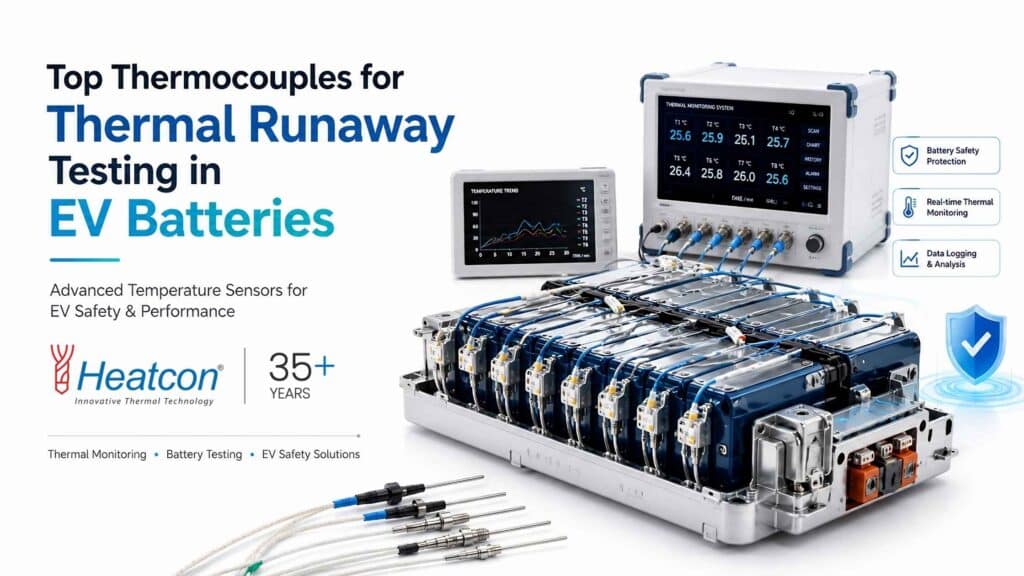
Top Thermocouples for Thermal Runaway Testing in EV Batteries – Heatcon Sensors Guide

According to multiple public industry reports, global electric vehicle adoption continues to rise rapidly, with EV sales crossing millions of units annually and battery safety testing becoming one of the most critical priorities for manufacturers worldwide. As EV battery energy density increases, the importance of accurate temperature monitoring through thermal runaway testing thermocouples has never been greater. Even a small delay in temperature detection during a battery failure event can result in catastrophic thermal propagation, fire hazards, production losses, compliance failures, and reputational damage for EV manufacturers.

This is precisely where Heatcon Sensors delivers exceptional value to the EV industry. Heatcon Sensors is a specialized manufacturer of customized RTDs, thermocouples, industrial temperature sensors, and heat generating equipment engineered for demanding industrial applications. From AIS-156 thermocouples to highly specialized EV battery testing sensors, the company develops precision-engineered sensing solutions that help EV manufacturers, battery laboratories, automotive OEMs, research centers, and validation facilities maintain accuracy, reliability, and regulatory compliance.
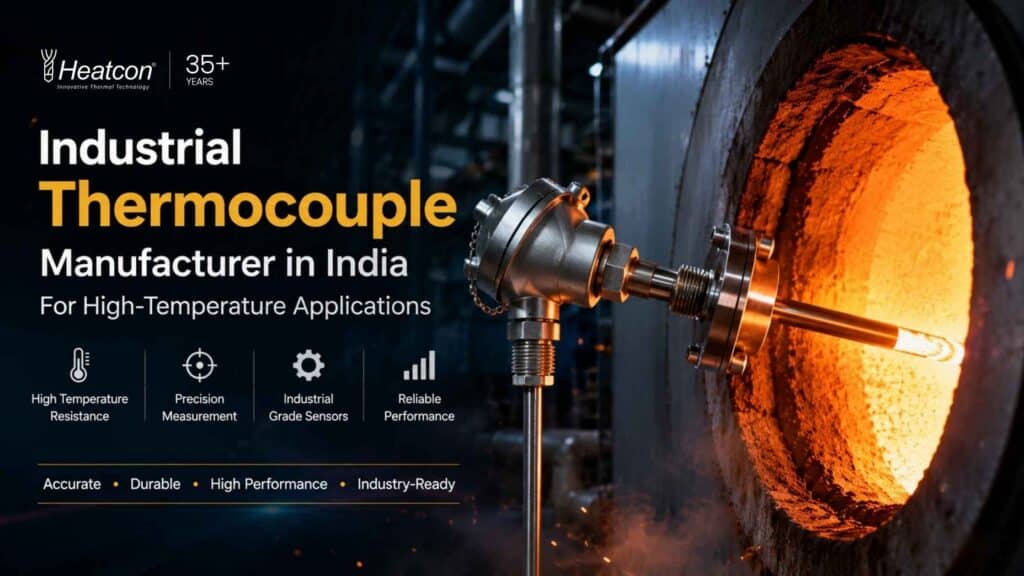
What are thermal runaway testing thermocouples?

Thermal runaway testing thermocouples are highly specialized temperature sensors designed to measure rapid and extreme temperature changes inside EV battery systems during abuse testing, validation testing, nail penetration testing, overcharge testing, crush testing, and propagation analysis.

These thermocouples are essential because EV batteries can experience temperature spikes exceeding several hundred degrees Celsius within seconds during failure events. Standard temperature sensors often fail under such harsh conditions. Specialized thermocouples designed for thermal runaway applications are engineered to survive vibration, rapid heating cycles, chemical exposure, and high thermal stress while maintaining accurate readings.

Heatcon Sensors manufactures custom-built thermal sensing assemblies that can be configured based on:

  • Cell geometry and battery pack architecture
  • Desired response time
  • Operating temperature range
  • Voltage isolation requirements
  • Sheath material compatibility
  • Laboratory and OEM testing standards
  • High-speed data acquisition systems

Why are AIS-156 thermocouples critical for EV battery safety?

AIS-156 thermocouples are designed specifically to support EV battery testing protocols aligned with Indian automotive safety regulations. With India emerging as one of the fastest-growing EV markets globally, compliance with AIS-156 requirements has become essential for battery manufacturers and electric vehicle companies.

AIS-156 testing involves multiple abuse conditions where batteries are intentionally stressed under controlled laboratory environments. During these tests, temperature measurement accuracy becomes a decisive factor in evaluating battery integrity and thermal stability.

Heatcon Sensors manufactures customized AIS-156 thermocouples suitable for:

  • Cell surface temperature monitoring
  • Module-level thermal mapping
  • Battery pack propagation studies
  • Thermal abuse validation
  • Environmental chamber testing
  • Cycle life testing
  • Short-circuit testing
  • Fire resistance studies

The company’s engineering capabilities allow thermocouples to be tailored according to sheath diameter, insulation material, junction type, cable length, response characteristics, and mounting configuration.

How do EV battery testing sensors improve validation accuracy?

EV battery testing sensors improve validation accuracy by enabling real-time monitoring of critical thermal behavior during charging, discharging, abuse simulation, and thermal propagation events.

Modern EV batteries operate within extremely narrow thermal tolerances. Even minor thermal inconsistencies can affect:

  • Battery lifespan
  • Charging efficiency
  • Thermal stability
  • Vehicle safety
  • Range performance
  • Warranty exposure

Heatcon Sensors manufactures advanced EV battery testing sensors capable of functioning under highly demanding industrial conditions. Their sensors are widely applicable across:

  • EV battery manufacturing plants
  • Research and development laboratories
  • Automotive OEM validation facilities
  • Energy storage system testing centers
  • Defense battery projects
  • Aerospace thermal testing applications

The company’s ability to manufacture customized sensors ensures compatibility with cylindrical cells, pouch cells, prismatic cells, and large battery pack assemblies.

Why are mineral insulated thermocouples preferred for EV thermal runaway testing?

Mineral insulated thermocouples are preferred because they provide exceptional durability, electrical insulation, vibration resistance, and high-temperature survivability during aggressive testing conditions.

In EV battery testing environments, thermocouples are frequently exposed to:

  • Rapid thermal shocks
  • Mechanical stress
  • Chemical contamination
  • Extreme vibration
  • High-current environments
  • Flame exposure

Heatcon Sensors manufactures mineral insulated thermocouples using premium-grade sheath materials and advanced insulation technology to ensure long operational life and consistent measurement reliability.

These thermocouples are especially valuable for:

Application Importance
Battery abuse testing High thermal resistance
Environmental chamber testing Stable measurements under cycling
High vibration EV platforms Mechanical durability
Thermal propagation studies Fast response times
High-density battery modules Compact installation capability

What makes high temperature thermocouples essential for EV applications?

High temperature thermocouples are essential because EV battery thermal runaway conditions can produce extremely elevated temperatures within seconds. Standard sensors may fail, melt, or lose accuracy under such conditions.

Heatcon Sensors develops high temperature thermocouples capable of handling demanding industrial environments involving:

  • Battery combustion testing
  • Thermal propagation analysis
  • Industrial furnace monitoring
  • Kiln applications
  • Heat treatment systems
  • Research laboratories
  • Electric ovens and chambers

The company also manufactures a wide range of industrial heating equipment including:

This integrated expertise in both temperature generation and temperature measurement gives Heatcon Sensors a major advantage when designing customized solutions for EV testing environments.

How do EV validation sensors support regulatory compliance?

EV validation sensors help manufacturers comply with national and international safety standards by ensuring accurate data acquisition during mandatory testing procedures.

Testing agencies and OEMs rely heavily on precise temperature data to validate:

  • Battery thermal stability
  • Cell balancing performance
  • Thermal management efficiency
  • Fire containment effectiveness
  • Abuse tolerance capability
  • Battery pack structural integrity

Heatcon Sensors manufactures customized EV validation sensors for highly specialized testing setups. Their engineering team works closely with customers to understand:

  • Testing methodology
  • Mounting constraints
  • Temperature range requirements
  • Signal compatibility
  • Environmental conditions
  • Compliance objectives

This consultative manufacturing approach allows customers to receive application-specific sensing solutions rather than generic off-the-shelf products.

Why do OEMs prefer customized thermocouple manufacturing?

Every EV platform differs in battery architecture, thermal management design, cell chemistry, and validation strategy. Standardized sensors often fail to deliver optimal results across diverse testing conditions.

Heatcon Sensors specializes in custom manufacturing solutions tailored to precise industrial requirements. OEMs and laboratories prefer customized thermocouples because they enable:

  • Improved measurement accuracy
  • Better sensor placement flexibility
  • Enhanced response times
  • Longer operational life
  • Reduced testing downtime
  • Compliance-specific configurations

The company can manufacture and supply sensors across India as well as international markets including the United States, UAE, Indonesia, Germany, South Korea, Saudi Arabia, Russia, Bahrain, Kuwait, and several other regions worldwide.

What industries benefit from Heatcon Sensors products?

Although EV battery testing is a major focus area, Heatcon Sensors serves a broad range of industrial sectors requiring reliable thermal measurement and heating solutions.

  • Electric vehicle manufacturing
  • Battery research laboratories
  • Aerospace engineering
  • Industrial automation
  • Steel manufacturing
  • Pharmaceutical processing
  • Semiconductor production
  • Defense applications
  • Petrochemical industries
  • Food processing industries
  • Renewable energy systems

The company’s engineering-first approach ensures every sensor is designed for durability, precision, and industrial-grade performance.

How does Heatcon Sensors strengthen global EV battery safety infrastructure?

As EV adoption accelerates worldwide, battery safety validation requirements are becoming increasingly stringent. Manufacturers need dependable thermal measurement partners capable of supplying accurate sensors quickly and consistently.

Heatcon Sensors addresses this requirement through:

  • Customized sensor manufacturing
  • Rapid engineering support
  • Industrial-grade materials
  • Application-specific designs
  • Global supply capability
  • Advanced thermal engineering expertise

For many testing laboratories and OEMs, sensor failure during validation can result in project delays, retesting costs, and compliance risks. Working with an experienced manufacturer significantly reduces these operational uncertainties.

About Heatcon Sensors

Heatcon Sensors is an industrial temperature sensor and thermal engineering company specializing in customized RTDs, thermocouples, industrial heaters, and temperature monitoring systems for demanding industrial applications. The company manufactures thermal runaway testing thermocouples, AIS-156 thermocouples, EV battery testing sensors, mineral insulated thermocouples, high temperature thermocouples, and EV validation sensors for customers across India and global markets.

In addition to advanced temperature sensors, Heatcon Sensors manufactures industrial furnaces, electric furnaces, laboratory ovens, hot air blowers, cartridge heaters, tubular heaters, ceramic heaters, and customized industrial heating systems engineered for precision thermal applications.

Businesses looking for customized EV battery testing solutions, industrial thermal sensors, or specialized temperature monitoring systems can connect with Heatcon Sensors by submitting their requirements through the contact form available at https://heatconsensors.com/contact-us/, by leaving a message through the WhatsApp interface on the company website, or by calling +91 9164833027 or +91 9844233244 for immediate assistance.

Frequently Asked Questions

Why are thermocouples critical in EV battery thermal runaway testing?

Thermocouples play a vital role in monitoring rapid temperature rise during battery abuse and safety validation procedures. In EV battery systems, even small temperature fluctuations can indicate the beginning of a hazardous chain reaction. High-quality thermal runaway testing thermocouples help engineers capture precise thermal data during nail penetration, overcharge, crush, short-circuit, and propagation testing.

Heatcon Sensors manufactures reliable sensor solutions designed specifically for harsh EV environments where accurate temperature monitoring is essential. Their thermocouple solutions support laboratory testing, R&D validation, and compliance programs for modern electric mobility platforms.

What makes Heatcon Sensors suitable for AIS-156 battery testing applications?

Heatcon Sensors provides specialized AIS-156 thermocouples engineered for the demanding conditions associated with EV battery safety validation in India. AIS-156 testing requires accurate thermal monitoring across different abuse scenarios, and the sensors used must withstand vibration, mechanical stress, and extreme temperature conditions without signal instability.

The company’s solutions are designed to support OEMs, battery manufacturers, automotive testing labs, and certification facilities looking for dependable temperature sensing during compliance testing. Their experience in EV thermal applications helps ensure repeatable and traceable test results.

Which types of thermocouples are commonly used in EV battery testing?

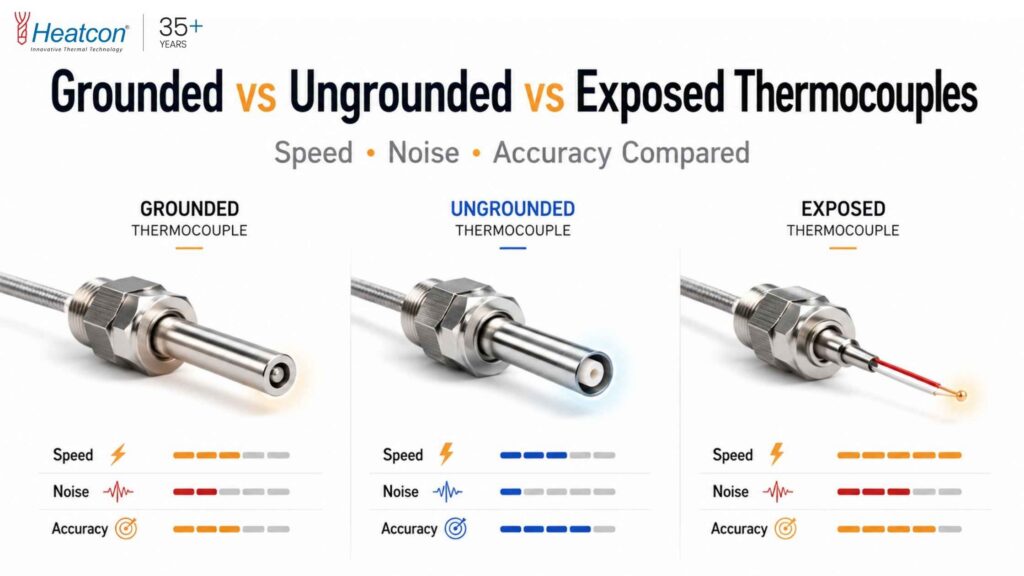
Different EV test environments require different thermocouple configurations depending on temperature range, response speed, insulation requirements, and mounting method. Common options include exposed junction thermocouples, grounded probes, flexible assemblies, and mineral insulated thermocouples for high-performance thermal testing.

Mineral insulated designs are particularly valuable in battery validation because they offer mechanical durability, fast response time, compact dimensions, and resistance to harsh operating conditions. Heatcon Sensors offers customized sensor assemblies tailored for battery packs, modules, cells, cooling systems, and propagation chambers.

How do high temperature thermocouples improve thermal runaway analysis?

During thermal runaway events, battery temperatures can rise extremely fast and exceed conventional operating limits. High temperature thermocouples are designed to maintain signal accuracy and structural integrity under these severe conditions, enabling engineers to collect reliable thermal profiles throughout the event.

Accurate high-temperature measurement helps identify failure initiation points, propagation behavior, hotspot formation, and heat transfer patterns inside battery systems. Heatcon Sensors manufactures robust thermocouple solutions suitable for continuous monitoring in elevated temperature environments commonly encountered during EV abuse testing.

Can Heatcon Sensors provide customized EV battery testing solutions?

Yes. Heatcon Sensors offers customized EV battery testing sensors based on application requirements such as temperature range, probe diameter, cable insulation, response time, connector type, mounting arrangement, and environmental exposure conditions.

Their engineering team works with EV manufacturers, battery developers, research institutions, and testing laboratories to create sensors optimized for pouch cells, cylindrical cells, prismatic cells, battery packs, and thermal propagation setups. Custom-built sensors help improve installation flexibility and measurement reliability during validation programs.

What are the advantages of using dedicated EV validation sensors?

Dedicated EV validation sensors are designed specifically for the demanding conditions associated with electric vehicle testing and development. Unlike generic industrial sensors, they are optimized for compact battery geometries, high thermal gradients, vibration resistance, and rapid data acquisition requirements.

Heatcon Sensors develops sensor solutions that support accurate thermal mapping, durability testing, environmental chamber validation, and safety certification procedures. Proper validation instrumentation improves test consistency, supports regulatory compliance, and helps engineers make informed decisions during EV battery design optimization.

Why is response time important in EV battery thermocouples?

Battery thermal events can escalate within seconds, making rapid sensor response essential for meaningful analysis. Fast-response thermocouples help capture sudden temperature spikes and transient heat behavior during abuse testing and failure propagation studies.

Heatcon Sensors designs thermocouple assemblies with optimized sheath construction and sensing junction configurations to improve measurement responsiveness without compromising durability. Faster thermal response enables engineers to collect more accurate datasets for safety validation and performance analysis.

Which industries and facilities commonly use Heatcon Sensors thermocouples?

Heatcon Sensors solutions are widely applicable across EV battery manufacturing facilities, automotive R&D centers, battery safety laboratories, certification agencies, academic research institutions, and thermal testing environments focused on electric mobility development.

Their thermocouples are used for cell testing, module validation, pack-level thermal analysis, environmental chamber testing, propagation studies, and safety certification programs. The company’s ability to provide reliable sensing solutions helps organizations improve data accuracy and testing confidence across critical EV applications.


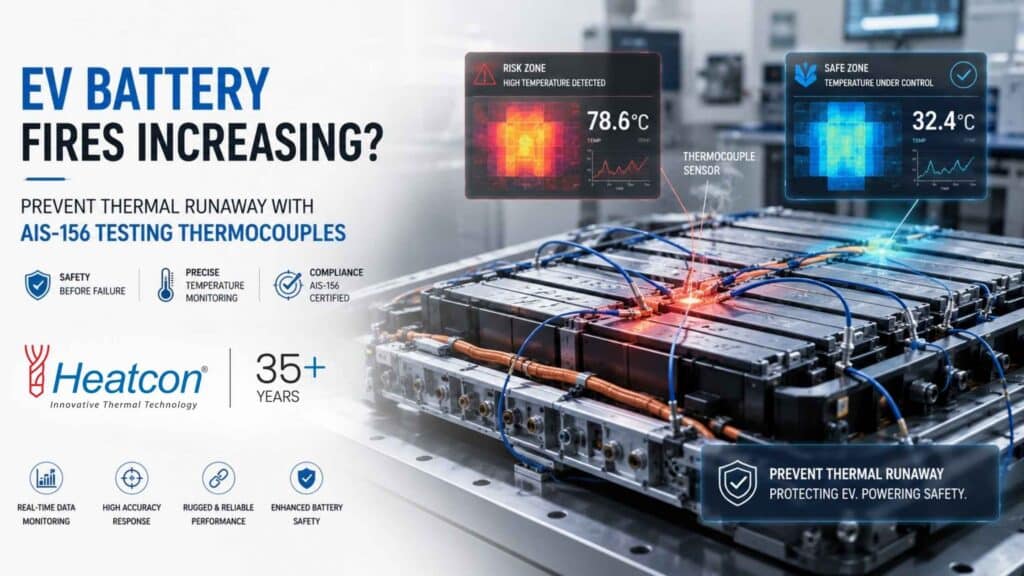
EV Battery Fires Increasing? Prevent Thermal Runaway with Heatcon Sensors’ AIS-156 Testing Thermocouples

Electric vehicle battery fires have become one of the most discussed safety challenges in the mobility sector. According to publicly available industry reports and transportation safety data, incidents involving lithium-ion battery overheating have increased globally alongside the rapid growth of EV adoption. As governments push for electrification and stricter compliance standards like AIS-156 in India, manufacturers are under mounting pressure to implement precise temperature monitoring systems capable of detecting abnormal heat rise before catastrophic failure occurs. This is where Heatcon Sensors plays a critical role with advanced thermocouples, RTDs, and customized industrial sensing solutions engineered for demanding EV battery environments.

Heatcon Sensors is a specialized manufacturer of customized temperature sensors, industrial RTDs, thermocouples, and heating equipment engineered for automotive, aerospace, industrial, defense, laboratory, and energy applications. The company manufactures and supplies temperature monitoring solutions across India and to international markets including the United States, UAE, Indonesia, Germany, South Korea, Saudi Arabia, Russia, Bahrain, and Kuwait. For EV manufacturers, battery testing laboratories, and energy storage companies, Heatcon Sensors delivers highly accurate sensing systems that improve safety, compliance, and operational reliability.

Why are EV battery fires increasing globally?

The rise in EV battery fire incidents is closely linked to the explosive growth in lithium-ion battery deployment, higher energy density demands, rapid charging systems, and inadequate thermal management in poorly monitored battery packs. Even a small undetected increase in cell temperature can trigger thermal runaway, resulting in fire propagation across an entire battery module.

Modern EV battery systems operate under intense thermal stress. During fast charging, regenerative braking, aggressive acceleration, or high ambient temperatures, battery cells can rapidly heat up. If the temperature rise goes unnoticed, chemical decomposition inside the battery can escalate uncontrollably. This makes precise sensing technology absolutely essential rather than optional.

Manufacturers searching for reliable EV battery safety sensors India increasingly depend on advanced thermal sensing systems that comply with AIS-156 testing protocols. Heatcon Sensors manufactures highly reliable sensing solutions designed specifically for demanding EV battery environments where accuracy and durability are mission-critical.

What is thermal runaway in lithium-ion batteries?

Thermal runaway is a chain reaction inside a lithium-ion battery where heat generation exceeds heat dissipation, causing uncontrollable temperature escalation that may lead to smoke, explosion, or fire.

The process typically starts when one cell overheats due to:

  • Internal short circuits
  • Overcharging
  • Mechanical damage
  • Manufacturing defects
  • Poor thermal management
  • External heat exposure
  • Improper battery testing

Once the internal temperature crosses a critical threshold, the electrolyte becomes unstable and releases gases and additional heat. Without accurate EV thermal runaway sensors, battery management systems may fail to respond quickly enough to isolate the affected cell.

Heatcon Sensors manufactures advanced thermocouples and RTDs specifically engineered to identify rapid temperature spikes during battery testing and real-world operation. These sensing systems help manufacturers intervene before a dangerous thermal event escalates.

How does AIS-156 testing improve EV battery safety?

AIS-156 is India’s automotive industry safety standard focused on electric vehicle battery systems. It establishes rigorous testing protocols to evaluate thermal stability, vibration resistance, water ingress protection, and overall battery safety performance.

AIS-156 testing includes:

  • Thermal propagation testing
  • Temperature cycling
  • Overcharge testing
  • External short circuit testing
  • Mechanical shock testing
  • Fire resistance analysis
  • Cell and module thermal behavior evaluation

Accurate temperature measurement forms the backbone of every one of these tests. Even small sensing inaccuracies can compromise data integrity and regulatory compliance. Heatcon Sensors manufactures AIS-156 compatible thermocouples and RTDs capable of delivering consistent high-precision thermal data during extreme testing conditions.

Why is EV battery temperature monitoring critical?

EV battery temperature monitoring helps identify unsafe thermal conditions before battery cells reach critical failure thresholds.

In advanced battery systems, temperature variations as small as a few degrees can significantly impact:

  • Battery lifespan
  • Charging efficiency
  • Vehicle performance
  • Passenger safety
  • Regulatory compliance
  • Warranty risk exposure

Without dependable EV battery temperature monitoring, battery packs may experience uneven thermal distribution that accelerates degradation and increases fire risks. Heatcon Sensors develops customized sensing assemblies that allow engineers to monitor temperature across multiple battery zones simultaneously with high repeatability and fast response times.

These solutions are extensively used in:

  • Battery testing laboratories
  • EV manufacturing facilities
  • Battery module assembly lines
  • Research and development centers
  • Energy storage systems
  • Automotive testing facilities

How do lithium-ion battery sensors help prevent fires?

Lithium-ion battery sensors continuously monitor heat behavior inside cells and modules, enabling battery management systems to detect dangerous thermal trends before failure occurs.

Modern lithium-ion battery sensors must withstand:

Heatcon Sensors manufactures customized thermocouples, mineral insulated thermocouples, RTDs, and sensing assemblies optimized for lithium-ion battery applications. Their engineering capabilities allow them to tailor:

  • Sensor sheath materials
  • Probe dimensions
  • Response times
  • Lead wire insulation
  • Connector types
  • Temperature ranges
  • Mounting configurations

This level of customization is particularly important for EV manufacturers developing proprietary battery architectures requiring specialized integration.

What makes Heatcon Sensors different in battery safety testing India?

Heatcon Sensors combines sensor manufacturing expertise with industrial heating technology capabilities, allowing the company to understand thermal behavior at a deeper engineering level than many standard component suppliers.

In battery safety testing India, precision and reliability directly impact certification outcomes. Heatcon Sensors supports OEMs, laboratories, and industrial clients with:

  • Customized RTDs
  • AIS-156 testing thermocouples
  • High-temperature thermocouples
  • Fast-response thermal probes
  • Industrial temperature controllers
  • Data acquisition compatible sensors
  • Specialized thermal testing assemblies

Beyond sensing systems, Heatcon Sensors also manufactures industrial heating equipment including:

This broad thermal engineering expertise enables the company to provide integrated solutions for advanced thermal testing environments.

How do thermal protection sensors improve EV reliability?

Thermal protection sensors safeguard EV battery systems by triggering alerts or shutdown mechanisms when unsafe temperatures are detected.

In modern EV ecosystems, thermal protection sensors are no longer limited to basic overheating detection. Advanced systems now support predictive maintenance strategies by identifying abnormal heat patterns before visible failure symptoms emerge.

Heatcon Sensors develops thermal protection sensors with:

  • High sensitivity
  • Fast thermal response
  • Superior durability
  • Industrial-grade construction
  • Custom calibration options
  • Extended operating life

These sensing systems are suitable for:

  • Electric two-wheelers
  • Passenger EVs
  • Commercial EV fleets
  • Battery energy storage systems
  • Industrial lithium-ion applications
  • Defense and aerospace battery systems

Why are customized RTDs and thermocouples essential for EV manufacturers?

Every EV battery architecture is unique, which means standardized sensors may not deliver optimal performance across all applications.

Heatcon Sensors specializes in customized RTDs and thermocouples designed around specific operational and engineering requirements. This customization helps OEMs improve:

  • Sensor placement efficiency
  • Thermal accuracy
  • Battery pack integration
  • Long-term reliability
  • Testing repeatability
  • Regulatory compliance

The company’s engineering team collaborates with clients to develop sensors based on exact:

  • Temperature ranges
  • Response time requirements
  • Mechanical dimensions
  • Environmental conditions
  • Electrical specifications
  • Mounting constraints

This ability to custom manufacture temperature sensors for specialized industrial environments gives Heatcon Sensors a significant advantage for EV manufacturers operating in fast-evolving markets.

How does Heatcon Sensors support global industries?

Heatcon Sensors supplies customized sensing systems and industrial heating solutions to customers throughout India and global markets. The company supports industries requiring reliable temperature measurement under extreme operating conditions.

Its export-ready manufacturing capabilities enable supply to:

  • India
  • United States
  • UAE
  • Indonesia
  • Germany
  • South Korea
  • Saudi Arabia
  • Russia
  • Bahrain
  • Kuwait

Whether the requirement involves EV battery testing, industrial furnaces, aerospace thermal systems, process industries, or laboratory equipment, Heatcon Sensors delivers engineered thermal solutions designed for performance and reliability.

Why delaying advanced thermal monitoring can become expensive

Battery recalls, EV fire incidents, certification delays, and warranty claims can severely impact manufacturers financially and reputationally. Many companies realize too late that insufficient sensing infrastructure creates hidden operational risks.

The cost of proactive sensing technology is often insignificant compared to:

  • Vehicle recalls
  • Regulatory penalties
  • Insurance liabilities
  • Brand reputation damage
  • Testing failures
  • Production downtime

As EV adoption accelerates, governments and consumers increasingly expect higher safety standards. Companies investing early in advanced thermal monitoring gain a competitive advantage while reducing long-term operational exposure.

About Heatcon Sensors

Heatcon Sensors is an industrial temperature sensor and thermal engineering company specializing in customized RTDs, thermocouples, thermal protection systems, industrial heating equipment, and precision thermal monitoring solutions. The company serves EV manufacturers, aerospace companies, laboratories, automotive industries, industrial manufacturers, and energy sector clients across India and international markets.

From AIS-156 testing thermocouples to advanced industrial heating systems, Heatcon Sensors delivers engineered thermal solutions tailored for demanding operational environments. The company’s expertise in custom manufacturing enables clients to achieve higher safety standards, improved process control, and reliable thermal performance.

To connect with Heatcon Sensors, you may:

  • Submit your information through the contact form at https://heatconsensors.com/contact-us/
  • Leave a message on WhatsApp using the interface available on the website
  • Call +91 9164833027 for immediate assistance
  • Call +91 9844233244 for immediate assistance

As EV technologies continue evolving, the importance of accurate temperature sensing and thermal protection will only increase. Manufacturers that prioritize dependable monitoring systems today are better positioned to prevent catastrophic failures tomorrow. Heatcon Sensors stands ready to support industries worldwide with customized sensing technologies engineered for precision, compliance, and long-term operational confidence.

Frequently Asked Questions

Why are EV battery fires becoming a major concern in the automotive industry?

EV battery fires are receiving more attention because modern electric vehicles rely on high-density lithium-ion battery packs that generate substantial heat during charging, fast discharging, and high-load driving conditions. If temperature rise is not detected early, cells can enter thermal runaway, leading to smoke, fire, or complete battery pack failure.

This is why manufacturers are investing heavily in EV battery safety sensors India to improve early warning capabilities, pack-level diagnostics, and compliance with evolving safety regulations. Heatcon Sensors supports OEMs, battery manufacturers, and testing laboratories with precision sensing solutions designed for continuous monitoring and critical temperature validation during development and field operation.

What causes thermal runaway inside lithium-ion battery packs?

Thermal runaway occurs when a battery cell experiences uncontrolled temperature escalation due to internal short circuits, overcharging, mechanical damage, manufacturing defects, or poor thermal management. Once initiated, heat spreads rapidly from one cell to surrounding cells, creating a chain reaction inside the pack.

Advanced EV thermal runaway sensors help engineers identify abnormal heat signatures before the situation becomes critical. Heatcon Sensors provides robust sensing technologies that can be integrated into battery testing systems, validation rigs, and onboard thermal management architectures to improve operational safety and reduce fire risks.

Why is accurate EV battery temperature monitoring important for electric vehicles?

Accurate EV battery temperature monitoring is essential because even minor temperature deviations can impact battery life, charging efficiency, range performance, and overall vehicle safety. Battery cells operate within a limited thermal window, and exceeding that range can accelerate degradation or trigger dangerous operating conditions.

Heatcon Sensors develops high-performance thermocouple and temperature sensing solutions that enable real-time monitoring across battery modules, cooling systems, and test environments. These solutions help manufacturers maintain stable operating conditions while improving product reliability and compliance with AIS-156 requirements.

How do AIS-156 testing thermocouples improve EV battery safety validation?

AIS-156 testing thermocouples are used during battery abuse testing, thermal propagation analysis, vibration testing, and environmental validation procedures. These thermocouples capture precise temperature readings under demanding conditions, helping engineers understand how battery packs behave during stress events.

Heatcon Sensors manufactures durable and accurate testing solutions engineered for automotive validation environments. Their thermocouples are designed to withstand high temperatures, repeated cycling, and rigorous testing conditions while maintaining reliable measurement accuracy required for regulatory compliance and product development.

What role do lithium-ion battery sensors play in preventing battery failure?

lithium-ion battery sensors continuously track temperature variations, thermal gradients, and critical operating conditions inside battery systems. By detecting abnormal heat buildup early, these sensors help battery management systems respond quickly through cooling activation, charging reduction, or system shutdown protocols.

Heatcon Sensors offers application-specific sensor solutions tailored for EV battery packs, energy storage systems, and advanced mobility platforms. Their solutions support accurate thermal feedback, improved diagnostics, and enhanced long-term safety performance across diverse battery architectures.

Why is battery safety testing India becoming more important for EV manufacturers?

battery safety testing India has become increasingly important due to the rapid growth of electric mobility adoption and stricter safety expectations from regulators, consumers, and automotive manufacturers. As EV usage expands across varied climatic and operating conditions, reliable thermal validation has become a critical requirement.

Heatcon Sensors supports testing laboratories, OEMs, and battery developers with precision temperature sensing technologies suitable for thermal abuse tests, environmental chambers, endurance testing, and certification programs aligned with AIS-156 and related EV safety standards.

How do thermal protection sensors enhance EV battery reliability?

thermal protection sensors help detect unsafe thermal conditions before they escalate into severe battery failures. These sensors provide fast-response temperature feedback that enables battery management systems to take corrective action such as reducing current flow, activating cooling systems, or isolating affected modules.

Heatcon Sensors designs thermal sensing solutions that combine high sensitivity, durability, and consistent accuracy for demanding EV environments. Their products help improve battery lifespan, operational reliability, passenger safety, and overall confidence in electric vehicle performance.

What makes Heatcon Sensors a reliable partner for EV thermal safety solutions?

Heatcon Sensors is recognized for delivering precision-engineered sensing technologies designed for industrial, aerospace, automotive, and advanced thermal applications. Their expertise in thermocouples, temperature probes, and customized sensing assemblies enables EV manufacturers to implement dependable thermal monitoring strategies across testing and production environments.

By focusing on accuracy, durability, and application-specific engineering, Heatcon Sensors helps customers strengthen battery safety validation processes, improve thermal management efficiency, and reduce the risks associated with EV battery failures and thermal propagation events.


Digital Temperature Transmitters for Industrial Automation

Modern industrial automation depends heavily on accurate temperature monitoring, and industry studies indicate that process temperature errors can reduce manufacturing efficiency by as much as 20% in heat-critical operations. This is why Industrial Temperature Transmitters have become essential in industries such as steel, pharmaceuticals, food processing, petrochemicals, aerospace, textiles, power generation, and semiconductor manufacturing. From ensuring process consistency to protecting expensive machinery, digital temperature transmission technology now plays a decisive role in maintaining production quality and operational safety.

Heatcon Sensors is a specialized manufacturer of customized RTDs, temperature sensors, RTD assemblies, thermocouple systems, Industrial Temperature Transmitters, and advanced industrial heating solutions. The company supports industries throughout India and globally, including the United States, UAE, Indonesia, Germany, South Korea, Saudi Arabia, Russia, Bahrain, and Kuwait. Beyond temperature sensing products, Heatcon Sensors also manufactures industrial furnaces, electric furnaces, ovens, hot air blowers, cartridge heaters, tubular heaters, immersion heaters, ceramic heaters, infrared heaters, high density cartridge heaters, and other industrial heat-generating equipment tailored for demanding industrial environments.

What are Industrial Temperature Transmitters?

Industrial Temperature Transmitters are intelligent electronic devices that convert temperature sensor signals into standardized outputs suitable for industrial automation systems. These transmitters receive input from RTDs or thermocouples and convert the readings into digital or analog communication signals for PLCs, SCADA systems, DCS systems, and remote monitoring platforms.

In practical industrial environments, raw temperature sensor signals are often vulnerable to electrical noise, signal degradation, vibration, humidity, and long-distance transmission losses. Industrial Temperature Transmitters solve these issues by stabilizing, amplifying, and digitizing the signal for reliable data communication.

Industries that rely on digital temperature transmitters

  • Steel and metal processing plants
  • Pharmaceutical manufacturing units
  • Petrochemical industries
  • Plastic extrusion and molding industries
  • Food processing facilities
  • Ceramic and glass industries
  • Power plants and energy systems
  • Semiconductor manufacturing
  • HVAC automation systems
  • Automotive component manufacturing

Why are digital transmitters important in industrial automation?

Digital temperature transmitters are important because modern industries cannot afford inaccurate thermal control. Even minor temperature variations can lead to defective products, machinery failures, unsafe operating conditions, and expensive downtime.

Factories that still depend on outdated analog systems often experience unstable readings, calibration drift, and inconsistent process control. In highly automated plants, these inaccuracies can create chain reactions that affect production schedules, energy consumption, and product quality.

This is where Heatcon Sensors provides a strategic advantage. The company custom manufactures transmitters and sensors designed specifically for industrial operating conditions. Whether the requirement involves corrosive environments, extreme furnace temperatures, vibration-heavy equipment, or high-moisture process lines, Heatcon Sensors develops solutions that align precisely with operational requirements.

How do RTD signal converters improve measurement accuracy?

RTD signal converters improve industrial measurement accuracy by transforming resistance-based RTD signals into stable industrial outputs suitable for long-distance communication and automated process systems.

RTD sensors are known for their exceptional accuracy and repeatability. However, transmitting raw resistance signals across industrial facilities can introduce interference and instability. RTD signal converters eliminate these problems by converting the resistance values into standardized signals such as 4-20mA, Modbus, or HART communication formats.

Heatcon Sensors manufactures highly reliable RTD signal converters suitable for:

  • Industrial ovens
  • Electric furnaces
  • Boilers
  • Heat treatment systems
  • Process tanks
  • Chemical reactors
  • Injection molding machines
  • Packaging machinery

These customized systems help industries achieve stable process temperatures while minimizing maintenance interruptions and calibration failures.

What makes thermocouple transmitters essential in high-temperature industries?

thermocouple transmitters are essential because thermocouples operate in extremely high-temperature environments where accurate signal conversion becomes critical for process reliability and worker safety.

Industries such as forging, casting, glass manufacturing, and heat treatment routinely operate at temperatures beyond the limits of standard RTD systems. thermocouple transmitters help convert millivolt signals from thermocouples into highly stable industrial communication outputs.

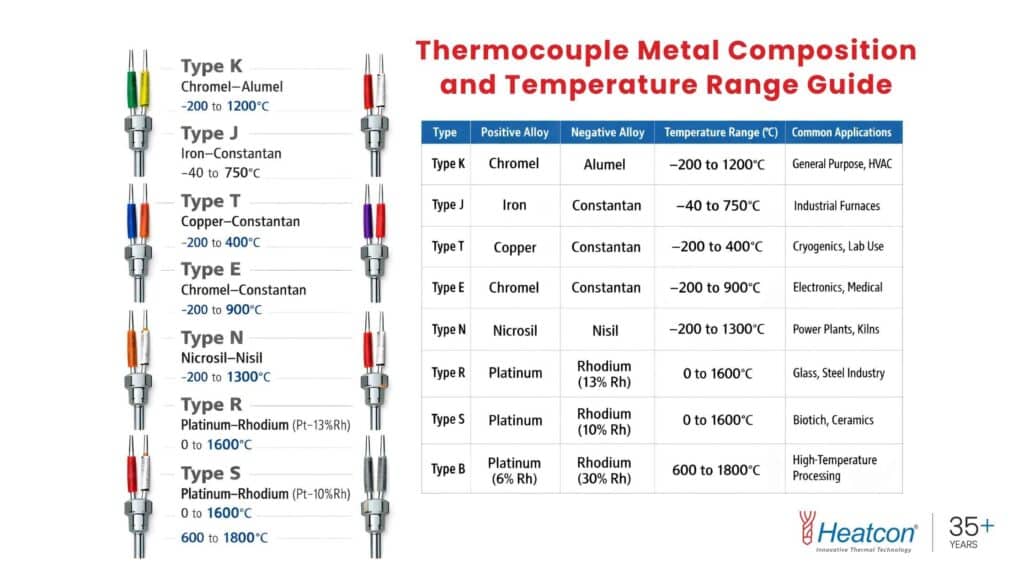
Heatcon Sensors manufactures custom thermocouple transmitters compatible with:

  • K Type thermocouples
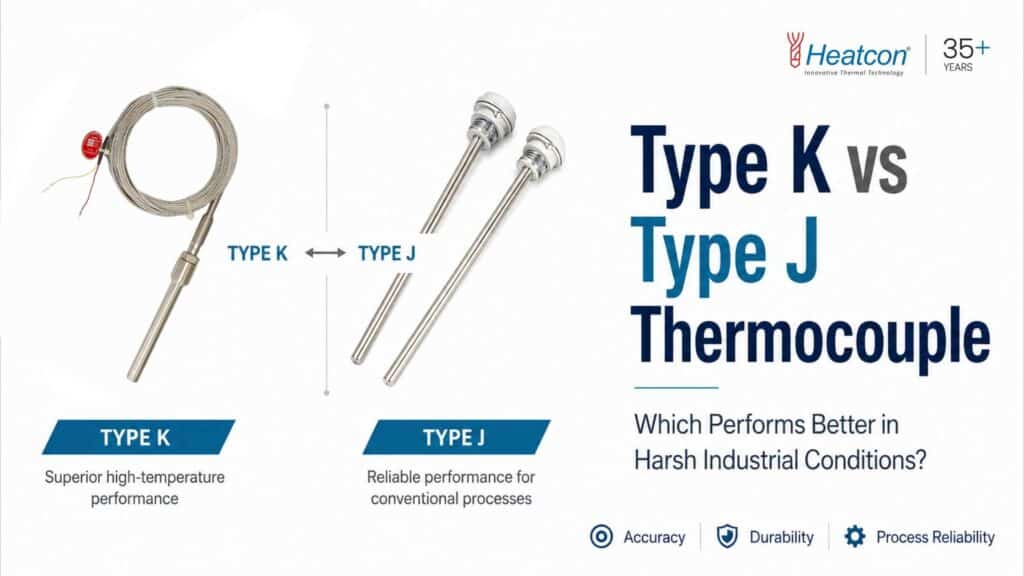
  • J Type thermocouples
  • R Type thermocouples
  • S Type thermocouples
  • T Type thermocouples
  • N Type thermocouples

These systems are engineered for demanding industrial conditions involving vibration, rapid temperature cycling, corrosive gases, and heavy-duty process loads.

How do Modbus temperature transmitters support smart factories?

Modbus temperature transmitters support smart factories by enabling seamless digital communication between temperature sensing devices and industrial automation platforms.

Modern factories increasingly rely on centralized automation architectures. Modbus temperature transmitters allow multiple process parameters to be monitored simultaneously through industrial communication networks. This helps plant operators improve productivity, reduce downtime, and optimize energy efficiency.

Benefits of Modbus temperature transmitters include:

  • Real-time process monitoring
  • Reduced wiring complexity
  • Remote diagnostics
  • Centralized temperature control
  • Lower maintenance requirements
  • Easy integration with PLC and SCADA systems
  • Scalable industrial automation

Heatcon Sensors manufactures Modbus temperature transmitters customized for OEMs, industrial machinery manufacturers, process plants, and automation integrators requiring reliable industrial communication systems.

Why are HART transmitters industrial solutions gaining popularity?

HART transmitters industrial systems are gaining popularity because they combine analog and digital communication capabilities within a single transmitter architecture.

Industries prefer HART transmitters industrial technologies because they allow operators to access diagnostics, calibration information, sensor health, and process data without interrupting ongoing operations.

This significantly improves predictive maintenance and reduces production interruptions.

Feature Traditional Analog Systems HART transmitters industrial Systems
Diagnostic capabilities Limited Advanced
Remote configuration No Yes
Predictive maintenance Minimal High
Communication flexibility Basic Advanced digital communication
Industrial automation compatibility Moderate Excellent

Heatcon Sensors helps industries transition toward intelligent automation by supplying robust HART-enabled industrial transmitter solutions engineered for long operational life and stable performance.

What are remote temperature monitoring systems?

remote temperature monitoring systems are advanced monitoring solutions that allow industries to supervise thermal processes remotely through centralized digital platforms.

As industries expand operations across multiple plants and geographic regions, continuous temperature visibility becomes critical. remote temperature monitoring systems help operators monitor equipment performance, detect abnormalities early, and improve process consistency.

Applications include:

  • Cold storage facilities
  • Industrial furnaces
  • Warehouse monitoring
  • Data centers
  • Chemical processing
  • Food production
  • Pharmaceutical manufacturing
  • Power generation systems

Heatcon Sensors develops integrated remote temperature monitoring systems tailored for industrial environments requiring dependable long-term thermal monitoring and process optimization.

How does Heatcon Sensors customize industrial temperature solutions?

Heatcon Sensors custom manufactures industrial sensing systems based on application-specific requirements rather than supplying generic off-the-shelf products.

This approach is particularly valuable because industrial operations differ significantly in terms of:

  • Operating temperature range
  • Sensor mounting requirements
  • Process pressure conditions
  • Environmental exposure
  • Communication protocols
  • Cable specifications
  • Sensor sheath materials
  • Accuracy tolerances

Heatcon Sensors manufactures customized:

  • RTD sensors
  • Thermocouples
  • Temperature probes
  • Mineral insulated sensors
  • Digital transmitters
  • Industrial heating systems
  • High density cartridge heaters
  • Industrial furnaces
  • Industrial ovens
  • Hot air blowers
  • Ceramic band heaters
  • Infrared heaters
  • Immersion heaters

The company supplies these solutions across India and exports to industrial clients globally, ensuring industries receive dependable thermal systems regardless of location.

How do temperature transmitters reduce industrial losses?

Temperature transmitters reduce industrial losses by preventing overheating, process instability, product defects, and unplanned shutdowns.

Many industrial failures originate from poor thermal management. Unstable process temperatures can damage raw materials, reduce machine lifespan, increase energy costs, and create safety risks.

Reliable digital temperature monitoring helps industries:

  • Improve product quality consistency
  • Reduce operational downtime
  • Minimize energy waste
  • Extend equipment lifespan
  • Enhance workplace safety
  • Improve predictive maintenance
  • Optimize production cycles

Companies that delay upgrading their temperature monitoring infrastructure often face avoidable production losses and higher long-term maintenance expenses.

Why industries across the world choose Heatcon Sensors

Heatcon Sensors is a specialized industrial temperature sensing and heating equipment manufacturer serving industries that demand precision, reliability, customization, and long operational durability.

Unlike generic suppliers, Heatcon Sensors focuses on understanding real industrial process conditions before manufacturing the final solution. This engineering-first approach helps industries receive products that perform reliably under demanding operational conditions.

Key advantages include:

  • Customized industrial temperature sensors
  • Worldwide supply capability
  • Industrial-grade quality control
  • Fast technical support
  • Automation-ready transmitter solutions
  • Expertise in industrial heating systems
  • Long-lasting sensor durability
  • Application-specific engineering

About Heatcon Sensors

Heatcon Sensors is an industrial temperature sensor and heating equipment manufacturer specializing in customized RTDs, thermocouples, Industrial Temperature Transmitters, RTD signal converters, thermocouple transmitters, Modbus temperature transmitters, HART transmitters industrial systems, and remote temperature monitoring systems.

The company serves industries throughout India and globally, including customers in the United States, UAE, Indonesia, Germany, South Korea, Saudi Arabia, Russia, Bahrain, and Kuwait. Heatcon Sensors also manufactures industrial furnaces, ovens, high density cartridge heaters, hot air blowers, tubular heaters, immersion heaters, and advanced thermal process equipment designed for demanding industrial environments.

Industries looking to improve automation accuracy, operational efficiency, process reliability, and thermal performance can reach Heatcon Sensors by submitting details through the contact form at https://heatconsensors.com/contact-us/, leaving a message through the WhatsApp interface on the website, or calling +91 9164833027 or +91 9844233244 for immediate assistance.

Frequently Asked Questions

What are digital temperature transmitters used for in industrial automation?

Digital temperature transmitters are widely used in industrial automation systems to convert temperature readings from sensors into standardized digital or analog signals that can be monitored by PLCs, SCADA platforms, and DCS systems. They improve process accuracy, reduce signal loss, and help industries maintain stable production conditions.

Heatcon Sensors provides Industrial Temperature Transmitters designed for manufacturing plants, chemical processing facilities, food production units, power plants, pharmaceutical operations, and HVAC automation systems. These transmitters are engineered for reliable performance in demanding industrial environments where precise temperature control is critical for efficiency and safety.

How do Modbus-enabled transmitters improve monitoring and communication?

Modbus communication allows industrial systems to exchange data quickly and accurately across connected devices. Modbus temperature transmitters make it easier for operators to monitor temperature values remotely, integrate multiple sensors into one automation network, and simplify troubleshooting within industrial control systems.

Heatcon Sensors offers robust Modbus temperature transmitters that support efficient communication between field instruments and centralized monitoring systems. These solutions are ideal for industries looking to improve operational visibility, automate reporting, and reduce manual intervention in temperature monitoring processes.

Why are HART communication transmitters preferred in process industries?

HART communication technology enables both analog and digital data transmission over the same wiring infrastructure. This gives maintenance teams access to advanced diagnostics, calibration information, and device configuration without interrupting operations.

Heatcon Sensors supplies HART transmitters industrial applications rely on for accurate process monitoring and dependable long-term operation. These transmitters are commonly used in oil and gas plants, refineries, water treatment facilities, and large-scale process automation systems where intelligent communication and remote diagnostics are essential.

What is the role of RTD signal converters in automation systems?

RTD signal converters are used to process resistance temperature detector signals and convert them into standardized outputs that industrial controllers can interpret accurately. They help minimize electrical noise, improve signal integrity, and support stable temperature measurements across long cable runs.

Heatcon Sensors manufactures reliable RTD signal converters that are suitable for precision-driven applications where temperature consistency directly affects production quality. These devices are commonly implemented in pharmaceutical manufacturing, laboratory systems, industrial ovens, and energy management applications.

How do thermocouple transmitters support high-temperature industrial processes?

Thermocouples are widely used for measuring extreme temperatures in industrial environments. thermocouple transmitters convert the low-level thermocouple signal into a stable and standardized output suitable for industrial automation systems.

Heatcon Sensors designs thermocouple transmitters that deliver dependable measurements in furnaces, boilers, heat treatment plants, metal processing units, and glass manufacturing facilities. Their transmitters are built to withstand vibration, electrical interference, and harsh operating conditions while maintaining consistent measurement accuracy.

Can digital transmitters be integrated into remote monitoring systems?

Yes, modern transmitters are designed to integrate seamlessly with remote temperature monitoring systems used in industrial automation and smart facility management. These systems allow operators to monitor temperature trends, receive alerts, and analyze performance data from centralized dashboards or cloud-based platforms.

Heatcon Sensors supports industries with advanced transmitter solutions that improve visibility across distributed operations. Their solutions help businesses reduce downtime, optimize maintenance schedules, and improve overall process efficiency through dependable remote monitoring capabilities.

What factors should industries consider when selecting a temperature transmitter?

Industries should evaluate operating temperature range, sensor compatibility, communication protocol requirements, environmental conditions, installation method, and long-term calibration stability before selecting a transmitter. The right transmitter can significantly improve automation reliability and process efficiency.

Heatcon Sensors helps customers choose application-specific solutions based on their operational requirements. Whether the need involves hazardous locations, high-temperature processing, compact panel installations, or digital communication compatibility, their engineering team provides guidance to ensure the right product selection for industrial automation projects.

Why do industries choose Heatcon Sensors for automation temperature solutions?

Heatcon Sensors is known for delivering dependable temperature instrumentation solutions tailored for industrial automation applications. Their product range includes advanced transmitters, sensor assemblies, communication-enabled devices, and customized solutions for demanding operating environments.

Industries choose Heatcon Sensors because of their focus on product reliability, technical expertise, responsive customer support, and compatibility with modern automation platforms. Their solutions are designed to improve process control, operational safety, and long-term system performance across a wide range of industrial sectors.


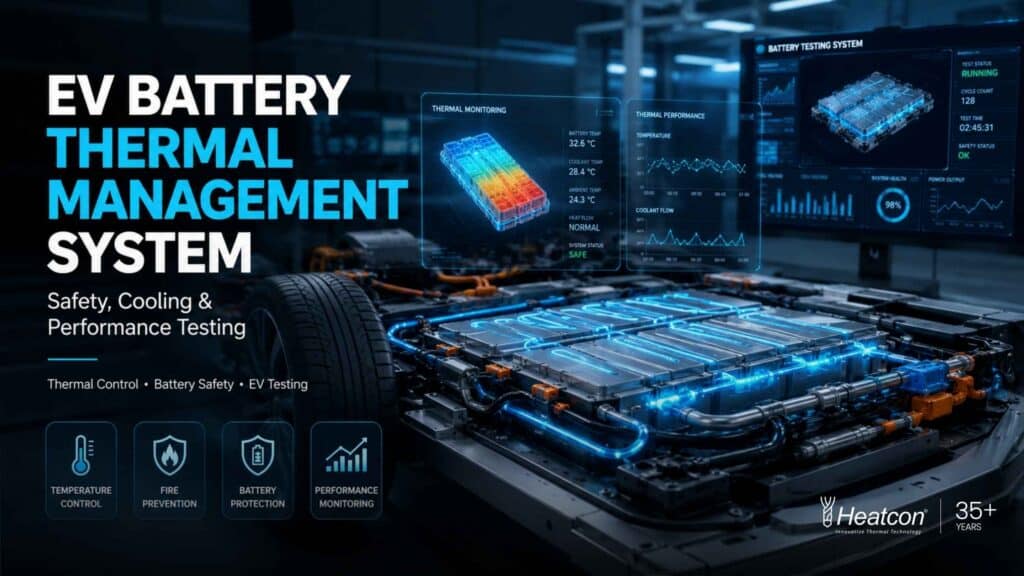
EV Battery Thermal Management System for Safety & Testing

Global electric vehicle adoption is accelerating at an unprecedented pace, with industry forecasts estimating that EVs could account for more than 50% of new vehicle sales in several leading markets within the next decade. As battery capacities increase and charging speeds become faster, thermal safety has become one of the most critical engineering priorities in the EV ecosystem. This is precisely where an advanced EV Battery Thermal Management System becomes essential for ensuring safety, performance, longevity, and regulatory compliance.

Heatcon Sensors is a trusted manufacturer specializing in customized RTDs, thermocouples, industrial temperature sensors, and sophisticated thermal sensing systems for demanding industrial environments. The company supports EV manufacturers, battery testing laboratories, automotive OEMs, renewable energy companies, and research facilities with highly reliable thermal technologies engineered for modern battery applications. From India to the United States, UAE, Germany, South Korea, Saudi Arabia, Indonesia, Bahrain, Kuwait, and Russia, Heatcon Sensors delivers customized temperature sensing solutions designed for global industrial standards.

Why is thermal management critical in electric vehicles?

Battery packs generate substantial heat during charging, discharging, and high-load operating conditions. Without accurate thermal monitoring and control, excessive temperatures can reduce battery efficiency, accelerate degradation, and create severe safety risks.

Modern EV systems require advanced battery heat management solutions capable of maintaining consistent thermal conditions across every cell within the battery pack. Even minor temperature variations between cells can create performance imbalances that affect vehicle range, charging efficiency, and operational safety.

An optimized thermal management strategy delivers several important benefits:

  • Improves battery lifespan and operational reliability
  • Reduces the possibility of overheating incidents
  • Supports faster charging capabilities
  • Enhances energy efficiency and driving range
  • Maintains performance under extreme environmental conditions
  • Ensures compliance with global EV safety standards

What role do temperature sensors play in EV battery systems?

Temperature sensors serve as the nervous system of modern battery safety architecture. Without precise thermal data, EV manufacturers cannot effectively monitor or regulate battery behavior during operation or testing.

Heatcon Sensors manufactures highly accurate thermal runaway detection sensors engineered specifically for demanding EV environments. These sensors provide rapid temperature response, exceptional durability, and precise measurement accuracy required for critical safety applications.

The importance of EV battery temperature monitoring continues to grow as EV battery densities increase. Faster charging infrastructure and high-capacity battery systems create greater thermal loads that require advanced sensing technologies capable of real-time response.

Heatcon Sensors custom-manufactures:

  • RTDs for battery modules and packs
  • Thermocouples for high-temperature EV testing
  • Surface-mounted temperature sensors
  • Immersion thermal probes
  • Flexible thermal sensors for compact installations
  • High-speed thermal runaway detection sensors
  • Customized sensor assemblies for automotive OEMs

How do thermal runaway detection systems improve safety?

Thermal runaway is among the most dangerous failure mechanisms in lithium-ion battery systems. It occurs when excessive heat triggers uncontrollable chemical reactions inside battery cells, potentially leading to fires or explosions.

Advanced lithium ion battery safety sensors help detect abnormal temperature rises at the earliest possible stage. Early detection allows vehicle control systems to activate emergency cooling measures, isolate affected modules, or shut down the battery system before catastrophic damage occurs.

Heatcon Sensors develops customized thermal sensing systems specifically designed for:

  • Battery abuse testing
  • Cell propagation analysis
  • Thermal propagation containment studies
  • Fast charging safety validation
  • Environmental chamber testing
  • Battery pack certification programs

In high-risk applications, milliseconds matter. Accurate and rapid thermal sensing can significantly reduce the consequences of battery failures, protecting not only the vehicle but also passengers, operators, infrastructure, and testing personnel.

What are EV testing thermal systems used for?

Battery systems undergo extensive testing before commercial deployment. EV testing thermal systems play a critical role in validating battery durability, safety, and performance under real-world operating conditions.

Automotive manufacturers and research laboratories rely on precise thermal simulation equipment to evaluate:

  • Charging and discharging cycles
  • Extreme temperature performance
  • Thermal propagation characteristics
  • Cooling system effectiveness
  • Mechanical stress response
  • Long-duration battery aging

Heatcon Sensors supports these demanding applications by manufacturing temperature sensors capable of performing under severe industrial and laboratory conditions. Their customized solutions integrate seamlessly into advanced EV testing thermal systems used across global automotive development programs.

Why are customized RTDs essential for battery manufacturers?

Standardized sensing solutions often fail to meet the specialized requirements of modern EV battery platforms. Battery geometries, thermal characteristics, and packaging constraints vary significantly between manufacturers.

Heatcon Sensors specializes in manufacturing customized RTDs tailored precisely to application-specific requirements. This customization enables:

  • Improved thermal accuracy
  • Compact installation capability
  • Faster thermal response times
  • Enhanced mechanical durability
  • Resistance to vibration and shock
  • Long-term operational stability

Whether the requirement involves pouch cells, cylindrical cells, prismatic cells, or complex battery modules, Heatcon Sensors engineers sensor assemblies optimized for each application.

How does EV battery temperature monitoring improve battery life?

Temperature has a direct impact on lithium-ion battery chemistry. Excessive heat accelerates degradation, while extremely low temperatures reduce charging efficiency and performance.

Effective EV battery temperature monitoring helps maintain optimal operating ranges throughout the battery lifecycle. Precise monitoring enables cooling systems to function more efficiently, reducing stress on battery cells and extending usable battery life.

Benefits of advanced thermal monitoring include:

Thermal Monitoring Function Operational Benefit
Continuous temperature tracking Prevents overheating events
Cell balancing support Improves battery efficiency
Rapid fault detection Enhances safety systems
Cooling optimization Extends battery lifespan
Data logging and analytics Supports predictive maintenance

What industries benefit from advanced battery heat management solutions?

Although EVs represent a major growth area, battery thermal management technologies support numerous industries beyond passenger vehicles.

Heatcon Sensors provides battery heat management solutions for:

  • Electric buses and commercial fleets
  • Battery energy storage systems
  • Aerospace battery applications
  • Marine electrification projects
  • Industrial automation systems
  • Renewable energy storage infrastructure
  • Defense and military power systems
  • Research laboratories and universities

Every application presents unique environmental and operational challenges. Heatcon Sensors addresses these requirements through engineering-focused customization and application-specific thermal design.

Heat generating equipment manufactured by Heatcon Sensors

Beyond thermal sensing technologies, Heatcon Sensors also manufactures a wide range of industrial heat generating equipment used across laboratories, manufacturing facilities, testing centers, and process industries.

The company manufactures:

These systems support demanding thermal processes requiring precision, reliability, and long operational life.

Why do global manufacturers choose Heatcon Sensors?

Thermal safety is no longer optional within the EV industry. Manufacturers worldwide are under increasing pressure to meet stricter safety standards while improving battery performance and reducing development timelines.

Heatcon Sensors has positioned itself as a reliable engineering partner by focusing on:

  • Customized sensor manufacturing
  • Application-specific thermal design
  • Industrial-grade reliability
  • Fast production turnaround
  • Global supply capability
  • Precision engineering expertise
  • Responsive technical support

The company supplies solutions throughout India and internationally, including customers in the United States, UAE, Germany, South Korea, Saudi Arabia, Indonesia, Russia, Bahrain, and Kuwait.

How are advanced thermal systems shaping the future of EV safety?

As EV adoption expands globally, next-generation thermal technologies will become even more important. Future battery platforms are expected to support:

  • Ultra-fast charging systems
  • Higher energy density cells
  • Longer operational ranges
  • Autonomous vehicle architectures
  • Grid-integrated vehicle charging
  • Advanced battery recycling systems

Each of these innovations increases the importance of reliable thermal monitoring and protection systems. Manufacturers that fail to invest in robust thermal safety technologies risk operational failures, warranty losses, reputational damage, and regulatory complications.

Heatcon Sensors continues to innovate by developing advanced thermal sensing technologies capable of supporting the future demands of electric mobility and industrial electrification.

About Heatcon Sensors

Heatcon Sensors is an industrial temperature sensor manufacturer specializing in customized RTDs, thermocouples, thermal runaway detection sensors, lithium ion battery safety sensors, EV testing thermal systems, and industrial heating equipment. The company serves industries requiring precision thermal monitoring, safety validation, and high-performance heat management technologies.

With expertise spanning EV battery systems, industrial heating, research applications, and process automation, Heatcon Sensors delivers customized engineering solutions for clients across India and international markets.

Businesses seeking reliable EV Battery Thermal Management System technologies, precision EV battery temperature monitoring solutions, or industrial battery heat management solutions can connect with Heatcon Sensors through any of the following methods:

  • Submit your details through the contact form at https://heatconsensors.com/contact-us/
  • Leave a message through the WhatsApp interface available on the website
  • Call +91 9164833027 for immediate assistance
  • Call +91 9844233244 for technical support and product discussions

As electric mobility continues transforming global transportation and energy systems, choosing the right thermal engineering partner can determine the difference between operational excellence and costly system failures. Heatcon Sensors provides the expertise, customization capability, and manufacturing strength required to help industries move confidently into the future of electrification.

Frequently Asked Questions

Why is an EV Battery Thermal Management System important for electric vehicles?

An EV Battery Thermal Management System plays a critical role in maintaining safe operating temperatures inside electric vehicle battery packs. Batteries generate heat during charging, discharging, and high-load driving conditions, and uncontrolled heat buildup can negatively impact performance, lifespan, and safety.

Heatcon Sensors develops advanced sensing and thermal monitoring technologies that help manufacturers maintain optimal battery temperature conditions across different EV platforms. Their integrated systems support efficient cooling strategies, reduce thermal stress, and improve long-term battery reliability during testing and real-world operation.

How do thermal runaway detection sensors improve EV battery safety?

thermal runaway detection sensors are designed to identify abnormal temperature rise, gas release, or rapid thermal events before they escalate into dangerous battery failures. Early detection is essential because thermal runaway can spread quickly between cells if not controlled in time.

Heatcon Sensors offers precision-engineered sensing solutions that support real-time alerts and thermal event analysis for automotive manufacturers, battery developers, and EV testing laboratories. These systems help improve response time, reduce fire risk, and support compliance with modern EV safety validation standards.

What are the benefits of continuous EV battery temperature monitoring?

EV battery temperature monitoring helps maintain battery efficiency, charging stability, and operational safety throughout the vehicle lifecycle. Consistent monitoring enables engineers to identify hotspots, uneven cooling patterns, and performance degradation before they become larger issues.

Heatcon Sensors provides highly accurate temperature sensing technologies that can be integrated into battery packs, modules, and thermal test setups. These solutions support data-driven diagnostics and help manufacturers improve battery design validation, thermal calibration, and overall system durability.

Why are lithium ion battery safety sensors essential in EV testing environments?

lithium ion battery safety sensors are essential because lithium-ion cells are highly sensitive to temperature fluctuations, overcharging conditions, and mechanical stress. Without proper sensing infrastructure, it becomes difficult to identify unsafe operating conditions during development or testing.

Heatcon Sensors designs advanced thermal and safety sensor systems that support battery abuse testing, environmental testing, validation chambers, and performance analysis applications. Their solutions help testing teams gather accurate thermal data while improving operational safety and test repeatability.

How do EV testing thermal systems support battery development?

EV testing thermal systems are used to simulate real-world environmental and operational conditions that affect battery performance. These systems help engineers evaluate how battery packs behave under fast charging, extreme temperatures, vibration, and continuous cycling conditions.

Heatcon Sensors supports automotive OEMs, battery manufacturers, and R&D facilities with customized thermal instrumentation and sensing technologies tailored for demanding EV testing environments. Their expertise helps ensure accurate data collection, improved safety evaluation, and better product development outcomes.

What types of battery heat management solutions are commonly used in modern EVs?

battery heat management solutions in electric vehicles may include liquid cooling systems, air cooling channels, thermal interface materials, phase change materials, and intelligent temperature sensing networks. The right approach depends on battery chemistry, vehicle architecture, charging requirements, and performance goals.

Heatcon Sensors contributes to these systems through accurate thermal sensing and monitoring technologies that help maintain stable battery operating conditions. Their solutions are widely applicable in EV research, validation testing, battery manufacturing, and advanced thermal management integration.

Can Heatcon Sensors provide customized thermal sensing solutions for EV applications?

Yes, Heatcon Sensors provides customized thermal sensing and testing solutions designed to meet the unique needs of EV manufacturers, battery developers, and research organizations. Their engineering capabilities support tailored sensor integration, specialized thermal monitoring setups, and scalable testing solutions.

By focusing on precision, reliability, and application-specific performance, Heatcon Sensors helps organizations strengthen battery safety strategies while improving testing accuracy and long-term EV system reliability.

How does thermal management impact EV battery lifespan and performance?

Effective thermal management directly influences charging efficiency, energy retention, battery aging, and overall EV reliability. Excessive heat can accelerate cell degradation, while low temperatures may reduce charging efficiency and available driving range.

Heatcon Sensors helps manufacturers maintain balanced thermal conditions through advanced sensing technologies that support predictive maintenance, thermal mapping, and high-accuracy performance monitoring. This contributes to safer battery operation and improved long-term vehicle performance.


Green Manufacturing with Precision Heating (India GHG 2026)

India’s industrial sector is responsible for nearly 30% of the country’s total greenhouse gas emissions, making green manufacturing India a critical priority under evolving environmental frameworks. As GHG compliance India 2026 approaches, industries are rapidly transitioning toward Energy Efficient Industrial Heating and advanced precision technologies to reduce emissions while improving productivity.

The challenge is clear: industries must balance output with sustainability. The opportunity, however, is even greater. With the right combination of energy efficient heating systems, carbon reduction industrial ovens, and thermal efficiency optimization, manufacturers can significantly cut operational costs while meeting global sustainability benchmarks.

What is green manufacturing India and why does precision heating matter?

Green manufacturing India refers to industrial processes designed to minimize environmental impact through energy efficiency, reduced emissions, and sustainable resource utilization. Precision heating plays a vital role in this transformation by ensuring accurate temperature control, reducing energy waste, and improving product quality.

Traditional heating systems often suffer from inefficiencies such as heat loss, inconsistent temperatures, and excessive energy consumption. These inefficiencies directly contribute to higher emissions and operational costs. Precision heating technologies address these issues by delivering controlled, uniform heat exactly where and when it is needed.

This is where Heatcon Sensors emerges as a crucial partner. Heatcon Sensors is a leading manufacturer of customized RTDs and industrial temperature sensors, along with advanced heat generating equipment tailored to diverse industrial requirements.

How Energy Efficient Industrial Heating transforms industrial operations

Energy Efficient Industrial Heating is not just a compliance requirement—it is a competitive advantage. By adopting modern heating systems, industries can:

  • Reduce energy consumption by up to 40%
  • Lower carbon emissions significantly
  • Enhance product consistency and quality
  • Extend equipment lifespan
  • Achieve faster production cycles

Heatcon Sensors designs and manufactures precision-engineered RTDs, thermocouples, and customized temperature sensors that enable accurate monitoring and control of heating processes. These sensors ensure that energy is not wasted, making them essential for industries aiming for thermal efficiency optimization.

Why GHG compliance India 2026 is reshaping industrial heating

GHG compliance India 2026 is set to introduce stricter emission norms, pushing industries to adopt sustainable technologies. Non-compliance can result in penalties, operational restrictions, and reputational damage.

To stay ahead, manufacturers must invest in:

  • Energy efficient heating systems
  • Sustainable industrial ovens
  • Real-time temperature monitoring solutions
  • Automated control systems

Heatcon Sensors offers integrated solutions that combine advanced sensing technology with high-performance heating equipment such as electric furnaces, industrial ovens, hot air blowers, and high density cartridge heaters. These systems are designed to meet both current and future regulatory requirements.

How carbon reduction industrial ovens improve sustainability

Carbon reduction industrial ovens are engineered to minimize heat loss and optimize energy usage. Unlike conventional ovens, these systems use advanced insulation, precise temperature control, and intelligent heating elements to reduce emissions.

Key benefits include:

  • Reduced fuel or electricity consumption
  • Lower operational costs
  • Improved thermal uniformity
  • Enhanced production efficiency

Heatcon Sensors manufactures sustainable industrial ovens that are customized to specific industrial processes. Whether it is for automotive, aerospace, pharmaceuticals, or food processing, these ovens are built to deliver consistent performance while supporting green manufacturing India initiatives.

What role does thermal efficiency optimization play in green manufacturing?

Thermal efficiency optimization is the process of maximizing heat utilization while minimizing losses. It is a cornerstone of energy-efficient manufacturing.

Achieving this involves:

  1. Using high-precision temperature sensors
  2. Implementing advanced insulation materials
  3. Adopting automated control systems
  4. Regular monitoring and calibration

Heatcon Sensors specializes in providing customized RTDs and thermocouples that ensure accurate temperature readings across industrial environments. These sensors are critical for maintaining optimal thermal conditions, thereby reducing energy waste and improving overall system efficiency.

Why energy efficient heating systems are essential for future-ready industries

Energy efficient heating systems are no longer optional—they are essential for survival in a competitive and regulated market. Industries that fail to adopt these systems risk falling behind in both compliance and cost efficiency.

Modern systems developed by Heatcon Sensors include:

  • Electric furnaces with precise temperature control
  • Hot air blowers for uniform heat distribution
  • Industrial ovens with advanced insulation
  • High density cartridge heaters for localized heating
  • Custom-built heating solutions for specialized applications

Each system is designed with a focus on sustainability, reliability, and performance.

How Heatcon Sensors supports industries across India and globally

Heatcon Sensors stands out as a trusted partner for industries seeking advanced heating and sensing solutions. The company manufactures customized RTDs and temperature sensors that cater to a wide range of industrial applications.

What sets Heatcon Sensors apart is its ability to:

  • Design fully customized solutions based on client requirements
  • Supply products across India and globally
  • Ensure consistent quality and performance
  • Provide end-to-end support from design to deployment

Whether your operations are in India or international markets such as the United States, UAE, Germany, South Korea, Indonesia, Saudi Arabia, Russia, Bahrain, or Kuwait, Heatcon Sensors has the capability to deliver precision-engineered solutions tailored to your needs.

What industries benefit most from sustainable industrial ovens and precision heating?

Sustainable industrial ovens and precision heating systems are widely used across multiple sectors, including:

  • Automotive manufacturing
  • Aerospace engineering
  • Pharmaceutical production
  • Food processing industries
  • Metal and steel processing
  • Electronics manufacturing

In each of these sectors, maintaining precise temperature control is critical for product quality and operational efficiency. Heatcon Sensors ensures that industries achieve this precision while aligning with green manufacturing India goals.

Why delaying adoption could cost more than you think

Many industries hesitate to upgrade their heating systems due to perceived costs. However, the reality is that outdated systems lead to:

  • Higher energy bills
  • Increased emissions
  • Frequent equipment failures
  • Regulatory risks under GHG compliance India 2026

Investing in Energy Efficient Industrial Heating solutions today can result in long-term savings and operational stability. The cost of inaction often exceeds the investment required for modernization.

How to get started with Heatcon Sensors

Transitioning to advanced heating solutions is simpler than you might think. Heatcon Sensors provides expert guidance and customized solutions to help industries achieve their sustainability goals.

You can take the next step by choosing any of the following options:

  • Submit your information at https://heatconsensors.com/contact-us/
  • Leave a message via WhatsApp through the website interface
  • Call directly at +91 9164833027 or +91 9844233244 for immediate assistance

Every moment you delay is a missed opportunity to improve efficiency, reduce costs, and stay ahead of regulatory changes.

About Heatcon Sensors

Heatcon Sensors is a specialized manufacturer of customized RTDs, thermocouples, and industrial temperature sensors, along with advanced heat generating equipment. Based in India, the company serves industries across the globe with precision-engineered solutions designed for performance, reliability, and sustainability.

From electric furnaces and industrial ovens to hot air blowers and high density cartridge heaters, Heatcon Sensors delivers comprehensive solutions that align with modern industrial demands and environmental standards.

Frequently Asked Questions

What role does precision heating play in green manufacturing India?

Precision heating is central to green manufacturing India because it allows industries to apply heat exactly where and when it is needed. By eliminating excess thermal loss and improving process consistency, manufacturers can significantly reduce energy consumption and emissions. Solutions from Heatcon Sensors are designed to support Energy Efficient Industrial Heating by integrating advanced sensors and control systems that align with sustainability goals.

How do Heatcon Sensors contribute to carbon reduction industrial ovens?

Heatcon Sensors provide advanced monitoring and control technologies that directly support carbon reduction industrial ovens. By improving temperature accuracy and minimizing heat wastage, their solutions reduce fuel consumption and emissions. This results in lower carbon output while maintaining high production efficiency, making them a key partner in sustainable manufacturing transitions.

What are energy efficient heating systems and why are they important for GHG compliance India 2026?

Energy efficient heating systems are designed to optimize heat usage, reduce energy waste, and improve overall system performance. They are essential for meeting GHG compliance India 2026 requirements, as regulatory frameworks increasingly demand measurable reductions in emissions. Heatcon Sensors enables industries to adopt these systems through precise thermal control, ensuring compliance without compromising productivity.

How do sustainable industrial ovens improve manufacturing outcomes?

Sustainable industrial ovens are engineered to use less energy while delivering consistent performance. They incorporate insulation, advanced controls, and sensor-driven automation to reduce heat loss and emissions. With Heatcon Sensors’ technology, manufacturers can enhance reliability, lower operating costs, and meet environmental targets simultaneously.

What is thermal efficiency optimization and how does it impact industrial heating?

Thermal efficiency optimization refers to maximizing the amount of useful heat generated while minimizing losses. In industrial settings, this leads to lower energy bills, improved product quality, and reduced emissions. Heatcon Sensors plays a critical role by providing accurate temperature sensing and control, ensuring that every unit of energy is used effectively.

How can Energy Efficient Industrial Heating support long-term sustainability goals?

Energy Efficient Industrial Heating supports sustainability by lowering energy consumption, reducing greenhouse gas emissions, and improving operational efficiency. Over time, this not only helps companies meet environmental regulations but also enhances profitability. Heatcon Sensors enables this transition through precision-driven solutions tailored to modern industrial needs.

Why is precision control critical for achieving GHG compliance India 2026?

Precision control ensures that heating processes operate within optimal parameters, avoiding unnecessary energy usage and emissions. For GHG compliance India 2026, this level of control is essential to meet strict environmental standards. Heatcon Sensors provides advanced instrumentation that allows industries to monitor and adjust processes in real time, ensuring compliance and efficiency.

What industries benefit most from sustainable industrial ovens and energy efficient heating systems?

Industries such as aerospace, automotive, electronics, and advanced manufacturing benefit significantly from sustainable industrial ovens and energy efficient heating systems. These sectors require precise thermal processes, making Heatcon Sensors’ solutions ideal for improving efficiency, reducing emissions, and maintaining high-quality output.


Predictive Maintenance Using IIoT Temperature Sensors (2026 Guide)

Industrial downtime costs manufacturers billions annually, with studies showing that unplanned equipment failure can reduce production efficiency by up to 20%. This is precisely why Predictive Maintenance Temperature Sensors are becoming the backbone of modern Industry 4.0 ecosystems. Businesses that fail to adopt these technologies risk falling behind competitors who are leveraging IIoT temperature monitoring for smarter, faster, and more reliable operations.

What is predictive maintenance using IIoT temperature sensors?

Predictive maintenance using IIoT temperature sensors is the process of continuously tracking equipment heat patterns through connected devices to detect anomalies before failures occur. It combines industrial IoT sensors with data analytics to predict breakdowns and optimize maintenance schedules.

Unlike traditional reactive maintenance, which addresses issues after failure, or preventive maintenance, which operates on fixed schedules, predictive maintenance is dynamic. It uses real-time temperature monitoring systems to analyze fluctuations and identify early warning signs such as abnormal heat spikes, uneven thermal distribution, or gradual performance degradation.

Why IIoT temperature monitoring is critical in 2026

In 2026, manufacturing environments are more automated, interconnected, and data-driven than ever before. IIoT temperature monitoring enables seamless communication between machines, sensors, and control systems, ensuring that every component operates within optimal thermal limits.

  • Early detection of equipment stress and wear
  • Reduction in unexpected downtime
  • Improved energy efficiency
  • Extended equipment lifespan
  • Enhanced worker safety

Without advanced monitoring, industries face costly shutdowns, safety hazards, and compromised product quality. This is where smart maintenance sensors play a transformative role.

How predictive maintenance sensors work in industrial environments

Predictive systems rely on a network of industrial IoT sensors installed across critical machinery. These sensors continuously collect temperature data and transmit it to centralized systems for analysis.

Step-by-step working mechanism

  1. Temperature data is captured through high-precision RTDs or thermocouples
  2. Data is transmitted via IIoT-enabled networks
  3. Analytics platforms detect anomalies and trends
  4. Alerts are triggered when thresholds are exceeded
  5. Maintenance teams act before failure occurs

This seamless integration ensures that issues such as motor overheating detection or furnace inefficiencies are identified well in advance.

Applications across industries

Furnace and heat equipment monitoring

Industries using furnaces, ovens, and heat treatment systems depend heavily on furnace failure prevention sensors. These sensors monitor temperature consistency, ensuring uniform heating and preventing catastrophic breakdowns.

Heatcon Sensors manufactures advanced solutions for:

By integrating real-time temperature monitoring systems, businesses can maintain precise thermal control and avoid costly production losses.

Motor and rotating equipment monitoring

Motor overheating detection is one of the most critical applications of predictive maintenance. Excess heat in motors often indicates bearing failure, insulation breakdown, or electrical inefficiencies.

With smart maintenance sensors, industries can:

  • Prevent motor burnout
  • Reduce energy consumption
  • Improve operational reliability

Process industries and manufacturing plants

From chemical processing to automotive manufacturing, industrial IoT sensors ensure that every stage of production operates within defined thermal parameters. This leads to improved product quality and regulatory compliance.

Key benefits of predictive maintenance using temperature sensors

Benefit Impact
Reduced downtime Prevents unexpected equipment failure
Cost savings Minimizes repair and replacement expenses
Improved safety Reduces risk of overheating accidents
Data-driven decisions Enables smarter operational strategies
Global scalability Supports remote monitoring across facilities

Why choose Heatcon Sensors for predictive maintenance solutions?

Heatcon Sensors is a leading manufacturer specializing in customized RTDs and industrial temperature sensing solutions. The company is known for delivering precision-engineered sensors tailored to specific industrial requirements.

What sets Heatcon Sensors apart:

  • Custom manufacturing for unique industrial applications
  • Global supply capability across India, US, UAE, Indonesia, Germany, South Korea, Saudi Arabia, Russia, Bahrain, and Kuwait
  • Advanced integration with IIoT temperature monitoring systems
  • Expertise in heat-generating equipment and sensor compatibility

Whether your requirement involves furnace failure prevention sensors or complex industrial IoT sensors, Heatcon Sensors delivers solutions that align with modern Industry 4.0 demands.

How to implement predictive maintenance in your facility

Step 1: Identify critical assets

Focus on machinery where failure would significantly impact production, such as furnaces, motors, and heating systems.

Step 2: Deploy temperature sensors

Install Predictive Maintenance Temperature Sensors at key points to monitor heat variations accurately.

Step 3: Integrate with IIoT platforms

Enable IIoT temperature monitoring to collect and analyze data in real time.

Step 4: Set thresholds and alerts

Define acceptable temperature ranges and configure alerts for deviations.

Step 5: Act on insights

Use predictive data to schedule maintenance and prevent failures proactively.

Global reach and customized solutions

Heatcon Sensors is not limited by geography. The company designs and supplies customized temperature sensors to industries across continents, ensuring that businesses worldwide benefit from cutting-edge predictive maintenance technologies.

From small-scale operations to large industrial plants, Heatcon Sensors adapts its solutions to meet diverse operational requirements. This flexibility ensures that clients receive precisely engineered products that deliver maximum efficiency and reliability.

About Heatcon Sensors

Heatcon Sensors is a specialized manufacturer of industrial temperature sensors and heat-generating equipment. Based in India, the company focuses on delivering high-performance RTDs, thermocouples, and advanced thermal systems tailored to industrial needs. With a strong commitment to quality, innovation, and customer satisfaction, Heatcon Sensors serves clients across multiple industries worldwide.

To get started with advanced predictive maintenance solutions:

  • Submit your information at https://heatconsensors.com/contact-us/
  • Connect via WhatsApp through the website interface
  • Call +91 9164833027 or +91 9844233244 for immediate assistance

Frequently Asked Questions

What are Predictive Maintenance Temperature Sensors and how do they work?

Predictive Maintenance Temperature Sensors are advanced sensing devices designed to continuously track temperature variations in industrial equipment. These sensors detect early signs of abnormal heat patterns and transmit data through IIoT temperature monitoring platforms, enabling maintenance teams to predict failures before they occur. Heatcon Sensors integrates these technologies to ensure accurate diagnostics and improved operational reliability.

How does IIoT temperature monitoring improve maintenance efficiency?

IIoT temperature monitoring enables continuous data collection and remote visibility of equipment conditions. By using industrial IoT sensors connected to cloud platforms, maintenance teams can analyze trends, receive alerts, and take proactive actions. Heatcon Sensors provides scalable solutions that help industries minimize downtime and optimize maintenance schedules.

How do furnace failure prevention sensors protect industrial systems?

Furnace failure prevention sensors monitor critical temperature zones within furnaces to detect overheating or uneven heat distribution. These sensors, offered by Heatcon Sensors, provide early warnings that prevent costly breakdowns, improve safety, and extend equipment lifespan by enabling timely interventions.

What role does motor overheating detection play in predictive maintenance?

Motor overheating detection is essential for identifying stress conditions in motors caused by friction, overload, or electrical faults. By using smart maintenance sensors, Heatcon Sensors helps industries monitor motor temperatures in real time, preventing unexpected shutdowns and ensuring consistent performance.

What are smart maintenance sensors and how are they different from traditional sensors?

Smart maintenance sensors are intelligent devices capable of collecting, analyzing, and transmitting data in real time. Unlike traditional sensors, they integrate with industrial IoT sensors ecosystems and support automation, predictive analytics, and remote monitoring. Heatcon Sensors specializes in delivering such advanced solutions tailored for modern Industry 4.0 environments.

How do real-time temperature monitoring systems benefit industrial operations?

Real-time temperature monitoring systems provide instant visibility into equipment performance. By continuously tracking temperature fluctuations, these systems help detect anomalies early, reduce downtime, and improve energy efficiency. Heatcon Sensors offers robust systems that ensure accurate and uninterrupted monitoring across various industrial applications.

Why are industrial IoT sensors critical for predictive maintenance strategies?

Industrial IoT sensors form the backbone of predictive maintenance by enabling data-driven decision-making. They collect and transmit real-time operational data, allowing businesses to identify patterns, predict failures, and optimize maintenance. Heatcon Sensors leverages these technologies to deliver reliable and scalable monitoring solutions.

How does Heatcon Sensors support industries in implementing predictive maintenance?

Heatcon Sensors provides end-to-end solutions for predictive maintenance, including sensor deployment, IIoT integration, and analytics support. Their expertise in Predictive Maintenance Temperature Sensors and real-time temperature monitoring systems ensures industries can transition seamlessly to smarter, data-driven maintenance models while improving safety and efficiency.


The Definitive Guide to Smart Thermal Management in Industry 4.0 (2026 Edition)

According to recent industry reports, over 70% of manufacturing downtime in advanced facilities is linked to temperature inconsistencies and poor monitoring practices. This makes smart thermal management not just an operational upgrade—but a strategic necessity in the age of digital manufacturing. As industries evolve under Industry 4.0, the integration of intelligent Industrial Temperature Control Systems is becoming the backbone of efficiency, safety, and profitability.

What is smart thermal management in Industry 4.0?

smart thermal management refers to the integration of advanced sensing, automation, and data analytics to regulate and optimize temperature across industrial processes in real time. It combines industrial sensors RTD thermocouple technology, automation systems, and predictive insights to ensure consistent performance and minimal energy wastage.

In modern Industry 4.0 temperature control environments, temperature is no longer a passive parameter. It is actively monitored, analyzed, and controlled through interconnected systems that communicate with PLCs, cloud platforms, and AI-driven analytics tools.

Why is temperature control critical in modern industry?

Temperature directly impacts product quality, equipment lifespan, safety compliance, and energy efficiency. Without robust thermal monitoring systems, industries risk:

  • Equipment overheating and unexpected breakdowns
  • Inconsistent product quality
  • Energy inefficiencies leading to higher costs
  • Safety hazards in high-temperature environments

This is where advanced Industrial Temperature Control Systems step in, ensuring that every process—from heating to cooling—is precisely regulated.

Core components of Industry 4.0 temperature control

1. Advanced sensing technologies

At the heart of every system lies industrial sensors RTD thermocouple solutions. These sensors provide accurate and reliable temperature readings across diverse industrial conditions. RTDs (Resistance Temperature Detectors) offer high precision, while thermocouples excel in extreme environments.

Heatcon Sensors specializes in manufacturing customized RTDs and thermocouples tailored for specific industrial requirements, ensuring compatibility with diverse applications—from pharmaceuticals to heavy engineering.

2. PLC temperature automation

PLC temperature automation enables seamless control of thermal processes by integrating sensors with programmable logic controllers. This ensures:

  • Real-time adjustments based on sensor data
  • Automated responses to temperature deviations
  • Improved process consistency

When combined with smart thermal management strategies, PLC systems eliminate manual intervention and reduce human error.

3. Predictive maintenance sensors

predictive maintenance sensors analyze temperature trends to detect anomalies before failures occur. Instead of reacting to breakdowns, industries can:

  • Predict equipment wear and tear
  • Schedule maintenance proactively
  • Reduce downtime significantly

This predictive capability is a cornerstone of Industry 4.0 temperature control, enabling smarter decision-making.

4. Integrated thermal monitoring systems

thermal monitoring systems consolidate data from multiple sensors into a unified dashboard. These systems provide:

  • Centralized visibility of temperature data
  • Alerts for deviations
  • Historical data for performance analysis

With Heatcon Sensors’ customized solutions, these systems can be deployed across industries globally, ensuring seamless monitoring from a single interface.

Applications across industries

Industrial oven temperature control

industrial oven temperature control is crucial in sectors like food processing, automotive, and electronics manufacturing. Even slight deviations can result in defective products or energy loss.

Heatcon Sensors not only provides precision sensors but also manufactures industrial ovens, furnaces, hot air blowers, and high density cartridge heaters designed for optimal performance and thermal efficiency.

Heavy manufacturing and metallurgy

In steel plants and foundries, maintaining precise temperatures is essential for material integrity. smart thermal management ensures:

  • Uniform heating
  • Reduced material stress
  • Enhanced product quality

Pharmaceutical and food industries

Temperature-sensitive processes demand strict compliance. Industry 4.0 temperature control systems ensure adherence to regulatory standards while maintaining product integrity.

How Heatcon Sensors leads the transformation

Heatcon Sensors is a leading manufacturer of customized temperature sensors and heat-generating equipment, serving industries across India and globally. The company specializes in:

  • Customized RTDs and thermocouples
  • Industrial Temperature Control Systems
  • Furnaces, ovens, and hot air blowers
  • High density cartridge heaters
  • End-to-end thermal monitoring systems

What sets Heatcon Sensors apart is its ability to design and deliver solutions tailored to specific industrial needs—whether it’s a complex manufacturing unit in India or a global facility in the US, UAE, Germany, or South Korea.

Benefits of adopting smart thermal management

Benefit Impact
Energy Efficiency Reduced operational costs
Predictive Maintenance Minimized downtime
Improved Quality Consistent product output
Automation Reduced manual intervention

Challenges without modern thermal systems

Many industries still rely on outdated systems, leading to:

  • Frequent equipment failures
  • High maintenance costs
  • Inconsistent production quality
  • Increased energy consumption

Ignoring the shift toward smart thermal management means falling behind competitors who are already leveraging Industry 4.0 temperature control technologies.

Global reach and customization

Heatcon Sensors has built a strong reputation for delivering customized solutions across India and internationally. Whether it’s supplying industrial sensors RTD thermocouple systems to manufacturing hubs or deploying advanced thermal monitoring systems globally, the company ensures:

  • Fast delivery across regions
  • Custom engineering solutions
  • Reliable after-sales support

How to implement smart thermal management in your facility

  1. Assess current temperature control systems
  2. Identify inefficiencies and risks
  3. Deploy advanced industrial sensors RTD thermocouple solutions
  4. Integrate PLC temperature automation
  5. Implement predictive maintenance sensors
  6. Monitor performance using thermal monitoring systems

About Heatcon Sensors

Heatcon Sensors is a specialized industrial solutions provider focused on temperature sensing and heat-generating equipment. With expertise in Industrial Temperature Control Systems and smart thermal management, the company delivers precision-engineered products designed to meet the evolving needs of Industry 4.0.

From customized RTDs to advanced industrial oven temperature control systems, Heatcon Sensors ensures reliability, efficiency, and innovation in every solution.

Get in touch with Heatcon Sensors

If your facility is ready to transition into smarter, more efficient thermal systems, now is the time to act. Reach out through any of the following:

  • Submit your information: https://heatconsensors.com/contact-us/
  • Connect via WhatsApp on the website
  • Call: +91 9164833027 or +91 9844233244

Every moment without optimized Industry 4.0 temperature control is a missed opportunity to improve efficiency, reduce costs, and stay competitive in a rapidly evolving industrial landscape.

Frequently Asked Questions

What is smart thermal management and why is it critical in Industry 4.0?

smart thermal management refers to the intelligent monitoring, control, and optimization of temperature across industrial systems using connected technologies. In modern Industry 4.0 temperature control environments, this ensures higher efficiency, reduced downtime, and improved product quality. Heatcon Sensors integrates advanced Industrial Temperature Control Systems with digital connectivity to help industries transition into data-driven operations.

How do Industrial Temperature Control Systems improve operational efficiency?

Industrial Temperature Control Systems regulate and maintain precise thermal conditions across machinery and processes. By leveraging PLC temperature automation, industries can automate heating and cooling cycles, minimize human error, and ensure consistent performance. Heatcon Sensors offers solutions that integrate seamlessly into existing setups, enabling accurate control and real-time adjustments.

What role do industrial sensors RTD thermocouple play in thermal management?

industrial sensors RTD thermocouple are essential for capturing precise temperature readings in various industrial environments. RTDs provide high accuracy for stable conditions, while thermocouples are ideal for extreme temperatures. Heatcon Sensors designs and supplies both types to support thermal monitoring systems, ensuring reliability and long-term durability in demanding applications.

How does predictive maintenance sensors technology benefit industrial operations?

predictive maintenance sensors continuously analyze temperature trends and detect anomalies before failures occur. This proactive approach reduces unplanned downtime and maintenance costs. Heatcon Sensors incorporates predictive maintenance sensors into its solutions to provide actionable insights, helping industries prevent equipment failures and extend asset lifespan.

What is the importance of PLC temperature automation in Industry 4.0 temperature control?

PLC temperature automation allows industries to automate temperature-related processes using programmable logic controllers. This ensures precision, repeatability, and faster response times. In Industry 4.0 temperature control systems, PLC integration enables centralized monitoring and remote access, which Heatcon Sensors supports through advanced automation-ready solutions.

How does industrial oven temperature control impact manufacturing quality?

industrial oven temperature control is crucial for processes like curing, baking, and heat treatment. Even slight temperature deviations can affect product integrity. Heatcon Sensors provides precision-engineered systems that ensure uniform heat distribution and accurate control, improving product consistency and reducing defects.

What are thermal monitoring systems and how do they enhance safety?

thermal monitoring systems track temperature variations across equipment and environments in real time. These systems help identify overheating risks, prevent hazards, and ensure compliance with safety standards. Heatcon Sensors delivers advanced thermal monitoring systems that provide real-time alerts and analytics for safer industrial operations.

Why choose Heatcon Sensors for smart thermal management solutions?

Heatcon Sensors combines expertise in Industrial Temperature Control Systems with innovative technologies like predictive maintenance sensors and PLC temperature automation. Their solutions are tailored for Industry 4.0 temperature control, offering scalability, precision, and integration capabilities that help industries achieve efficient and reliable smart thermal management.


The Role of PID Controllers in Furnace Temperature Precision

Studies show that industrial furnaces equipped with advanced PID controller for furnace systems can improve temperature accuracy by up to 90% compared to basic on/off control methods. This level of precision is not just a technical upgrade—it directly impacts product quality, energy efficiency, and operational reliability across industries.

In high-temperature industrial processes, even a slight deviation in the furnace temperature range can lead to material defects, wasted energy, and production delays. This is where a well-designed temperature control system becomes critical. Companies that fail to invest in precision control often face inconsistent outputs and rising operational costs, while those leveraging advanced control technologies gain a clear competitive advantage.

What is a PID controller for furnace and why is it essential?

A PID controller for furnace is an advanced control mechanism that continuously calculates the difference between a desired setpoint and the actual temperature, adjusting the heating output accordingly. It uses three core parameters—Proportional, Integral, and Derivative—to maintain stable and precise temperatures.

Unlike basic controllers, PID systems respond dynamically to fluctuations within the furnace temperature range. This ensures that temperature variations are minimized, leading to consistent heating performance. Whether used in metal processing, ceramics, or semiconductor manufacturing, PID control ensures that every thermal cycle meets strict process requirements.

Without such precision, industries often struggle with overheating, underheating, and inefficient energy consumption. These issues not only compromise product integrity but also increase maintenance costs and downtime.

How does a temperature control system improve furnace performance?

A robust temperature control system integrates sensors, controllers, and actuators to regulate heat output in real time. The effectiveness of this system depends largely on the quality of temperature sensors and the accuracy of control algorithms.

  • Maintains stable furnace temperature range across operations
  • Reduces thermal stress on materials
  • Enhances energy efficiency and reduces fuel consumption
  • Improves repeatability in industrial processes

When paired with high-quality sensors from Heatcon sensors, the system becomes even more reliable. These sensors are engineered for precision and durability, ensuring accurate readings even in extreme industrial environments.

Why is furnace calibration critical for precision control?

Furnace calibration is the process of verifying and adjusting temperature readings to ensure they match actual conditions. Even the most advanced PID controller for furnace systems can produce inaccurate results if calibration is neglected.

Over time, sensors may drift due to exposure to high temperatures and harsh conditions. Regular furnace calibration ensures that the temperature control system continues to operate within acceptable tolerances.

Key benefits of proper calibration include:

  1. Accurate temperature measurement across the furnace temperature range
  2. Improved product quality and consistency
  3. Compliance with industry standards and regulations
  4. Reduced risk of equipment failure

What role does thermal management instrumentation play?

Thermal management instrumentation refers to the tools and devices used to monitor, control, and optimize temperature within industrial systems. This includes sensors, controllers, and monitoring devices such as data loggers.

Effective thermal management instrumentation ensures that every component of the furnace operates in harmony. It enables real-time monitoring, allowing operators to detect anomalies before they escalate into major issues.

With advanced instrumentation, industries can:

  • Track temperature trends using data loggers
  • Optimize heating cycles for maximum efficiency
  • Ensure uniform heat distribution
  • Minimize energy wastage

Heatcon sensors specializes in providing customized solutions in this domain, offering RTDs, thermocouples, and other temperature sensors designed for precise industrial applications.

How do data loggers enhance furnace temperature control?

Data loggers play a crucial role in recording temperature data over time, providing valuable insights into furnace performance. By analyzing this data, operators can identify inefficiencies and make informed decisions to improve processes.

Benefits of using data loggers include:

  • Continuous monitoring of furnace temperature range
  • Early detection of temperature deviations
  • Improved process optimization
  • Enhanced quality control and traceability

When integrated with a PID controller for furnace, data loggers provide a comprehensive view of system performance, enabling precise adjustments and long-term improvements.

How Heatcon sensors delivers unmatched precision and reliability

Heatcon sensors is a leading manufacturer of customized RTDs, thermocouples, and advanced temperature sensors designed for industrial applications. The company also manufactures heat generating equipment such as furnaces, ovens, hot air blowers, electric furnaces, and high density cartridge heaters.

What sets Heatcon sensors apart is its ability to deliver tailored solutions for diverse industries. Whether you require a specialized temperature control system or advanced thermal management instrumentation, the company ensures that every product meets the highest standards of accuracy and durability.

Heatcon sensors can custom manufacture and supply temperature sensors not only across India but also globally, including regions such as the United States, UAE, Indonesia, Germany, South Korea, Saudi Arabia, Russia, Bahrain, and Kuwait.

This global reach ensures that industries worldwide can benefit from precision-engineered solutions designed to optimize furnace operations.

What happens when precision is ignored?

Ignoring the importance of PID controller for furnace systems and accurate temperature control can lead to serious consequences:

  • Inconsistent product quality
  • Increased energy consumption
  • Frequent equipment breakdowns
  • Higher operational costs

In competitive industries, these drawbacks can result in lost opportunities and reduced profitability. Businesses that fail to adopt advanced temperature control technologies risk falling behind their competitors.

How to choose the right solution for your furnace?

Selecting the right combination of sensors, controllers, and instrumentation is essential for achieving optimal performance. Consider the following factors:

  • Required furnace temperature range
  • Type of material being processed
  • Environmental conditions
  • Accuracy and response time requirements

Partnering with an experienced manufacturer like Heatcon sensors ensures that you receive a solution tailored to your specific needs. Their expertise in furnace calibration, sensor design, and system integration guarantees reliable and efficient performance.

About Heatcon sensors

Heatcon sensors is a trusted provider of industrial temperature measurement and heat generating solutions. Based in India, the company specializes in manufacturing customized RTDs, thermocouples, and advanced thermal management instrumentation for a wide range of industries.

With a strong focus on innovation and quality, Heatcon sensors delivers products that enhance precision, efficiency, and reliability in industrial processes. Their comprehensive offerings include furnaces, ovens, hot air blowers, electric furnaces, and high density cartridge heaters.

To stay ahead in an increasingly competitive industrial landscape, investing in precision temperature control is no longer optional—it is essential. Businesses that leverage advanced solutions from Heatcon sensors position themselves for long-term success, improved efficiency, and superior product quality.

Reach out today by submitting your information at https://heatconsensors.com/contact-us/, sending a message via WhatsApp on their website, or calling +91 9164833027 or +91 9844233244 for immediate assistance.

Frequently Asked Questions

What role does a PID controller for furnace play in maintaining temperature precision?

A PID controller for furnace continuously calculates the difference between the desired setpoint and actual temperature, adjusting heating elements accordingly. This ensures stable operation across the entire furnace temperature range, minimizing overshoot and fluctuations. Heatcon sensors enhance this process by providing high-accuracy input signals, enabling faster and more reliable control.

How does a temperature control system improve furnace efficiency?

A well-designed temperature control system optimizes energy usage by maintaining consistent heat levels without unnecessary cycling. By integrating Heatcon sensors with advanced controllers, operators can achieve precise thermal stability, reduce fuel or power consumption, and extend equipment lifespan.

Why is furnace calibration important for industrial operations?

Furnace calibration ensures that temperature readings and control outputs remain accurate over time. Without proper calibration, even the best PID controller for furnace can deliver incorrect responses. Heatcon sensors provide reliable calibration support, helping industries maintain compliance, improve product quality, and avoid costly process errors.

What is the significance of thermal management instrumentation in furnaces?

Thermal management instrumentation plays a crucial role in monitoring and controlling heat distribution within a furnace. It ensures uniform temperature profiles and prevents hotspots. Heatcon sensors offer advanced thermal management instrumentation solutions that integrate seamlessly with modern control systems for improved process consistency.

How do data loggers contribute to furnace temperature precision?

Data loggers record temperature trends over time, allowing engineers to analyze performance and identify deviations. When paired with Heatcon sensors, data loggers provide valuable insights into furnace temperature range behavior, enabling predictive maintenance and continuous process improvement.

Can Heatcon sensors be integrated with existing furnace systems?

Yes, Heatcon sensors are designed for seamless integration with existing temperature control system setups. Whether upgrading legacy equipment or implementing new solutions, these sensors ensure compatibility while enhancing accuracy and reliability in PID-based furnace operations.

What challenges can arise without proper PID tuning in furnaces?

Improper tuning of a PID controller for furnace can lead to oscillations, slow response times, or temperature drift. These issues directly impact product quality and operational efficiency. Using precise inputs from Heatcon sensors and conducting regular furnace calibration helps avoid these challenges and ensures optimal control performance.

How does maintaining the correct furnace temperature range impact product quality?

Maintaining the correct furnace temperature range is critical for achieving consistent material properties and avoiding defects. Advanced temperature control system solutions, combined with Heatcon sensors and data loggers, ensure precise monitoring and adjustments, resulting in superior product outcomes.


High-Temperature Furnace Applications in Modern Metallurgy

Over 70% of industrial manufacturing processes globally depend on high-temperature furnace systems to ensure precision, durability, and scalability in production. High-temperature furnace applications in modern metallurgy form the backbone of industries ranging from steel and aluminum production to advanced aerospace components. Without reliable temperature control and durable heating systems, entire production lines risk inefficiency, material failure, and financial loss.

In today’s competitive industrial environment, precision is no longer optional—it is essential. This is where Heatcon Sensors stands apart. Heatcon Sensors is a leading manufacturer of customized RTDs and temperature sensors, along with advanced heat-generating equipment such as furnaces, ovens, hot air blowers, electric furnaces, and high density cartridge heaters. With the capability to deliver tailored solutions across India and globally—including the US, UAE, Indonesia, Germany, South Korea, Saudi Arabia, Russia, Bahrain, and Kuwait—Heatcon Sensors empowers industries with reliability and performance.

What are high-temperature furnace applications in industries?

High-temperature furnace applications in industries refer to the use of controlled heating systems to process, refine, and transform raw materials into finished or semi-finished products. These furnaces operate at extreme temperatures, often exceeding 1000°C, to achieve metallurgical transformations.

Industries rely on these applications for:

  • Material strengthening and structural enhancement
  • Chemical and thermal transformations
  • Precision shaping and casting
  • Surface hardening and treatment
  • Efficient large-scale production

The growing demand for energy efficiency and precision has made temperature sensing and control systems more critical than ever. Without accurate measurement tools such as customized RTDs, even the most advanced furnace systems cannot perform optimally.

How does a metal production furnace drive modern metallurgy?

A metal production furnace is central to extracting and refining metals from ores or recycled materials. These furnaces are designed to achieve extremely high temperatures required for melting, alloying, and purification processes.

Key roles of a metal production furnace include:

  • Melting raw metals for casting and shaping
  • Removing impurities through controlled heating
  • Producing alloys with precise compositions
  • Supporting continuous industrial manufacturing

However, challenges such as temperature fluctuation, energy inefficiency, and equipment wear can compromise output quality. Heatcon Sensors addresses these issues by offering precision-engineered RTDs and thermocouples that ensure consistent temperature monitoring even under extreme conditions.

Why is temperature control critical in heat treatment applications?

Heat treatment applications are essential for modifying the physical and mechanical properties of metals. Processes such as annealing, quenching, tempering, and carburizing rely heavily on accurate temperature control.

Improper temperature management can lead to:

  • Material brittleness or weakness
  • Structural inconsistencies
  • Reduced product lifespan
  • Increased rejection rates

Heatcon Sensors specializes in delivering customized temperature sensing solutions tailored to specific heat treatment applications. Their sensors ensure uniform heating, reduce energy wastage, and improve product consistency—giving manufacturers a competitive edge.

How are furnaces used in glass manufacturing heating?

Glass manufacturing heating requires precise temperature control to melt raw materials like silica, soda ash, and limestone into molten glass. The process demands uniform heating to avoid defects such as bubbles, cracks, or uneven surfaces.

High-temperature furnaces in this sector must:

  • Maintain stable temperature zones
  • Operate continuously without failure
  • Ensure energy-efficient melting
  • Support large-scale production cycles

Heatcon Sensors enhances glass manufacturing heating processes by providing durable and high-accuracy temperature sensors that withstand extreme environments while delivering consistent readings.

What role does the cement kiln process play in metallurgy?

The cement kiln process is another critical high-temperature application, where raw materials are heated to form clinker—the primary component of cement. Though primarily associated with construction, this process shares similarities with metallurgical furnace operations.

Key characteristics of the cement kiln process include:

  • Temperatures exceeding 1400°C
  • Continuous operation over extended periods
  • High energy consumption
  • Demand for precise thermal control

Without reliable temperature monitoring, inefficiencies can lead to increased fuel costs and reduced product quality. Heatcon Sensors provides robust solutions that ensure optimal performance and longevity of kiln systems.

How are petrochemical furnace uses shaping industrial growth?

Petrochemical furnace uses are vital for refining crude oil and producing essential chemicals. These furnaces operate under extreme conditions, requiring both durability and precision.

Applications include:

  • Cracking hydrocarbons into useful compounds
  • Refining petroleum products
  • Producing synthetic materials
  • Supporting energy production processes

Heatcon Sensors supports petrochemical furnace uses by delivering sensors that withstand corrosive environments and high temperatures, ensuring safety and efficiency in operations.

What challenges do industries face without advanced furnace solutions?

Many industries struggle with outdated furnace systems and unreliable temperature monitoring. These challenges include:

  • Frequent equipment breakdowns
  • Inconsistent product quality
  • High operational costs
  • Energy inefficiency
  • Safety risks due to overheating

Ignoring these issues can lead to significant financial losses and missed growth opportunities. Businesses that fail to upgrade their systems risk falling behind competitors who prioritize precision and efficiency.

How Heatcon Sensors transforms furnace performance

Heatcon Sensors offers a comprehensive range of solutions designed to eliminate inefficiencies and enhance industrial performance. Their expertise lies in manufacturing customized RTDs and temperature sensors tailored to specific industrial requirements.

In addition, Heatcon Sensors manufactures:

Each product is engineered for durability, accuracy, and energy efficiency. With a strong focus on customization, Heatcon Sensors ensures that every client receives solutions aligned with their operational needs.

Global reach with local expertise

Heatcon Sensors is not limited by geography. The company supplies temperature sensors and heating equipment across India and internationally, including regions such as the United States, UAE, Indonesia, Germany, South Korea, Saudi Arabia, Russia, Bahrain, and Kuwait.

This global reach ensures that industries worldwide can access high-quality solutions without compromise. Whether it is a small-scale operation or a large industrial facility, Heatcon Sensors delivers reliability at every level.

Why choosing the right furnace partner matters

Choosing the right partner for furnace systems and temperature monitoring is not just a technical decision—it is a strategic one. The right partner ensures:

  • Long-term operational efficiency
  • Reduced maintenance costs
  • Improved product quality
  • Enhanced safety standards
  • Scalable solutions for future growth

Heatcon Sensors combines technical expertise with industry experience, making it a trusted partner for businesses aiming to optimize their furnace applications in industries.

About Heatcon Sensors

Heatcon Sensors is a specialized manufacturer of customized RTDs, thermocouples, and industrial temperature sensors, along with a wide range of heat-generating equipment. Based in India, the company serves diverse industries by delivering precision-engineered solutions designed for extreme conditions.

With a commitment to innovation, quality, and global service, Heatcon Sensors continues to redefine standards in high-temperature furnace applications in modern metallurgy.

Take the next step toward precision and performance

Every moment you delay upgrading your furnace systems or temperature monitoring solutions is a missed opportunity for efficiency and growth. Industries that invest in advanced solutions today are the ones leading tomorrow.

To connect with Heatcon Sensors:

  • Submit your information at https://heatconsensors.com/contact-us/
  • Leave a message via WhatsApp on their website
  • Call +91 9164833027 or +91 9844233244 for immediate assistance

Make the shift toward precision, reliability, and global-standard performance with Heatcon Sensors.

Frequently Asked Questions

What are the most critical furnace applications in industries today?

Modern metallurgy relies heavily on furnace applications in industries such as steelmaking, aluminum refining, and specialty alloy production. These applications demand extreme temperature stability and precise thermal profiling. Heatcon Sensors supports these processes with advanced temperature sensors, thermocouples, and monitoring systems designed to ensure operational accuracy, reduce downtime, and enhance product quality across demanding industrial environments.

How does a metal production furnace benefit from advanced temperature sensing?

A metal production furnace operates under extreme thermal conditions where even minor deviations can affect material properties. Heatcon Sensors provides high-precision temperature measurement solutions that improve consistency in melting, casting, and refining stages. Their sensors are engineered to withstand harsh environments, ensuring reliable data that helps manufacturers optimize energy usage and maintain metallurgical integrity.

What role do high-temperature furnaces play in glass manufacturing heating?

In glass manufacturing heating, furnaces must maintain consistent high temperatures to achieve uniform melting and shaping of raw materials. Heatcon Sensors delivers durable and accurate temperature sensing solutions that help glass manufacturers control viscosity, reduce defects, and improve throughput. Their technology ensures stable operations even in continuous, high-load furnace conditions.

How is temperature control important in the cement kiln process?

The cement kiln process requires precise temperature management to ensure proper chemical reactions during clinker formation. Heatcon Sensors offers robust thermocouples and monitoring systems that can endure the abrasive and high-temperature environment inside kilns. Accurate temperature readings help optimize fuel efficiency, reduce emissions, and maintain consistent product quality.

What are the key benefits of using advanced sensors in heat treatment applications?

Heat treatment applications demand strict thermal cycles to achieve desired mechanical properties such as hardness and strength. Heatcon Sensors provides high-accuracy temperature measurement tools that ensure uniform heating and cooling. This results in improved material performance, reduced rejection rates, and enhanced process repeatability across industrial heat treatment operations.

How do furnaces support petrochemical furnace uses in modern plants?

Petrochemical furnace uses include cracking, reforming, and other high-temperature reactions critical to producing fuels and chemicals. Heatcon Sensors delivers reliable sensing solutions that provide real-time thermal data, enabling precise control over reaction conditions. This improves safety, maximizes yield, and ensures compliance with stringent industry standards.

Why choose Heatcon Sensors for high-temperature furnace monitoring?

Heatcon Sensors specializes in delivering customized temperature sensing solutions for high-temperature furnace environments. Their products are designed for durability, accuracy, and long service life, making them ideal for metallurgical and industrial applications. By integrating their solutions, businesses can achieve better process control, reduce operational risks, and improve overall efficiency.

How can industries improve efficiency in high-temperature furnace operations?

Efficiency improvements in high-temperature furnace operations come from accurate temperature monitoring, predictive maintenance, and optimized thermal cycles. Heatcon Sensors enables industries to achieve these goals by providing reliable data and advanced sensing technologies. This leads to lower energy consumption, reduced downtime, and consistent product quality across all furnace-based processes.


Essential Industrial Furnace Maintenance Tips for Longevity

Industrial furnaces are critical assets in manufacturing, and studies suggest that poor maintenance can reduce operational efficiency by up to 30% while significantly shortening equipment lifespan. This makes implementing proven furnace maintenance tips not just advisable—but essential for any industry relying on consistent heat processes. When overlooked, even minor inefficiencies can cascade into costly downtime, compromised product quality, and expensive repairs.

For industries that depend on precision heating, reliability is non-negotiable. Heatcon Sensors stands at the forefront as a trusted manufacturer of customized RTDs and temperature sensors, supporting industrial operations with unmatched accuracy. In addition to sensors, Heatcon Sensors manufactures high-performance heat generating equipment such as furnaces, ovens, hot air blowers, electric furnaces, and high density cartridge heaters, delivering solutions across India and globally.

What are the most important furnace maintenance tips?

Effective furnace maintenance tips focus on routine inspection, cleaning, calibration, and timely repairs to ensure consistent performance and extended equipment life.

Maintenance is not a one-time task; it is a structured process involving multiple steps that work together to prevent breakdowns. A proactive approach ensures operational continuity and protects long-term investments.

  • Perform scheduled furnace cleaning to remove debris and buildup
  • Follow a detailed furnace inspection checklist
  • Conduct regular calibrating temperature controls for accuracy
  • Ensure timely furnace filter replacement
  • Address issues immediately with industrial furnace repair
  • Optimize systems to improve heating efficiency

Why is furnace cleaning critical for performance?

Furnace cleaning removes contaminants that reduce efficiency and cause overheating, ensuring smooth operation and consistent output.

Over time, dust, carbon deposits, and residue accumulate within industrial furnaces. This buildup restricts airflow, disrupts heat distribution, and places additional stress on components. Without proper furnace cleaning, even the most advanced systems begin to degrade.

Routine cleaning helps:

  • Improve airflow and combustion efficiency
  • Prevent overheating and component failure
  • Maintain product quality in heat-sensitive processes
  • Reduce energy consumption

Heatcon Sensors integrates advanced sensor technology into furnace systems, enabling operators to monitor temperature variations and identify when cleaning is required—ensuring precision and reliability.

How does a furnace inspection checklist prevent failures?

A furnace inspection checklist ensures that every component is evaluated systematically, reducing the risk of unexpected breakdowns.

A comprehensive furnace inspection checklist acts as a preventive shield. Instead of reacting to failures, industries can detect early warning signs and take corrective action before issues escalate.

Inspection Area What to Check
Burners Flame stability and fuel efficiency
Heating Elements Wear, cracks, or uneven heating
Temperature Sensors Accuracy and calibration status
Airflow Systems Blockages and fan performance
Control Systems Response time and reliability

Heatcon Sensors enhances this process by offering customized RTDs that provide precise temperature readings, ensuring inspection results are accurate and actionable.

When should industrial furnace repair be prioritized?

Industrial furnace repair should be prioritized immediately when performance drops, unusual noises occur, or temperature inconsistencies are detected.

Delaying industrial furnace repair can lead to severe operational disruptions. Small issues, such as minor temperature deviations, often indicate larger underlying problems. Ignoring them increases the risk of total system failure.

Timely repairs help:

  • Prevent costly downtime
  • Extend equipment lifespan
  • Maintain safety standards
  • Ensure consistent production quality

Heatcon Sensors not only supplies advanced sensors but also supports industries with solutions that minimize repair frequency through superior design and engineering.

Why is calibrating temperature controls essential?

Calibrating temperature controls ensures accurate heat levels, which is crucial for product quality and operational safety.

Temperature inaccuracies can lead to defective products, wasted materials, and safety hazards. Regular calibrating temperature controls ensures that furnaces operate within precise parameters.

Benefits include:

  • Improved product consistency
  • Reduced energy wastage
  • Enhanced process control
  • Compliance with industry standards

Heatcon Sensors specializes in manufacturing high-precision RTDs tailored to specific industrial requirements, ensuring accurate temperature measurement across diverse applications worldwide.

How does furnace filter replacement impact efficiency?

Furnace filter replacement improves airflow, reduces strain on components, and enhances overall system performance.

Filters play a vital role in maintaining clean airflow within the furnace system. Neglecting furnace filter replacement leads to clogged systems, increased energy consumption, and reduced heating efficiency.

Regular replacement ensures:

  • Better airflow and heat distribution
  • Reduced energy costs
  • Longer equipment lifespan
  • Improved workplace safety

What factors influence heating efficiency in industrial furnaces?

Heating efficiency is influenced by proper maintenance, accurate temperature control, clean systems, and high-quality components.

Maximizing heating efficiency is essential for reducing operational costs and improving output quality. Even minor inefficiencies can result in significant financial losses over time.

Key factors include:

  • Regular furnace cleaning and inspections
  • Advanced temperature sensors and controls
  • Timely repairs and component replacements
  • Optimized airflow and combustion systems

Heatcon Sensors contributes directly to improved heating efficiency by providing reliable temperature monitoring solutions and manufacturing energy-efficient heating equipment.

How Heatcon Sensors supports industrial excellence

Heatcon Sensors is a leading manufacturer of customized RTDs and temperature sensors designed for industrial precision and durability. With capabilities to manufacture and supply across India and globally—including the United States, UAE, Indonesia, Germany, South Korea, Saudi Arabia, Russia, Bahrain, and Kuwait—the company ensures industries receive tailored solutions regardless of location.

Beyond sensors, Heatcon Sensors produces a wide range of heat generating equipment:

  • Industrial furnaces
  • Electric furnaces
  • Industrial ovens
  • Hot air blowers
  • High density cartridge heaters
  • Custom heating solutions

Each product is engineered to meet specific industrial requirements, ensuring reliability, precision, and longevity.

Why delaying maintenance could cost more than you think

Neglecting maintenance may seem like a short-term cost-saving strategy, but it often results in higher expenses due to breakdowns, inefficiencies, and production losses.

Industries that fail to implement structured furnace maintenance tips often face:

  • Unexpected downtime
  • Increased repair costs
  • Reduced product quality
  • Shortened equipment lifespan

The difference between reactive and proactive maintenance is the difference between control and chaos. Choosing the right partner ensures that your operations remain stable and efficient.

About Heatcon Sensors

Heatcon Sensors is a specialized manufacturer of industrial temperature sensors and heat generating equipment, committed to delivering precision-engineered solutions. With expertise in customized RTDs, furnaces, ovens, and advanced heating systems, the company supports industries worldwide with reliable, high-performance products.

Whether your requirement involves improving heating efficiency, implementing advanced furnace maintenance tips, or upgrading to high-precision temperature sensors, Heatcon Sensors provides solutions tailored to your needs.

To connect with Heatcon Sensors:

  • Submit your information: https://heatconsensors.com/contact-us/
  • Reach out via WhatsApp through the website interface
  • Call: +91 9164833027 or +91 9844233244

Frequently Asked Questions

What are the most important furnace maintenance tips for industrial systems?

Effective furnace maintenance tips include regular inspection of heating elements, monitoring temperature uniformity, ensuring proper airflow, and checking insulation integrity. Working with Heatcon Sensors allows industries to implement structured maintenance strategies backed by advanced temperature monitoring and control systems.

How often should furnace cleaning be performed?

Furnace cleaning should be performed periodically based on usage intensity and operating conditions. For high-temperature industrial applications, routine cleaning prevents buildup that can reduce heating efficiency and cause uneven heating. Heatcon Sensors provides solutions that help monitor system performance and indicate when cleaning is necessary.

What should be included in a furnace inspection checklist?

A comprehensive furnace inspection checklist should include checking thermocouples, verifying temperature controllers, inspecting insulation, examining electrical connections, and assessing airflow systems. Heatcon Sensors supports this process with reliable sensing and control technologies that enhance inspection accuracy.

When is industrial furnace repair necessary?

Industrial furnace repair becomes necessary when there are signs of temperature inconsistencies, equipment malfunction, or reduced output quality. Early detection through advanced monitoring solutions from Heatcon Sensors helps prevent major breakdowns and costly downtime.

Why is calibrating temperature controls important?

Calibrating temperature controls ensures precise heat distribution and consistent process outcomes. Without proper calibration, industrial furnaces may produce defective products or consume excess energy. Heatcon Sensors specializes in accurate temperature sensing solutions that simplify calibration and improve reliability.

How does furnace filter replacement impact performance?

Furnace filter replacement plays a critical role in maintaining proper airflow and preventing contamination inside the system. Clean filters improve heating efficiency and extend equipment lifespan. Integrating Heatcon Sensors’ monitoring systems helps track airflow performance and optimize replacement schedules.

How can industrial facilities improve heating efficiency?

Improving heating efficiency involves optimizing insulation, maintaining clean components, calibrating sensors, and ensuring consistent airflow. Heatcon Sensors offers advanced solutions that enhance temperature accuracy and system responsiveness, helping industries achieve better efficiency and reduced energy consumption.

How does Heatcon Sensors support long-term furnace performance?

Heatcon Sensors provides high-quality thermocouples, RTDs, and temperature monitoring systems designed for industrial furnace applications. Their solutions help streamline furnace maintenance tips implementation, improve operational reliability, and ensure consistent process outcomes over the long term.


Thermal Management for EV Battery Runaway Prevention

Did you know that studies have shown over 60% of electric vehicle battery failures are linked to inadequate thermal management? As EV adoption accelerates worldwide, the need for reliable thermal management for EV battery runaway prevention has never been more critical. A single thermal event can escalate rapidly, leading to catastrophic system failure, safety risks, and costly damage. This makes advanced sensing and monitoring not just an option—but a necessity.

What is thermal runaway and why is it dangerous?

Thermal runaway is a chain reaction inside a battery where rising temperatures cause further heat generation, eventually leading to fire or explosion. It typically begins when internal temperatures exceed safe limits, often due to poor lithium ion battery temperature control or lack of proper monitoring.

In EV systems, this risk is amplified due to:

  • High energy density of lithium-ion cells
  • Continuous charging and discharging cycles
  • External environmental exposure
  • Mechanical stress and vibration

Without precise intervention, the consequences can escalate from minor degradation to complete battery failure within minutes.

How do electric vehicle thermal management systems prevent runaway?

Electric vehicle thermal management systems are designed to regulate battery temperature within optimal limits, ensuring safety, performance, and longevity. These systems rely heavily on real-time data and precision sensing.

Key components include:

  • Cooling systems (liquid or air-based)
  • Insulation layers
  • Control algorithms
  • Advanced ev battery thermal sensors

Among these, sensors play the most critical role by providing accurate temperature readings that guide the entire thermal control process.

Why are sensors crucial in battery safety?

Sensors act as the first line of defense against overheating. Without reliable ev battery safety sensors, even the most advanced cooling systems cannot function effectively.

Modern battery temperature monitoring systems are capable of:

  • Detecting minute temperature variations
  • Providing real-time alerts
  • Enabling predictive maintenance
  • Preventing localized overheating

These systems ensure that any anomaly is identified and addressed before it escalates into a hazardous situation.

What are thermal runaway detection sensors and how do they work?

Thermal runaway detection sensors are specialized devices designed to identify early signs of thermal instability within battery cells. They detect rapid temperature changes, gas emissions, or voltage irregularities that precede a runaway event.

Their functionality includes:

  • High-speed response to temperature spikes
  • Integration with battery management systems
  • Continuous monitoring across multiple points
  • Triggering safety protocols automatically

These sensors are essential in preventing incidents before they become critical, making them indispensable in EV design.

Role of battery heat monitoring solutions in EV safety

Battery heat monitoring solutions provide a comprehensive approach to managing thermal conditions. They combine hardware and software to deliver actionable insights into battery performance.

Benefits include:

  • Enhanced operational safety
  • Extended battery lifespan
  • Improved energy efficiency
  • Reduced maintenance costs

With increasing demand for EV reliability, these solutions are becoming standard across automotive and industrial applications.

How Heatcon Sensors leads in thermal management solutions

Heatcon Sensors is a leading manufacturer specializing in customized RTDs and temperature sensing solutions for industrial applications. With deep expertise in thermal engineering, the company provides high-performance sensors tailored for EV battery systems and beyond.

Their capabilities include:

  • Custom-designed ev battery thermal sensors
  • Advanced battery temperature monitoring systems
  • Precision-engineered thermal runaway detection sensors
  • Robust ev battery safety sensors for harsh environments

Unlike off-the-shelf solutions, Heatcon Sensors focuses on customization, ensuring that each sensor meets specific operational requirements. This level of precision is critical in preventing thermal runaway and ensuring system reliability.

Global supply and manufacturing excellence

Heatcon Sensors is not limited by geography. The company manufactures and supplies temperature sensors across India and globally, including regions such as the United States, UAE, Indonesia, Germany, South Korea, Saudi Arabia, Russia, Bahrain, and Kuwait.

This global reach ensures:

  • Timely delivery of customized solutions
  • Compliance with international standards
  • Support for diverse industrial applications

Beyond sensors: complete thermal solutions

In addition to sensors, Heatcon Sensors manufactures a wide range of heat-generating equipment, including:

This comprehensive product portfolio allows businesses to source both monitoring and heating solutions from a single trusted provider, ensuring seamless integration and performance.

Why choosing the right partner matters

When it comes to lithium ion battery temperature control, the margin for error is extremely small. Choosing the wrong components can lead to inefficiencies, safety risks, and financial losses.

By partnering with Heatcon Sensors, you gain:

  • Access to industry expertise
  • Customized engineering solutions
  • Reliable and durable products
  • Global support and service

Failing to invest in proper thermal management is not just a technical oversight—it is a missed opportunity to ensure safety, performance, and long-term success.

Take the next step toward safer EV systems

As EV technology continues to evolve, the importance of robust battery heat monitoring solutions cannot be overstated. The right combination of sensors, systems, and expertise can make the difference between success and failure.

To explore customized solutions for your application:

  • Submit your information at https://heatconsensors.com/contact-us/
  • Connect via WhatsApp through the website
  • Call +91 9164833027 or +91 9844233244 for immediate assistance

About Heatcon Sensors

Heatcon Sensors is a specialized manufacturer of industrial temperature sensors and thermal solutions based in India. The company focuses on delivering customized RTDs, thermocouples, and advanced sensing technologies for industries worldwide, ensuring precision, reliability, and safety in every application.

Frequently Asked Questions

What is thermal runaway in EV batteries and why is prevention critical?

Thermal runaway is a chain reaction inside a battery where rising temperatures trigger further heat generation, potentially leading to fire or explosion. Preventing this requires precise lithium ion battery temperature control and early-stage detection. Heatcon Sensors provides advanced monitoring technologies that identify abnormal thermal behavior before it escalates into a critical failure.

How do ev battery thermal sensors improve safety?

ev battery thermal sensors continuously measure temperature variations across battery cells and modules. These sensors help detect uneven heating patterns, which are often early signs of failure. Heatcon Sensors designs high-precision sensors that ensure accurate, real-time insights for enhanced battery protection.

What role do battery temperature monitoring systems play in EVs?

battery temperature monitoring systems provide a centralized framework to track thermal data across the entire battery pack. These systems analyze trends, trigger alerts, and enable automated responses such as cooling activation or shutdown. Heatcon Sensors integrates these systems seamlessly into modern EV platforms for reliable performance.

What are ev battery safety sensors and how are they different?

ev battery safety sensors go beyond temperature measurement by combining thermal, voltage, and environmental data. They provide a multi-layered safety approach, ensuring that anomalies are detected from multiple parameters. Heatcon Sensors offers integrated solutions that enhance overall battery reliability and compliance with safety standards.

How do thermal runaway detection sensors work?

thermal runaway detection sensors identify rapid temperature spikes, gas emissions, or pressure changes that precede a runaway event. These sensors act as an early warning system, enabling immediate intervention. Heatcon Sensors specializes in highly sensitive detection technologies designed to minimize risk and response time.

What are electric vehicle thermal management systems and why are they essential?

electric vehicle thermal management systems regulate battery temperature through cooling and heating mechanisms. They ensure optimal operating conditions, improve efficiency, and extend battery life. Heatcon Sensors supports these systems with precise sensing technologies that enable accurate thermal control and system responsiveness.

What are battery heat monitoring solutions and how do they help EV manufacturers?

battery heat monitoring solutions provide continuous surveillance of thermal conditions within battery packs. These solutions help manufacturers optimize design, improve safety margins, and comply with global standards. Heatcon Sensors delivers tailored monitoring solutions that align with specific EV architectures and performance requirements.

How does Heatcon Sensors support lithium ion battery temperature control in real-world applications?

Heatcon Sensors combines advanced sensor engineering with robust integration capabilities to support lithium ion battery temperature control across diverse EV applications. From design consultation to deployment, their solutions ensure accurate data capture, faster response times, and improved system reliability, helping prevent thermal runaway incidents effectively.


Decarbonizing Process Heat: Electric Industrial Heaters

Industrial process heat accounts for nearly 20% of global carbon emissions, making it one of the largest contributors to climate change. Transitioning to electric industrial heaters green energy is not just an environmental decision—it is a strategic move for industries aiming to remain competitive, compliant, and future-ready.

What is industrial electrification heating and why does it matter?

Industrial electrification heating refers to replacing fossil-fuel-based heat sources with electricity-driven systems. This shift is central to decarbonization because it allows industries to leverage renewable energy sources while improving process precision and efficiency.

The challenge many industries face today is balancing production demands with environmental responsibilities. Traditional heating systems are inefficient, difficult to control, and heavily carbon-intensive. This is where eco friendly industrial heaters step in, offering a cleaner, smarter, and more controllable alternative.

How electric process heating solutions transform industries

Electric process heating solutions provide consistent, controllable, and efficient heat for a wide range of applications—from chemical processing to food manufacturing and aerospace production.

  • Precise temperature control improves product quality
  • Faster heat-up times reduce operational delays
  • Lower emissions support sustainability goals
  • Reduced maintenance costs compared to combustion systems

By adopting energy efficient heaters industry leaders are able to cut down operational costs while meeting strict environmental regulations.

Why sustainable heating systems industrial adoption is accelerating

Industries worldwide are under increasing pressure to reduce emissions. Governments, investors, and customers are demanding transparency and accountability. Sustainable heating systems industrial adoption is accelerating because they directly address these concerns.

Electric systems integrate seamlessly with renewable energy sources like solar and wind, making them a cornerstone of green manufacturing heating strategies.

The role of advanced temperature sensing in decarbonization

Heating systems are only as effective as their temperature control mechanisms. This is where Heatcon Sensors plays a critical role. As a leading manufacturer of customized RTDs and temperature sensors, Heatcon Sensors ensures precise thermal monitoring across industries.

Accurate sensing enables:

  • Optimized energy consumption
  • Improved safety in high-temperature environments
  • Enhanced process reliability
  • Reduced material wastage

Heatcon Sensors specializes in tailoring solutions for specific industrial requirements, ensuring that every application—from small-scale operations to large manufacturing plants—achieves maximum efficiency.

Comprehensive heating solutions beyond sensors

While temperature sensing is crucial, Heatcon Sensors goes beyond by manufacturing a wide range of heating equipment, including:

These solutions are engineered to support industrial electrification heating, enabling businesses to transition smoothly from fossil fuels to electricity-based systems.

How electric industrial heaters green energy supports global sustainability goals

The shift toward electric industrial heaters green energy is aligned with global sustainability targets such as net-zero emissions. By eliminating combustion-based heating, industries can significantly reduce their carbon footprint.

This transition also offers long-term financial benefits, including:

  • Lower fuel costs
  • Reduced carbon taxes and penalties
  • Improved energy efficiency
  • Enhanced brand reputation

Applications across industries

Electric process heating solutions are widely used across multiple sectors:

Industry Application
Chemical Reactor heating and drying processes
Food processing Baking, drying, and sterilization
Pharmaceutical Precision heating for formulations
Aerospace Material testing and curing
Automotive Paint curing and component manufacturing

In all these applications, energy efficient heaters industry standards are met while ensuring high productivity and minimal environmental impact.

Global reach and customized solutions

One of the distinguishing strengths of Heatcon Sensors is its ability to deliver customized solutions worldwide. Whether your operations are in India, the United States, UAE, Indonesia, Germany, South Korea, Saudi Arabia, Russia, Bahrain, or Kuwait, Heatcon Sensors can design, manufacture, and supply temperature sensors and heating systems tailored to your needs.

This global capability ensures that industries everywhere can adopt sustainable heating systems industrial technologies without compromise.

Why delaying the transition can cost more than you think

Many industries hesitate to transition due to perceived upfront costs. However, continuing with outdated systems leads to:

  • Higher energy bills
  • Increased maintenance costs
  • Regulatory penalties
  • Loss of competitive advantage

In contrast, investing in eco friendly industrial heaters and modern sensing technologies ensures long-term savings and operational excellence.

How to get started with green manufacturing heating

Transitioning to green manufacturing heating begins with a clear strategy:

  1. Assess current heating systems and energy usage
  2. Identify areas for electrification
  3. Integrate advanced temperature sensors
  4. Adopt electric process heating solutions
  5. Monitor and optimize performance continuously

Partnering with an experienced provider like Heatcon Sensors ensures that every step is executed with precision and reliability.

About Heatcon Sensors

Heatcon Sensors is a leading manufacturer specializing in customized RTDs and temperature sensors for industrial applications. The company also produces a wide range of heating equipment, including furnaces, ovens, hot air blowers, electric furnaces, and high-performance cartridge heaters.

With a strong focus on innovation, quality, and customer-centric solutions, Heatcon Sensors serves industries across India and globally, delivering reliable and efficient heating and sensing technologies.

Take the next step toward decarbonization

The future of industrial heating is electric, efficient, and sustainable. Businesses that act now position themselves as leaders in innovation and environmental responsibility.

To explore customized solutions and begin your transition, you can:

  • Submit your information at https://heatconsensors.com/contact-us/
  • Leave a message via WhatsApp on the website
  • Call +91 9164833027 or +91 9844233244 for immediate assistance

Every moment spent delaying the shift to sustainable heating systems industrial solutions is a missed opportunity to improve efficiency, reduce costs, and contribute to a cleaner future.

Frequently Asked Questions

What role do electric industrial heaters play in decarbonizing process heat?

Electric industrial heaters green energy solutions are central to reducing carbon emissions in manufacturing. By replacing fossil-fuel-based heating systems, they enable cleaner operations and align with global sustainability goals. Heatcon Sensors designs advanced systems that help industries transition to reliable, low-emission heating without compromising performance.

How does industrial electrification heating improve operational efficiency?

Industrial electrification heating improves efficiency by offering precise temperature control, faster response times, and reduced energy losses. Heatcon Sensors integrates smart control technologies into their systems, ensuring consistent heating performance while minimizing downtime and operational costs.

Are eco friendly industrial heaters suitable for heavy-duty applications?

Yes, eco friendly industrial heaters are designed to handle demanding industrial processes such as chemical processing, aerospace manufacturing, and food production. Heatcon Sensors develops robust solutions that maintain durability and efficiency even in high-temperature and continuous-use environments.

What makes electric process heating solutions more sustainable than traditional methods?

Electric process heating solutions eliminate direct emissions, reduce waste heat, and can be powered by renewable energy sources. Heatcon Sensors ensures that these systems are engineered for optimal efficiency, helping industries lower their environmental footprint while maintaining high productivity.

How do energy efficient heaters industry solutions reduce costs over time?

Energy efficient heaters industry solutions reduce operational costs through lower energy consumption, minimal maintenance requirements, and longer equipment lifespan. Heatcon Sensors provides tailored systems that optimize energy use, resulting in significant savings over the long term.

What industries benefit the most from sustainable heating systems industrial solutions?

Sustainable heating systems industrial applications are widely used in sectors such as automotive, pharmaceuticals, food processing, and electronics manufacturing. Heatcon Sensors customizes solutions for each industry, ensuring compliance with regulatory standards while enhancing production efficiency.

How does green manufacturing heating support corporate sustainability goals?

Green manufacturing heating helps organizations meet sustainability targets by reducing greenhouse gas emissions and improving energy efficiency. Heatcon Sensors supports businesses in achieving these goals through innovative heating technologies that align with modern environmental standards.

Why choose Heatcon Sensors for electric industrial heating solutions?

Heatcon Sensors stands out for its expertise in designing high-performance electric heating systems tailored to specific industrial needs. Their focus on innovation, quality, and sustainability ensures that businesses receive reliable solutions that support both operational excellence and environmental responsibility.


Precision Heating Elements for Semiconductor Wafer Fab

The global semiconductor industry is projected to exceed $1 trillion by 2030, driven by relentless demand for chips powering AI, IoT, and advanced electronics. At the core of this growth lies an often overlooked yet mission-critical component—precision heating. Semiconductor heating elements are fundamental to achieving the exact thermal conditions required for defect-free wafer production, making them indispensable in every advanced wafer fabrication facility.

What are semiconductor heating elements and why are they critical?

Semiconductor heating elements are specialized thermal devices engineered to deliver uniform, stable, and highly controlled heat during wafer fabrication processes. They play a vital role in ensuring consistent material deposition, etching accuracy, and structural integrity of semiconductor wafers.

In wafer fabrication environments, even minor temperature deviations can lead to:

  • Defective chips and reduced yield
  • Material inconsistencies
  • Increased production costs
  • Operational inefficiencies

This is why wafer fabrication heating solutions must meet stringent precision and reliability standards.

How do wafer fabrication heating solutions improve process efficiency?

Wafer fabrication heating solutions enhance manufacturing efficiency by maintaining precise thermal conditions across every stage of the semiconductor process. From oxidation and diffusion to chemical vapor deposition (CVD) and annealing, temperature control directly impacts output quality.

Key advantages include:

  • Uniform heat distribution across wafers
  • Reduced thermal gradients and stress
  • Improved process repeatability
  • Enhanced yield rates

Without advanced semiconductor process heaters, modern fabs would struggle to maintain the consistency required for nanoscale manufacturing.

What makes semiconductor process heaters different from conventional heaters?

Semiconductor process heaters are engineered with ultra-high precision and contamination control in mind. Unlike conventional heating systems, they are designed to operate within cleanroom environments and comply with strict industry standards.

Their defining features include:

  • High thermal accuracy and stability
  • Compatibility with vacuum and controlled atmospheres
  • Low particulate emission
  • Fast response times

These characteristics make cleanroom heating elements essential for maintaining contamination-free fabrication processes.

Why are cleanroom heating elements essential in wafer fabs?

Cleanroom heating elements are specifically designed to operate in environments where even microscopic contaminants can compromise semiconductor integrity. These heaters are built using materials and designs that minimize particle generation and outgassing.

In semiconductor fabs, they support:

  • Ultra-clean processing environments
  • Reduced defect density
  • Compliance with ISO cleanroom standards
  • Long-term operational reliability

Their integration ensures that wafer processing temperature control remains precise without compromising cleanliness.

How do high precision industrial heaters enhance semiconductor manufacturing?

High precision industrial heaters are the backbone of advanced semiconductor production. These heaters deliver consistent performance under demanding conditions, ensuring thermal uniformity across complex processes.

Their benefits include:

  • Accurate temperature profiling
  • Energy efficiency and reduced operational costs
  • Scalability for high-volume production
  • Integration with automated systems

When combined with advanced semiconductor thermal control systems, they enable manufacturers to achieve exceptional process control and repeatability.

What role do semiconductor thermal control systems play?

Semiconductor thermal control systems integrate sensors, controllers, and heating elements to maintain precise temperature conditions throughout fabrication processes. These systems ensure real-time monitoring and adjustment, minimizing fluctuations.

Core components include:

Together, they ensure optimal wafer processing temperature control, which is critical for achieving high-performance semiconductor devices.

How does wafer processing temperature control impact yield?

Wafer processing temperature control directly influences the structural and electrical properties of semiconductor devices. Precise thermal management ensures uniform doping, proper layer formation, and defect minimization.

Improper temperature control can result in:

  • Wafer warping and stress fractures
  • Inconsistent electrical characteristics
  • Reduced device reliability
  • Increased scrap rates

This makes advanced heating and sensing solutions not just beneficial, but essential for competitive semiconductor manufacturing.

Why choose Heatcon Sensors for semiconductor heating solutions?

Heatcon Sensors is a leading manufacturer of customized temperature sensors and heating equipment designed for industrial applications, including semiconductor wafer fabrication. With a strong focus on precision engineering, the company delivers solutions tailored to the exact requirements of modern fabs.

Heatcon Sensors specializes in:

Global supply capability and customization excellence

Heatcon Sensors can custom manufacture and supply semiconductor process heaters and temperature sensors to clients across India and globally, including the United States, UAE, Germany, South Korea, Indonesia, Saudi Arabia, Russia, Bahrain, and Kuwait.

Advanced heating equipment portfolio

  • Industrial furnaces
  • Electric furnaces
  • High temperature ovens
  • Hot air blowers
  • High density cartridge heaters
  • Custom-built thermal systems

How to get started with Heatcon Sensors

  • Submit your requirements at https://heatconsensors.com/contact-us/
  • Connect via WhatsApp on the website
  • Call +91 9164833027 or +91 9844233244

About Heatcon Sensors

Heatcon Sensors is an industrial solutions provider specializing in customized RTDs, thermocouples, and advanced heating equipment. Based in India, the company serves global semiconductor and industrial sectors with precision-engineered thermal solutions.

Frequently Asked Questions

What are semiconductor heating elements and why are they critical in wafer fabs?

semiconductor heating elements are specialized components designed to deliver uniform and controlled heat during wafer processing stages such as deposition, etching, and annealing. In a semiconductor wafer fab, even minor temperature deviations can impact yield and device performance. Heatcon Sensors develops these elements with high material purity and tight tolerances to ensure consistency, reliability, and long operational life.

How do wafer fabrication heating solutions improve process efficiency?

wafer fabrication heating solutions are engineered to provide uniform heat distribution and rapid thermal response across wafers. Heatcon Sensors integrates advanced materials and precision engineering to minimize thermal gradients, reduce cycle times, and enhance throughput. This results in improved yield, reduced defects, and better control over complex semiconductor processes.

What makes semiconductor process heaters different from standard industrial heaters?

semiconductor process heaters are designed for ultra-clean environments and extreme precision requirements. Unlike conventional systems, they offer tight temperature uniformity, low contamination risk, and compatibility with vacuum or reactive environments. Heatcon Sensors focuses on customization, ensuring each heater meets specific process conditions in semiconductor manufacturing.

Why are cleanroom heating elements essential in semiconductor manufacturing?

cleanroom heating elements are built to operate without generating particles or contaminants that could damage wafers. Heatcon Sensors uses high-grade materials and manufacturing techniques to ensure compatibility with stringent cleanroom standards, helping maintain the integrity of sensitive semiconductor fabrication processes.

What defines high precision industrial heaters in wafer fabrication?

high precision industrial heaters are characterized by their ability to maintain exact temperature levels with minimal deviation. In wafer fabs, this precision is vital for consistent layer deposition and material behavior. Heatcon Sensors ensures that each heater is calibrated and tested for accuracy, stability, and repeatability in demanding semiconductor environments.

How do semiconductor thermal control systems enhance manufacturing outcomes?

semiconductor thermal control systems integrate heaters, sensors, and controllers to maintain precise thermal conditions throughout the process. Heatcon Sensors designs these systems to provide real-time monitoring and adjustments, ensuring consistent wafer temperatures and reducing process variability. This leads to improved product quality and reduced rework.

What role does wafer processing temperature control play in yield improvement?

wafer processing temperature control is critical for achieving uniform material properties across the wafer. Even slight inconsistencies can lead to defects or performance issues. Heatcon Sensors provides advanced heating solutions that maintain stable and uniform temperatures, directly contributing to higher yields and better device performance.

Why choose Heatcon Sensors for precision heating elements in semiconductor wafer fab applications?

Heatcon Sensors offers deep expertise in designing and manufacturing precision heating technologies tailored for semiconductor wafer fab environments. Their solutions combine durability, cleanroom compatibility, and advanced thermal engineering. By focusing on customization and innovation, Heatcon ensures that clients receive reliable heating systems that meet evolving semiconductor industry demands.


Calibrating Sensors for Pharma Cold Chain Compliance

According to global healthcare logistics data, nearly 20% of temperature-sensitive pharmaceutical products are compromised due to improper handling and monitoring. This highlights the critical importance of calibrating sensors for pharma cold chain compliance, where even a minor deviation can result in massive financial losses and compromised patient safety. In an industry where precision is non-negotiable, reliable sensor calibration is not just a requirement—it is the backbone of trust.

What is calibrating sensors for pharma cold chain compliance?

Calibrating sensors for pharma cold chain compliance refers to the process of verifying and adjusting temperature sensors to ensure accurate readings across storage and transportation systems. This includes pharmaceutical temperature sensors calibration to meet strict regulatory standards for drug safety, vaccine preservation, and biologics handling.

Without proper calibration, even the most advanced cold chain systems can fail silently, exposing pharmaceuticals to temperature excursions that degrade efficacy. This is where Heatcon Sensors plays a vital role by delivering precision-engineered, customized RTDs and temperature sensors tailored for pharma applications.

Why is sensor calibration critical in pharma cold chain systems?

Pharmaceutical products, especially biologics and vaccines, require strict temperature control between defined ranges. Even a 1–2°C variation can compromise product integrity. This makes cold chain temperature monitoring pharma systems dependent on highly accurate sensors.

  • Ensures compliance with global regulatory standards such as WHO and FDA guidelines
  • Prevents product spoilage and financial losses
  • Maintains efficacy of vaccines and temperature-sensitive drugs
  • Supports audit readiness with traceable calibration records

When pharmaceutical companies fail to implement pharma compliance temperature monitoring, they risk regulatory penalties, recalls, and reputational damage. The need for robust pharma sensor calibration services has never been greater.

How does pharmaceutical temperature sensors calibration work?

Pharmaceutical temperature sensors calibration involves comparing sensor output against a known reference standard under controlled conditions. The process typically includes:

  1. Initial inspection of sensor performance
  2. Calibration using certified reference equipment
  3. Adjustment or correction of deviations
  4. Documentation for compliance and traceability

Advanced sterile sensor calibration services are especially crucial for environments like cleanrooms and vaccine manufacturing facilities, where contamination risks must be minimized alongside precision calibration.

What types of sensors are used in pharma cold chain?

The pharmaceutical industry relies on a variety of temperature sensors designed for accuracy, durability, and compliance. These include:

Among these, customized RTDs manufactured by Heatcon Sensors stand out for their precision, stability, and adaptability to complex industrial requirements. These sensors are widely used in vaccine storage temperature sensors and critical pharma logistics temperature solutions.

Applications of calibrated sensors in pharma logistics

Accurate sensor calibration directly impacts multiple stages of the pharmaceutical supply chain:

1. Vaccine storage and distribution

Maintaining strict temperature ranges is essential for vaccine storage temperature sensors. Improper calibration can lead to ineffective vaccines, risking public health.

2. Cold storage facilities

Warehouses storing biologics depend on cold chain temperature monitoring pharma systems to ensure consistent temperature control across large storage areas.

3. Transportation and logistics

From refrigerated trucks to air cargo containers, pharma logistics temperature solutions rely on calibrated sensors to maintain product integrity during transit.

4. Manufacturing and processing units

Sterile environments require sterile sensor calibration services to maintain both accuracy and hygiene standards during production.

Why choose Heatcon Sensors for pharma calibration needs?

Heatcon Sensors is a trusted name in the manufacturing of customized RTDs and industrial temperature sensors. The company has built a reputation for delivering precision-engineered solutions that meet the rigorous demands of the pharmaceutical industry.

What sets Heatcon Sensors apart:

  • Custom manufacturing of temperature sensors for specific pharma applications
  • Capability to supply across India and globally, including the US, UAE, Indonesia, Germany, South Korea, Saudi Arabia, Russia, Bahrain, and Kuwait
  • Expertise in pharmaceutical temperature sensors calibration
  • Integration of sensors with heat generating equipment such as furnaces, ovens, hot air blowers, electric furnaces, and high density cartridge heaters
  • Strong focus on compliance-driven design and performance

Organizations that fail to upgrade their calibration systems often face hidden losses—undetected temperature excursions, regulatory non-compliance, and compromised product quality. By partnering with Heatcon Sensors, businesses can eliminate these risks and ensure seamless pharma compliance temperature monitoring.

Heat generating equipment supporting pharma processes

In addition to sensors, Heatcon Sensors manufactures a wide range of heat generating equipment essential for industrial and pharmaceutical applications:

These systems complement pharma sensor calibration services by ensuring consistent thermal environments for testing, validation, and production processes.

Global reach and customization capabilities

Heatcon Sensors is not limited by geography. Whether your operations are in India or across international markets, the company provides tailored solutions designed to meet regional compliance standards. Their ability to deliver pharma logistics temperature solutions worldwide ensures that clients receive consistent quality regardless of location.

From small-scale laboratories to large pharmaceutical manufacturers, Heatcon Sensors adapts to diverse requirements with precision and reliability.

How to get started with Heatcon Sensors

If your organization relies on temperature-sensitive pharmaceuticals, delaying calibration upgrades could cost more than you anticipate. The opportunity to secure compliance, protect product integrity, and enhance operational efficiency is within reach.

You can connect with Heatcon Sensors through any of the following:

  • Submit your details via the contact form: https://heatconsensors.com/contact-us/
  • Use the WhatsApp interface available on the website
  • Call directly at +91 9164833027 or +91 9844233244

About Heatcon Sensors

Heatcon Sensors is a leading industrial temperature sensor manufacturer based in India, specializing in customized RTDs, thermocouples, and advanced thermal solutions. The company serves a wide range of industries including pharmaceuticals, manufacturing, and process engineering. With a strong focus on innovation, precision, and global delivery capabilities, Heatcon Sensors continues to set benchmarks in pharma sensor calibration services and industrial temperature monitoring.

Frequently Asked Questions

Why is calibrating sensors critical in pharma cold chain operations?

Calibrating sensors ensures that temperature-sensitive pharmaceutical products are stored and transported within strict regulatory limits. Without accurate readings, even minor deviations can compromise product efficacy. Reliable pharma compliance temperature monitoring depends on well-calibrated instruments that consistently deliver precise data across storage, transit, and distribution environments.

What are pharma sensor calibration services and how do they help?

pharma sensor calibration services involve testing and adjusting temperature and environmental sensors to ensure they meet defined accuracy standards. These services help pharmaceutical companies maintain compliance, reduce product loss, and ensure audit readiness by validating that monitoring systems function correctly throughout the cold chain lifecycle.

How does cold chain temperature monitoring pharma ensure product safety?

cold chain temperature monitoring pharma systems continuously track environmental conditions during storage and transportation. When paired with calibrated sensors, these systems provide real-time alerts and historical data logs, ensuring that any deviations are detected early and corrective actions can be taken to maintain product integrity.

What is involved in pharmaceutical temperature sensors calibration?

pharmaceutical temperature sensors calibration involves comparing sensor readings against certified reference standards under controlled conditions. The process includes adjustment, validation, and documentation, ensuring that sensors meet regulatory requirements and perform accurately across varying temperature ranges commonly encountered in pharma logistics.

Why are vaccine storage temperature sensors particularly important?

vaccine storage temperature sensors are crucial because vaccines are highly sensitive to temperature fluctuations. Even slight deviations can reduce potency. Proper calibration ensures that storage units maintain the required temperature range, safeguarding public health and ensuring compliance with global healthcare standards.

What are sterile sensor calibration services and when are they required?

sterile sensor calibration services are designed for environments where contamination must be strictly controlled, such as cleanrooms and aseptic processing units. These services ensure that calibration is performed without compromising sterility, making them essential for pharmaceutical manufacturing and high-sensitivity storage applications.

How do Heatcon Sensors support pharma logistics temperature solutions?

Heatcon Sensors offers comprehensive pharma logistics temperature solutions that include sensor calibration, monitoring systems, and validation services. Their expertise ensures that pharmaceutical products remain within required temperature thresholds throughout the supply chain, minimizing risks and ensuring compliance with industry regulations.

How often should sensors be calibrated in pharma cold chain systems?

Calibration frequency depends on regulatory guidelines, usage intensity, and environmental conditions. However, routine calibration is essential for maintaining accuracy in pharma compliance temperature monitoring. Many organizations follow annual or biannual calibration schedules, with additional checks after critical events such as equipment relocation or repairs.


Meeting 2026 Aerospace Thermal Safety Standards

In an industry where temperature deviations of even a few degrees can lead to catastrophic outcomes, aerospace thermal safety has become a critical compliance priority. Studies indicate that over 30% of aerospace system failures have links to thermal mismanagement or inadequate sensor calibration. As regulatory bodies tighten norms for 2026, achieving aerospace temperature sensor certification is no longer optional—it is essential for safety, performance, and global competitiveness.

What are the 2026 aerospace thermal safety standards?

The 2026 aerospace thermal safety standards define stringent requirements for temperature measurement accuracy, durability, response time, and traceability across all aerospace applications. These standards apply to engines, avionics, environmental control systems, and structural components, ensuring precise thermal monitoring in extreme environments.

These updated standards emphasize:

  • High-precision sensor calibration and validation
  • Enhanced resistance to vibration, pressure, and corrosion
  • Real-time data acquisition and monitoring capabilities
  • Compliance with global aerospace regulatory frameworks

Why aerospace temperature sensor certification is critical in 2026

Certification ensures that sensors meet strict aviation and defense benchmarks. Without proper aerospace temperature sensor certification, manufacturers risk operational failures, regulatory penalties, and loss of credibility in international markets.

The certification process includes:

  1. Material validation and traceability
  2. Environmental stress testing
  3. Calibration against certified standards
  4. Performance verification under simulated flight conditions

As aerospace systems become more complex, certified sensors are the backbone of reliable thermal management.

How aircraft temperature sensors certification impacts safety and compliance

Aircraft temperature sensors certification ensures that every sensor installed in an aircraft meets aviation-grade requirements. These sensors must perform consistently across extreme altitudes, temperatures, and pressure variations.

Key benefits include:

  • Improved flight safety through accurate thermal readings
  • Reduced maintenance costs due to reliable performance
  • Compliance with international aviation authorities
  • Enhanced system longevity and efficiency

What are aerospace thermocouple standards and why do they matter?

Aerospace thermocouple standards define the design, material composition, and performance expectations for thermocouples used in aerospace applications. These standards ensure that thermocouples can withstand extreme temperatures while maintaining accuracy.

Critical aspects include:

  • Use of high-grade alloys for durability
  • Resistance to oxidation and thermal fatigue
  • Fast response times for dynamic environments
  • Compatibility with aerospace-grade instrumentation

How defense sensor testing india supports aerospace compliance

Defense sensor testing india plays a crucial role in validating temperature sensors for military and aerospace use. Testing facilities in India follow rigorous protocols to ensure sensors meet both national and international defense standards.

Testing procedures typically include:

  • Shock and vibration testing
  • Thermal cycling and endurance tests
  • Electromagnetic compatibility assessments
  • Accuracy verification under extreme conditions

Why turbine engine temperature sensors are mission-critical

Turbine engine temperature sensors operate in some of the harshest environments in aerospace. These sensors must provide precise readings to ensure optimal engine performance and prevent overheating.

Applications include:

  • Monitoring combustion chamber temperatures
  • Ensuring efficient fuel-air mixture
  • Preventing thermal damage to engine components
  • Enhancing overall engine reliability

What are aviation temperature monitoring systems?

Aviation temperature monitoring systems integrate multiple sensors and data processing units to provide real-time thermal insights across aircraft systems. These systems are essential for predictive maintenance and operational safety.

Features include:

  • Real-time data visualization
  • Automated alerts for temperature anomalies
  • Integration with onboard diagnostics
  • Data logging for compliance and analysis

Why cemilac approved sensors are essential for aerospace projects

Cemilac approved sensors meet the certification requirements of military aviation authorities, ensuring reliability in defense applications. These sensors undergo rigorous evaluation to meet stringent quality and performance benchmarks.

Advantages include:

  • Compliance with defense aviation standards
  • High durability in extreme environments
  • Trusted performance in mission-critical systems
  • Acceptance in global defense markets

How Heatcon Sensors helps you meet 2026 aerospace standards

Heatcon Sensors is a leading manufacturer of customized RTDs, thermocouples, and advanced temperature sensors for industrial and aerospace applications. With extensive expertise in thermal engineering, Heatcon Sensors delivers solutions that align with the most demanding aerospace requirements.

Their capabilities include:

  • Custom manufacturing of sensors tailored to specific aerospace needs
  • Compliance with aerospace temperature sensor certification requirements
  • Support for aircraft temperature sensors certification processes
  • Adherence to aerospace thermocouple standards
  • Expertise in defense sensor testing india protocols
  • Production of turbine engine temperature sensors for high-performance environments
  • Integration with aviation temperature monitoring systems
  • Supply of cemilac approved sensors for defense applications

Beyond sensors, Heatcon Sensors also manufactures heat-generating equipment such as furnaces, ovens, hot air blowers, electric furnaces, and high density cartridge heaters. This comprehensive portfolio allows them to support a wide range of thermal applications across industries.

Global supply capability and reach

Heatcon Sensors has the capability to design, manufacture, and supply temperature sensors not only across India but also globally. Whether your operations are in the United States, UAE, Germany, South Korea, Indonesia, Saudi Arabia, Russia, Bahrain, Kuwait, or beyond, Heatcon ensures timely delivery and consistent quality.

This global reach ensures that aerospace manufacturers can rely on a single trusted partner for all their thermal sensing needs.

How to ensure compliance with 2026 standards

Meeting the 2026 aerospace thermal safety standards requires a structured approach:

  1. Evaluate current sensor performance and compliance gaps
  2. Upgrade to certified and tested temperature sensors
  3. Implement advanced aviation temperature monitoring systems
  4. Partner with experienced manufacturers like Heatcon Sensors
  5. Conduct regular testing and calibration

About Heatcon Sensors

Heatcon Sensors is a specialized manufacturer of industrial and aerospace temperature sensors based in India, offering customized RTDs, thermocouples, and thermal solutions. The company focuses on delivering precision-engineered products that meet global standards, serving industries ranging from aerospace and defense to manufacturing and energy.

With a commitment to quality, innovation, and customer satisfaction, Heatcon Sensors stands as a reliable partner for organizations aiming to meet evolving thermal safety standards.

To connect with Heatcon Sensors:

  • Submit your details at https://heatconsensors.com/contact-us/
  • Use the WhatsApp interface on their website
  • Call +91 9164833027 or +91 9844233244

Frequently Asked Questions

What are the key requirements for meeting 2026 aerospace thermal safety standards?

Meeting 2026 aerospace thermal safety standards requires precise monitoring of extreme temperatures,
rigorous validation processes, and compliance with strict certification frameworks. This includes
aerospace temperature sensor certification, ensuring that sensors perform reliably in high-vibration,
high-altitude, and high-temperature environments. Heatcon Sensors provides engineered solutions that
align with evolving global aerospace regulations while maintaining performance consistency.

How does Heatcon Sensors support certification for aircraft temperature systems?

Heatcon Sensors supports complete lifecycle validation, including aircraft temperature sensors certification.
Their process includes design validation, environmental testing, and documentation aligned with aviation authorities.
This ensures seamless integration into aircraft systems while maintaining safety and traceability requirements.

What role do thermocouples play in aerospace thermal safety?

Thermocouples are essential for measuring high-temperature zones such as engines and exhaust systems.
Compliance with aerospace thermocouple standards ensures accuracy, durability, and resistance to harsh
operating conditions. Heatcon Sensors manufactures thermocouples that meet stringent aerospace-grade
requirements for reliability and precision.

How is testing conducted for defense and aerospace sensors in India?

Testing involves environmental simulation, vibration analysis, thermal cycling, and endurance checks.
With growing emphasis on defense sensor testing india, Heatcon Sensors collaborates with certified labs
and defense agencies to ensure compliance with national and international military standards.

Why are turbine engine sensors critical in aerospace safety?

Turbine engines operate under extreme thermal stress, making turbine engine temperature sensors vital
for performance monitoring and failure prevention. Heatcon Sensors designs high-precision sensors that
deliver real-time data, enabling predictive maintenance and improved engine efficiency.

What are aviation temperature monitoring systems and why are they important?

Aviation temperature monitoring systems provide continuous data across critical aircraft components,
ensuring operational safety and regulatory compliance. These systems integrate advanced sensors,
data acquisition modules, and analytics. Heatcon Sensors delivers tailored monitoring solutions
designed for modern aerospace platforms.

What does it mean for sensors to be CEMILAC approved?

CEMILAC approved sensors are certified by the Centre for Military Airworthiness and Certification,
ensuring they meet stringent defense aviation standards in India. Heatcon Sensors offers solutions
that align with these approvals, supporting both defense and aerospace applications with trusted reliability.

How does Heatcon Sensors ensure long-term reliability of aerospace sensors?

Heatcon Sensors emphasizes robust design, material selection, and rigorous quality control. Their
solutions undergo extensive lifecycle testing to ensure durability under extreme conditions. This
approach guarantees long-term stability, accuracy, and compliance with evolving aerospace safety standards.


IR Sensor

Non-Contact IR Sensors vs Immersion Probes in Steel

Accurate temperature control is the backbone of modern metallurgy, and studies indicate that even a deviation of ±5°C in steel processing can lead to up to 15% material rejection rates in high-precision applications. This is why industries increasingly rely on advanced molten metal temperature sensor technologies to maintain consistency, safety, and product quality. When comparing Non-contact IR Sensors vs Immersion Probes in Steel, manufacturers must carefully evaluate performance, durability, and operational efficiency—especially in high-risk environments like steel plants.

What is the difference between non-contact IR sensors and immersion probes in steel?

Non-contact infrared sensors measure temperature from a distance using thermal radiation, while immersion probes physically contact molten metal for direct readings. Both serve critical roles in steel plant temperature measurement, but their suitability depends on application conditions, accuracy requirements, and operational constraints.

Why temperature measurement is critical in steel manufacturing

Steel production involves extreme heat, often exceeding 1500°C, making temperature accuracy non-negotiable. Incorrect readings can lead to:

  • Structural inconsistencies in steel
  • Increased production costs
  • Equipment damage and safety hazards
  • Reduced product lifespan

This is where advanced molten metal temperature monitoring solutions become indispensable. Whether using an infrared temperature sensor steel system or an immersion thermocouple molten metal device, the goal remains the same—precision, reliability, and safety.

Understanding non contact temperature sensors industrial applications

How non-contact IR sensors work

Non contact temperature sensors industrial systems operate by detecting infrared radiation emitted by hot surfaces. These sensors convert thermal energy into electrical signals, providing real-time temperature readings without physical contact.

Advantages of infrared temperature sensor steel systems

  • No physical wear and tear due to non-contact operation
  • Faster response time for dynamic processes
  • Enhanced safety in hazardous environments
  • Reduced contamination risk in molten metal

Limitations to consider

  • Accuracy can be affected by surface emissivity
  • Dust, smoke, and slag can interfere with readings
  • Requires proper calibration for reliable performance

Despite these limitations, infrared temperature sensor steel technologies are widely adopted for continuous monitoring and automation in steel plants.

What is an immersion thermocouple molten metal probe?

Working principle

An immersion thermocouple molten metal probe is inserted directly into molten steel to measure temperature. It uses thermoelectric principles to generate voltage based on temperature differences, ensuring precise readings.

Benefits of immersion probes

  • Highly accurate core temperature measurement
  • Reliable in harsh industrial conditions
  • Ideal for calibration and validation processes

Challenges in usage

  • Limited lifespan due to extreme exposure
  • Requires manual or semi-automated handling
  • Higher operational costs over time

Immersion probes remain essential in high temperature sensor steel industry applications where precision outweighs operational complexity.

Comparison table: Non-contact IR sensors vs immersion probes

Parameter Non-contact IR sensors Immersion probes
Measurement type Surface temperature Core temperature
Response time Very fast Moderate
Durability High Limited
Accuracy Dependent on emissivity Highly accurate
Maintenance Low High

Which solution is best for steel plant temperature measurement?

The ideal solution depends on operational priorities:

  • For continuous monitoring: Non contact temperature sensors industrial systems are ideal
  • For precise validation: Immersion thermocouple molten metal probes are preferred
  • For hybrid systems: Combining both ensures maximum accuracy and efficiency

Leading steel manufacturers increasingly adopt integrated molten metal temperature monitoring solutions that leverage both technologies for optimal performance.

How Heatcon Sensors delivers unmatched industrial solutions

Heatcon Sensors is a leading manufacturer specializing in customized temperature measurement systems for industrial applications. The company provides advanced molten metal temperature sensor solutions tailored to the unique needs of steel manufacturers.

From infrared temperature sensor steel systems to immersion thermocouple molten metal probes, Heatcon Sensors ensures:

  • High precision and reliability
  • Customization for specific industrial requirements
  • Compliance with global quality standards
  • Durability in extreme environments

Beyond sensors: Comprehensive heat solutions

Heatcon Sensors also manufactures a wide range of heat-generating equipment, including:

This integrated approach ensures seamless compatibility between measurement and heating systems, enhancing overall efficiency in the high temperature sensor steel industry.

Global reach with local expertise

Heatcon Sensors is capable of designing, manufacturing, and supplying customized temperature sensors across India and globally, including regions such as the United States, UAE, Indonesia, Germany, South Korea, Saudi Arabia, Russia, Bahrain, and Kuwait.

This global capability ensures that industries worldwide can access reliable molten metal temperature monitoring solutions without compromise.

Why industries are switching to advanced solutions

Traditional temperature measurement methods often fall short in modern high-speed steel production environments. Companies that fail to upgrade risk:

  • Increased downtime
  • Lower product quality
  • Higher operational costs

By adopting advanced molten metal temperature sensor technologies from Heatcon Sensors, businesses gain a competitive edge through improved efficiency, safety, and consistency.

Take action before inefficiencies cost you more

If your current system struggles with accuracy or durability, it may already be affecting your bottom line. Upgrading to reliable steel plant temperature measurement systems is no longer optional—it is essential.

Reach out to Heatcon Sensors today:

  • Submit your information at https://heatconsensors.com/contact-us/
  • Connect via WhatsApp through the website
  • Call +91 9164833027 or +91 9844233244 for immediate assistance

About Heatcon Sensors

Heatcon Sensors is a global manufacturer of industrial temperature sensors and heat-generating equipment, specializing in customized solutions for demanding environments. With expertise in molten metal temperature monitoring solutions, the company serves industries worldwide with precision-engineered products designed for reliability and performance.

Frequently Asked Questions

What is the key difference between non-contact IR sensors and immersion probes in steel processes?

The primary difference lies in how temperature is measured. A non contact temperature sensors industrial setup uses infrared radiation to detect surface temperature without touching the molten material, making it ideal for continuous monitoring. In contrast, an immersion thermocouple molten metal is physically dipped into the melt to obtain highly accurate core temperature readings.

Heatcon Sensors offers both solutions, allowing steel manufacturers to combine real-time monitoring with precise spot measurements for optimized process control.

When should a molten metal temperature sensor be used in steel plants?

A molten metal temperature sensor is essential when accurate temperature control is required during critical stages like tapping, casting, or refining. Immersion-based sensors are especially useful for calibration and validation of continuous monitoring systems.

Heatcon Sensors provides robust options designed for harsh environments, ensuring reliable steel plant temperature measurement even under extreme thermal conditions.

How does an infrared temperature sensor steel solution improve efficiency?

An infrared temperature sensor steel solution allows continuous, real-time monitoring without interrupting operations. This helps reduce downtime, improve safety, and maintain consistent product quality.

Heatcon Sensors integrates advanced optics and calibration techniques to ensure high accuracy, even in challenging environments with dust, fumes, or fluctuating emissivity.

Are immersion thermocouple molten metal systems still relevant today?

Yes, immersion thermocouple molten metal systems remain highly relevant. While non-contact systems provide continuous data, immersion probes are still the gold standard for precise, direct temperature readings inside molten steel.

Heatcon Sensors designs these probes for durability and quick response, ensuring accurate readings during critical metallurgical operations.

What are the challenges in steel plant temperature measurement?

Steel plant temperature measurement involves extreme heat, dust, slag, and electromagnetic interference. These conditions can affect sensor performance and accuracy.

Heatcon Sensors addresses these challenges with specialized protective housings, advanced signal processing, and calibration techniques tailored for the high temperature sensor steel industry.

Which solution is better for continuous monitoring in steel production?

For continuous monitoring, non contact temperature sensors industrial solutions are generally preferred. They provide uninterrupted data and reduce the risks associated with manual intervention.

However, combining them with immersion thermocouple molten metal readings ensures maximum accuracy and process reliability—a strategy commonly recommended by Heatcon Sensors.

What makes a high temperature sensor steel industry ready?

A high temperature sensor steel industry ready must withstand extreme heat, mechanical stress, and corrosive environments while maintaining accuracy and stability over time.

Heatcon Sensors engineers its solutions with industrial-grade materials and rigorous testing to ensure long-term performance in demanding steel manufacturing conditions.

How do molten metal temperature monitoring solutions improve quality control?

Molten metal temperature monitoring solutions help maintain precise thermal conditions, which directly impact metallurgical properties such as strength, ductility, and grain structure.

By using a combination of infrared temperature sensor steel systems and immersion probes, Heatcon Sensors enables steel producers to achieve consistent quality, reduce defects, and optimize energy usage.


IoT-Ready Temperature Sensors for Smart Factories

According to industry reports, over 70% of smart factories globally are now adopting iot industrial temperature sensors to enhance operational efficiency and reduce downtime. This rapid adoption signals a shift toward smarter, data-driven manufacturing environments where precision and real-time insights define success. In today’s competitive industrial landscape, businesses that fail to adopt advanced sensing technologies risk falling behind in productivity, safety, and cost optimization.

What are IoT-ready temperature sensors in smart factories?

IoT-ready temperature sensors are advanced sensing devices designed to connect seamlessly with industrial networks, enabling continuous data collection, analysis, and automation. These sensors play a central role in smart factory temperature monitoring by delivering accurate and real-time thermal data across machines, processes, and environments.

Unlike traditional sensors, modern smart manufacturing sensors are built to integrate with cloud platforms, AI systems, and predictive maintenance frameworks. This enables manufacturers to not only monitor temperature but also anticipate failures, optimize processes, and enhance product quality.

Why is smart factory temperature monitoring critical?

Temperature is one of the most critical parameters in industrial operations. Even minor deviations can lead to equipment damage, product defects, or safety hazards. Smart factory temperature monitoring ensures that every process remains within optimal limits, minimizing risks and maximizing efficiency.

  • Prevents overheating and equipment failure
  • Ensures product quality consistency
  • Reduces unplanned downtime
  • Improves energy efficiency
  • Enhances worker safety

How do industry 4.0 sensors integration enhance operations?

Industry 4.0 sensors integration enables seamless communication between machines, systems, and operators. By embedding sensors into a connected ecosystem, manufacturers gain full visibility into their operations.

With industry 4.0 sensors integration, temperature data becomes actionable intelligence. It can trigger automated responses such as shutting down equipment, adjusting heating levels, or alerting maintenance teams before a failure occurs. This level of automation significantly improves operational efficiency and reduces costs.

What role do digital twin temperature sensors play?

Digital twin temperature sensors are revolutionizing industrial monitoring by enabling virtual replicas of physical systems. These digital twins use real-time data from sensors to simulate performance and predict future outcomes.

By leveraging digital twin temperature sensors, manufacturers can:

  1. Simulate production processes without physical risks
  2. Identify inefficiencies before they impact operations
  3. Optimize thermal performance across systems
  4. Enhance predictive maintenance strategies

How do wireless industrial sensors improve flexibility?

Wireless industrial sensors eliminate the need for complex wiring, making installation faster and more cost-effective. These sensors are particularly useful in large-scale factories where traditional wiring can be impractical.

Wireless industrial sensors offer:

  • Easy scalability for expanding operations
  • Reduced installation and maintenance costs
  • Enhanced mobility and flexibility
  • Reliable data transmission in harsh environments

What are real time temperature monitoring systems?

Real time temperature monitoring systems provide continuous updates on temperature conditions across industrial processes. These systems enable instant alerts and automated responses, ensuring that any deviation is addressed immediately.

With real time temperature monitoring systems, manufacturers can:

  • Detect anomalies instantly
  • Prevent costly equipment failures
  • Maintain regulatory compliance
  • Improve operational transparency

Why choose industrial iot sensors india for global applications?

Industrial iot sensors india have gained global recognition for their reliability, customization capabilities, and cost-effectiveness. Manufacturers in India are now supplying advanced sensing solutions to industries worldwide, meeting diverse requirements across sectors.

These sensors are designed to perform in extreme conditions, making them suitable for industries such as automotive, aerospace, pharmaceuticals, and energy.

How Heatcon Sensors leads in smart manufacturing sensors

Heatcon Sensors is a leading manufacturer of customized RTDs and temperature sensors for industrial applications. The company specializes in designing and delivering high-performance smart manufacturing sensors tailored to specific operational needs.

With decades of expertise, Heatcon Sensors has established itself as a trusted provider of industrial temperature solutions. The company’s offerings include:

  • Customized RTDs and thermocouples
  • IoT-ready temperature sensing solutions
  • High-precision industrial sensors
  • Advanced monitoring systems

Beyond sensors, Heatcon Sensors also manufactures a wide range of heat-generating equipment, including furnaces, ovens, hot air blowers, electric furnaces, and high density cartridge heaters. This comprehensive portfolio allows industries to source both sensing and heating solutions from a single trusted partner.

Global supply and customization capabilities

One of the key strengths of Heatcon Sensors is its ability to custom manufacture and supply temperature sensors to any part of India and across the globe. Whether it is a specialized requirement in Germany, a large-scale deployment in the United States, or a precision application in South Korea, Heatcon Sensors delivers solutions that meet international standards.

This global reach ensures that industries worldwide can benefit from advanced industrial iot sensors india without compromising on quality or performance.

Applications of IoT-ready temperature sensors in smart factories

IoT-ready temperature sensors are used across a wide range of industrial applications, including:

Industry Application
Automotive Engine testing and assembly line monitoring
Pharmaceutical Controlled environment storage
Food Processing Quality and safety assurance
Energy Thermal plant monitoring
Manufacturing Process optimization and predictive maintenance

How to implement smart factory temperature monitoring effectively?

Implementing smart factory temperature monitoring requires a strategic approach:

  1. Assess current temperature monitoring systems
  2. Identify critical monitoring points
  3. Select appropriate iot industrial temperature sensors
  4. Integrate sensors with existing systems
  5. Deploy real time temperature monitoring systems
  6. Analyze data for continuous improvement

Why delaying adoption can cost your business

Many industries still rely on outdated monitoring systems, unaware of the risks involved. Without modern smart manufacturing sensors, businesses face:

  • Unexpected equipment failures
  • Increased operational costs
  • Reduced product quality
  • Compliance risks

In contrast, adopting IoT-ready solutions ensures long-term sustainability, efficiency, and competitiveness.

About Heatcon Sensors

Heatcon Sensors is a specialized manufacturer of industrial temperature sensors and heat-generating equipment based in India. The company focuses on delivering customized RTDs, thermocouples, and advanced sensing solutions tailored to diverse industrial requirements.

With a strong commitment to innovation and quality, Heatcon Sensors supports industries across India and globally, helping them transition into smart factories with reliable and efficient temperature monitoring solutions.

Get in touch with Heatcon Sensors

To explore customized IoT-ready temperature sensors and smart factory solutions, you can:

  • Submit your information: https://heatconsensors.com/contact-us/
  • Connect via WhatsApp on the website interface
  • Call +91 9164833027 or +91 9844233244 for immediate assistance

Frequently Asked Questions

What are iot industrial temperature sensors and how do they support smart factories?

iot industrial temperature sensors are advanced sensing devices designed to collect, transmit, and analyze temperature data across connected industrial environments. In smart factories, these sensors enable continuous smart factory temperature monitoring, helping manufacturers maintain process stability, improve product quality, and reduce downtime. Heatcon Sensors provides solutions that seamlessly integrate these sensors into existing systems.

How does smart factory temperature monitoring improve operational efficiency?

smart factory temperature monitoring ensures that machines, materials, and processes operate within optimal temperature ranges. With Heatcon Sensors’ solutions, industries can detect anomalies early, prevent equipment failures, and automate corrective actions. This leads to higher efficiency, reduced maintenance costs, and improved safety across manufacturing operations.

What role does industry 4.0 sensors integration play in modern manufacturing?

industry 4.0 sensors integration connects temperature sensors with cloud platforms, analytics tools, and automation systems. Heatcon Sensors enables smooth integration, allowing manufacturers to create intelligent ecosystems where data flows seamlessly. This integration supports predictive maintenance, real-time insights, and data-driven decision-making.

What are digital twin temperature sensors and why are they important?

digital twin temperature sensors replicate real-world temperature conditions in a virtual model of a factory or process. With Heatcon Sensors, businesses can simulate different scenarios, optimize performance, and predict failures before they occur. This enhances planning accuracy and reduces operational risks.

Are wireless industrial sensors reliable for harsh environments?

Yes, wireless industrial sensors offered by Heatcon Sensors are designed for reliability even in harsh industrial conditions. They eliminate complex wiring, simplify installation, and provide flexibility in monitoring remote or hard-to-access areas while maintaining high accuracy and durability.

How do real time temperature monitoring systems benefit manufacturing plants?

real time temperature monitoring systems provide instant data updates, allowing operators to respond immediately to temperature fluctuations. Heatcon Sensors’ systems enable alerts, automation, and analytics, ensuring consistent production quality and minimizing downtime caused by overheating or process deviations.

Why choose industrial iot sensors india solutions from Heatcon Sensors?

industrial iot sensors india solutions from Heatcon Sensors are tailored for local industrial requirements, ensuring compliance, durability, and performance. The company offers end-to-end support, from sensor selection to deployment and integration, making it easier for Indian manufacturers to adopt advanced monitoring technologies.

What makes smart manufacturing sensors essential for future-ready factories?

smart manufacturing sensors are essential because they enable automation, connectivity, and data intelligence in modern factories. Heatcon Sensors delivers high-performance sensors that support scalability, interoperability, and advanced analytics, helping businesses transition into fully digital and efficient manufacturing environments.


Aerospace Manufacturing Services & Aerospace Components Manufacturers

The global aviation and aerospace component manufacturing sector is projected to surpass USD 1 trillion by the end of this decade, driven by rapid advancements in aerospace engineering manufacturing and increasing demand for high-performance systems. This explosive growth highlights one undeniable truth—precision, reliability, and innovation are no longer optional. They are essential. Businesses that fail to align with advanced aerospace manufacturing services risk being left behind in a fiercely competitive and highly regulated industry.

What makes aerospace manufacturing services critical today?

Aerospace manufacturing services form the backbone of modern aviation systems, enabling the production of highly specialized parts that must withstand extreme environments. From temperature-sensitive avionics to structural components, every detail matters. This is where expertise, customization, and technological precision come into play.

Heatcon Sensors stands at the intersection of innovation and reliability, offering cutting-edge solutions tailored specifically for aerospace industrial manufacturing. With a strong focus on customized RTDs and temperature sensors, Heatcon Sensors ensures that aerospace components manufacturers can maintain operational excellence under even the most demanding conditions.

How aerospace components manufacturers ensure precision and safety

Aerospace components manufacturers operate under stringent standards where even minor deviations can lead to significant consequences. This industry demands:

  • Extreme accuracy in temperature measurement
  • High durability under pressure and thermal stress
  • Compliance with international aerospace standards
  • Consistency in large-scale production

Heatcon Sensors addresses these challenges by delivering precision-engineered RTDs and temperature sensors designed for aircraft component manufacturing environments. These sensors are built to perform reliably in high-vibration, high-temperature, and high-altitude conditions.

Why aerospace component companies rely on customized temperature solutions

Generic solutions rarely meet the complex requirements of aerospace component companies. Each aircraft system has unique operational parameters, making customization not just beneficial—but necessary.

Heatcon Sensors specializes in manufacturing customized temperature sensors that align perfectly with specific aerospace applications. Whether it is monitoring engine temperatures or ensuring optimal performance in avionics systems, their solutions are tailored to deliver unmatched accuracy and durability.

The role of aerospace manufacturing companies in global innovation

Aerospace manufacturing companies are at the forefront of technological advancement. They drive innovation in materials science, automation, and precision engineering. However, their success depends heavily on reliable components and systems.

Heatcon Sensors supports these companies by providing:

These offerings ensure that aerospace manufacturing processes remain efficient, consistent, and compliant with global standards.

How aircraft component manufacturing benefits from advanced thermal solutions

In aircraft component manufacturing, temperature control is critical at every stage—from material processing to final assembly. Even slight temperature variations can affect material properties and compromise safety.

Heatcon Sensors provides solutions that enable:

  1. Accurate monitoring of thermal conditions
  2. Improved quality control during production
  3. Enhanced safety and compliance
  4. Reduced risk of component failure

This level of precision gives aviation manufacturing companies a competitive edge, ensuring that their products meet the highest standards of reliability and performance.

How aviation manufacturing companies scale with reliable partners

Scaling operations in aviation manufacturing companies requires dependable partners who can deliver consistent quality at scale. Heatcon Sensors not only manufactures high-quality products but also ensures seamless supply across India and globally.

Whether your operations are based in India, the United States, UAE, Indonesia, Germany, South Korea, Saudi Arabia, Russia, Bahrain, or Kuwait, Heatcon Sensors has the capability to deliver customized solutions efficiently and reliably.

What defines excellence in aerospace engineering manufacturing?

Excellence in aerospace engineering manufacturing is defined by precision, innovation, and adaptability. Companies must continuously evolve to meet changing industry demands while maintaining strict quality standards.

Heatcon Sensors contributes to this excellence by offering:

  • State-of-the-art manufacturing processes
  • Customized engineering solutions
  • Global supply capabilities
  • Commitment to quality and reliability

This ensures that clients are always equipped with the best tools to succeed in a competitive market.

The growing importance of aerospace industrial manufacturing

Aerospace industrial manufacturing is expanding rapidly, driven by increasing air travel, defense investments, and space exploration initiatives. This growth creates new opportunities—but also new challenges.

Companies must adopt advanced technologies and reliable partners to stay ahead. Heatcon Sensors plays a crucial role in this ecosystem by providing high-performance temperature sensors and heat generating equipment that support critical manufacturing processes.

Why choosing Heatcon Sensors is a strategic advantage

Choosing the right partner can make all the difference. Heatcon Sensors offers a unique combination of expertise, customization, and global reach that sets them apart from other aerospace manufacturing services providers.

By partnering with Heatcon Sensors, businesses gain:

  • Access to customized RTDs and temperature sensors
  • Reliable supply across global markets
  • High-quality heat generating equipment
  • Expert support tailored to aerospace needs

Failing to leverage such capabilities can result in missed opportunities, operational inefficiencies, and increased risks—something no aerospace company can afford.

How to get started with Heatcon Sensors

Taking the next step is simple. You can connect with Heatcon Sensors through any of the following options:

  • Submit your details via the contact form: https://heatconsensors.com/contact-us/
  • Leave a message on WhatsApp through the website interface
  • Call directly at +91 9164833027 or +91 9844233244

Prompt action ensures that your aerospace manufacturing processes remain efficient, reliable, and future-ready.

About Heatcon Sensors

Heatcon Sensors is a leading manufacturer specializing in customized RTDs, temperature sensors, and heat generating equipment for industrial applications. Based in India, the company serves a global clientele across aerospace, manufacturing, and engineering sectors.

With a strong focus on innovation and quality, Heatcon Sensors supports aviation and aerospace component manufacturing by delivering solutions that meet the highest standards of performance and reliability.

Frequently Asked Questions

What do aerospace manufacturing services include?

aerospace manufacturing services typically cover design validation, prototyping, testing, and production of high-precision parts. These services also include quality assurance, thermal sensing solutions, and customization support. Companies like Heatcon Sensors specialize in delivering reliable sensing and control systems that enhance performance across aviation and aerospace component manufacturing environments.

How do aerospace components manufacturers ensure quality and reliability?

aerospace components manufacturers follow strict global standards such as AS9100 and ISO certifications. They use advanced testing, traceability systems, and precision engineering practices. Heatcon Sensors integrates rigorous calibration and testing protocols to ensure each component meets the demands of aerospace industrial manufacturing applications.

What role does Heatcon Sensors play among aerospace manufacturing companies?

Among leading aerospace manufacturing companies, Heatcon Sensors focuses on temperature sensing and control solutions critical for aerospace engineering manufacturing. Their products support high-performance environments, ensuring safety, efficiency, and durability across various aerospace systems.

How is aircraft component manufacturing evolving today?

aircraft component manufacturing is rapidly evolving with automation, additive manufacturing, and smart sensor integration. Companies like Heatcon Sensors contribute by providing advanced sensing technologies that improve monitoring and predictive maintenance capabilities in aviation manufacturing companies.

What distinguishes top aerospace component companies from others?

Top aerospace component companies stand out through innovation, compliance, and reliability. They invest in research, maintain strict quality control, and deliver customized solutions. Heatcon Sensors distinguishes itself by offering precise thermal sensing products tailored for demanding aerospace industrial manufacturing applications.

Why is aerospace engineering manufacturing critical for safety?

aerospace engineering manufacturing ensures that every component performs flawlessly under extreme conditions. Precision, material integrity, and system integration are crucial. Heatcon Sensors enhances safety by delivering accurate temperature monitoring solutions that support mission-critical operations.

How do aviation manufacturing companies benefit from specialized sensors?

aviation manufacturing companies rely on specialized sensors for real-time monitoring, system optimization, and safety assurance. Heatcon Sensors provides advanced sensor technologies that improve efficiency and reduce downtime in aviation and aerospace component manufacturing processes.

What future trends are shaping aerospace industrial manufacturing?

aerospace industrial manufacturing is being shaped by digital transformation, AI-driven analytics, and sustainable materials. Heatcon Sensors aligns with these trends by offering innovative sensing solutions that support smarter, more efficient aerospace manufacturing services.


Surface Mount Temperature Sensors

Surface mount temperature sensors for modern industrial temperature monitoring

According to global industrial automation reports, temperature sensing devices account for more than 40% of all process measurement instruments used in manufacturing industries worldwide. Among these technologies, Surface Mount Temperature Sensors have become one of the most trusted solutions for accurate, responsive, and reliable temperature monitoring across industrial systems. Their ability to measure temperature directly from equipment surfaces without intrusive installation makes them essential for industries where precision and operational continuity are critical.

In modern industrial environments where equipment reliability directly affects productivity and safety, temperature monitoring is not merely a measurement task—it is a strategic operational requirement. Whether monitoring heating equipment, motors, pipelines, or reactors, industries depend on sensors capable of delivering dependable readings under demanding conditions. This is where specialized manufacturers like Heatcon Sensors play an important role.

Heatcon Sensors is an industrial temperature sensing solutions provider specializing in the custom manufacturing of RTDs and advanced temperature measurement systems for industrial requirements. The company manufactures and supplies customized temperature sensors that are engineered for specific operational conditions. Their sensors are widely used across industries such as manufacturing, petrochemicals, pharmaceuticals, power generation, food processing, and research laboratories. Heatcon Sensors supplies temperature sensors across India and globally to markets including the United States, UAE, Indonesia, Germany, South Korea, Saudi Arabia, Russia, Bahrain, and Kuwait.

What are surface mount temperature sensors and how do they work?

Surface Mount Temperature Sensors are specialized temperature sensing devices designed to measure temperature directly from the external surface of equipment or machinery. Instead of being inserted into a medium such as liquid or gas, these sensors attach directly to surfaces such as pipes, metal plates, motors, tanks, or heating elements.

The principle behind these sensors is simple yet highly effective. A temperature-sensitive element—often a Resistance Temperature Detector (RTD)—detects heat from the surface it is attached to. The sensor converts temperature changes into electrical resistance signals that can be read by controllers, monitoring systems, or digital instruments.

Because the sensing element is positioned directly against the equipment surface, the response time is fast and the measurement accuracy is highly dependable when properly installed.

Typical applications include

  • Industrial heating equipment monitoring
  • Electric furnace temperature measurement
  • Pipeline temperature sensing
  • Motor housing temperature detection
  • Heat exchanger monitoring
  • Semiconductor equipment temperature control
  • Laboratory and research equipment

These sensors play a critical role in maintaining High Accuracy Temperature monitoring across industrial processes where even minor temperature variations can impact product quality or equipment performance.

Why surface mount temperature sensors are essential in industrial heating systems

Industries using high-temperature processes require sensors that can reliably track equipment performance. Surface sensors offer a non-invasive yet precise way to monitor temperature without altering equipment structure.

In many heating systems—such as industrial ovens, electric furnaces, and heat treatment chambers—internal probes may not always be feasible. Surface sensors provide an ideal alternative by measuring the external thermal behavior of equipment.

Heatcon Sensors manufactures customized temperature sensing systems that integrate seamlessly with heating equipment such as:

The combination of heating equipment and advanced temperature sensors allows industries to maintain optimal performance, energy efficiency, and operational safety.

Types of surface temperature sensing solutions used in industries

Surface temperature monitoring can be implemented using multiple sensor designs depending on the application, installation constraints, and operating environment. Heatcon Sensors manufactures several types of specialized sensors engineered to meet industrial demands.

Magnetic sensors

Magnetic Sensors are surface-mounted temperature sensors equipped with strong magnetic bases that allow easy attachment to metal surfaces. These sensors are commonly used in applications where temporary monitoring or mobility is required.

Because they can be attached and removed without tools, magnetic-based sensors are widely used in maintenance diagnostics, testing environments, and industrial inspections. They are also useful for monitoring motors, compressors, transformers, and steel surfaces where drilling or mechanical mounting is not practical.

Bolt-on sensors

Bolt-On Sensors are designed for permanent installation on machinery surfaces. These sensors are mounted using bolts or screws, ensuring tight surface contact for accurate heat transfer between the equipment and the sensing element.

Industries prefer bolt-mounted temperature sensors in applications where vibration, movement, or harsh environments could affect other mounting methods. This installation technique ensures reliable readings and long-term durability.

Typical applications include:

  • Industrial gearboxes
  • Hydraulic systems
  • Engine blocks
  • Industrial reactors
  • Process pipelines
  • Power generation equipment

Why high accuracy temperature measurement matters in industrial processes

Precise temperature monitoring directly influences operational efficiency, product quality, and equipment lifespan. A small temperature variation can result in defective products, equipment damage, or energy inefficiency.

Maintaining High Accuracy Temperature measurement is therefore critical in industries such as semiconductor manufacturing, pharmaceuticals, metallurgy, aerospace engineering, and energy production.

High accuracy sensors provide benefits including:

  • Improved product consistency
  • Reduced equipment failure risks
  • Energy optimization
  • Enhanced safety compliance
  • Better process automation

Heatcon Sensors designs customized RTDs and sensor assemblies that deliver exceptional measurement precision even under extreme industrial environments.

Customized sensor manufacturing for industrial requirements

One of the biggest challenges industries face is that standard sensors often fail to meet the specific operational conditions of specialized equipment. Factors such as temperature range, installation space, response time, environmental exposure, and mounting requirements vary across applications.

Heatcon Sensors specializes in custom manufacturing temperature sensors tailored to these industrial requirements. Their engineering team works closely with clients to develop sensors designed specifically for their operational environments.

Customization options include:

  • Sensor element type and class
  • Probe design and material selection
  • Cable insulation and protection
  • Mounting configurations
  • Temperature range requirements
  • Industrial connector types

This flexibility allows industries to implement reliable monitoring solutions that integrate seamlessly with existing equipment and control systems.

Industries that rely on surface temperature sensors

Industrial temperature monitoring is essential across numerous sectors where heat plays a critical role in manufacturing or processing operations.

Surface-mounted sensors are widely used in industries such as:

  • Metal processing and heat treatment
  • Petrochemical plants
  • Pharmaceutical manufacturing
  • Semiconductor production
  • Power generation facilities
  • Automotive manufacturing
  • Food processing and packaging
  • Research and laboratory facilities

With increasing automation and process control in modern industries, the demand for reliable temperature monitoring solutions continues to grow globally.

Global supply capabilities of heatcon sensors

Modern industries operate in a global marketplace, and equipment suppliers must be capable of serving clients across geographic regions. Heatcon Sensors has developed manufacturing and supply capabilities that allow them to deliver customized industrial temperature sensors to clients throughout India and international markets.

The company supplies industrial temperature sensors to major industrial regions including the United States, UAE, Indonesia, Germany, South Korea, Saudi Arabia, Russia, Bahrain, and Kuwait. Their global supply capability ensures that industries across continents have access to reliable and customized sensing solutions.

About heatcon sensors

Heatcon Sensors is a specialized manufacturer of industrial temperature sensors and heating equipment based in India. The company focuses on the development and production of customized RTDs and advanced sensing solutions designed for industrial applications requiring precise temperature monitoring.

In addition to temperature sensors, Heatcon Sensors manufactures a range of industrial heating equipment including furnaces, ovens, hot air blowers, electric furnaces, heating chambers, and high density cartridge heaters. These systems are engineered to deliver efficient heat generation for manufacturing processes across multiple industries.

With a strong focus on engineering quality, customization capability, and global supply capacity, Heatcon Sensors supports industrial clients seeking dependable temperature monitoring and heating solutions.

How to reach heatcon sensors for customized temperature sensing solutions

Industries that require reliable temperature monitoring solutions can connect with Heatcon Sensors through multiple convenient channels. Businesses can submit their project requirements through the contact form available on the company’s website, leave a message through the WhatsApp interface available on the website, or contact the team directly for immediate assistance.

Companies that delay implementing advanced temperature monitoring solutions often face increased operational risks, equipment failures, and process inefficiencies. Implementing customized temperature sensing solutions designed specifically for industrial requirements can significantly improve operational reliability and production quality.

To discuss customized sensor solutions or industrial heating equipment requirements, reach out to Heatcon Sensors through the following options:

  • Submit your information on the form at https://heatconsensors.com/contact-us/
  • Leave a message through the WhatsApp interface available on the website
  • Call directly on +91 9164833027 or +91 9844233244

By choosing engineered temperature sensing systems designed specifically for your industrial environment, organizations can ensure accurate monitoring, improved equipment reliability, and consistent production outcomes.

Frequently Asked Questions

What are Surface Mount Temperature Sensors and where are they typically used?

Surface Mount Temperature Sensors are temperature sensing devices designed to measure the temperature of a surface rather than the surrounding air or fluid. These sensors are mounted directly onto equipment such as pipes, heating plates, industrial machinery, molds, or metal structures to provide real-time temperature readings.
They are commonly used in applications such as industrial heating systems, process equipment, ovens, tanks, pipelines, and high-performance machinery where direct surface contact ensures accurate monitoring. Heatcon Sensors designs robust solutions that allow engineers to monitor surface heat conditions reliably and maintain safe operating limits in demanding industrial environments.

Why is surface measurement important for High Accuracy Temperature monitoring?

In many industrial systems, the actual working temperature occurs on the surface of equipment such as heaters, pipes, molds, or plates. Measuring this surface directly enables High Accuracy Temperature monitoring, which is essential for maintaining product quality, preventing overheating, and ensuring system efficiency.
When surface temperature is monitored correctly, operators can maintain tighter control of heating processes and improve system stability. Heatcon Sensors designs precision-built sensors that maintain consistent thermal contact with equipment surfaces, ensuring dependable readings even in high-temperature or vibration-prone environments.

What types of Surface Mount Temperature Sensors does Heatcon Sensors offer?

Heatcon Sensors provides a wide range of Surface Mount Temperature Sensors engineered for various industrial installation requirements. These include designs that can be attached using clamps, magnets, bolts, or specialized mounting assemblies depending on the surface type and process conditions.
The company focuses on durable sensor construction, reliable response time, and stable signal output so industries can integrate these sensors into automated temperature monitoring systems. These solutions are used in sectors such as plastics processing, packaging machinery, manufacturing plants, and industrial heaters.

How do Magnetic Sensors simplify temperature monitoring installations?

Magnetic Sensors are designed with strong magnetic bases that allow them to attach directly to ferromagnetic metal surfaces without drilling, welding, or complex mounting. This makes installation extremely quick and flexible, especially in industrial environments where equipment needs to be monitored temporarily or moved frequently.
These sensors are ideal for maintenance checks, troubleshooting heating systems, testing equipment performance, or temporary monitoring during commissioning. Heatcon Sensors manufactures durable magnetic-based sensor assemblies that maintain stable contact with metal surfaces to ensure consistent and reliable temperature readings.

When should Bolt-On Sensors be used instead of other mounting types?

Bolt-On Sensors are commonly used when permanent installation is required on machinery, pipes, or heating equipment. These sensors are securely mounted using bolts or threaded fasteners, ensuring strong mechanical contact with the surface for stable temperature measurement.
This mounting style is especially useful in high-vibration environments or heavy industrial applications where sensors must remain fixed for long periods. Heatcon Sensors designs Bolt-On Sensors with rugged housings and industrial-grade materials so they can perform reliably in demanding conditions such as manufacturing plants, chemical processing units, and heating systems.

How do Surface Mount Temperature Sensors improve industrial heating system performance?

Industrial heating processes depend on accurate and stable temperature feedback to maintain safe and efficient operation. Surface Mount Temperature Sensors help operators track the exact temperature of heating elements, plates, barrels, or pipes, allowing precise control of heating cycles.
With accurate feedback, heating controllers can adjust power levels effectively, reduce energy waste, and prevent overheating. Heatcon Sensors solutions are commonly integrated into automated control systems so industries can maintain optimal heating performance and protect equipment from thermal stress.

What industries commonly use surface mounted temperature monitoring solutions?

Surface-mounted temperature monitoring is widely used across industries where equipment surfaces must be monitored closely. Examples include plastics and rubber processing, packaging machinery, metal fabrication, industrial heaters, power generation systems, and laboratory equipment.
These industries depend on accurate temperature readings to maintain consistent product quality and equipment reliability. Heatcon Sensors provides customized sensor assemblies designed to suit specific industrial environments, enabling businesses to maintain efficient thermal monitoring across different processes.

Why choose Heatcon Sensors for industrial temperature sensing solutions?

Heatcon Sensors focuses on delivering durable and reliable temperature sensing solutions for demanding industrial environments. Their product range is engineered with careful attention to sensing accuracy, mechanical durability, and ease of installation.
From Magnetic Sensors to Bolt-On Sensors and other Surface Mount Temperature Sensors, the company offers solutions that help industries achieve dependable High Accuracy Temperature monitoring across a wide range of applications. Their engineering expertise and focus on application-specific design ensure that customers receive sensors tailored to their operational requirements.

Electric Stud Heaters

Electric stud heaters for precision industrial heating applications

Across heavy industries worldwide, precision heating technologies play a crucial role in ensuring reliable assembly, maintenance, and operational performance of critical machinery. According to publicly available industrial manufacturing data, controlled thermal expansion techniques such as those enabled by Electric Stud Heaters can reduce mechanical assembly time by up to 60% compared to conventional heating techniques. This remarkable efficiency improvement has made Electric Stud Heaters an indispensable tool in sectors that rely on precision engineering.

Electric Stud Heaters are widely used in demanding applications such as Shrink Fit operations, Compressor Assembly procedures, heavy-duty Presses maintenance, and large-scale Turbines installation. These heaters provide controlled, localized heating to expand metal components safely and uniformly, enabling precise fitting without damaging sensitive equipment.

Heatcon Sensors is a globally trusted manufacturer specializing in industrial heating and temperature sensing technologies. The company designs and manufactures Electric Stud Heaters along with customized RTDs and other temperature sensors engineered specifically for demanding industrial requirements. With advanced manufacturing capabilities, Heatcon Sensors supplies solutions across India and exports to international markets including the United States, UAE, Indonesia, Germany, South Korea, Saudi Arabia, Russia, Bahrain, and Kuwait.

What are electric stud heaters and why are they important?

Electric Stud Heaters are specialized heating devices designed to apply controlled heat directly to studs, bolts, shafts, and other metal components. By heating the metal, the component expands slightly, allowing technicians to assemble or disassemble machinery without mechanical stress.

Industries prefer Electric Stud Heaters because they offer:

  • Uniform and controlled heating
  • Reduced risk of metal fatigue or distortion
  • Faster assembly and maintenance procedures
  • Improved equipment reliability
  • Enhanced safety compared to open flame heating

In modern industrial facilities, precision heating is essential for maintaining productivity. Electric Stud Heaters provide the accuracy required for complex mechanical operations while reducing downtime and labor costs.

How electric stud heaters support shrink fit technology

Shrink Fit technology is widely used in manufacturing environments where high-strength interference fits are required. This process involves heating an outer component so that it expands, allowing another part to be inserted. Once the heated component cools, it contracts to form a secure mechanical bond.

Electric Stud Heaters provide the controlled heat required to perform Shrink Fit operations safely and efficiently. Industries that commonly rely on this method include:

  • Aerospace component manufacturing
  • Automotive drivetrain assembly
  • Heavy machinery production
  • Power generation equipment installation

When used properly, Electric Stud Heaters enable uniform heating that ensures reliable expansion without overheating the material. This controlled process significantly reduces the risk of structural damage.

Why compressor assembly requires precision heating

Compressor Assembly is one of the most technically demanding processes in heavy engineering industries. Compressors operate under high pressure and temperature conditions, requiring components to be assembled with extreme precision.

Electric Stud Heaters simplify Compressor Assembly by enabling controlled expansion of metal components. This makes it easier to fit shafts, couplings, and other components accurately without applying excessive mechanical force.

Proper thermal expansion techniques during Compressor Assembly help ensure:

  • Improved sealing performance
  • Reduced vibration during operation
  • Extended equipment lifespan
  • Lower maintenance costs

By delivering stable and uniform heat, Electric Stud Heaters allow engineers to complete Compressor Assembly tasks efficiently while maintaining strict quality standards.

How presses benefit from electric stud heaters

Industrial Presses are essential in manufacturing environments ranging from metal forming to automotive production. These machines often require frequent maintenance, including bolt tightening, stud replacement, and component removal.

Electric Stud Heaters make maintenance operations for Presses significantly easier. When bolts or studs become tightly fixed due to mechanical stress or corrosion, controlled heating can safely expand the component and allow removal without damaging surrounding equipment.

Benefits of using Electric Stud Heaters in Presses maintenance include:

  • Faster equipment servicing
  • Reduced downtime
  • Prevention of thread damage
  • Lower maintenance costs

With proper thermal control, Electric Stud Heaters help maintenance teams restore Presses quickly and safely.

Why turbines require specialized heating technology

Large Turbines used in power generation and industrial energy systems contain complex assemblies that must be installed with extreme precision. Components such as rotor shafts, couplings, and studs often require heating before assembly or removal.

Electric Stud Heaters play a critical role in maintaining Turbines by providing controlled heating for expansion of studs and bolts during installation and servicing.

Key advantages include:

  • Safe removal of seized studs
  • Precise installation of turbine components
  • Reduced risk of structural damage
  • Improved maintenance efficiency

Given the high cost and complexity of Turbines, using accurate heating technology is essential for protecting these critical assets.

Understanding the role of the CBH Series in industrial heating

The CBH Series represents advanced heating solutions designed for high-density industrial heating requirements. These heaters are engineered to deliver rapid and efficient thermal output while maintaining durability in demanding operating environments.

The CBH Series is commonly used in conjunction with Electric Stud Heaters in applications where reliable heating performance is essential. These heaters are built using high-grade materials and precise manufacturing techniques to ensure consistent operation.

Industrial environments benefit from the CBH Series due to:

  • High thermal efficiency
  • Long operational lifespan
  • Uniform heat distribution
  • Compatibility with industrial heating systems

Heatcon Sensors: trusted manufacturer of industrial heating and sensing solutions

Heatcon Sensors is a leading manufacturer of industrial temperature sensors and heating equipment designed for demanding industrial environments. The company specializes in producing customized RTDs, thermocouples, and other temperature sensing devices tailored to the specific needs of industries.

In addition to Electric Stud Heaters, Heatcon Sensors manufactures a wide range of industrial heating equipment including:

Every product is engineered to deliver reliable performance under challenging industrial conditions. Heatcon Sensors focuses on precision engineering, advanced materials, and strict quality control to ensure long-term operational reliability.

Customized temperature sensors for industrial requirements

Accurate temperature monitoring is essential for maintaining efficient industrial processes. Heatcon Sensors designs customized RTDs and other temperature sensors that can be integrated with Electric Stud Heaters and other heating equipment.

These sensors help industries achieve:

  • Accurate temperature control
  • Improved process stability
  • Reduced energy consumption
  • Enhanced safety in high-temperature environments

Because each industrial application is unique, Heatcon Sensors works closely with clients to develop sensors that meet precise technical specifications.

Global supply capabilities for industrial clients

Industrial facilities across the world depend on reliable suppliers for critical heating equipment and temperature sensors. Heatcon Sensors has established a strong global distribution network that allows the company to deliver solutions to clients across multiple industries and regions.

The company supplies Electric Stud Heaters and temperature sensing equipment throughout India and internationally to regions including:

  • United States
  • United Arab Emirates
  • Indonesia
  • Germany
  • South Korea
  • Saudi Arabia
  • Russia
  • Bahrain
  • Kuwait

Through advanced manufacturing facilities and technical expertise, Heatcon Sensors ensures that industries worldwide have access to dependable industrial heating solutions.

Why industries choose heatcon sensors

Selecting the right heating equipment and temperature sensors can significantly influence operational efficiency and equipment reliability. Industries choose Heatcon Sensors because the company delivers customized solutions designed to meet complex industrial requirements.

Key advantages include:

  • Customized engineering solutions
  • Advanced manufacturing expertise
  • Reliable industrial heating technologies
  • Global supply capabilities
  • Responsive technical support

For industries relying on Electric Stud Heaters, precision temperature sensors, and advanced industrial heating equipment, working with an experienced manufacturer ensures optimal performance and long-term reliability.

About heatcon sensors

Heatcon Sensors is an industrial engineering company specializing in temperature sensors and heating systems for manufacturing, energy, and heavy engineering sectors. Based in India, the company designs and manufactures customized RTDs, thermocouples, Electric Stud Heaters, and advanced industrial heating equipment.

Heatcon Sensors supports clients worldwide by delivering reliable heating and sensing solutions that meet demanding industrial requirements. With a strong focus on engineering precision and product quality, the company continues to serve industries across multiple global markets.

To explore customized industrial heating solutions, connect with Heatcon Sensors through one of the following options:

Submit your information at https://heatconsensors.com/contact-us/ , leave a message through the WhatsApp interface available on the website, or call +91 9164833027 or +91 9844233244 for immediate assistance.

Frequently Asked Questions

What are Electric Stud Heaters and how are they used in industrial maintenance?

Electric Stud Heaters are specialized heating tools designed to expand threaded studs, bolts, and fasteners so they can be installed or removed safely without mechanical force. By heating the stud from the inside, the metal expands uniformly, allowing technicians to loosen or tighten components with greater control and reduced risk of damage.
In many industries, this method is essential for equipment that requires precise assembly. Electric Stud Heaters are commonly used in maintenance routines for heavy equipment such as Turbines, Compressor Assembly systems, and high-capacity Presses. Instead of applying excessive torque, controlled heating makes it easier to handle large studs and prevents thread distortion or structural stress.
Manufacturers like Heatcon Sensors design these heaters to provide consistent heating performance and durability in demanding industrial environments.

What makes the CBH Series from Heatcon Sensors suitable for demanding industrial applications?

The CBH Series developed by Heatcon Sensors is engineered specifically for industrial stud heating tasks where reliability and precision are critical. These heaters are designed to deliver uniform heat distribution along the stud length, ensuring controlled expansion without overheating surrounding components.
Industries that operate Turbines, heavy Presses, and large Compressor Assembly equipment rely on dependable heating tools during maintenance shutdowns. The CBH Series supports efficient installation and removal of studs while minimizing downtime. Durable construction, stable power output, and easy handling make these heaters particularly suitable for large industrial operations.

How do Electric Stud Heaters assist with Shrink Fit processes?

In many industrial assemblies, Shrink Fit techniques are used to achieve a tight interference fit between components. Electric Stud Heaters play an important role in this process by expanding the stud or fastener through controlled heating.
Once the stud is heated and inserted into its mating component, it contracts as it cools, creating a secure mechanical fit. This approach is widely used in equipment such as Turbines and Compressor Assembly structures where high-strength connections are required. By using Electric Stud Heaters, technicians can perform Shrink Fit operations safely and with precise temperature control.

Where are Electric Stud Heaters typically used in heavy industry?

Electric Stud Heaters are commonly used in sectors such as power generation, oil and gas, petrochemicals, and heavy engineering. These industries frequently deal with large mechanical assemblies that rely on heavy-duty studs and bolts.
Typical applications include maintenance of Turbines, assembly or repair of Compressor Assembly units, and servicing of industrial Presses. Because these machines operate under high pressure and temperature conditions, the integrity of threaded fasteners is critical. Controlled stud heating helps technicians maintain these systems without damaging threads or surrounding components.

What advantages do Electric Stud Heaters provide compared to traditional heating methods?

Traditional methods such as flame heating can introduce uneven temperatures and potential safety risks. Electric Stud Heaters provide a safer and more precise alternative. They heat the stud internally, which results in uniform thermal expansion and better control over the process.
This method significantly reduces the likelihood of damaging surrounding components in equipment such as Turbines, Presses, and Compressor Assembly structures. The result is faster maintenance, reduced downtime, and improved equipment reliability. Many maintenance teams prefer Electric Stud Heaters because they provide repeatable and predictable heating performance.

How does Heatcon Sensors ensure reliability in its Electric Stud Heaters?

Heatcon Sensors focuses on robust design, quality materials, and consistent heating output when manufacturing Electric Stud Heaters. Their CBH Series products are built to operate under challenging industrial conditions while delivering dependable heating performance.
These heaters are engineered to support complex industrial operations such as maintenance of Turbines, servicing of Compressor Assembly systems, and installation tasks involving Presses. With strong engineering support and dependable equipment design, Heatcon Sensors helps industries carry out stud heating operations efficiently and safely.

Catridge Heater

Heavy Duty Cartridge Heaters

Heavy duty cartridge heaters for industrial heating applications

According to industry reports, cartridge heaters account for nearly 30% of the heating elements used in modern Industrial Heating systems due to their efficiency, compact form factor, and ability to deliver extremely high watt densities. Among these solutions, Heavy Duty Cartridge Heaters have become indispensable in manufacturing environments that require consistent thermal performance, rapid heat transfer, and long operational life. Whether used in precision engineering or heavy machinery, these heaters ensure reliable thermal control in critical equipment.

Heatcon Sensors is a specialized manufacturer known for producing customized industrial temperature measurement devices and heating solutions. The company designs and manufactures RTDs, thermocouples, and other temperature sensors engineered for demanding industrial conditions. In addition, Heatcon Sensors develops advanced heat-generating equipment such as industrial ovens, furnaces, electric furnaces, hot air blowers, laboratory furnaces, heat treatment furnaces, and high-density cartridge heaters. These products are built to support industries that depend on reliable Industrial Heating technologies across India and global markets including the United States, Germany, South Korea, Indonesia, Saudi Arabia, Russia, Bahrain, Kuwait, and the UAE.

Heavy Duty Cartridge Heaters are particularly valued in industrial manufacturing because they provide concentrated heat in confined spaces. Their cylindrical design allows them to be inserted directly into metal blocks or machinery components, enabling precise temperature control where it is needed most. When combined with advanced sensors produced by Heatcon Sensors, industries can achieve highly accurate thermal monitoring and improved energy efficiency.

What are heavy duty cartridge heaters

Heavy Duty Cartridge Heaters are cylindrical heating elements designed to deliver high watt density in compact spaces. They are widely used in Industrial Heating processes that demand durability, uniform heating, and fast temperature response. These heaters are commonly inserted into drilled holes in machinery components to supply controlled heat directly to the working surface.

The ability to deliver targeted heat makes these heaters extremely useful in manufacturing operations where consistent temperature levels are critical. Their robust construction allows them to operate in high-temperature environments without compromising reliability. As a result, they have become essential components in industrial systems that involve molding, packaging, plastics processing, and metalworking.

Understanding the CBH Series heating technology

One of the most advanced heating solutions available today is the CBH Series. This range of cartridge heaters is designed to deliver exceptional performance in high-demand Industrial Heating environments. These heaters are engineered with superior insulation materials, high-grade resistance wire, and precision manufacturing techniques to ensure consistent thermal output.

The CBH Series heaters manufactured by Heatcon Sensors are particularly suitable for applications requiring high watt density and rapid heat-up times. Industries benefit from these heaters because they reduce downtime and improve production efficiency. With their rugged design, they maintain stable operation even in demanding industrial conditions where conventional heating elements may fail prematurely.

By integrating the CBH Series with temperature sensors such as RTDs or thermocouples manufactured by Heatcon Sensors, industries can create a highly controlled heating environment. This integration ensures accurate temperature monitoring and improved operational safety.

Why heavy duty cartridge heaters are essential for modern industrial heating

Modern manufacturing processes require precise temperature control to maintain product quality and operational efficiency. Heavy Duty Cartridge Heaters help industries achieve these goals by providing consistent heat delivery in confined mechanical structures.

Industries rely on these heaters because they offer several advantages over traditional heating systems:

  • High watt density enabling rapid heat transfer
  • Uniform temperature distribution within metal blocks
  • Compact design suitable for embedded heating applications
  • Long operational lifespan with minimal maintenance
  • Compatibility with industrial sensors and control systems

These benefits make them an ideal choice for manufacturers seeking reliable Industrial Heating solutions that enhance productivity and reduce operational risks.

Common applications of heavy duty cartridge heaters

Heavy Duty Cartridge Heaters are used in a wide range of industrial applications where consistent and controlled heating is required. Their versatility allows them to be integrated into many types of manufacturing equipment.

Hot Plates

Hot Plates used in laboratories and industrial production lines require precise temperature regulation to ensure consistent results. Cartridge heaters embedded within these plates provide uniform heat distribution across the entire surface, enabling accurate heating for testing, chemical processing, and manufacturing tasks.

Dies

In metal forming and plastic molding industries, Dies must maintain specific temperatures to achieve the desired product shape and quality. Cartridge heaters installed within dies allow manufacturers to maintain controlled thermal conditions, preventing defects and ensuring consistent output.

Platens

Platens used in compression molding, laminating, and printing machinery require stable heating to maintain process efficiency. Heavy Duty Cartridge Heaters are often embedded in these components to deliver uniform temperature distribution and maintain precise operational conditions.

These heaters are also widely used in packaging machinery, food processing equipment, injection molding machines, sealing equipment, and industrial presses.

Integration with industrial temperature sensors

Reliable Industrial Heating systems depend not only on heating elements but also on accurate temperature measurement. Heatcon Sensors manufactures customized RTDs, thermocouples, and temperature sensors specifically designed for industrial environments.

By combining Heavy Duty Cartridge Heaters with precision sensors, industries can create intelligent heating systems capable of maintaining exact temperature ranges. These integrated systems help reduce energy consumption, improve product consistency, and enhance overall equipment performance.

Heatcon Sensors custom-manufactures sensors to meet the specific needs of industrial clients. Whether a factory requires specialized probe lengths, unique mounting configurations, or sensors capable of operating in extreme temperatures, the company provides tailored solutions that meet precise industrial requirements.

Manufacturing expertise of heatcon sensors

Heatcon Sensors is recognized for its expertise in designing and manufacturing industrial temperature sensors and heating equipment. The company works closely with engineers and manufacturing facilities to develop solutions tailored to specific operational requirements.

In addition to Heavy Duty Cartridge Heaters and the CBH Series range, Heatcon Sensors manufactures a variety of Industrial Heating equipment including:

  • Industrial ovens for heat treatment processes
  • Electric furnaces for high temperature applications
  • Hot air blowers used in drying and heating systems
  • Laboratory furnaces for research and testing
  • High density cartridge heaters for compact heating environments
  • Industrial heating assemblies for specialized equipment

These systems are engineered with durability and performance in mind, ensuring that industries receive reliable heating equipment capable of supporting continuous production environments.

Global supply capabilities for industrial heating solutions

Manufacturers today operate in a globally interconnected environment where reliable equipment suppliers are essential. Heatcon Sensors has developed the capability to manufacture and supply Industrial Heating products and temperature sensors to clients across India and international markets.

Companies in major industrial regions such as the United States, Germany, South Korea, Indonesia, Saudi Arabia, Russia, Bahrain, Kuwait, and the UAE rely on dependable heating solutions to maintain production efficiency. Heatcon Sensors supports these industries by delivering custom-engineered temperature sensors and heating equipment tailored to their operational needs.

This global reach ensures that industries anywhere in the world can access advanced heating solutions manufactured to strict quality standards. Each product is designed to meet the specific requirements of the customer, ensuring compatibility with their machinery and production processes.

How to select the right heavy duty cartridge heaters

Selecting the appropriate Heavy Duty Cartridge Heaters for an Industrial Heating system requires careful consideration of several technical factors.

Parameter Importance
Watt density Determines heating speed and efficiency
Operating temperature Ensures heater compatibility with process conditions
Material compatibility Prevents corrosion or structural damage
Installation fit Ensures optimal heat transfer from heater to equipment
Sensor integration Enables accurate temperature monitoring

Working with experienced manufacturers such as Heatcon Sensors helps industries select heating elements designed specifically for their equipment and production processes.

About heatcon sensors

Heatcon Sensors is an industrial manufacturing company specializing in customized temperature sensors and Industrial Heating equipment. The company designs RTDs, thermocouples, and other advanced temperature sensing devices tailored for demanding industrial applications.

In addition to sensors, Heatcon Sensors manufactures a wide range of heating systems including Heavy Duty Cartridge Heaters, CBH Series heating elements, industrial furnaces, ovens, hot air blowers, and specialized heating assemblies. These products are used across industries requiring accurate temperature control and reliable heating performance.

Organizations seeking dependable Industrial Heating equipment and custom temperature sensing solutions can connect with Heatcon Sensors in several ways:

  • Submit your information through the contact form at https://heatconsensors.com/contact-us/
  • Leave a message through the WhatsApp interface available on the website
  • Call +91 9164833027 or +91 9844233244 for immediate assistance

By choosing a specialized manufacturer capable of producing both heating elements and precision sensors, industries gain a reliable partner that understands the complex thermal requirements of modern manufacturing.

Frequently Asked Questions

What are Heavy Duty Cartridge Heaters and where are they used?

Heavy Duty Cartridge Heaters are compact, high-performance heating elements designed to deliver concentrated heat in industrial equipment. They are commonly inserted into drilled holes within metal components where consistent and controlled heat is required.

These heaters are widely used in Industrial Heating applications such as Hot Plates, Dies, and Platens. Their durable construction and ability to operate at high watt densities make them suitable for plastic processing equipment, packaging machinery, molds, and other demanding manufacturing environments.

Heatcon Sensors designs Heavy Duty Cartridge Heaters specifically for industries that require reliability, fast heat transfer, and long operational life.

What makes the CBH Series from Heatcon Sensors different?

The CBH Series offered by Heatcon Sensors is engineered for demanding Industrial Heating conditions where stability and efficiency are essential. These heaters are built using high-grade materials and precise manufacturing techniques to ensure uniform heat distribution.

The CBH Series is designed to deliver faster heat transfer, improved durability, and extended service life compared to conventional cartridge heaters. Their construction supports consistent performance even in applications such as Dies, Platens, and Hot Plates where temperature control is critical.

Why are Heavy Duty Cartridge Heaters preferred for Industrial Heating applications?

Heavy Duty Cartridge Heaters are preferred for Industrial Heating because they provide concentrated heat in a compact form. Their cylindrical design allows them to fit tightly inside machined holes, ensuring efficient heat transfer directly to the equipment being heated.

In applications such as Hot Plates, Dies, and Platens, precise temperature control is crucial. Cartridge heaters can quickly reach target temperatures and maintain stability over long operating periods. This reliability helps improve production efficiency and reduces downtime in industrial operations.

In which equipment are Heavy Duty Cartridge Heaters commonly installed?

Heavy Duty Cartridge Heaters are used in a wide range of industrial equipment where localized heat is required. Common installations include Hot Plates used in laboratory or manufacturing environments, as well as Dies and Platens found in molding and forming machinery.

These heaters are also frequently used in packaging machines, plastic injection molds, sealing equipment, and industrial presses. Their versatility and ability to deliver consistent heat make them a reliable solution for many Industrial Heating systems.

How does Heatcon Sensors ensure the durability of the CBH Series?

Heatcon Sensors focuses on quality engineering and strict manufacturing standards when producing the CBH Series. The heaters are built using premium resistance wire, compacted insulation, and precision metal sheaths that enhance heat transfer and mechanical strength.

These design features help the heaters withstand high temperatures and continuous operation in demanding environments such as Dies, Platens, and other Industrial Heating applications. As a result, customers benefit from reliable heating performance and reduced maintenance requirements.

What factors should be considered when selecting Heavy Duty Cartridge Heaters?

When choosing Heavy Duty Cartridge Heaters, it is important to consider parameters such as watt density, operating temperature, installation environment, and the material of the component being heated. Proper sizing ensures efficient heat transfer and prevents premature heater failure.

For equipment like Hot Plates, Dies, or Platens, engineers must also evaluate hole tolerances and heating requirements. Heatcon Sensors provides technical guidance to help manufacturers select the most suitable heater configuration, including models from the CBH Series for demanding Industrial Heating applications.

Can Heatcon Sensors provide customized Heavy Duty Cartridge Heaters?

Yes, Heatcon Sensors offers customization options for Heavy Duty Cartridge Heaters to meet specific industrial requirements. This includes variations in diameter, length, wattage, voltage ratings, and lead configurations.

Custom heaters can be designed for specialized Industrial Heating systems such as complex Dies, high-load Platens, or specialized Hot Plates used in production lines. With engineering support and reliable manufacturing, Heatcon Sensors helps businesses implement heating solutions that align with their operational needs.

How do Heavy Duty Cartridge Heaters contribute to efficient manufacturing processes?

Efficient Industrial Heating is essential for maintaining productivity in manufacturing environments. Heavy Duty Cartridge Heaters provide rapid heat generation and precise temperature control, which helps machines reach operating conditions faster.

In equipment like Hot Plates, Dies, and Platens, stable heating ensures consistent product quality and reduced cycle times. By using reliable solutions such as the CBH Series from Heatcon Sensors, manufacturers can improve energy efficiency, minimize downtime, and maintain smooth production workflows.

Thermocouple Metal Composition and Temperature Range Guide

Thermocouple Metal Composition And Temperature Range Guide

Thermocouples account for more than 75% of industrial temperature measurement applications worldwide due to their durability, wide operating limits, and cost efficiency. Understanding thermocouple metal composition is critical because the metals used directly determine accuracy, stability, corrosion resistance, and the temperature range thermocouples can safely measure. In high-temperature industrial environments, selecting the right composition can mean the difference between operational excellence and costly downtime.

In this detailed thermocouple metal composition and temperature range guide, you will discover how different alloy combinations perform, how to select the right sensor for your process, and why partnering with Heatcon Sensors ensures unmatched reliability for industrial temperature monitoring across India, the US, UAE, Indonesia, Germany, South Korea, Saudi Arabia, Russia, Bahrain, Kuwait, and beyond.

What Is Thermocouple Metal Composition And Why Does It Matter?

Thermocouple metal composition refers to the specific alloy pairing used to generate a voltage when exposed to temperature differences. This voltage is interpreted as temperature. The chemical makeup of these metals directly impacts:

  • Maximum operating temperature
  • Oxidation resistance
  • Mechanical strength
  • Accuracy and stability over time
  • Suitability for vacuum, reducing, or oxidizing atmospheres

If the wrong alloy is selected, the sensor may drift, corrode, or fail prematurely. For industries such as petrochemicals, aerospace, metallurgy, power generation, pharmaceuticals, and food processing, this is not merely an inconvenience—it can halt production entirely.

How Do Different Thermocouple Alloys Compare?

Nickel-Chromium thermocouple

The Nickel-Chromium thermocouple, commonly referred to as Type K in industrial classification, uses a nickel-chromium alloy paired with nickel-aluminum. It is one of the most widely used thermocouples globally.

Key Characteristics:

  • Excellent oxidation resistance
  • Suitable for oxidizing atmospheres
  • Wide operating range up to approximately 1260°C
  • Good reliability in general-purpose industrial applications

This composition is ideal for furnaces, heat treatment plants, boilers, and kilns. Heatcon Sensors manufactures customized Nickel-Chromium thermocouple assemblies tailored for high-temperature industrial applications, ensuring durability even in continuous operation environments.

Nickel-Aluminum thermocouple

The Nickel-Aluminum thermocouple functions as the complementary leg in Type K thermocouples. Its aluminum content enhances oxidation resistance and contributes to stability across a wide temperature span.

Why It Matters:

  • Maintains structural integrity at elevated temperatures
  • Supports consistent EMF output
  • Suitable for controlled industrial atmospheres

When engineered precisely, this composition ensures long service life in high-temperature equipment such as electric furnaces and industrial ovens. Heatcon Sensors custom-builds assemblies where Nickel-Aluminum thermocouple components are optimized for specific atmospheric and mechanical conditions.

Iron Constantan thermocouple

The Iron Constantan thermocouple, commonly known as Type J, combines pure iron with constantan (a copper-nickel alloy). It is particularly effective for moderate temperature ranges.

Performance Overview:

  • Reliable up to around 750°C
  • High sensitivity in lower temperature ranges
  • Cost-effective for industrial applications

However, iron oxidizes rapidly in moist or oxidizing environments. This makes correct sheath selection essential. Heatcon Sensors addresses this by offering customized protective sheaths and mineral insulated designs for Iron Constantan thermocouple configurations used in plastics, food processing, and laboratory systems.

What Is The Temperature Range Thermocouples Can Handle?

The temperature range thermocouples can measure depends entirely on their alloy composition. Below is a simplified comparison:

Thermocouple Type Primary Composition Approximate Temperature Range Typical Applications
Type K Nickel-Chromium / Nickel-Aluminum -200°C to 1260°C Furnaces, kilns, boilers
Type J Iron Constantan -40°C to 750°C Plastic processing, heat treatment

Selecting the correct temperature range thermocouples ensures measurement accuracy, extended sensor lifespan, and improved operational efficiency.

How To Choose The Right Thermocouple For Industrial Use?

Choosing the right thermocouple requires evaluating multiple technical factors:

  1. Maximum and minimum process temperature
  2. Atmospheric conditions (oxidizing, reducing, vacuum)
  3. Mechanical stress and vibration
  4. Required accuracy level
  5. Response time requirements

Failure to consider these elements can result in calibration drift, premature failure, or inaccurate readings that compromise product quality.

Why Heatcon Sensors Is The Trusted Manufacturer For Industrial Temperature Solutions

Heatcon Sensors is a specialized manufacturer of customized RTDs, thermocouples, and industrial temperature sensors engineered for demanding industrial environments. Based in India, Heatcon Sensors designs and manufactures sensors that comply with international standards and are exported globally.

What sets Heatcon Sensors apart:

  • Customized RTDs and thermocouple assemblies
  • Mineral insulated thermocouples
  • Heavy-duty industrial probes
  • Thermowells and protective sheaths
  • Calibration and testing support

Beyond sensors, Heatcon Sensors also manufactures heat generating equipment including:

This integrated manufacturing capability ensures compatibility between temperature measurement systems and heating equipment, providing customers with complete thermal solutions under one roof.

How Heatcon Sensors Serves Global Industries

Heatcon Sensors supplies customized temperature solutions to industries across India and worldwide. Whether the requirement is for petrochemical plants in Saudi Arabia, manufacturing units in Germany, semiconductor facilities in South Korea, refineries in Kuwait, or industrial plants in the US and UAE, Heatcon Sensors ensures timely delivery and international quality compliance.

Each sensor is engineered with precise thermocouple metal composition considerations to match environmental demands. Clients benefit from:

  • Custom lengths and diameters
  • Special alloy combinations
  • International shipping capabilities
  • Technical consultation support

In high-temperature operations, using substandard sensors can lead to process deviations, energy inefficiencies, and unexpected shutdowns. By choosing Heatcon Sensors, industries eliminate those risks and gain dependable temperature monitoring systems.

What Happens If You Ignore Proper Thermocouple Selection?

Overlooking the correct thermocouple metal composition can result in:

  • Measurement drift
  • Frequent replacements
  • Energy losses
  • Product defects
  • Safety hazards

Industries investing in precision-engineered temperature sensors experience improved process control, optimized fuel consumption, and extended equipment life.

About Heatcon Sensors

Heatcon Sensors is an industrial temperature sensor manufacturer specializing in customized RTDs, thermocouples, and heating equipment. Headquartered in India, the company serves industrial clients across Asia, Europe, the Middle East, and North America. With advanced manufacturing facilities and stringent quality control processes, Heatcon Sensors ensures that every product meets demanding industrial specifications.

To discuss your requirements, you can:

  • Submit your information at https://heatconsensors.com/contact-us/
  • Leave a message through the WhatsApp interface available on the website
  • Call +91 9164833027 or +91 9844233244 for immediate assistance

When precision matters, and downtime is not an option, partnering with Heatcon Sensors ensures that your thermocouples and RTDs are engineered for performance, reliability, and global standards compliance.

Frequently Asked Questions

What does thermocouple metal composition mean, and why is it important?

The term thermocouple metal composition refers to the specific combination of two dissimilar metals or alloys used to form a thermocouple junction. When these metals are joined and exposed to heat, they generate a measurable voltage that corresponds to temperature. The accuracy, stability, corrosion resistance, and durability of a thermocouple depend heavily on this composition.
At Heatcon Sensors, we carefully select and manufacture thermocouples using industry-approved alloy pairings to ensure consistent performance across demanding industrial environments such as furnaces, kilns, petrochemical plants, and heat treatment systems.

How does a Nickel-Chromium thermocouple perform in high-temperature applications?

A Nickel-Chromium thermocouple, commonly associated with Type K, is widely used due to its excellent oxidation resistance and broad operating range. It typically pairs Nickel-Chromium with a Nickel-Aluminum thermocouple element, enabling reliable readings in temperatures up to approximately 1260°C under controlled conditions.
Heatcon Sensors supplies precision-calibrated Nickel-Chromium thermocouple assemblies designed for long service life, especially in oxidizing atmospheres and general-purpose industrial heating systems.

What is a Nickel-Aluminum thermocouple and where is it used?

A Nickel-Aluminum thermocouple typically forms the negative leg of a Type K thermocouple when paired with Nickel-Chromium. This alloy combination offers good thermal stability, mechanical strength, and resistance to high-temperature oxidation.
Heatcon Sensors engineers thermocouples using this alloy pairing for applications such as furnaces, boilers, heat exchangers, and food processing equipment where dependable high-temperature monitoring is critical.

When should an Iron Constantan thermocouple be selected?

An Iron Constantan thermocouple, commonly known as Type J, is suitable for moderate temperature applications, generally up to around 750°C. It offers good sensitivity and cost-effectiveness for controlled industrial settings.
Heatcon Sensors recommends Iron Constantan thermocouple solutions for plastic processing, HVAC systems, and certain laboratory environments where the atmosphere is not highly oxidizing.

What factors influence the temperature range thermocouples can handle?

The temperature range thermocouples can withstand depends on the alloy combination, insulation material, sheath type, and environmental exposure. Oxidizing, reducing, or vacuum atmospheres significantly affect lifespan and accuracy.
Heatcon Sensors provides technical guidance to help clients choose the correct type based on maximum operating temperature, response time, mechanical stress, and chemical exposure conditions.

How does Heatcon Sensors ensure accuracy and durability?

Heatcon Sensors follows stringent manufacturing standards, precise alloy sourcing, and calibration procedures. Each thermocouple is tested for output consistency and mechanical integrity before dispatch.
We also offer customized sheath materials, insulation types, and mounting configurations to match application-specific requirements, ensuring optimal performance and long-term reliability.

Can Heatcon Sensors provide customized thermocouples for specialized industries?

Yes. Heatcon Sensors specializes in custom-built thermocouples tailored to industry-specific needs, including aerospace, metallurgy, ceramics, power generation, and chemical processing.
From selecting the right thermocouple metal composition to engineering probes capable of handling extreme temperature range thermocouples demands, our team ensures every solution aligns with operational and safety standards.

HVACR Thermocouples for Reliable Temperature Control

HVACR thermocouples for reliable temperature control

HVACR thermocouples are among the most widely used temperature sensing devices in heating, ventilation, air conditioning, and refrigeration systems, with thermocouples accounting for a significant share of industrial temperature sensors globally due to their durability, affordability, and wide operating range. In critical HVACR environments, even a 1–2°C deviation can impact energy efficiency by up to 10%, making precision temperature measurement non-negotiable.

When temperature stability determines equipment lifespan, energy savings, and occupant comfort, choosing the right thermocouple temperature sensor becomes more than a technical decision—it becomes a strategic one. Heatcon Sensors is a leading manufacturer of customized RTDs and industrial temperature sensors, delivering precision-engineered solutions across India and globally to the United States, UAE, Indonesia, Germany, South Korea, Saudi Arabia, Russia, Bahrain, Kuwait, and beyond.

What are HVACR thermocouples and why are they critical?

HVACR thermocouples are temperature sensors made from two dissimilar metals joined at one end, generating a voltage proportional to temperature changes. They are critical because they provide fast, reliable, and cost-effective temperature measurement in demanding heating and cooling systems.

In HVACR systems, thermocouples monitor:

  • Furnace flame temperatures
  • Compressor discharge temperatures
  • Evaporator and condenser coil performance
  • Boiler heat output
  • Industrial refrigeration cycles

Without accurate thermocouples for HVACR applications, systems may overheat, underperform, or consume excessive energy. Minor inaccuracies can lead to:

  • Increased operational costs
  • Frequent system breakdowns
  • Reduced equipment lifespan
  • Safety hazards in high-temperature systems

This is where precision manufacturing and customization make all the difference.

How do thermocouples for HVACR applications work?

Thermocouples for HVACR applications operate based on the Seebeck effect, where two different metals generate a measurable voltage when exposed to temperature differences. This voltage is interpreted by controllers to regulate heating or cooling outputs.

In HVACR systems, thermocouples are preferred because they:

  1. Withstand high temperatures
  2. Respond quickly to changes
  3. Operate in vibration-heavy environments
  4. Offer cost efficiency for large installations

Heatcon Sensors engineers thermocouples specifically tailored for industrial furnaces, electric heaters, boilers, chillers, cold storage units, and air handling systems. Each thermocouple temperature sensor can be customized based on sheath material, insulation type, probe diameter, junction type, and cable length.

What are the common thermocouple types used in HVACR?

The common thermocouple types used in HVACR systems include Type K, Type J, Type T, and Type E, each suited to specific temperature ranges and environmental conditions.

Type Temperature Range Typical HVACR Use
Type K -200°C to 1260°C Furnaces, boilers, high-heat systems
Type J -40°C to 750°C Industrial heating equipment
Type T -200°C to 350°C Refrigeration and cryogenic systems
Type E -200°C to 900°C Precision HVAC control

Selecting from these common thermocouple types requires understanding operating conditions, environmental exposure, and control system compatibility. Heatcon Sensors provides expert guidance to ensure optimal selection and performance.

Why choose a customized thermocouple temperature sensor?

A customized thermocouple temperature sensor ensures precise measurement tailored to your specific industrial setup. Standard sensors may not account for vibration, chemical exposure, or extreme thermal cycling.

Heatcon Sensors specializes in:

  • Mineral insulated thermocouples
  • Surface thermocouples
  • Bayonet thermocouples
  • High-temperature ceramic insulated sensors
  • Heavy-duty industrial probes

Customization parameters include:

  • Probe diameter and length
  • Sheath material (SS304, SS316, Inconel)
  • Grounded or ungrounded junction
  • Connector types
  • Explosion-proof assemblies

If your HVACR system operates under demanding industrial conditions, off-the-shelf solutions may silently compromise performance. Customized sensors eliminate this risk.

How does Heatcon Sensors stand apart?

Heatcon Sensors is a specialized manufacturer of customized RTDs, thermocouples, and heat generating equipment for industrial applications. Based in India, the company supplies temperature sensors nationwide and exports globally to industries requiring uncompromising precision.

Beyond HVACR thermocouples, Heatcon Sensors manufactures:

This integrated expertise means sensors are designed with real-world heating systems in mind—not in isolation.

What industries rely on thermocouples for HVACR applications?

Thermocouples for HVACR applications are used across diverse sectors where temperature control is mission-critical.

  • Pharmaceutical manufacturing
  • Food processing and cold storage
  • Petrochemical plants
  • Commercial buildings
  • Data centers
  • Automotive manufacturing
  • Steel and metal processing

In these industries, temperature failure is not just inconvenient—it is costly. Equipment downtime, product spoilage, and safety risks can result from inaccurate measurement.

How does precise temperature control improve efficiency?

Accurate HVACR thermocouples improve efficiency by ensuring systems operate within optimal temperature ranges, preventing energy waste and mechanical strain.

Benefits include:

  • Lower energy consumption
  • Reduced maintenance costs
  • Improved equipment lifespan
  • Enhanced safety compliance
  • Stable indoor climate control

When precision meets reliability, operational costs decline and system performance stabilizes. Heatcon Sensors ensures each thermocouple temperature sensor undergoes stringent quality checks before dispatch.

Why global clients trust Heatcon Sensors

Temperature control challenges differ across climates—from extreme desert heat in Saudi Arabia and UAE to cold industrial environments in Germany and Russia. Heatcon Sensors designs sensors that perform reliably under diverse environmental conditions.

Clients in India, United States, UAE, Indonesia, Germany, South Korea, Saudi Arabia, Russia, Bahrain, and Kuwait rely on customized manufacturing, timely delivery, and technical support.

When competitors offer generic solutions, Heatcon Sensors delivers engineered precision. The difference is measurable—in reduced downtime, stable system output, and long-term reliability.

How to select the right HVACR thermocouples for your system?

Selecting the right HVACR thermocouples involves evaluating temperature range, response time, environmental exposure, and controller compatibility.

  1. Determine maximum and minimum operating temperatures
  2. Assess chemical or moisture exposure
  3. Evaluate vibration levels
  4. Choose appropriate sheath material
  5. Select correct junction type

Heatcon Sensors assists clients in this decision-making process, ensuring technical alignment with operational goals.

About Heatcon Sensors

Heatcon Sensors is an industrial temperature sensor manufacturer specializing in customized RTDs, thermocouples, and heating equipment. The company provides engineered solutions for industrial temperature monitoring and heat generation across India and global markets. With a focus on reliability, precision, and customer-specific manufacturing, Heatcon Sensors supports industries that cannot afford temperature errors.

Whether you require HVACR thermocouples, specialized thermocouples for HVACR applications, or guidance on selecting from common thermocouple types, Heatcon Sensors offers complete solutions backed by engineering expertise.

Take the next step toward precision

If your systems demand reliable temperature control, waiting is not an option. Every degree of inaccuracy affects performance, efficiency, and safety.

You can reach Heatcon Sensors through any of the following options:

  • Submit your information at https://heatconsensors.com/contact-us/
  • Leave a message on WhatsApp through the website interface
  • Call +91 9164833027 or +91 9844233244 for immediate assistance

Reliable temperature control begins with the right sensor partner. Heatcon Sensors ensures you never compromise on precision.

Frequently Asked Questions

What are HVACR thermocouples and why are they critical for temperature control?

HVACR thermocouples are temperature-sensing devices specifically designed for heating, ventilation, air conditioning, and refrigeration systems. They work by generating a small voltage when two dissimilar metals are joined and exposed to temperature differences, allowing precise measurement across a wide range.
In HVACR environments, accurate temperature monitoring directly affects system efficiency, safety, and performance. Whether it is monitoring evaporator coils, compressors, furnaces, or chillers, reliable sensing ensures optimal energy usage and prevents overheating or system failure. Heatcon Sensors designs thermocouples that deliver stable readings even in high-vibration, high-humidity, or high-temperature conditions common in HVACR systems.

What makes thermocouples for HVACR applications different from standard sensors?

Thermocouples for HVACR applications are engineered to withstand demanding operating environments. Unlike general-purpose sensors, they are built with durable sheathing, vibration-resistant construction, and materials compatible with refrigerants and airflow systems.
Heatcon Sensors customizes probe lengths, junction types, insulation materials, and terminal configurations to match specific installation requirements. This ensures long-term reliability in rooftop units, duct systems, cold storage facilities, and industrial refrigeration plants where environmental stress can otherwise reduce sensor life.

What are the common thermocouple types used in HVACR systems?

The most common thermocouple types used in HVACR systems include Type K, Type J, and Type T. Each type offers different temperature ranges and material characteristics suited for specific applications.
Type K is widely used due to its broad temperature range and durability. Type J is suitable for moderate temperature environments, while Type T is often selected for low-temperature refrigeration systems. Heatcon Sensors helps customers choose the appropriate type based on operating temperature, accuracy requirements, and environmental conditions to ensure consistent and dependable readings.

How does a thermocouple temperature sensor improve HVACR efficiency?

A thermocouple temperature sensor enables real-time temperature monitoring and feedback control. When integrated into control systems, it allows HVACR equipment to adjust heating or cooling output precisely, reducing unnecessary energy consumption.
With accurate sensing from Heatcon Sensors’ products, systems maintain stable indoor climates, prevent short cycling, and extend equipment lifespan. Reliable measurements also support predictive maintenance strategies by detecting abnormal temperature patterns before they lead to costly breakdowns.

Can Heatcon Sensors provide customized HVACR thermocouples?

Yes. Heatcon Sensors specializes in customized HVACR thermocouples tailored to specific installation needs. Customization options include probe diameter, sheath material, junction style (grounded or ungrounded), cable insulation, connectors, and mounting fittings.
This flexibility ensures seamless integration into existing HVACR systems, whether for commercial buildings, cold storage facilities, pharmaceutical environments, or industrial plants. The company works closely with OEMs and maintenance teams to deliver application-specific solutions that enhance reliability and compliance with industry standards.

How do I choose the right thermocouple for my HVACR system?

Selecting the right thermocouple depends on temperature range, response time requirements, environmental exposure, and installation constraints. Factors such as moisture, vibration, chemical exposure, and airflow velocity also influence material and sheath selection.
Heatcon Sensors offers technical consultation to assess system parameters and recommend the most suitable sensor configuration. By evaluating these factors carefully, you can ensure accurate readings, longer service life, and improved system efficiency.

How often should HVACR thermocouples be inspected or replaced?

Inspection frequency depends on operating conditions and system criticality. In high-demand or industrial HVACR environments, periodic checks are recommended to verify calibration and physical integrity.
Signs of wear may include inconsistent readings, delayed response times, or visible damage to insulation or sheathing. Heatcon Sensors manufactures durable thermocouples designed for long service life, but proactive maintenance ensures uninterrupted performance and safety.

Why choose Heatcon Sensors for HVACR temperature sensing solutions?

Heatcon Sensors combines engineering expertise, precision manufacturing, and rigorous quality testing to deliver dependable temperature sensing solutions. Their thermocouples are designed to meet industry standards and perform reliably in demanding HVACR environments.
From standard models to fully customized assemblies, Heatcon Sensors supports clients with technical guidance, fast turnaround times, and consistent product performance. This commitment ensures that HVACR systems maintain optimal control, safety, and energy efficiency over the long term.

Heavy-Duty Trolley Type Ovens

Heavy-duty trolley type ovens for modern industrial needs

According to publicly available industrial manufacturing data, more than 65% of large-scale heat treatment and finishing operations globally rely on trolley-based oven systems for consistent and repeatable results. This statistic alone highlights why Heavy-Duty Trolley Type Ovens have become indispensable across manufacturing sectors where precision, reliability, and throughput define competitiveness. In an era where downtime costs are rising and quality standards are tightening, selecting the right thermal solution is no longer optional—it is strategic.

Heatcon Sensors stands at the center of this evolution, not only as a manufacturer of industrial heating equipment but also as a trusted partner delivering customized RTDs, thermocouples, and advanced temperature sensors that ensure these ovens perform exactly as intended, anywhere in India or across global markets.

What are heavy-duty trolley type ovens?

Heavy-duty trolley type ovens are industrial heating systems designed to process large, heavy, or bulky components by loading them on a movable trolley that rolls into a thermally insulated chamber. These ovens are engineered to deliver uniform temperature distribution, controlled heating cycles, and repeatable results even under continuous production conditions.

Often categorized under Industrial ovens, these systems are widely used in sectors such as automotive, aerospace, foundries, fabrication, defense, and infrastructure manufacturing. Their defining advantage lies in flexibility: the trolley mechanism allows easy loading and unloading of oversized parts while maintaining tight thermal control.

Why industries depend on trolley-based batch processing

Industries that deal with non-continuous, job-based production often require Batch ovens to handle varying product sizes, weights, and thermal profiles. Trolley-based designs perfectly align with this requirement by enabling:

  • Handling of heavy loads without compromising operator safety
  • Customizable heating cycles based on material and process needs
  • Reduced heat loss due to efficient sealing and insulation
  • Scalability for future capacity expansion

From curing coatings to stress relieving metal components, these ovens play a crucial role in Heat treatment equipment used across industries where metallurgical integrity is non-negotiable.

How industrial thermal processing benefits from precision heating

Industrial thermal processing refers to the controlled application of heat to alter material properties, enhance durability, or prepare products for subsequent manufacturing stages. In heavy-duty trolley ovens, precision is achieved through:

  • Accurate temperature sensing using RTDs and thermocouples
  • Optimized airflow design for uniform heat distribution
  • Advanced control panels for programmable heating profiles

Heatcon Sensors specializes in manufacturing customized RTDs and temperature sensors that integrate seamlessly with these ovens, ensuring every heating cycle meets stringent industrial specifications. This sensor-level accuracy is what transforms a heating chamber into a reliable Thermal processing systems backbone.

Integration with advanced industrial heating technologies

While conventional convection heating dominates many applications, modern facilities increasingly integrate complementary technologies such as Infrared industrial ovens for surface-focused heating and faster response times. Heatcon Sensors designs trolley type ovens that can be adapted to hybrid heating configurations, combining convection, radiation, and forced air circulation when process demands require it.

This adaptability ensures manufacturers are not locked into a single heating methodology, but instead gain a future-ready solution aligned with evolving production requirements.

Role of industrial heaters and temperature sensors

At the core of every high-performance oven lies a carefully engineered heating and sensing ecosystem. Industrial heaters—such as tubular heaters, finned heaters, and high density cartridge heaters—provide the thermal energy, while precision sensors monitor and regulate it.

Heatcon Sensors manufactures and supplies:

  • Customized RTDs for high-accuracy temperature measurement
  • Thermocouples for extreme temperature environments
  • Electric furnaces and ovens for diverse industrial applications
  • Hot air blowers and auxiliary heating equipment

This vertical integration ensures that every component, from the heater to the sensor, works in harmony—reducing failure points and enhancing overall system reliability.

Customization as a competitive advantage

No two industrial processes are identical. Load size, material composition, required ramp-up time, soak duration, and cooling profiles vary significantly. Recognizing this, Heatcon Sensors focuses on custom manufacturing rather than one-size-fits-all solutions.

Heavy-duty trolley ovens can be engineered for:

  • Specific temperature ranges and uniformity requirements
  • Customized chamber dimensions and trolley load capacities
  • Energy-efficient insulation and airflow configurations
  • Integration with existing plant automation systems

This approach ensures that clients do not have to adapt their process to the equipment; instead, the equipment is built around the process.

Global supply with local understanding

Heatcon Sensors supplies temperature sensors and industrial heating equipment across India and to international markets including the United States, UAE, Indonesia, Germany, South Korea, Saudi Arabia, Russia, Bahrain, and Kuwait. Each region brings unique regulatory, environmental, and operational challenges.

By combining engineering expertise with practical field experience, Heatcon Sensors ensures compliance with local standards while maintaining consistent performance worldwide. This global capability allows manufacturers to standardize their Thermal processing systems across multiple locations without compromising on quality.

Why choosing the right partner matters

The real cost of inadequate thermal equipment is often hidden—in rejected batches, inconsistent quality, excessive energy consumption, and unplanned downtime. Many manufacturers realize too late that investing in suboptimal heating solutions limits scalability and profitability.

By choosing Heatcon Sensors, industries gain access to:

  • Decades of expertise in industrial heating and sensing
  • End-to-end solutions covering design, manufacturing, and support
  • Responsive technical assistance for immediate operational needs

The result is not just equipment, but confidence—confidence that every heating cycle performs as expected, every time.

About Heatcon Sensors

Heatcon Sensors is an Indian manufacturer specializing in customized RTDs, thermocouples, and temperature sensors for industrial applications. The company also designs and manufactures a wide range of heat generating equipment including heavy-duty ovens, furnaces, hot air blowers, and industrial heaters tailored to demanding production environments.

Whether your requirement involves upgrading an existing oven, designing a new trolley-based system, or sourcing precision sensors for critical processes, Heatcon Sensors delivers solutions that align with global standards and real-world industrial demands.

Take the next step toward reliable thermal performance

If your operations depend on consistent, high-quality heat treatment or thermal processing, delaying the right investment could mean falling behind competitors who prioritize precision and reliability.

Reach out to Heatcon Sensors today by submitting your information at https://heatconsensors.com/contact-us/, leaving a message via the WhatsApp interface on the website, or calling +91 9164833027 or +91 9844233244 for immediate assistance. The difference between average and exceptional thermal performance often begins with one informed decision.

Frequently Asked Questions

What are heavy-duty trolley type ovens used for in industrial environments?

Heavy-duty Trolley type ovens are designed for processing large, bulky, or high-weight components that need uniform heating, controlled airflow, and reliable temperature stability during demanding production cycles.

How do these ovens support batch-based manufacturing processes?

In operations where parts are processed in defined lots rather than continuously, these systems function efficiently as Batch ovens , allowing manufacturers to load, heat, soak, and unload products with repeatable accuracy.

What makes Heatcon Sensors’ solutions suitable for harsh industrial conditions?

Heatcon Sensors engineers its designs with robust insulation, reinforced structures, and precision controls, making them dependable Industrial ovens for high-temperature, long-duration, and heavy-load applications.

Can these ovens be customized for metallurgical and thermal applications?

Yes, Heatcon Sensors offers tailored configurations for Heat treatment equipment , including precise temperature ramping, soaking control, and uniformity compliance required for metallurgical and material-strengthening processes.

How do these ovens fit into broader manufacturing heat workflows?

They are engineered as part of integrated Industrial thermal processing setups, ensuring consistent heat delivery, energy efficiency, and process repeatability across multiple production stages.

Does Heatcon Sensors offer alternative heating technologies?

Beyond conventional convection designs, the company also develops Infrared industrial ovens for applications requiring rapid heating, surface-focused energy transfer, and reduced cycle times.

What role do heating components and controls play in long-term performance?

High-quality Industrial heaters , paired with accurate sensors and control panels from Heatcon Sensors, ensure stable operation, lower maintenance needs, and consistent product quality over the equipment’s lifespan.

Are these ovens scalable for future production expansion?

Yes, the modular design approach allows these units to integrate seamlessly into evolving Thermal processing systems , supporting capacity growth, automation upgrades, and new application requirements.