
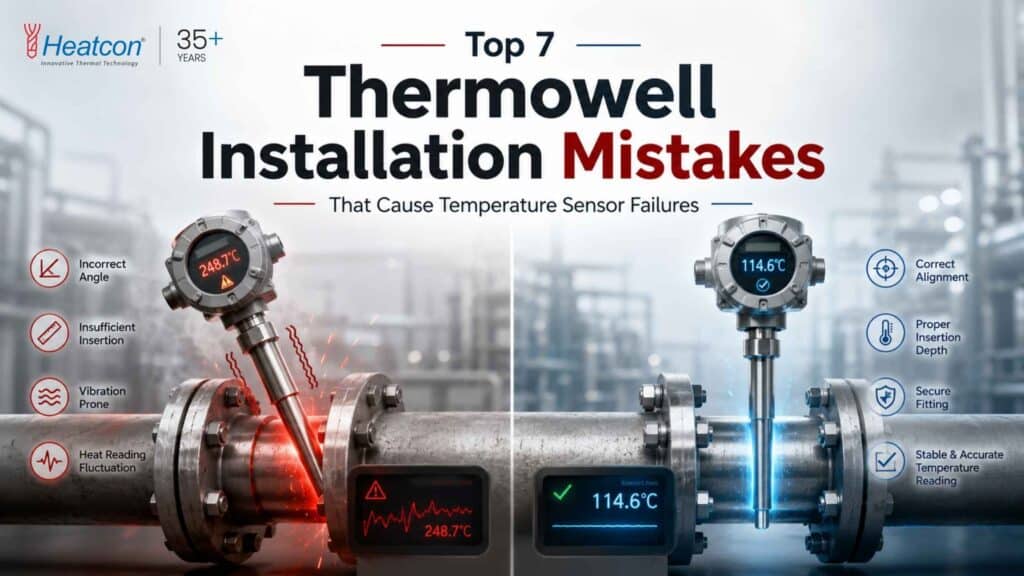
What Are The Most Common Thermowell Installation Mistakes?
Thermowell installation mistakes are a leading cause of temperature sensor failures in industrial environments. According to industry studies, up to 45% of premature temperature sensor breakdowns can be traced back to errors in thermowell selection or installation. This not only results in unplanned downtime but also increases maintenance costs and the risk of process inefficiencies.
For process engineers, plant managers, and maintenance professionals, understanding these pitfalls is crucial. In this comprehensive guide, we will explore the top seven thermowell installation mistakes, delve into technical nuances like thermowell immersion length, ASME thermowell standards, and flow-induced vibration, and share how Heatcon Sensors—India’s premier manufacturer and exporter of customized RTDs and temperature sensors—can help you prevent such costly errors, wherever your plant is located: India, US, UAE, Indonesia, Germany, South Korea, Saudi Arabia, Russia, Bahrain, Kuwait, or beyond.
Why Is Correct Thermowell Installation Critical For Temperature Sensors?
A thermowell acts as a protective barrier between the temperature sensor and the process media. It shields the sensor from harsh chemicals, high-pressure environments, and abrasive flows. However, even the highest quality RTDs (Resistance Temperature Detectors) or thermocouples can fail prematurely if thermowell installation mistakes are made.
- Incorrect installation can lead to inaccurate readings, sensor drift, and frequent replacements.
- Improper thermowell selection or mounting increases the risk of mechanical failure and process hazards.
- Following industry standards and leveraging expert guidance, like that offered by Heatcon Sensors, ensures reliable temperature measurement and process safety.
How Do Thermowell Installation Mistakes Lead To Sensor Failures?
Let’s break down the seven most common thermowell installation mistakes, their consequences, and proven ways to avoid them:
-
Improper thermowell immersion length selection
Quick answer: Not selecting the correct thermowell immersion length leads to heat conduction errors, lagging response times, and inaccurate readings.
The thermowell immersion length—the distance the thermowell extends into the process media—determines how effectively the sensor measures the true process temperature. If the immersion length is too short, the sensor may pick up heat from the pipe wall rather than the process fluid, resulting in false readings. If it is too long, the thermowell is vulnerable to flow-induced vibration and mechanical fatigue.
- Follow the general rule: immerse at least 10 times the thermowell’s outer diameter, or as specified by ASME thermowell standards.
- Consult with Heatcon Sensors for custom-designed thermowells optimized for your process and geometry.
-
Neglecting ASME thermowell standards compliance
Quick answer: Ignoring ASME thermowell standards can result in unsafe installations, regulatory non-compliance, and catastrophic sensor failures.
The ASME thermowell standards (PTC 19.3 TW-2016) provide comprehensive guidelines on thermowell design, material selection, vibration calculations, and installation procedures. Failing to adhere to these standards increases the risk of thermowell breakage, which can jeopardize plant safety and process continuity.
- Always specify ASME-compliant thermowells, especially for high-pressure or high-velocity applications.
- Heatcon Sensors manufactures thermowells and temperature sensors that meet or exceed ASME and international standards.
-
Ignoring flow-induced vibration analysis
Quick answer: Overlooking flow-induced vibration during installation can cause thermowell fatigue, cracking, and catastrophic sensor failure.
Flow-induced vibration occurs when process fluids create cyclical forces on the thermowell, causing it to vibrate at its natural frequency. Persistent vibration leads to metal fatigue and eventual failure. According to ASME studies, flow-induced vibration is responsible for 80% of thermowell failures in high-velocity lines.
- Request a vibration analysis for every critical installation—Heatcon Sensors provides expert guidance and custom solutions to minimize vibration risks.
- Consider using shortened thermowells or velocity collars where high velocities are unavoidable.
-
Poor sealing and incorrect mounting orientation
Quick answer: Inadequate sealing and improper mounting orientation can lead to process leaks, ingress of contaminants, and sensor damage.
Thermowell threads must be properly sealed using compatible gaskets and compounds, and mounting orientation should follow best practices (usually perpendicular to flow for optimal temperature sensing).
- Always use factory-recommended mounting hardware and sealing materials.
- Heatcon Sensors offers installation guides and technical support to ensure leak-free and correct orientation every time.
-
Incorrect material selection for thermowell and sensor
Quick answer: Choosing unsuitable materials for your process environment accelerates corrosion, abrasion, and sensor failure.
Each process fluid poses unique challenges—acidic, alkaline, high-pressure, or abrasive. Material mismatch can quickly degrade both the thermowell and the temperature sensor.
- Specify materials compatible with your process media; consider stainless steel, Inconel, Hastelloy, or custom alloys as needed.
- Heatcon Sensors can custom-manufacture thermowells and sensors for any application, anywhere in the world.
-
Inadequate process data during engineering and procurement
Quick answer: Failing to provide accurate process data leads to suboptimal thermowell design and premature sensor failure.
Critical process parameters—temperature, pressure, velocity, media type—are essential for correct thermowell and sensor design. Incomplete or inaccurate data during procurement frequently results in equipment not fit for purpose.
- Partner with a knowledgeable supplier like Heatcon Sensors, who will guide you through the data collection process and offer tailored recommendations.
-
Overlooking periodic inspection and maintenance
Quick answer: Skipping routine inspection and maintenance increases the risk of undetected wear, corrosion, and unexpected sensor failures.
Even perfectly installed thermowells and sensors are subject to wear and corrosion over time. Regular inspection is crucial to catch early signs of damage and schedule replacements before failure occurs.
- Establish an inspection schedule based on process conditions and sensor criticality.
- Heatcon Sensors provides ongoing support and advice for long-term reliability and performance.
How To Prevent Thermowell Installation Mistakes In Your Facility
Preventing thermowell installation mistakes starts with collaboration between your engineering team and an experienced sensor manufacturer. Here’s a step-by-step approach:
- Collect accurate process data (temperature, pressure, velocity, fluid type).
- Specify application-specific requirements (corrosion resistance, response time).
- Choose thermowell and sensor materials suited to your process.
- Adhere strictly to ASME thermowell standards and conduct vibration analysis.
- Work with a trusted manufacturer like Heatcon Sensors for design and supply.
- Implement a robust inspection and maintenance program.
By following these steps and leveraging the technical expertise of Heatcon Sensors, you can achieve accurate, reliable, and long-lasting temperature measurement—no matter where your facility is located.
Why Choose Heatcon Sensors For Custom RTDs, Thermowells, And Temperature Sensors?
Heatcon Sensors is a leading manufacturer of customized RTDs, thermocouples, and temperature sensors, with decades of experience catering to diverse industries across India and internationally. Whether your operations are in Mumbai, Delhi, Chennai, Bengaluru, or global hubs like Houston, Jebel Ali, Jakarta, Berlin, Seoul, Riyadh, Moscow, Manama, or Kuwait City, Heatcon Sensors delivers precision-engineered solutions tailored to your requirements.
- Customized solutions: Heatcon Sensors designs and manufactures RTDs, thermowells, and temperature sensors to your exact specifications, ensuring perfect fit and reliable performance.
- Global reach: Fast, reliable supply to any part of India or the world—US, UAE, Indonesia, Germany, South Korea, Saudi Arabia, Russia, Bahrain, Kuwait, and beyond.
- Comprehensive product range: In addition to sensors, Heatcon Sensors manufactures heat generating equipment such as industrial furnaces, ovens, hot air blowers, electric furnaces, high density cartridge heaters, immersion heaters, band heaters, and more.
- Unmatched expertise: Deep technical knowledge in process instrumentation, compliance with ASME thermowell standards, and hands-on guidance for vibration analysis and installation best practices.
- Industry trust: Preferred by top companies in oil & gas, chemical, power generation, pharmaceuticals, food processing, and more.
About Heatcon Sensors
Heatcon Sensors is a renowned manufacturer and exporter based in India, specializing in the design and manufacture of customized temperature sensors, RTDs, thermocouples, and thermowells for critical industrial applications. The company also provides an extensive range of heat-generating equipment, including industrial furnaces, ovens, hot air blowers, electric furnaces, and high density cartridge heaters. With a strong commitment to quality, innovation, and customer satisfaction, Heatcon Sensors delivers reliable solutions to clients across India and in major industrial regions worldwide.
How To Contact Heatcon Sensors For Your Temperature Sensor Needs
Don’t risk costly downtime or process failures due to thermowell installation mistakes. Partner with Heatcon Sensors for expert guidance, custom solutions, and rapid support. You can reach out in any of the following ways:
- Submit your requirements through the online form.
- Leave a message on Whatsapp via the interface on the Heatcon Sensors website.
- Call for immediate assistance: +91 9164833027 or +91 9844233244.
Secure your process with the industry’s most reliable temperature measurement solutions—choose Heatcon Sensors today.
Frequently Asked Questions
What are the most common thermowell installation mistakes that lead to sensor failures?
The most frequent thermowell installation mistakes include improper immersion length selection, incorrect orientation, inadequate support, failure to follow ASME thermowell standards, poor sealing, and neglecting vibration analysis. These errors can cause inaccurate readings, premature sensor damage, or even sensor detachment. Heatcon Sensors provides on-site assessment and best-practice recommendations to help prevent these issues.
How does thermowell immersion length affect temperature measurement accuracy?
Thermowell immersion length directly influences the accuracy and responsiveness of temperature measurements. Too short an immersion can lead to heat conduction from the process connection, resulting in false readings. Heatcon Sensors assists clients in calculating the optimal immersion length for process conditions, ensuring precise and reliable sensor performance.
Why is compliance with ASME thermowell standards critical during installation?
Compliance with ASME thermowell standards ensures mechanical integrity, proper fit, and safety under process conditions. Non-compliance can result in thermowell failure, leaks, or unsafe operation. Heatcon Sensors manufactures thermowells according to ASME standards and provides guidance on selecting compliant designs for specific applications.
What is flow-induced vibration and how does it impact thermowell reliability?
Flow-induced vibration occurs when high-velocity fluids cause oscillations in the thermowell, potentially leading to fatigue failure or sensor breakage. Heatcon Sensors conducts wake frequency calculations and recommends appropriate thermowell profiles, supports, or dampeners to mitigate vibration risks for your application.
How can improper sealing during installation cause temperature sensor issues?
Improper sealing can allow process fluid or contaminants to enter the thermowell, leading to corrosion, insulation breakdown, or sensor drift. Heatcon Sensors offers a range of sealing options, including threaded, flanged, and welded connections, and provides installation support to ensure a leak-free system.
What role does orientation play in thermowell installation mistakes?
Incorrect orientation, such as installing thermowells against the direction of flow or at improper angles, may increase vibration, reduce measurement accuracy, and accelerate wear. Heatcon Sensors advises on optimal orientation based on process dynamics and provides installation training to avoid these common mistakes.
How does Heatcon Sensors help prevent thermowell installation mistakes?
Heatcon Sensors offers end-to-end support, from engineering consultation and site assessment to custom thermowell design and installation guidance. By applying industry best practices, conducting vibration and immersion length analysis, and ensuring ASME compliance, Heatcon helps clients avoid costly thermowell installation mistakes and maximize sensor lifespan.
What types of thermowells does Heatcon Sensors manufacture for challenging process conditions?
Heatcon Sensors manufactures a wide variety of thermowells, including threaded, flanged, weld-in, and Van Stone types. Each can be customized for material, immersion length, and wall thickness to suit high pressure, corrosive, or high-velocity environments—helping clients address specific application challenges and avoid installation errors.
Can Heatcon Sensors assess existing installations for potential failure risks?
Yes, Heatcon Sensors provides site surveys and audits to identify risks such as improper immersion, non-compliance with ASME thermowell standards, and flow-induced vibration. Their expert team recommends corrective actions or retrofits to optimize performance and reliability of existing temperature measurement systems.