
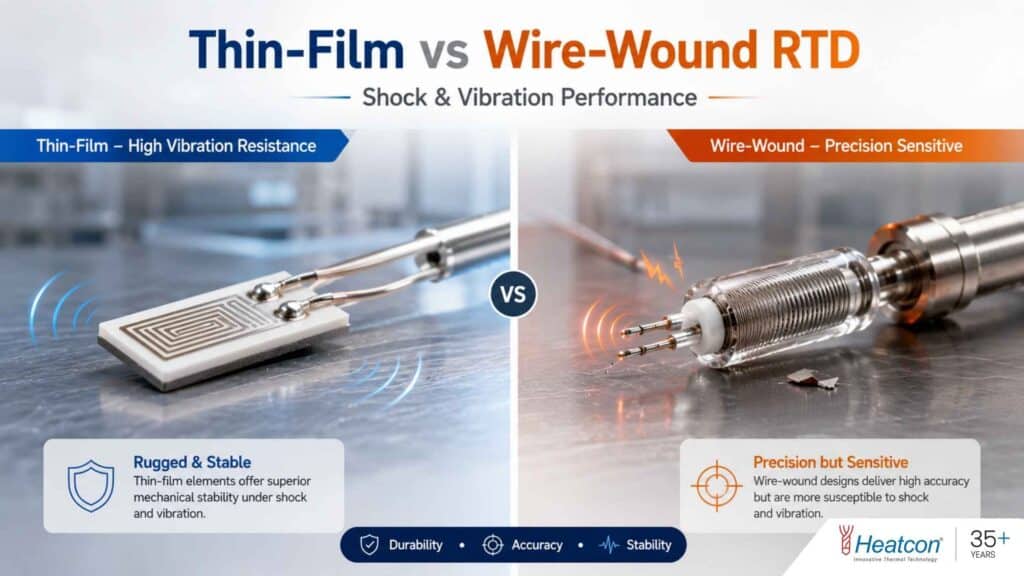
The choice between thin film and wire wound RTD elements is crucial for industries where shock and vibration are a part of daily operations. According to industry reports, over 60% of RTDs in industrial environments are exposed to significant mechanical stress, making sensor durability a top priority. But which sensor technology—thin film or wire wound—offers better survival under such harsh conditions? In this comprehensive guide, we answer this and more, helping you make the right choice for your process requirements, whether you operate in India, the US, UAE, Indonesia, Germany, South Korea, Saudi Arabia, Russia, Bahrain, Kuwait, or anywhere else in the world.
What is the difference between thin film and wire wound RTD elements?
Thin film and wire wound RTD elements are both platinum resistance temperature detectors, but their construction and performance characteristics differ significantly:
- Thin film RTD elements feature a thin layer of platinum deposited on a ceramic substrate and laser-trimmed to precise resistance values.
- Wire wound RTD elements are crafted by winding fine platinum wire around a ceramic or glass core, then sealing it for protection.
The debate of thin film RTD vs wire wound is central when selecting sensors for environments prone to mechanical shock and vibration. Understanding the construction is the first step in determining which type excels in ruggedness and reliability.
| Parameter | Thin Film RTD | Wire Wound RTD |
|---|---|---|
| Construction | Platinum layer on ceramic substrate | Platinum wire wound on ceramic/glass core |
| Operating Range | -70°C to 500°C | -200°C to 850°C |
| Shock/Vibration Resistance | Good (in standard conditions) | Excellent (with rugged design) |
| Response Time | Faster (thin film RTD response time is typically 1–3 seconds) | Moderate (slightly slower due to construction) |
| Accuracy | Class B (standard), Class A (select types) | Class A, 1/3 DIN, 1/10 DIN (highest accuracy) |
| Cost | Lower | Higher |
| Customizability | Limited | High (Heatcon Sensors excels here) |
Which RTD element survives shock and vibration better?
When directly comparing thin film RTD vs wire wound for resistance to shock and vibration, wire wound RTDs have a clear edge. The robust construction of wire wound RTDs allows them to withstand intense mechanical and thermal cycling found in process plants, power generation, steel mills, refineries, and more.
- Wire wound RTD advantages include enhanced mechanical stability, longer lifespan under stress, and the ability to be further ruggedized with vibration-resistant encapsulation.
- Thin film RTDs, though sturdy in many settings, may develop micro-cracks or delamination if exposed to repetitive or severe shock and vibration, especially over time.
For applications where sensors are mounted on vibrating machinery, rotating equipment, or in mobile/transport settings, rugged RTD sensors built on the wire wound principle are the industry standard.
How do thin film RTDs respond to shock and vibration?
Thin film RTDs are engineered for solid performance in moderately rugged industrial environments. They excel in applications requiring rapid thermal response due to their small mass and intimate contact with the process.
- The thin film RTD response time is typically 1–3 seconds, making them ideal for applications where quick detection of temperature changes is critical.
- However, if subjected to persistent vibration or mechanical shock, especially beyond specified limits, the thin film platinum layer can develop faults, impacting sensor accuracy and reliability.
For moderate vibration, thin film RTDs often suffice, but for frequent, high-intensity shock and vibration, wire wound RTDs are the preferred choice.
What are the key wire wound RTD advantages for rugged industrial environments?
Wire wound RTDs are the gold standard for demanding environments due to several critical advantages:
- Superior Mechanical Durability: The coiled platinum wire is flexible and can absorb shocks without fracturing. Protective encapsulation further enhances resistance.
- Long-Term Stability: They maintain calibration over years of use, even with regular vibration exposure.
- High Temperature Tolerance: Operating ranges up to 850°C make them suitable for furnaces, ovens, and high-temperature processes.
- Custom Ruggedization: Wire wound RTDs can be customized with spring-loaded tips, armored cables, and heavy-duty housings for ultimate ruggedness.
- Global Reliability: Trusted in mission-critical installations worldwide—from oil rigs in Saudi Arabia to steel plants in Germany and power stations in India.
How to choose between thin film and wire wound RTDs for your application?
Here’s a decision matrix to help you make the best choice for your process:
- Choose thin film RTDs if:
- You need fast thermal response (thin film RTD response time is unbeatable for many applications).
- Installation is in a low- to moderate-vibration environment.
- Cost is a significant factor and ultra-high accuracy is not required.
- Choose wire wound RTDs if:
- The environment involves frequent or intense shock and vibration.
- Long-term stability, reliability, and ruggedness are critical.
- High accuracy or wide temperature range is needed.
If you require sensors tailored for harsh, unique, or challenging conditions, Heatcon Sensors can custom-manufacture rugged RTD sensors to your exact specifications—delivering worldwide, with support in India, US, UAE, and beyond.
What makes Heatcon Sensors the preferred RTD source globally?
Heatcon Sensors is not just another sensor supplier; we are a partner in your success. Our expertise in designing and manufacturing both thin film and wire wound RTDs is backed by decades of experience serving every major industry, including chemicals, pharmaceuticals, power, food processing, and more.
- Custom Manufacturing: We build to your exact needs, from sensor geometry to lead wire length and housing style.
- Global Supply Chain: Heatcon Sensors can deliver to any city or country—India, US, UAE, Indonesia, Germany, South Korea, Saudi Arabia, Russia, Bahrain, Kuwait, and beyond.
- Heat Generating Equipment: We also manufacture industrial furnaces, ovens, hot air blowers, electric furnaces, high density cartridge heaters, tubular heaters, immersion heaters, and more—making us a one-stop solution for temperature and heating technology.
- Quality and Compliance: All products comply with international standards and come with full documentation and support.
- Expert Support: Our engineers help you choose the right sensor—thin film or wire wound—tailored for your shock, vibration, and accuracy requirements.
- Submit your requirements on our contact form
- Message us via WhatsApp through the interface available on our website
- Call our experts for immediate assistance: +91 9164833027 or +91 9844233244
Don’t risk downtime or sensor failure—choose Heatcon Sensors for reliable, accurate, and rugged RTD solutions.
About Heatcon Sensors
Heatcon Sensors is a leading manufacturer and global supplier of temperature sensors, RTDs, thermocouples, and industrial heating equipment. Based in India and serving clients worldwide, we are trusted by top industries for our quality, customization, and on-time delivery. Our solutions power critical processes in India, US, UAE, Germany, and more.
- Website: https://heatconsensors.com/
- Facebook: Heatcon Sensors Facebook
- Instagram: Heatcon Sensors Instagram
If your process demands sensors that survive shock, vibration, and extreme conditions, trust the experts at Heatcon Sensors.
Frequently Asked Questions
What is the key difference between thin film RTD vs wire wound RTD elements?
The main difference between thin film RTD vs wire wound RTD elements lies in their construction. Thin film RTDs use a very thin layer of resistive material deposited on a ceramic substrate, making them compact and responsive. Wire wound RTDs, however, are made by winding a fine platinum wire around a ceramic or glass core. This fundamental difference impacts their durability, accuracy, and performance in demanding industrial conditions.
Which RTD type handles shock and vibration better in harsh environments?
Generally, wire wound RTDs offer superior resistance to mechanical shock and vibration compared to thin film designs. Their robust winding and support structure allow them to absorb and withstand physical impacts more effectively, making them a popular choice for rugged RTD sensors used in heavy industrial, aerospace, or automotive applications.
What are the main wire wound RTD advantages over thin film RTDs?
The key wire wound RTD advantages include higher long-term stability, better accuracy across a wider temperature range, and increased survivability under mechanical stress. They are less prone to drift and can operate reliably in environments with constant vibration or repeated shocks, making them ideal for critical measurement tasks.
How does thin film RTD response time compare to wire wound RTDs?
Thin film RTD response time is typically faster than that of wire wound RTDs due to their smaller mass and direct thermal contact with the measured environment. This makes thin film RTDs suitable for applications where rapid temperature changes need to be detected. However, this speed can come at the cost of reduced durability in high-vibration or shock-prone settings.
Are rugged RTD sensors available for both thin film and wire wound types?
Yes, both thin film and wire wound RTDs can be designed as rugged RTD sensors, but wire wound models are generally preferred for extreme environments. Heatcon Sensors offers both types, with custom engineering to enhance shock and vibration resistance, ensuring reliable operation in your toughest applications.
What solutions does Heatcon Sensors offer for applications with high shock and vibration?
Heatcon Sensors specializes in customizing both wire wound and thin film RTDs for challenging environments. For maximum durability, Heatcon recommends wire wound RTDs in reinforced housings, with advanced mounting options and protective features. These solutions ensure accurate temperature sensing and long sensor life even under rugged industrial or field conditions.
Can thin film RTDs be used in environments with moderate vibration?
Yes, thin film RTDs can perform well in environments with moderate vibration, especially when properly mounted and shielded. Heatcon Sensors can advise on installation best practices and provide robust assemblies to enhance sensor lifespan. However, for severe or continuous vibration, wire wound RTDs are usually recommended.
How do I choose between thin film and wire wound RTDs for my application?
Your choice depends on required accuracy, temperature range, response time, and environmental factors like shock and vibration. Thin film RTDs are best for applications needing compact size and fast response, while wire wound RTDs are ideal for high accuracy and ruggedness. Heatcon Sensors’ experts can help you select the optimal sensor for your needs—contact them for personalized advice.