
Did you know that over 75% of modern temperature sensors in industrial automation rely on thermistors for their accuracy, and the Steinhart-Hart equation is at the core of this precision? If your operations depend on reliable temperature readings, understanding this equation is crucial for optimal performance and safety.
What Is The Steinhart-Hart Equation And Why Does It Matter?
The Steinhart-Hart equation is a mathematical model that enables highly precise temperature calculation from the resistance readings of a thermistor. It is especially vital for applications demanding exact temperature monitoring, such as chemical processing, pharmaceutical manufacturing, HVAC, and food safety. The equation corrects for the non-linear relationship between a thermistor’s resistance and temperature, making it a gold standard in sensor technology.
For industries and businesses that cannot afford inaccuracies, relying on the Steinhart-Hart equation is not just a technical choice—it’s a strategic imperative. Inaccurate readings can lead to faulty processes, wasted resources, and costly downtime.
How Does The Steinhart-Hart Equation Work?
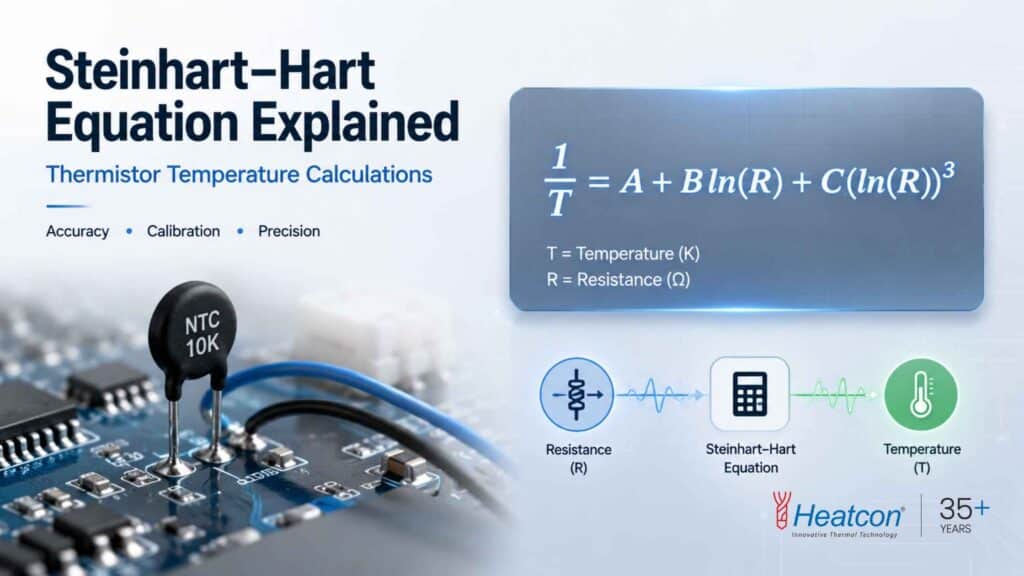
In simple terms, the Steinhart-Hart equation expresses temperature as a function of the natural logarithm of the measured resistance. The equation is as follows:
1/T = A + B*ln(R) + C*[ln(R)]³
- T: Absolute temperature in Kelvin
- R: Measured resistance of the thermistor (in Ohms)
- A, B, C: Thermistor-specific coefficients derived from calibration
This model allows engineers to achieve far greater accuracy than basic, linear equations could ever provide. For example, in critical temperature control environments—such as high-temperature industrial furnaces or sensitive pharmaceutical incubators—this accuracy can be the difference between success and costly failure.
Why Is Thermistor Linearization Essential?
Thermistors have an inherently nonlinear resistance-temperature relationship. This means that a simple voltage or resistance measurement does not directly translate to a precise temperature reading. Thermistor linearization is the process of converting this nonlinear behavior into a linear, predictable output, typically using mathematical models like the Steinhart-Hart equation.
- Linearization improves the sensor’s accuracy across a wide temperature range.
- It simplifies integration with digital systems, controllers, and PLCs.
- It ensures consistent, reliable temperature monitoring for mission-critical processes.
Heatcon Sensors leverages advanced thermistor linearization techniques in every customized RTD and thermistor product, ensuring that your operations are never compromised by inaccurate data.
How Do You Perform Thermistor Resistance Calculation?
Thermistor resistance calculation is a key step in determining the sensor’s temperature. The procedure generally involves:
- Measuring the resistance of the thermistor at the point of interest.
- Applying the Steinhart-Hart equation with the appropriate coefficients (A, B, C) for your specific thermistor.
- Calculating the corresponding temperature using the equation.
For high accuracy, it is crucial to use precise measurement equipment and ensure that the thermistor has been properly calibrated. This is where Heatcon Sensors’ expertise comes into play, delivering pre-calibrated, ready-to-integrate sensors for any industrial environment—whether you operate in India, the US, UAE, Indonesia, Germany, South Korea, Saudi Arabia, Russia, Bahrain, or Kuwait.
What Is The Thermistor Calibration Formula And Why Should You Care?
The thermistor calibration formula refers to the process of determining the A, B, and C coefficients for the Steinhart-Hart equation. Calibration is typically performed at three known temperature points, where resistance is measured and the coefficients are calculated.
- Proper calibration ensures that the thermistor’s output matches the true temperature, minimizing errors.
- It is essential for applications where even a 1°C error could cause significant issues.
- Heatcon Sensors provides expertly calibrated sensors, tailored to your specific process conditions and environmental requirements.
How To Use The Steinhart-Hart Equation In Real-World Applications?
Businesses across sectors—from steel manufacturing to semiconductor fabrication—use the Steinhart-Hart equation for dependable process control. Here’s how Heatcon Sensors makes a difference:
- Custom manufacturing of RTDs and temperature sensors to match your exact requirements.
- Global supply capabilities, delivering solutions across India and internationally to the US, UAE, Indonesia, Germany, South Korea, Saudi Arabia, Russia, Bahrain, and Kuwait.
- Integration support for various industries, including chemical, food processing, pharmaceuticals, automotive, and energy.
Heatcon Sensors ensures every sensor is engineered for your unique application—whether you need robust sensors for electric furnaces or precision sensors for laboratory ovens.
What Are The Benefits Of Using Heatcon Sensors’ Temperature Solutions?
Choosing the right sensor technology isn’t just about picking a product—it’s about securing your operational future. With Heatcon Sensors, you benefit from:
- Expertise in the application of the Steinhart-Hart equation, ensuring high accuracy and reliability.
- State-of-the-art thermistor linearization techniques embedded in every sensor.
- Comprehensive thermistor resistance calculation and calibration services.
- Custom design and manufacturing for challenging industrial environments.
- Global supply and support, reaching even the most remote locations.
Heatcon Sensors is a leader in customized RTDs, thermistors, and advanced temperature sensors, as well as heat-generating equipment like furnaces, ovens, hot air blowers, high density cartridge heaters, and electric furnaces. Every product is designed with your process and safety in mind.
How Can You Reach Out To Heatcon Sensors For Customized Solutions?
Don’t leave your temperature measurement to chance. For industry-leading accuracy and support, you have three easy options to connect with Heatcon Sensors:
- Submit your information on the contact form.
- Leave a message on Whatsapp through the interface available on the Heatcon Sensors website.
- Call directly on +91 9164833027 or +91 9844233244 for immediate assistance.
Make the smart choice—partner with Heatcon Sensors and ensure your operations are always one step ahead.
About Heatcon Sensors
Heatcon Sensors is a global leader in the design, manufacture, and supply of advanced temperature sensors and heat-generating equipment. Based in India, Heatcon serves customers worldwide—including the US, UAE, Indonesia, Germany, South Korea, Saudi Arabia, Russia, Bahrain, and Kuwait—with a reputation for quality, reliability, and custom engineering. Whether you need standard RTDs, thermocouples, or specialized solutions for harsh environments, Heatcon Sensors has the expertise and resources to deliver—on time, every time.
Frequently Asked Questions
What is the Steinhart-Hart equation and why is it important for thermistor measurements?
The Steinhart-Hart equation is a highly accurate mathematical formula used to relate the resistance of a thermistor to its temperature. It accounts for the non-linear behavior of thermistors over a wide range of temperatures, providing precise temperature calculations. This accuracy is essential for applications requiring reliable thermal management, such as those supported by Heatcon Sensors.
How does thermistor linearization benefit temperature sensing applications?
Thermistor linearization transforms the inherently non-linear resistance-temperature relationship into a near-linear response, enabling more straightforward and accurate temperature readings. By applying formulas like the Steinhart-Hart equation, Heatcon Sensors ensures that their thermistor-based solutions deliver consistent and trustworthy measurements across diverse environments.
What are the key variables in the Steinhart-Hart equation?
The Steinhart-Hart equation uses three coefficients (A, B, and C), which are unique to each thermistor, along with the measured resistance value. These coefficients are determined during calibration and enable the equation to accurately convert resistance to temperature. This approach enhances the precision of Heatcon Sensors’ temperature measurement systems.
How is thermistor resistance calculation performed in practical scenarios?
Thermistor resistance calculation typically involves measuring the voltage across the thermistor in a circuit and applying Ohm’s Law. The measured resistance is then used in the Steinhart-Hart equation or other calibration formulas to determine the exact temperature. Heatcon Sensors provides both the hardware and technical expertise to ensure accurate resistance measurements for critical applications.
What is the thermistor calibration formula and how is it used?
The thermistor calibration formula refers to mathematical models, such as the Steinhart-Hart equation, used to relate a thermistor’s resistance to temperature. Calibration involves determining the coefficients for the specific thermistor in use, ensuring precise temperature readings for each device. Heatcon Sensors calibrates thermistors using industry-standard procedures for optimal accuracy.
How does Heatcon Sensors support industries with thermistor-based temperature measurement solutions?
Heatcon Sensors offers a complete suite of thermistor-based temperature measurement solutions, from sensor selection and calibration to integration with control systems. By applying advanced formulas like the Steinhart-Hart equation and supporting thermistor linearization, Heatcon Sensors delivers reliable, industry-specific solutions for sectors such as HVAC, medical devices, and industrial automation.
Can the Steinhart-Hart equation be used for all types of thermistors?
The Steinhart-Hart equation is primarily suited for NTC (Negative Temperature Coefficient) thermistors but can also be adapted for some PTC (Positive Temperature Coefficient) types. The equation’s coefficients must be determined for each thermistor type for best results, a process that Heatcon Sensors facilitates during the thermistor calibration phase.
How does accurate calibration impact sensor performance over time?
Accurate calibration ensures that thermistor sensors maintain precise temperature readings across their operational lifespan. By using robust thermistor calibration formulas and periodic recalibration, as recommended by Heatcon Sensors, drift and environmental effects can be minimized, safeguarding the integrity of temperature-sensitive processes.
What makes Heatcon Sensors’ approach to thermistor resistance calculation unique?
Heatcon Sensors combines advanced electronic measurement techniques with precise mathematical modeling, including the Steinhart-Hart equation, to ensure thermistor resistance calculation is both fast and accurate. Their expertise in sensor calibration and system integration results in superior performance and reliability for client applications.
What is the steinhart hart equation used for in temperature measurement?
The steinhart hart equation is used to convert the resistance readings of a thermistor into accurate temperature values. This equation is especially important when you need high precision over a wide temperature range, making it the standard for calibrating thermistors in scientific, industrial, and commercial applications.
Why is the steinhart hart equation preferred over simpler models for thermistor calibration?
The steinhart hart equation is preferred over simpler models, such as the Beta parameter equation, because it provides greater accuracy across a broader temperature range. Its three-coefficient model accounts for the complex, non-linear response of thermistors, ensuring precise temperature measurements for demanding applications.