
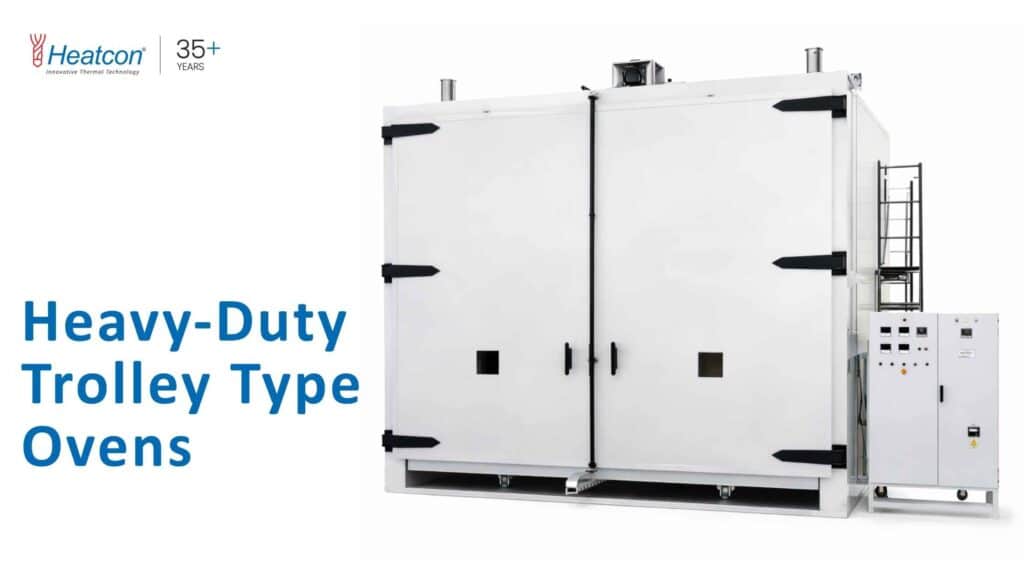
Heavy-duty trolley type ovens for modern industrial needs
According to publicly available industrial manufacturing data, more than 65% of large-scale heat treatment and finishing operations globally rely on trolley-based oven systems for consistent and repeatable results. This statistic alone highlights why Heavy-Duty Trolley Type Ovens have become indispensable across manufacturing sectors where precision, reliability, and throughput define competitiveness. In an era where downtime costs are rising and quality standards are tightening, selecting the right thermal solution is no longer optional—it is strategic.
Heatcon Sensors stands at the center of this evolution, not only as a manufacturer of industrial heating equipment but also as a trusted partner delivering customized RTDs, thermocouples, and advanced temperature sensors that ensure these ovens perform exactly as intended, anywhere in India or across global markets.
What are heavy-duty trolley type ovens?
Heavy-duty trolley type ovens are industrial heating systems designed to process large, heavy, or bulky components by loading them on a movable trolley that rolls into a thermally insulated chamber. These ovens are engineered to deliver uniform temperature distribution, controlled heating cycles, and repeatable results even under continuous production conditions.
Often categorized under Industrial ovens, these systems are widely used in sectors such as automotive, aerospace, foundries, fabrication, defense, and infrastructure manufacturing. Their defining advantage lies in flexibility: the trolley mechanism allows easy loading and unloading of oversized parts while maintaining tight thermal control.
Why industries depend on trolley-based batch processing
Industries that deal with non-continuous, job-based production often require Batch ovens to handle varying product sizes, weights, and thermal profiles. Trolley-based designs perfectly align with this requirement by enabling:
- Handling of heavy loads without compromising operator safety
- Customizable heating cycles based on material and process needs
- Reduced heat loss due to efficient sealing and insulation
- Scalability for future capacity expansion
From curing coatings to stress relieving metal components, these ovens play a crucial role in Heat treatment equipment used across industries where metallurgical integrity is non-negotiable.
How industrial thermal processing benefits from precision heating
Industrial thermal processing refers to the controlled application of heat to alter material properties, enhance durability, or prepare products for subsequent manufacturing stages. In heavy-duty trolley ovens, precision is achieved through:
- Accurate temperature sensing using RTDs and thermocouples
- Optimized airflow design for uniform heat distribution
- Advanced control panels for programmable heating profiles
Heatcon Sensors specializes in manufacturing customized RTDs and temperature sensors that integrate seamlessly with these ovens, ensuring every heating cycle meets stringent industrial specifications. This sensor-level accuracy is what transforms a heating chamber into a reliable Thermal processing systems backbone.
Integration with advanced industrial heating technologies
While conventional convection heating dominates many applications, modern facilities increasingly integrate complementary technologies such as Infrared industrial ovens for surface-focused heating and faster response times. Heatcon Sensors designs trolley type ovens that can be adapted to hybrid heating configurations, combining convection, radiation, and forced air circulation when process demands require it.
This adaptability ensures manufacturers are not locked into a single heating methodology, but instead gain a future-ready solution aligned with evolving production requirements.
Role of industrial heaters and temperature sensors
At the core of every high-performance oven lies a carefully engineered heating and sensing ecosystem. Industrial heaters—such as tubular heaters, finned heaters, and high density cartridge heaters—provide the thermal energy, while precision sensors monitor and regulate it.
Heatcon Sensors manufactures and supplies:
- Customized RTDs for high-accuracy temperature measurement
- Thermocouples for extreme temperature environments
- Electric furnaces and ovens for diverse industrial applications
- Hot air blowers and auxiliary heating equipment
This vertical integration ensures that every component, from the heater to the sensor, works in harmony—reducing failure points and enhancing overall system reliability.
Customization as a competitive advantage
No two industrial processes are identical. Load size, material composition, required ramp-up time, soak duration, and cooling profiles vary significantly. Recognizing this, Heatcon Sensors focuses on custom manufacturing rather than one-size-fits-all solutions.
Heavy-duty trolley ovens can be engineered for:
- Specific temperature ranges and uniformity requirements
- Customized chamber dimensions and trolley load capacities
- Energy-efficient insulation and airflow configurations
- Integration with existing plant automation systems
This approach ensures that clients do not have to adapt their process to the equipment; instead, the equipment is built around the process.
Global supply with local understanding
Heatcon Sensors supplies temperature sensors and industrial heating equipment across India and to international markets including the United States, UAE, Indonesia, Germany, South Korea, Saudi Arabia, Russia, Bahrain, and Kuwait. Each region brings unique regulatory, environmental, and operational challenges.
By combining engineering expertise with practical field experience, Heatcon Sensors ensures compliance with local standards while maintaining consistent performance worldwide. This global capability allows manufacturers to standardize their Thermal processing systems across multiple locations without compromising on quality.
Why choosing the right partner matters
The real cost of inadequate thermal equipment is often hidden—in rejected batches, inconsistent quality, excessive energy consumption, and unplanned downtime. Many manufacturers realize too late that investing in suboptimal heating solutions limits scalability and profitability.
By choosing Heatcon Sensors, industries gain access to:
- Decades of expertise in industrial heating and sensing
- End-to-end solutions covering design, manufacturing, and support
- Responsive technical assistance for immediate operational needs
The result is not just equipment, but confidence—confidence that every heating cycle performs as expected, every time.
About Heatcon Sensors
Heatcon Sensors is an Indian manufacturer specializing in customized RTDs, thermocouples, and temperature sensors for industrial applications. The company also designs and manufactures a wide range of heat generating equipment including heavy-duty ovens, furnaces, hot air blowers, and industrial heaters tailored to demanding production environments.
Whether your requirement involves upgrading an existing oven, designing a new trolley-based system, or sourcing precision sensors for critical processes, Heatcon Sensors delivers solutions that align with global standards and real-world industrial demands.
Take the next step toward reliable thermal performance
If your operations depend on consistent, high-quality heat treatment or thermal processing, delaying the right investment could mean falling behind competitors who prioritize precision and reliability.
Reach out to Heatcon Sensors today by submitting your information at https://heatconsensors.com/contact-us/, leaving a message via the WhatsApp interface on the website, or calling +91 9164833027 or +91 9844233244 for immediate assistance. The difference between average and exceptional thermal performance often begins with one informed decision.
Frequently Asked Questions
What are heavy-duty trolley type ovens used for in industrial environments?
Heavy-duty Trolley type ovens are designed for processing large, bulky, or high-weight components that need uniform heating, controlled airflow, and reliable temperature stability during demanding production cycles.
How do these ovens support batch-based manufacturing processes?
In operations where parts are processed in defined lots rather than continuously, these systems function efficiently as Batch ovens , allowing manufacturers to load, heat, soak, and unload products with repeatable accuracy.
What makes Heatcon Sensors’ solutions suitable for harsh industrial conditions?
Heatcon Sensors engineers its designs with robust insulation, reinforced structures, and precision controls, making them dependable Industrial ovens for high-temperature, long-duration, and heavy-load applications.
Can these ovens be customized for metallurgical and thermal applications?
Yes, Heatcon Sensors offers tailored configurations for Heat treatment equipment , including precise temperature ramping, soaking control, and uniformity compliance required for metallurgical and material-strengthening processes.
How do these ovens fit into broader manufacturing heat workflows?
They are engineered as part of integrated Industrial thermal processing setups, ensuring consistent heat delivery, energy efficiency, and process repeatability across multiple production stages.
Does Heatcon Sensors offer alternative heating technologies?
Beyond conventional convection designs, the company also develops Infrared industrial ovens for applications requiring rapid heating, surface-focused energy transfer, and reduced cycle times.
What role do heating components and controls play in long-term performance?
High-quality Industrial heaters , paired with accurate sensors and control panels from Heatcon Sensors, ensure stable operation, lower maintenance needs, and consistent product quality over the equipment’s lifespan.
Are these ovens scalable for future production expansion?
Yes, the modular design approach allows these units to integrate seamlessly into evolving Thermal processing systems , supporting capacity growth, automation upgrades, and new application requirements.