
Accurate temperature measurement is pivotal in industries ranging from pharmaceuticals to steel manufacturing. According to the International Society of Automation, over 65% of industrial temperature measurement errors are directly linked to improper RTD lead wire compensation. This startling statistic underlines the importance of understanding and implementing effective RTD lead wire compensation methods, especially in high-precision environments. In this article, we unravel the science and best practices behind RTD lead wire compensation India, and show how Heatcon Sensors, a leader in customized temperature solutions, can elevate your process control and product quality.
What Is RTD Lead Wire Compensation And Why Is It Critical?
RTD (Resistance Temperature Detector) sensors are renowned for their accuracy and stability in industrial temperature measurement. However, the resistance contributed by the lead wires connecting the sensor to the measurement device can introduce significant errors, especially over long distances. RTD lead wire compensation India is the practice of correcting these errors to ensure the measured temperature reflects the actual process temperature, not the added resistance of the connecting wires.
- Eliminates measurement inaccuracies caused by long or thin lead wires.
- Vital for industries demanding high precision, such as pharmaceuticals, chemicals, and energy sectors.
- Directly impacts product quality, safety, and compliance with standards.
How Does RTD Lead Wire Compensation Work?
RTD lead wire compensation India typically involves specialized wiring configurations and electronic correction techniques. The two most widely used approaches are the 3 wire RTD compensation and 4-wire arrangements, which aim to minimize or eliminate the effect of lead wire resistance.
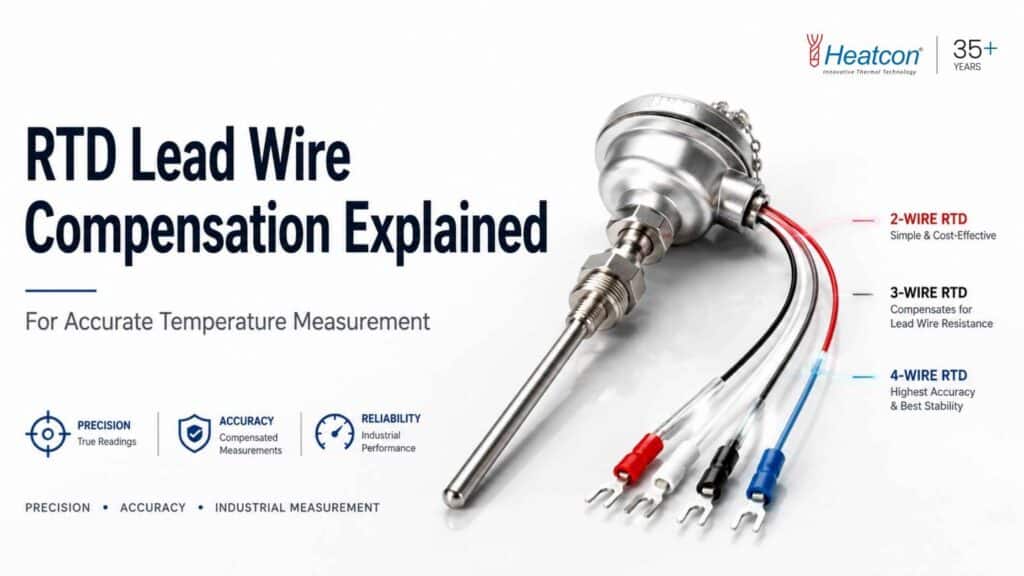
- 2-wire RTD: Simplest configuration but offers no compensation; lead resistance is included in the measurement, suitable only for short wire runs.
- 3 wire RTD compensation: The most popular industrial method, where the third wire is used to estimate and subtract the lead resistance, drastically improving accuracy for most practical installations.
- 4-wire RTD: Provides the most precise compensation by fully isolating the sensor resistance from lead resistance, recommended for laboratory or extremely high-precision applications.
Heatcon Sensors expertly manufactures all RTD configurations to meet your exact application requirements, ensuring optimal compensation and reliability no matter where you operate in India or across the globe.
What Is 3 Wire RTD Compensation And When Is It Used?
3 wire RTD compensation is a widely adopted technique in process industries due to its balance of accuracy, cost, and simplicity. By adding a third wire, the system can mathematically correct for the resistance of the lead wires, assuming all three wires are of equal length and material.
- Ideal for installations where the sensor is located far from the control panel.
- Reduces error to less than 0.1°C in most industrial settings.
- Standard in chemical, power, and food processing plants.
Heatcon Sensors provides meticulously engineered 3-wire RTDs, custom-built to your cable length and environmental conditions, ensuring uncompromised accuracy.
Why Is Lead Resistance Correction Necessary?
Lead resistance correction is crucial because the resistance of copper wires increases with length and temperature, which can falsely elevate the temperature reading of a PT100 or other RTD sensor. Even a single ohm of lead wire resistance can cause a significant error, sometimes over 2.5°C for a PT100 sensor.
Without proper correction, industrial processes may run outside optimal parameters, leading to compromised product quality, energy waste, or even hazardous conditions. Lead resistance correction is non-negotiable for compliance and operational excellence.
How Does The PT100 Compensation Method Ensure Precision?
The PT100 compensation method specifically addresses the unique needs of platinum-based RTDs, which have a nominal resistance of 100 ohms at 0°C. This method includes:
- Utilizing 3-wire or 4-wire arrangements for error minimization.
- Calibrating each sensor with its actual lead wire resistance profile.
- Employing advanced electronic transmitters that automatically compensate for varying lead resistances.
Heatcon Sensors has perfected the PT100 compensation method, offering tailored solutions for every industry—from oil refineries in Saudi Arabia to pharmaceutical plants in Germany and high-tech factories in South Korea.
What Is The Wheatstone Bridge RTD And Its Role In Compensation?
The Wheatstone bridge RTD configuration is a classic electronic technique for precisely measuring resistance changes in RTDs. By balancing the bridge circuit, the effect of lead resistance is minimized or even eliminated.
- Enables accurate differential measurement even with long cable runs.
- Commonly used in laboratory and industrial automation systems for its reliability and simplicity.
- Forms the basis for many digital and analog temperature transmitters.
Heatcon Sensors integrates Wheatstone bridge RTD circuitry into its transmitters and controllers, ensuring you always get a true reading—no matter the application or location, whether in India, UAE, Indonesia, or beyond.
Which Industries Benefit Most From RTD Lead Wire Compensation?
Accurate temperature measurement is essential wherever quality, safety, and efficiency matter. RTD lead wire compensation India is especially critical for:
- Pharmaceutical manufacturing
- Food and beverage processing
- Petrochemical plants
- Steel and metal foundries
- Power generation and distribution
- Semiconductor fabrication
- HVAC and refrigeration
Heatcon Sensors has a proven track record of serving these and many other sectors, providing not just sensors, but complete temperature management solutions.
How To Select The Right RTD And Compensation Method?
Choosing the right RTD and compensation method depends on several factors:
- Distance between sensor and instrument
- Required measurement accuracy
- Environmental conditions (temperature, humidity, electromagnetic interference)
- Budget constraints
- Industry-specific compliance standards
Heatcon Sensors offers expert guidance and can custom-manufacture sensors and compensation systems for any application, whether you need a simple 3-wire RTD for a local control room or an advanced 4-wire system for a large-scale refinery.
What Makes Heatcon Sensors The Preferred Choice For RTD Lead Wire Compensation?
Heatcon Sensors is India’s leading manufacturer of customized RTDs, thermocouples, and temperature sensors for industrial requirements. Here’s why clients across India, the US, UAE, Indonesia, Germany, South Korea, Saudi Arabia, Russia, Bahrain, and Kuwait trust Heatcon:
- Custom manufacturing to any specification, length, or configuration
- Fast delivery to any location in India or worldwide
- Comprehensive range covering RTDs, thermocouples, and thermistors
- Advanced compensation techniques including 3-wire, 4-wire, and Wheatstone bridge RTD circuits
- Strict adherence to global quality standards and industry certifications
Beyond sensors, Heatcon Sensors also manufactures a wide range of heat-generating equipment including industrial furnaces, ovens, hot air blowers, electric furnaces, high density cartridge heaters, immersion heaters, and more. This makes Heatcon a one-stop solution for all temperature and heating needs—boosting plant efficiency and product quality.
How Can You Reach Out To Heatcon Sensors?
Don’t compromise on accuracy and reliability in your temperature measurement systems. Contact Heatcon Sensors today through one of the following convenient options:
- Submit your information via the contact form.
- Leave a message on WhatsApp using the interface available on the Heatcon Sensors website.
- Call directly for immediate assistance: +91 9164833027 or +91 9844233244.
Secure your advantage with Heatcon Sensors and ensure your processes run at peak precision—trusted by industry leaders across continents.
About Heatcon Sensors
Heatcon Sensors is a globally recognized manufacturer and supplier of temperature sensors and heating equipment, headquartered in India. The company specializes in custom RTDs, thermocouples, and a comprehensive range of heat-generating solutions, serving industries across India, the US, UAE, Indonesia, Germany, South Korea, Saudi Arabia, Russia, Bahrain, and Kuwait. With a commitment to innovation, precision, and customer satisfaction, Heatcon Sensors stands as your partner for reliable, world-class temperature solutions.
Frequently Asked Questions
What is RTD lead wire compensation and why is it important?
RTD lead wire compensation is the process of eliminating or minimizing the errors introduced by the resistance of the wires connecting the RTD sensor to the measuring instrument. Without compensation, the resistance of these wires is added to the sensor resistance, resulting in inaccurate temperature readings. This is especially critical for precise applications and for installations where the RTD is located far from the measuring device. Heatcon Sensors provides expertise in RTD Lead Wire Compensation India to ensure your temperature measurements are accurate and reliable.
How does a 3 wire RTD compensation work?
The 3 wire RTD compensation method uses a third wire to help eliminate the effect of lead wire resistance. By arranging the wires so that two wires carry the same lead resistance and measuring the difference, the system can effectively cancel out the resistance of the lead wires. This approach is widely used in industrial applications, and Heatcon Sensors manufactures RTDs with precise 3 wire RTD compensation for optimal accuracy in temperature measurement.
What is lead resistance correction and when is it necessary?
Lead resistance correction is the process of adjusting the measured resistance to account for the resistance of the RTD’s connecting wires. This correction is necessary when the length of the lead wires is significant or when high accuracy is required. Heatcon Sensors supports customers across industries by providing solutions for lead resistance correction, either through sensor design (like 3-wire or 4-wire RTDs) or through system calibration.
What is the PT100 compensation method used by Heatcon Sensors?
The PT100 compensation method typically involves using a 3-wire or 4-wire configuration to minimize or eliminate the impact of lead wire resistance on temperature measurement. Heatcon Sensors supplies PT100 RTDs with advanced compensation methods, ensuring precise readings even in challenging installation environments. Their solutions are engineered to deliver consistent results for industrial, laboratory, and OEM applications.
How does a Wheatstone bridge RTD circuit aid in compensation?
A Wheatstone bridge RTD circuit is commonly used to measure the small resistance changes of RTDs accurately. When combined with 3 or 4-wire configurations, the bridge can compensate for the resistance of the lead wires by balancing the circuit. Heatcon Sensors utilizes Wheatstone bridge RTD techniques in their instrumentation and systems to provide accurate temperature measurements for demanding applications.
What are the main differences between 2-wire, 3-wire, and 4-wire RTD configurations?
2-wire RTD: Simplest, but includes the resistance of lead wires in the measurement, which can cause errors.
3-wire RTD: Uses an extra wire to compensate for lead resistance, providing improved accuracy.
4-wire RTD: Offers the highest accuracy by completely eliminating lead resistance effects.
Heatcon Sensors offers all three configurations, recommending 3-wire or 4-wire RTDs for critical applications where precise RTD lead wire compensation is required.
How does Heatcon Sensors ensure accurate RTD Lead Wire Compensation in India?
Heatcon Sensors is a leading provider of temperature sensing solutions in India, specializing in RTD Lead Wire Compensation India. They use high-quality materials, precision manufacturing, and advanced compensation techniques (such as optimized 3-wire and 4-wire designs) to minimize errors from lead wires. Their experienced engineers can also assist in selecting the best compensation method for your specific application and installation environment.
Can Heatcon Sensors provide custom RTD solutions for special installations?
Yes, Heatcon Sensors offers custom RTD sensor solutions tailored to unique installation requirements. Whether you require special lead lengths, specific compensation methods, or compatibility with certain instrumentation, their team can design and manufacture RTDs with appropriate lead resistance correction for your project. Contact their technical experts to discuss your application in detail.
What factors should be considered when choosing RTD lead wire compensation methods?
Key factors include the required accuracy, length and type of lead wires, installation environment, temperature range, and budget. For most applications, a 3 wire RTD compensation method offers a good balance of accuracy and cost. However, for critical or long-distance installations, 4-wire or advanced PT100 compensation method may be recommended. Heatcon Sensors’ experts can help guide you to the best solution for your needs.