
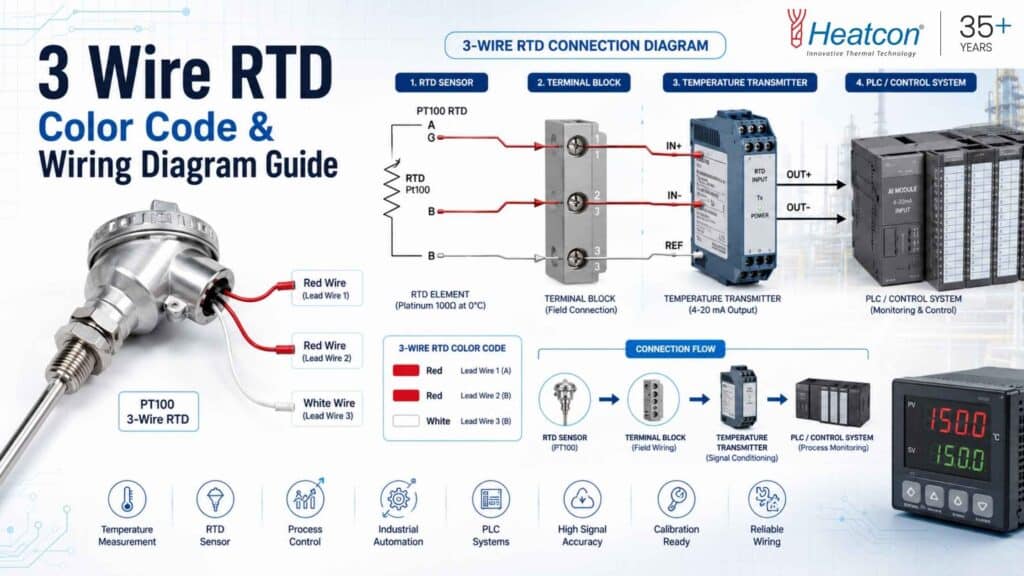
Did you know that over 75% of industrial temperature measurement applications worldwide rely on the accuracy and reliability of RTDs, with the 3 wire RTD configuration being the most widely adopted for minimizing error in critical processes? In industries where precision matters—like pharmaceuticals, petrochemicals, and food processing—the choice of 3 Wire RTD Color Code and wiring method can mean the difference between operational success and costly downtime. If you’re an engineer, technician, or plant manager, understanding the nuances of RTD color coding and connection standards is not just technical detail—it’s essential knowledge.
What Is a 3 Wire RTD and Its Color Code?
A 3 wire RTD (Resistance Temperature Detector) is a temperature sensor configuration that employs three wires to compensate for lead wire resistance, delivering highly accurate temperature readings. The 3 Wire RTD Color Code is a standardized system that helps installers and maintenance personnel quickly identify the correct wiring for installation and troubleshooting. This coding system, which varies slightly based on international standards like IEC and ANSI, is crucial for ensuring error-free connections.
Why Is Color Coding Important in RTDs?
Proper color coding in RTDs is vital because it:
- Reduces the risk of wiring errors during installation and maintenance
- Ensures compliance with international standards
- Makes troubleshooting and replacement faster and more efficient
- Prevents costly downtime and process errors
Heatcon Sensors, a leading global manufacturer, strictly adheres to these standards to guarantee optimal performance and reliability.
How Does PT100 Color Coding Work?
PT100 sensors are the most common RTDs, named for their platinum element with a resistance of 100 ohms at 0°C. PT100 color coding typically follows either the IEC or ANSI standards. In the IEC RTD wiring standard, two wires are colored the same (usually white), while the third is a different color (commonly red). This distinction is key for distinguishing the common lead from the measurement leads.
For example, in PT100 color coding according to IEC 60751:
- White – Two wires (to one side of the element)
- Red – One wire (to the other side of the element)
What Are the Common RTD Wiring Colors?
RTD wiring colors serve as a universal language for engineers across the globe, ensuring quick identification and error-free connections. The most widely used standards are IEC and ANSI, with each specifying distinct color codes for RTD wires.
| Standard | Wire 1 | Wire 2 | Wire 3 |
|---|---|---|---|
| IEC RTD wiring | White | White | Red |
| ANSI RTD color code | Red | Red | White |
Selecting the correct RTD wiring colors during installation is critical to maintaining system integrity and ensuring that your sensors deliver accurate data.
How Do You Connect 3 Wire RTDs: Wiring Diagram Explained
Connecting a 3 wire RTD involves attaching the three leads to the appropriate terminals of your measuring instrument or transmitter. This configuration compensates for lead wire resistance, which can cause errors in long cable runs. Below is a step-by-step guide:
- Identify the two wires of identical color (per IEC, these are usually white) and the single wire of a different color (usually red).
- Connect both same-colored wires to terminals A and B of the RTD input.
- Connect the differently colored wire to terminal C.
- Ensure secure, clean connections to prevent noise and contact resistance.
RTD terminal connections should match the instrument’s wiring diagram for optimal compensation. Heatcon Sensors provides detailed wiring diagrams with every shipment and offers technical guidance for installations in all regions, including India, US, UAE, Indonesia, Germany, South Korea, Saudi Arabia, Russia, Bahrain, and Kuwait.
What Are the Differences Between IEC and ANSI RTD Color Code Standards?
Both IEC RTD wiring and ANSI RTD color code standards have global acceptance. However, there are significant differences:
- IEC (International Electrotechnical Commission): Uses two white wires and one red wire for PT100 sensors.
- ANSI (American National Standards Institute): Uses two red wires and one white wire for PT100 sensors.
Understanding these differences is crucial for multinational operations and when importing or exporting sensors. Heatcon Sensors can manufacture RTDs with either standard, ensuring compliance and ease of integration, no matter your location.
How to Troubleshoot RTD Terminal Connections?
Troubleshooting RTD terminal connections often involves verifying continuity, checking for loose connections, and confirming proper color code adherence. Steps include:
- Using a multimeter to check for open circuits or shorts
- Ensuring wires are connected to the right terminals as per the supplied diagram
- Inspecting for corrosion, frayed wires, or environmental damage
With Heatcon Sensors’ custom solutions, you receive detailed documentation and after-sales support to resolve any wiring or connectivity issues swiftly.
Why Choose Heatcon Sensors for Your Industrial RTDs?
Heatcon Sensors is a globally recognized specialist in manufacturing and supplying customized RTDs and temperature sensors for industrial applications. With advanced production facilities and decades of experience, Heatcon Sensors delivers:
- Custom-manufactured sensors tailored to your process requirements
- Strict adherence to IEC or ANSI color code and wiring standards
- Worldwide delivery—including India, US, UAE, Indonesia, Germany, South Korea, Saudi Arabia, Russia, Bahrain, and Kuwait
- Expert technical assistance for installation, commissioning, and troubleshooting
Whether you need a single sensor or a large batch, Heatcon Sensors ensures rapid turnaround, high reliability, and precision engineering.
Comprehensive Industrial Solutions: More Than Just Sensors
Beyond RTDs, Heatcon Sensors is a trusted manufacturer of heat generating equipment such as:
- Industrial furnaces and ovens
- Hot air blowers
- Electric furnaces
- High density cartridge heaters
- Immersion heaters, tubular heaters, band heaters, and more
These robust products are engineered for demanding environments, from high-temperature research labs to continuous process industries. Heatcon Sensors’ integrated solutions ensure seamless performance and safety across your operations.
How to Order Customized RTDs and Heat Equipment Worldwide?
Don’t let non-standard sensors or unreliable wiring hold back your productivity. Heatcon Sensors makes it easy to source precisely what you need, wherever you are:
- Submit your information on our contact form
- Leave a message on WhatsApp via the website interface
- Call us directly at +91 9164833027 or +91 9844233244 for immediate assistance
With competitive pricing, custom engineering, and a commitment to excellence, Heatcon Sensors is your strategic partner for industrial temperature measurement and heating solutions.
About Heatcon Sensors
Heatcon Sensors is a pioneering Indian company with a global reach, specializing in the design, manufacturing, and supply of advanced temperature sensors and heat generating equipment for diverse industries. With a customer-centric approach, Heatcon Sensors delivers solutions that are innovative, reliable, and tailored to the unique needs of each client.
Stay ahead in your industry by choosing products that are engineered for precision, safety, and longevity. Connect with Heatcon Sensors today and elevate your process control to world-class standards.
Frequently Asked Questions
What is a 3 Wire RTD and why is the color code important?
A 3 Wire RTD (Resistance Temperature Detector) is a temperature sensor designed with three wires to help compensate for lead wire resistance, ensuring accurate readings. The 3 Wire RTD Color Code is essential because it standardizes wiring identification, reducing installation errors and ensuring compatibility with control systems. Correct color coding simplifies troubleshooting and guarantees optimal sensor performance.
What are the standard RTD wiring colors for PT100 sensors?
The standard RTD wiring colors for PT100 sensors depend on the governing standard. According to the IEC 60751 standard, two wires are white and one is red. For the ANSI standard, two red wires and one white wire are used. Understanding PT100 color coding helps ensure correct wiring during installation and maintenance, which is critical for reliable temperature measurement.
How does IEC RTD wiring differ from ANSI RTD color code?
IEC RTD wiring (per IEC 60751) typically uses two white wires and one red wire for 3 wire RTDs. In contrast, the ANSI RTD color code standard employs two red wires and one white wire. This distinction is important when wiring or replacing sensors, especially in international projects. Heatcon Sensors provides solutions tailored to both standards for global compatibility.
Why is the 3 wire configuration preferred over 2 wire connections?
The 3 wire configuration is preferred because it compensates for the resistance of the lead wires, minimizing measurement errors caused by long cable runs or varying ambient temperatures. This ensures higher accuracy compared to 2 wire RTDs, making them the industry standard for critical temperature measurement applications. Heatcon Sensors offers robust 3 wire RTDs for precise, reliable measurements.
How do I connect the wires to the RTD terminal connections?
For proper RTD terminal connections , follow the color code for your sensor’s standard. Typically, connect the two same-colored wires (either both white for IEC or both red for ANSI) to one side of the measurement circuit, and the third wire (red for IEC, white for ANSI) to the other side. Refer to Heatcon Sensors’ wiring diagrams and guides for step-by-step instructions specific to your RTD model.
What solutions does Heatcon Sensors offer for 3 Wire RTD color code and wiring?
Heatcon Sensors supplies a comprehensive range of 3 wire RTDs adhering to both IEC and ANSI standards, ensuring the correct 3 Wire RTD Color Code is used for your application. We provide detailed wiring diagrams, technical support, and custom cable assemblies to streamline installation. Our sensors are designed for reliability and easy integration with existing systems.
How can I identify and troubleshoot wiring issues in a PT100 RTD?
To identify and troubleshoot wiring issues in a PT100 RTD, use the PT100 color coding to verify each wire’s function and connection point. Check for continuity and correct resistance values with a multimeter. If readings are inconsistent, inspect for loose connections or damaged cables. Heatcon Sensors’ technical team can assist with troubleshooting guides and support for all RTD models.
Can I use RTDs with different color codes in the same system?
While it’s technically possible, it is not recommended to mix RTDs with different RTD wiring colors or standards (IEC vs. ANSI) in the same system, as it increases the risk of miswiring and measurement errors. For best results and simplified maintenance, use sensors with uniform color codes and clearly label all wiring. Heatcon Sensors can supply sensors and cables with customized color coding upon request.
Where can I find a wiring diagram for 3 wire RTDs from Heatcon Sensors?
Heatcon Sensors provides detailed wiring diagrams for 3 wire RTDs, covering both IEC and ANSI standards. These diagrams show how to connect according to the 3 Wire RTD Color Code and ensure correct RTD terminal connections . Contact our support team or visit our website’s resource section for downloadable diagrams specific to your RTD type.