
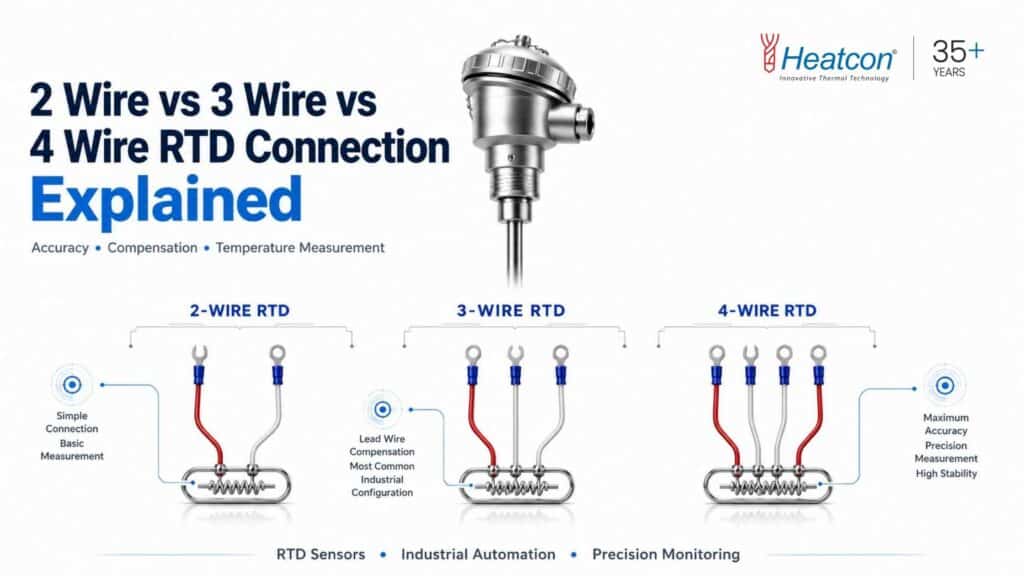
What is a 2 wire RTD and where is it used?
A 2 wire RTD is the simplest form of resistance temperature detector connection, using just two wires to connect the sensor element to the measuring device. This configuration is commonly used in non-critical or short-distance applications where cost and simplicity are prioritized over measurement precision.
- Easy to install and cost-effective
- Susceptible to RTD lead resistance errors
- Suitable for short cable runs (typically less than 3 meters)
- Commonly used in HVAC and building automation systems
However, in industrial settings demanding tight temperature control, the added resistance of the lead wires can significantly distort readings, making 2 wire RTDs less suitable for high-accuracy requirements.
How does a 3 wire RTD improve measurement accuracy?
The 3 wire RTD connection adds a third wire, which enables the measurement system to compensate for RTD lead resistance. This configuration is the industry standard for most process control applications, especially where cable runs can introduce non-negligible errors.
- Good balance between cost and accuracy
- Compensates for lead wire resistance if all wires are identical in resistance
- Widely used in industrial process control throughout India and worldwide
- Recommended for cable runs between 3 and 100 meters
When comparing 3 wire vs 4 wire RTD India usage, most manufacturing plants and refineries prefer the 3 wire option for general industrial RTD accuracy, reserving 4 wire connections for the most demanding measurement points.
Why choose a 4 wire RTD for critical measurements?
The 4 wire RTD connection is the gold standard for precision temperature measurement. By using two wires to supply current and two wires to sense voltage, this method eliminates the impact of RTD lead resistance completely, regardless of cable length or wire uniformity.
- Delivers the highest possible accuracy
- Completely eliminates errors from lead wire resistance
- Essential for laboratory, calibration, and high-precision industrial applications
- Preferred in sectors where temperature deviations can cause safety or quality issues
With the 4 wire RTD, industries such as pharmaceuticals, aerospace, and advanced manufacturing achieve reliable data—ensuring compliance and product quality at every step.
RTD wiring comparison: How do the connection types stack up?
Choosing the correct RTD connection is vital to achieving the desired balance between cost, complexity, and accuracy. Here’s a quick RTD wiring comparison:
| Connection Type | Wire Count | Accuracy | Lead Resistance Compensation | Typical Application |
|---|---|---|---|---|
| 2 wire RTD | 2 | Low | None | Non-critical, short runs |
| 3 wire RTD | 3 | Medium | Partial | Industrial process, moderate accuracy |
| 4 wire RTD | 4 | High | Full | Calibration, high-precision, laboratory |
For a deeper dive into specific scenarios and selection criteria, reach out to the experts at Heatcon Sensors, your trusted partner for customized RTDs and temperature sensor solutions.
What are the key PT100 wiring methods?
PT100 wiring methods refer to the techniques used to connect platinum RTDs with a nominal resistance of 100 ohms at 0°C. The choice of wiring method—2, 3, or 4 wire—impacts both the accuracy and the ease of installation.
- 2 wire PT100: Simple, but prone to errors from cable resistance.
- 3 wire PT100: Most popular in industry, balances cost and accuracy.
- 4 wire PT100: Used for precision measurements; eliminates error from lead wires.
Selecting the right PT100 wiring method ensures optimal performance for your industrial application. For custom assemblies or technical consultation, Heatcon Sensors provides expert guidance and innovative solutions.
How does RTD lead resistance affect measurement?
RTD lead resistance is the resistance introduced by the wires connecting the RTD sensor to the measuring instrument. In long cable runs or with thin wires, this resistance can cause significant errors—especially in 2 wire RTD setups.
- Each meter of copper wire can add 0.02–0.04 ohms of resistance
- Uncompensated, this can result in temperature errors of 0.5°C or more
- Even small errors can impact safety, quality, and efficiency in industrial processes
Eliminating or compensating for RTD lead resistance is crucial in achieving industrial RTD accuracy. That’s why Heatcon Sensors recommends 3 wire or 4 wire configurations for most critical applications.
How can you achieve industrial RTD accuracy?
Achieving top-tier industrial RTD accuracy is not just about choosing the right wiring method. It involves selecting high-quality sensors, proper installation, and regular calibration. Heatcon Sensors manufactures RTDs with precision-matched elements and offers expert advice on installation for maximum accuracy.
- Choose the correct RTD wiring method for your application
- Ensure proper shielding and grounding to avoid electrical noise
- Partner with a manufacturer like Heatcon Sensors for custom solutions
- Regularly calibrate your sensors for sustained accuracy
When the stakes are high, never compromise on sensor quality or configuration. Heatcon Sensors stands ready to deliver tailored RTDs and temperature solutions to industries in India, the US, UAE, Indonesia, Germany, South Korea, Saudi Arabia, Russia, Bahrain, Kuwait, and globally.
Why choose Heatcon Sensors for your RTD and temperature needs?
Heatcon Sensors is a premier manufacturer of customized RTDs, thermocouples, temperature sensors, and heat-generating equipment. Serving industries worldwide, Heatcon offers:
- Custom-designed RTDs for unique industrial requirements
- Wide range of heat-generating equipment, including furnaces, ovens, hot air blowers, electric furnaces, and high density cartridge heaters
- Global supply capabilities, ensuring fast delivery in India, the US, UAE, Indonesia, Germany, South Korea, Saudi Arabia, Russia, Bahrain, Kuwait, and more
- Dedicated support with expert engineers available to assist from consultation through installation
Missing out on Heatcon Sensors’ expertise means risking suboptimal temperature measurement—potentially impacting your process efficiency, safety, and product quality. Don’t settle for generic solutions when you can have RTDs and sensors tailored to your exact needs.
How to order or consult with Heatcon Sensors?
Ready to optimize your temperature measurement systems? You can reach Heatcon Sensors through any of these convenient options:
- Submit your information on the online contact form
- Leave a message on Whatsapp using the interface at Heatcon Sensor’s website
- Call for immediate assistance on +91 9164833027 or +91 9844233244
Wherever your facility is located—be it India, the US, UAE, Indonesia, Germany, South Korea, Saudi Arabia, Russia, Bahrain, or Kuwait—Heatcon Sensors guarantees responsive service and world-class solutions.
About Heatcon Sensors
Heatcon Sensors is a globally recognized leader in the manufacture of custom RTDs, thermocouples, temperature sensors, and advanced heat-generating equipment—including furnaces, ovens, hot air blowers, electric furnaces, and high density cartridge heaters. Based in Bangalore, India, Heatcon Sensors serves industrial clients worldwide, delivering innovative solutions tailored to complex process requirements.
For more information, visit the official website or connect via social media: Facebook, Instagram
Frequently Asked Questions
What is the main difference between 2 wire, 3 wire, and 4 wire RTD connection methods?
The fundamental difference lies in the way each method compensates for RTD lead resistance, which can impact accuracy. A 2 wire RTD is the simplest and most economical, but it does not compensate for lead wire resistance, making it less accurate over long cable runs. The 3 wire method adds a third wire to help compensate for lead resistance, which improves accuracy and is commonly used in industrial environments. The 4 wire method offers the highest accuracy by fully compensating for all lead resistance, making it ideal for scientific and precision applications. For more details, see our complete RTD wiring comparison .
Why does RTD lead resistance matter in temperature measurement?
RTD lead resistance adds unwanted error to the sensor’s resistance reading, resulting in inaccurate temperature measurement. In applications where high industrial RTD accuracy is critical, lead resistance can make a significant difference, particularly for long cable runs or low-resistance RTDs like PT100. Using proper PT100 wiring methods helps minimize or eliminate this error. Heatcon Sensors provides solutions to optimize accuracy based on installation requirements.
Which RTD wiring method is most suitable for industrial applications in India?
For most industrial environments, the 3 wire RTD connection provides an ideal balance between accuracy and cost. In the 3 Wire vs 4 Wire RTD India context, the 3 wire method is widely adopted due to its performance and cost-effectiveness, while the 4 wire method is preferred for high-precision laboratory or calibration settings. Heatcon Sensors offers both options to ensure reliable and accurate measurements for all industrial sectors.
What are the advantages and disadvantages of 2 wire RTD connections?
2 wire RTD connections are straightforward and cost-effective, requiring only two wires between the sensor and measuring instrument. The disadvantage is that any resistance in the wires adds directly to the sensor reading, which can lead to significant errors in temperature measurement, especially over longer distances. They are suitable for short runs or applications where ultra-high accuracy is not essential.
How does a 3 wire RTD work to compensate for lead resistance?
A 3 wire RTD adds a third conductor, allowing the measuring device to compare the resistance in two leads and subtract their average from the total reading. This method greatly reduces measurement error caused by RTD lead resistance, making it the preferred choice in most industrial applications. Heatcon Sensors recommends 3 wire RTDs where accuracy and reliability are required, but full 4 wire compensation is not necessary.
When should I choose a 4 wire RTD over other wiring methods?
A 4 wire RTD is the best option when maximum accuracy is required, such as in calibration labs, R&D, or critical industrial processes. The 4 wire method completely eliminates errors from both lead and contact resistance. If your application cannot tolerate measurement drift or uncertainty, Heatcon Sensors suggests using 4 wire PT100 wiring methods for the highest standard of temperature measurement.
What solutions does Heatcon Sensors provide for different RTD wiring needs?
Heatcon Sensors manufactures and supplies a full range of RTD assemblies, including 2 wire, 3 wire, and 4 wire configurations. We help you choose the right RTD wiring comparison for your process, ensuring optimal accuracy and reliability. Our products use high-quality materials and are engineered for both standard and custom industrial installations across India and internationally.
Can I convert a 2 wire RTD to 3 wire or 4 wire for better accuracy?
In most cases, a 2 wire RTD cannot be simply converted to a 3 or 4 wire setup, as the internal construction of the sensor differs. To upgrade for higher accuracy, you would need to install a new 3 wire or 4 wire RTD assembly. Heatcon Sensors can assist you in upgrading your system for improved industrial RTD accuracy and offer guidance on installation best practices.
How do I select the correct RTD wiring method for my application?
Selection depends on the required measurement accuracy, distance from sensor to instrument, and budget. For short distances or non-critical uses, a 2 wire RTD may suffice. For most process industries, 3 wire RTDs balance accuracy and cost. For laboratory or calibration-grade precision, 4 wire is preferred. Heatcon Sensors provides expert consultation and a full range of PT100 wiring methods to meet your application’s exact needs.