
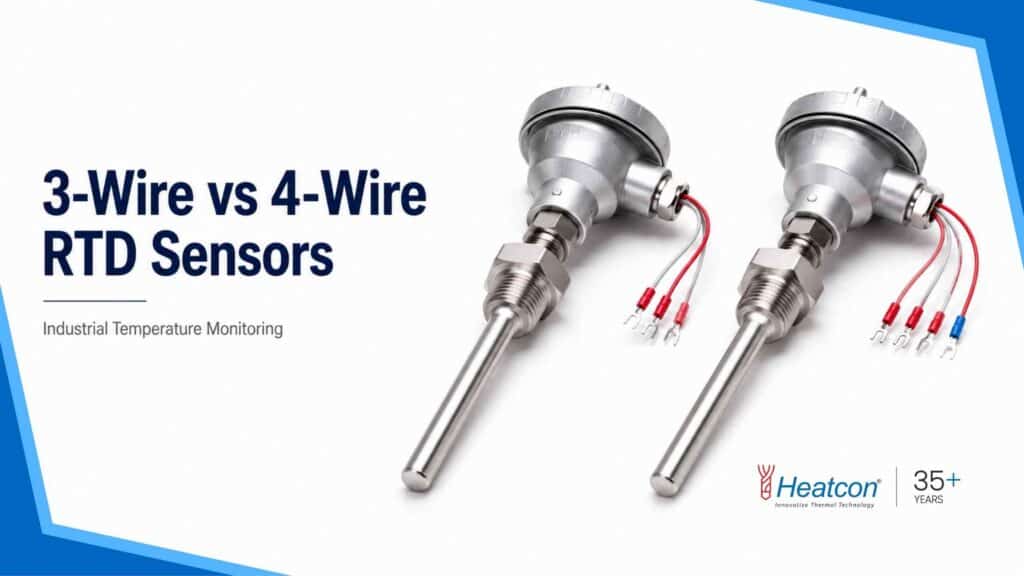
How Do 3 Wire And 4 Wire RTD Sensors Work?
RTDs, or Resistance Temperature Detectors, are precision temperature sensors that operate based on the predictable change in electrical resistance of platinum wire as temperature varies. The most widely used RTDs are PT100 elements, which have a resistance of 100 ohms at 0°C. The core difference between 3 wire vs 4 wire RTD India sensors lies in how they compensate for the resistance introduced by connecting wires—known as RTD lead wire resistance.
- 3-wire RTD: Designed to minimize errors due to lead wire resistance by adding a third wire. Commonly used where high accuracy is needed with moderate cost.
- 4-wire RTD: Eliminates the effect of lead wire resistance entirely, providing the highest accuracy for critical or long-distance measurements.
Why Is RTD Lead Wire Resistance Important?
RTD lead wire resistance is the resistance added by the copper wires connecting the sensor to the measuring instrument. If uncompensated, this added resistance skews the actual temperature reading, leading to errors that can have a cascading impact on product quality, equipment safety, and regulatory compliance. In demanding industrial environments—such as those found in chemical plants, refineries, and power generation—small errors can translate into significant operational risks.
Both 3-wire and 4-wire RTDs are engineered to address this challenge, but the level of compensation and accuracy differs. Understanding and selecting the right configuration is crucial for accurate RTD measurement across diverse applications.
PT100 3-Wire Vs PT100 4-Wire: What Should You Choose?
The PT100 3-wire configuration is the industry standard for most industrial RTD wiring scenarios. By using three wires, the system can mathematically compensate for the lead resistance, assuming all wires are of equal length and type. This balance is generally sufficient for installations with moderate distances between the sensor and transmitter, and where budget is a consideration.
In comparison, PT100 4-wire configuration is the ultimate choice for environments demanding the highest level of precision. The fourth wire enables the measurement instrument to completely cancel out the effects of lead wire resistance, regardless of wire length or variations. This makes PT100 4-wire RTDs indispensable in research laboratories, high-precision manufacturing, or when sensors are located far from control rooms.
| Feature | PT100 3-wire | PT100 4-wire |
|---|---|---|
| Lead Wire Compensation | Partial (Assumes equal wires) | Complete (Eliminates lead resistance) |
| Accuracy | High (±0.3°C typical) | Very High (±0.1°C or better) |
| Cost | Lower | Higher |
| Typical Use | Industrial process, general plant use | Research, calibration, critical processes |
| Industrial RTD Wiring Complexity | Moderate | Higher |
Where Are 3 Wire And 4 Wire RTD Sensors Used?
3-wire RTDs are predominantly used in industrial RTD wiring where installation cost and speed are important, and where wire runs are relatively short. They are found in:
- Furnaces and ovens
- Petrochemical reactors
- Pharmaceutical process tanks
- Food and beverage production lines
4-wire RTDs, thanks to their ability to provide the most accurate RTD measurement, are chosen for:
- Calibration laboratories
- High-precision manufacturing (e.g., semiconductor fabrication)
- Research and development facilities
- Long cable runs across plant sites
What Are The Industrial Applications Of RTD Sensors?
RTD sensors are the backbone of industrial temperature monitoring, powering the control systems of a vast array of heat-generating equipment. Heatcon Sensors, a leading RTD and temperature sensor manufacturer headquartered in India, serves industries worldwide with custom RTD solutions for:
- Electric furnaces and industrial ovens
- Hot air blowers and environmental chambers
- High density cartridge heaters
- Petrochemical and refinery equipment
- Food and beverage processing machinery
- Textile and paper drying machines
- Pharmaceutical batch reactors
Whether your facility is located in Mumbai, Bengaluru, Chennai, Hyderabad, Delhi, or any major city in India—or in key industrial hubs across the US, UAE, Indonesia, Germany, South Korea, Saudi Arabia, Russia, Bahrain, Kuwait—Heatcon Sensors can design, manufacture, and deliver RTD sensors tailored to your precise needs.
How To Achieve Accurate RTD Measurement In Your Facility?
To achieve accurate RTD measurement, you must consider not only the sensor element but the entire signal chain—sensor, wiring, transmitter, and control system. Here are key steps to ensure optimal accuracy:
- Select the right RTD configuration (3-wire for standard, 4-wire for critical accuracy).
- Minimize RTD lead wire resistance by choosing correct wire gauge and material.
- Follow best practices in industrial RTD wiring—avoid sharp bends, secure connections, and protect against electrical noise.
- Use transmitters and controllers compatible with your RTD configuration.
- Periodically calibrate sensors and wiring to maintain accuracy over time.
Heatcon Sensors’ expertise ensures that every sensor—whether PT100 3-wire or PT100 4-wire—is built to uncompromising standards, providing traceable, reliable results you can trust.
Why Choose Heatcon Sensors For Custom RTD Solutions?
Missing out on the right temperature monitoring solution can cost your business dearly—through product losses, unscheduled downtime, or failed audits. Heatcon Sensors is a global leader in the design and manufacture of customized temperature sensors, delivering excellence in 3 Wire vs 4 Wire RTD India and beyond. Here’s why industries worldwide rely on Heatcon:
- Custom Manufacturing: Every RTD is engineered to your specifications, including sensor type, configuration, wiring length, and enclosure.
- Global Delivery: From India to the US, UAE, Germany, and more—Heatcon Sensors ships worldwide, ensuring you receive your solution wherever your operations are based.
- Application Expertise: Decades of experience across all major industrial verticals, including heat-generating equipment like furnaces, ovens, hot air blowers, and high density cartridge heaters.
- Quality Assurance: Each sensor undergoes rigorous quality checks and calibration, ensuring the most accurate RTD measurement in the market.
How To Order Your Custom RTD Sensors From Heatcon?
Don’t compromise on your process—discover how easy it is to get the perfect RTD sensor for your needs:
- Visit Heatcon Sensors’ contact page and submit your requirements.
- Start a conversation instantly via WhatsApp using the interface on the Heatcon Sensors website.
- Call for immediate assistance at +91 9164833027 or +91 9844233244 and speak to a temperature sensor specialist.
Upgrade to precise, reliable, and efficient temperature monitoring—partner with Heatcon Sensors and experience the difference globally trusted expertise can make.
About Heatcon Sensors
Heatcon Sensors is a premier manufacturer and exporter of temperature sensors, specializing in both standard and custom-engineered RTDs and thermocouples for industrial applications. Based in India, Heatcon Sensors delivers complete temperature monitoring solutions to industries in India, the US, UAE, Indonesia, Germany, South Korea, Saudi Arabia, Russia, Bahrain, Kuwait, and across the world. In addition to RTDs, Heatcon designs and manufactures heat-generating equipment such as furnaces, ovens, hot air blowers, electric furnaces, and high density cartridge heaters.
Frequently Asked Questions
What is the main difference between 3-wire and 4-wire RTD sensors?
The key difference between 3-wire and 4-wire RTD sensors lies in how they compensate for RTD lead wire resistance . A 3-wire RTD uses a third wire to help correct for the lead resistance, which is a common approach in industrial RTD wiring. However, a 4-wire RTD offers the most precise compensation by fully eliminating lead resistance effects, ensuring the most accurate RTD measurement possible. PT100 3-wire setups are widely used for their balance of cost and accuracy in industrial applications, while PT100 4-wire configurations are preferred when maximum measurement accuracy is critical.
Why is compensating for lead wire resistance important in RTD measurements?
RTD lead wire resistance can introduce errors in temperature readings, especially when long cables are used in industrial environments. This resistance adds to the actual resistance of the RTD element, leading to inaccurate readings. Both 3-wire and 4-wire RTD wiring schemes aim to minimize or eliminate these errors, providing more reliable and accurate RTD measurement for process control and monitoring.
Which RTD configuration is best suited for industrial temperature monitoring in India?
When considering 3 Wire vs 4 Wire RTD India , the best choice depends on your application’s accuracy requirements and budget. For most industrial processes, PT100 3-wire RTDs provide a good balance of accuracy and cost. However, if your process demands the highest precision—such as in calibration labs or critical manufacturing—a PT100 4-wire RTD is recommended. Heatcon Sensors offers both configurations, ensuring optimal solutions for all industrial sectors in India.
What are the typical applications for PT100 3-wire and PT100 4-wire RTD sensors?
PT100 3-wire RTD sensors are commonly used in industrial automation, HVAC, and process industries where moderate accuracy is sufficient. PT100 4-wire RTDs are preferred for laboratory, pharmaceutical, and high-precision manufacturing applications, where eliminating any influence of lead wire resistance is critical. Heatcon Sensors provides tailored solutions for both, ensuring the right sensor for your specific industrial RTD wiring needs.
How does Heatcon Sensors ensure accurate RTD measurement in their products?
Heatcon Sensors utilizes high-quality materials and precision engineering in both 3-wire and 4-wire RTD assemblies. By carefully managing RTD lead wire resistance and offering expert guidance on industrial RTD wiring , Heatcon ensures reliable and accurate RTD measurement for all industrial temperature monitoring needs. Customization options are available to match specific application requirements.
Can I upgrade from a 3-wire RTD to a 4-wire RTD in my existing system?
Upgrading from a PT100 3-wire to a PT100 4-wire RTD is possible, but it requires that your measurement instruments support 4-wire configurations and may involve changing the cabling. Heatcon Sensors can assist with system analysis and provide custom solutions for seamless integration, maximizing the benefits of accurate RTD measurement in your process.
What factors should I consider when choosing between 3-wire and 4-wire RTD sensors?
Consider your required accuracy, budget, cable length, and compatibility with your instrumentation. For most industrial applications in India, a 3-wire RTD balances cost and performance, while a 4-wire RTD is ideal when measurement accuracy is the top priority. Heatcon Sensors’ experts can help you determine the best option for your application, ensuring efficient and reliable industrial RTD wiring .
How does Heatcon Sensors support industrial customers in India with RTD selection and implementation?
Heatcon Sensors provides personalized consultation, product customization, and technical support for selecting the right RTD sensor configuration. Whether you are comparing 3 Wire vs 4 Wire RTD India or need guidance on industrial RTD wiring , Heatcon’s experienced team ensures a smooth implementation and long-term reliability for your temperature monitoring systems.