
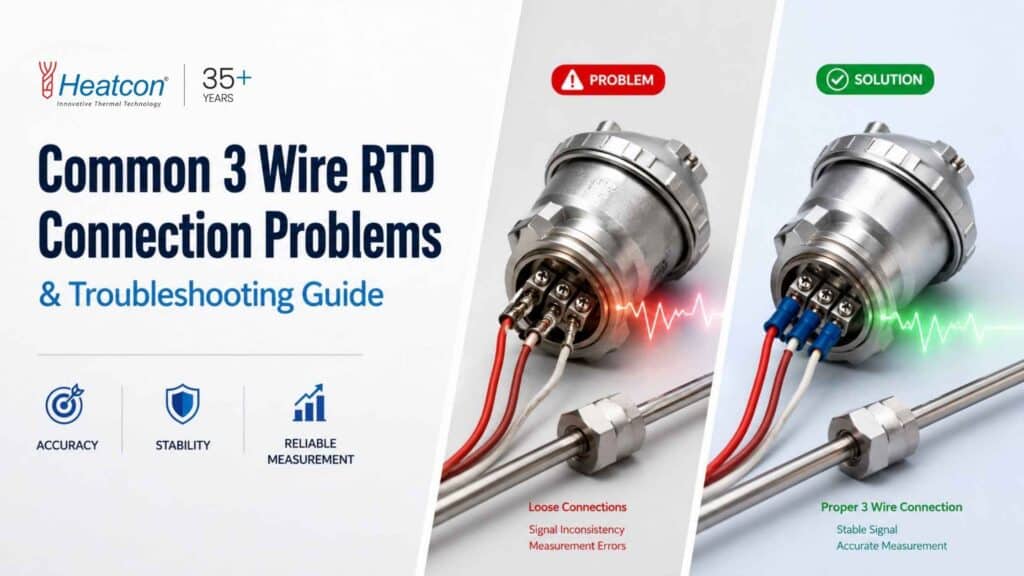
What Is A 3 Wire RTD And Why Is It Used?
A 3 wire RTD (Resistance Temperature Detector) is designed to compensate for lead wire resistance, making it a preferred solution for accurate temperature measurement in industrial environments. It uses three wires to create a bridge circuit, allowing for compensation of the resistance of the wires themselves. This approach drastically reduces errors caused by long cable runs—a necessity in sprawling plants across India, the US, UAE, Indonesia, Germany, South Korea, Saudi Arabia, Russia, Bahrain, and Kuwait.
Despite their advantages, 3 wire RTDs are not immune to connection problems. Proper installation, regular inspection, and troubleshooting are vital to ensure optimal performance and accuracy.
What Are The Most Common 3 Wire RTD Connection Problems?
The most common issues with 3 wire RTD connections include open circuits, unstable readings, sensor errors due to EMI, and problems arising from physical or environmental stresses. These issues can lead to incorrect readings, alarms, or even process shutdowns.
- RTD open circuit error: Often caused by broken wires or poor terminations.
- Unstable RTD reading: Usually due to loose connections, fluctuating environmental conditions, or electrical interference.
- EMI RTD issues: Result from electromagnetic interference, common in environments with heavy machinery or variable frequency drives.
- RTD sensor errors: Can be due to calibration drift, contamination, or incorrect wiring.
How To Identify And Troubleshoot 3 Wire RTD Problems?
To effectively troubleshoot 3 wire RTD issues, start with a systematic visual inspection and progress to targeted electrical tests. Below, we provide a step-by-step guide for 3 Wire RTD Troubleshooting that is applicable in manufacturing plants, refineries, chemical processing units, and power generation facilities worldwide.
- Visual Inspection: Check for frayed wires, loose connections, corrosion at terminals, or signs of physical damage.
- Continuity Test: Use a multimeter to check for continuity in all three wires. An open circuit indicates a broken wire or connection (RTD open circuit error).
- Resistance Measurement: Measure resistance between all wire combinations. For a PT100, the resistance at 0°C should be 100 ohms. Deviations indicate PT100 troubleshooting is needed.
- Check For EMI: If readings fluctuate erratically, consider EMI RTD issues. Use shielded cables, proper grounding, and route wiring away from high-power lines.
- Evaluate Connection Quality: Tighten terminal screws and ensure all connections are secure to prevent unstable RTD reading.
For advanced troubleshooting, compare readings from the suspect RTD with a calibrated reference sensor to identify RTD sensor errors caused by sensor aging or contamination.
What Causes RTD Sensor Errors And How Can They Be Prevented?
RTD sensor errors can stem from a variety of factors: mechanical shock, moisture ingress, chemical exposure, incorrect installation, or simply aging. Industrial environments, especially in cities like Mumbai, Dubai, Jakarta, Berlin, Seoul, Riyadh, Moscow, Manama, and Kuwait City, often present harsh conditions that accelerate sensor degradation.
- Mechanical Stress: Avoid pulling or twisting the sensor leads during installation.
- Moisture Protection: Use hermetically sealed or weatherproof RTDs for outdoor or humid environments.
- Correct Wiring: Always follow manufacturer instructions to prevent RTD open circuit error and ensure accurate compensation.
- Regular Calibration: Schedule periodic calibration to detect drift and maintain accuracy, especially for PT100 troubleshooting.
Partnering with a specialist like Heatcon Sensors ensures you receive rugged, application-specific RTDs—engineered to perform reliably in the world’s most challenging environments.
How To Solve Unstable RTD Reading And EMI RTD Issues?
Unstable RTD reading and EMI RTD issues are common in environments with high electrical noise or fluctuating power sources.
- Use Twisted Pair And Shielded Cables: This reduces electromagnetic coupling and noise pickup.
- Implement Proper Grounding: Ground the RTD shield at one end only (preferably at the control system) to avoid ground loops.
- Physically Isolate RTD Wiring: Route RTD wires away from high-current or high-voltage cables.
- Install Signal Conditioning: Use transmitters or isolators to convert RTD signals to 4–20 mA, reducing susceptibility to noise.
Heatcon Sensors offers custom RTDs with advanced shielding and insulation, ensuring stable operation even in the most demanding industrial settings worldwide.
What Is PT100 Troubleshooting And Why Is It Important?
PT100 troubleshooting involves verifying the integrity and accuracy of PT100 RTDs, which are platinum sensors standardized at 100 ohms at 0°C. It is crucial because PT100s are the gold standard for temperature measurement in pharmaceuticals, food processing, petrochemicals, and research laboratories across India and beyond.
- Verify Resistance At Known Temperatures: Use an ice bath for 0°C and boiling water for 100°C to check for correct resistance.
- Compare Against Calibrated Reference: Detects sensor drift or damage.
- Check Lead Wire Resistance: Excessive resistance can cause significant measurement errors, especially over long distances.
For mission-critical operations, always choose custom-engineered PT100 RTDs from Heatcon Sensors, tailored to your unique environment and process requirements.
How Does Heatcon Sensors Address 3 Wire RTD Troubleshooting Globally?
Heatcon Sensors is a globally recognized manufacturer of custom-built RTDs, thermocouples, and temperature sensing solutions. With decades of expertise, Heatcon Sensors serves industries in India, US, UAE, Indonesia, Germany, South Korea, Saudi Arabia, Russia, Bahrain, Kuwait, and worldwide.
- Customized Design: Each RTD is engineered for your unique process, environment, and industry standards.
- Global Supply Chain: Heatcon Sensors can deliver temperature sensors to any location—urban or remote, domestic or international.
- Comprehensive Support: From selection and installation guidance to 3 Wire RTD Troubleshooting and after-sales service, you receive unmatched technical support.
- One-Stop Solution: In addition to sensors, Heatcon Sensors manufactures heat generating equipment such as furnaces, ovens, hot air blowers, electric furnaces, high density cartridge heaters, and more.
Don’t risk downtime or inaccurate temperature control—choose the experts trusted by mission-critical industries worldwide.
How To Get Expert Help For 3 Wire RTD Troubleshooting?
If you are experiencing RTD sensor errors, unstable RTD reading, or need guidance on PT100 troubleshooting, reach out to Heatcon Sensors for fast and reliable support:
- Submit your details on the official contact form.
- Start a conversation via WhatsApp using the interface on the Heatcon Sensors website.
- Call directly at +91 9164833027 or +91 9844233244 for immediate assistance.
Ensure your critical temperature measurement systems are in expert hands—partner with Heatcon Sensors for proven reliability and performance.
About Heatcon Sensors
Heatcon Sensors is a leading manufacturer and global supplier of customized RTDs, thermocouples, temperature sensors, and heat generating equipment. Based in India, Heatcon Sensors has earned a reputation for engineering excellence and customer-centric solutions, meeting the needs of industries in the most challenging environments around the world. Whether you are in Mumbai, Houston, Dubai, Jakarta, Berlin, Seoul, Riyadh, Moscow, Manama, or Kuwait City, Heatcon Sensors delivers precision, reliability, and support you can trust.
Frequently Asked Questions
What are the most common 3-wire RTD connection problems?
Common issues with 3-wire RTD connections include loose or corroded terminals, incorrect wiring sequence, cable damage, and signal interference. These can lead to inaccurate temperature readings, sensor drift, or intermittent faults. Heatcon Sensors recommends regularly inspecting connections, using high-quality cable, and following proper wiring diagrams to prevent these problems.
How can I identify and resolve RTD sensor errors in my process?
RTD sensor errors often manifest as unexpected temperature readings, sudden spikes, or persistent off-scale values. Begin by checking the wiring and connections for continuity and correct placement. Use a calibrated multimeter to verify resistance values. If errors persist, consult Heatcon Sensors’ 3 Wire RTD Troubleshooting guide for step-by-step diagnostic instructions and recommended solutions.
What is an RTD open circuit error and how can I fix it?
An RTD open circuit error occurs when there is a break in the sensor or its wiring, resulting in a very high or infinite resistance reading. This can be due to a broken element, disconnected wire, or terminal fault. To fix it, check all wiring for continuity and ensure terminals are secure. Heatcon Sensors can provide replacement RTDs and guidance for proper installation to prevent recurrence.
What causes unstable RTD reading, and what steps can I take to stabilize it?
An unstable RTD reading may be caused by fluctuating connections, electromagnetic interference, moisture ingress, or poor shielding. To stabilize the measurement, ensure all electrical connections are tight and corrosion-free, use shielded cable, and ground the sensor assembly as per Heatcon’s recommendations. If instability continues, a comprehensive PT100 troubleshooting session may be necessary.
How do EMI RTD issues affect temperature measurement accuracy?
EMI RTD issues can induce unwanted electrical noise onto the sensor signal, causing erratic or inaccurate readings. This is particularly problematic in industrial environments with motors or high-frequency equipment. To minimize EMI, use twisted and shielded cables, route sensor wiring away from high-power lines, and ensure proper grounding. Heatcon Sensors offers EMI-resistant RTD solutions for demanding applications.
What steps are involved in 3 Wire RTD Troubleshooting?
3 Wire RTD Troubleshooting typically involves checking for continuity on all three wires, verifying correct wiring sequence, inspecting for shorts or opens, and measuring sensor resistance at known temperatures. Heatcon Sensors provides detailed troubleshooting charts and technical support to help you systematically locate and address RTD wiring issues.
When should I consider PT100 troubleshooting for my RTD sensor?
If you notice drift, erratic values, or lack of response in your temperature measurement, it’s time for PT100 troubleshooting. This process includes checking the sensor’s resistance at 0°C (should be 100 Ω for a PT100), confirming the absence of cable or connector faults, and ensuring the transmitter is correctly calibrated. Heatcon Sensors’ experts can guide you through comprehensive troubleshooting to restore sensor performance.
What services and solutions does Heatcon Sensors offer for RTD connection problems?
Heatcon Sensors provides diagnostic support, custom RTD assemblies, field calibration, and on-site troubleshooting for all types of RTD connection problems. Their technical team can recommend robust sensor designs, high-quality wiring, and EMI-resistant solutions to ensure reliable and accurate temperature measurement in your process.