
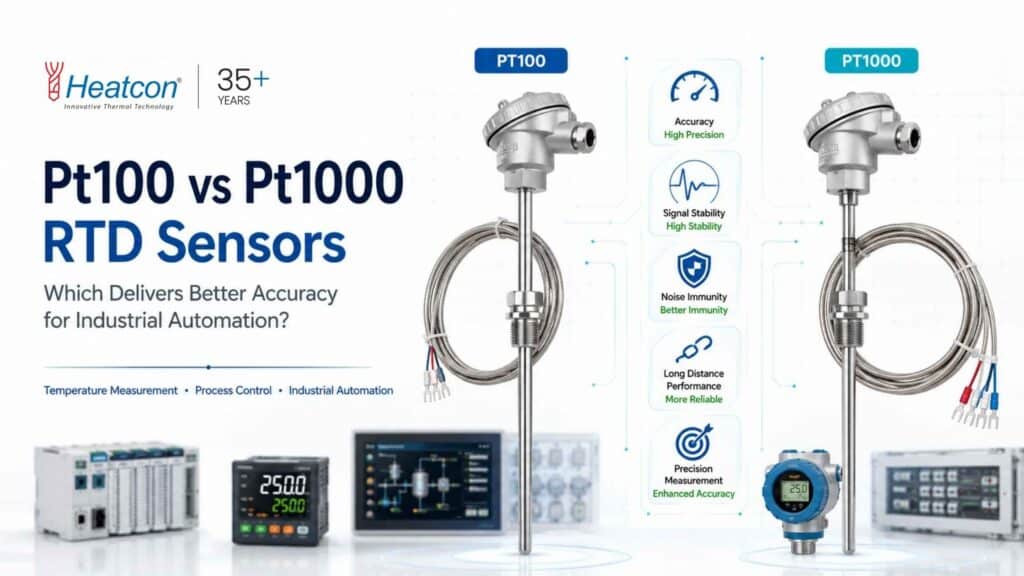
When it comes to precision temperature measurement in industrial environments, the debate of pt100 vs pt1000 sensors is at the forefront. According to industry data, over 60% of modern process automation systems now rely on resistance temperature detectors (RTDs) for critical temperature monitoring, with Pt100 and Pt1000 being the most widely implemented variants. The choice between these two can dramatically influence accuracy, stability, and operational costs for manufacturing and process industries. In this guide, we break down the nuances of RTD sensor comparison, explore the technology behind platinum RTD sensors, and help you make the best industrial RTD selection for your unique requirements.
What Are Pt100 And Pt1000 RTD Sensors?
Both Pt100 and Pt1000 sensors are types of platinum RTD sensors, which operate on the principle that platinum’s electrical resistance changes predictably with temperature. The numbers “100” and “1000” refer to the resistance (in ohms) at 0°C: a Pt100 sensor has a resistance of 100Ω, while a Pt1000 boasts 1000Ω at the same temperature. This fundamental difference leads to variations in sensitivity, wiring configuration, and suitability for diverse industrial applications.
- Pt100: 100Ω at 0°C, commonly used in process control and laboratory applications.
- Pt1000: 1000Ω at 0°C, often chosen for building automation and remote sensing where long cable runs are common.
How Does The Accuracy Of Pt100 Vs Pt1000 Compare?
In the context of industrial automation, accuracy is paramount. Both Pt100 and Pt1000 sensors are capable of high-precision measurements, but subtle differences exist. Pt100 sensors have set the industry standard for decades and are typically available in tighter tolerance classes (Class A and 1/10 DIN), offering exceptional accuracy for critical applications. Pt1000 sensors, meanwhile, provide improved immunity to electrical noise, especially over long cable distances, but may exhibit slightly greater self-heating at higher currents.
| Sensor Type | Class A Tolerance | Class B Tolerance |
|---|---|---|
| Pt100 | ±(0.15 + 0.002 × |t|)°C | ±(0.3 + 0.005 × |t|)°C |
| Pt1000 | ±(0.15 + 0.002 × |t|)°C | ±(0.3 + 0.005 × |t|)°C |
Both sensor types can achieve identical accuracy classes, but practical factors—such as wiring length, signal conditioners, and installation environment—can cause real-world results to differ. For installations with long cable runs or high electromagnetic interference, the higher base resistance of Pt1000 can reduce measurement errors.
Why Is RTD Sensor Comparison Essential For Industrial Automation?
The process of RTD sensor comparison is critical because every industrial environment has unique demands. For example, chemical plants in Mumbai, power stations in the US, or pharmaceutical factories in Germany may each require different RTD configurations. Choosing the wrong sensor can result in inaccurate readings, increased downtime, or even costly equipment damage. This is why Heatcon Sensors, a trusted manufacturer based in India, specializes in helping industries globally make informed decisions for their temperature monitoring needs.
- Industry-specific requirements (e.g., hazardous zones, hygiene standards)
- Environmental factors (humidity, vibration, ambient temperature)
- Regulatory compliance and documentation
What Are The Core Differences Between Pt100 And Pt1000 Sensors?
While both sensors deliver reliable performance, their construction and suitability differ in several key aspects:
- Resistance and Signal Strength: Pt1000 sensors generate a greater voltage signal for the same current, making them less susceptible to noise—especially useful in large-scale facilities in Saudi Arabia or remote oil fields in Russia.
- Wiring and Cost: Pt100 sensors often require 3- or 4-wire connections to minimize lead resistance errors. Pt1000 can often be used with just 2 wires, reducing installation costs.
- Self-Heating: Higher resistance in Pt1000 can lead to more self-heating at higher currents, which may distort readings if not managed properly.
- Availability and Support: Pt100 sensors have broader market acceptance, with a wide selection of transmitters and meters globally, including in Indonesia, South Korea, and Bahrain.
What Are The Pt1000 Advantages In Modern Automation?
The pt1000 advantages are particularly prominent in systems prioritizing simplicity and cost-efficiency. These include:
- Reduced wiring complexity: Especially valuable for large installations in the UAE or Kuwait.
- Lower susceptibility to electrical noise: Ideal for environments with high electromagnetic interference.
- Enhanced suitability for building and HVAC automation: Where long cable runs are common.
However, for applications demanding the tightest tolerances and broadest compatibility with legacy systems, Pt100 may remain the preferred choice.
How To Make The Right Industrial RTD Selection?
Making the optimal industrial RTD selection involves evaluating your process parameters, environmental conditions, and future scalability. Here’s a step-by-step approach:
- Define your required accuracy and temperature range.
- Assess wiring needs and installation distances.
- Consider regulatory standards relevant to your industry and region (for instance, pharmaceutical regulations in Germany or oil & gas standards in the Middle East).
- Consult with experienced manufacturers like Heatcon Sensors who can offer customized solutions, whether for furnaces in India, ovens in the US, or high-density cartridge heaters in South Korea.
Why Choose Heatcon Sensors For Customized RTDs And Temperature Solutions?
Heatcon Sensors is a leading manufacturer of platinum RTD sensors and heat-generating equipment including furnaces, ovens, hot air blowers, electric furnaces, and high-density cartridge heaters. With decades of expertise and a global footprint stretching from India to Russia, Indonesia, and beyond, Heatcon is uniquely positioned to deliver tailor-made temperature sensing solutions for every industrial requirement.
- Custom engineering: RTDs and sensors tailored for your exact process and environment.
- Comprehensive range: From miniature sensors for laboratory use to robust assemblies for steel plants.
- Rapid delivery: Logistics capabilities to supply across major cities in India, the US, UAE, Germany, and more.
- End-to-end support: From technical consultation to after-sales service, ensuring your systems operate at peak efficiency.
How To Reach Out To Heatcon Sensors?
Don’t leave your process accuracy to chance. Experience the Heatcon advantage by choosing the right RTD, custom-built for your industry. You can connect with Heatcon Sensors through any of these convenient options:
- Submit your information on the contact form.
- Leave a message on WhatsApp using the interface available on Heatcon Sensor’s website.
- Call us directly at +91 9164833027 or +91 9844233244 for immediate assistance.
Don’t let suboptimal temperature measurement cost your business in downtime or product quality—reach out today for a consultation and unlock the full potential of your automation systems.
About Heatcon Sensors
Heatcon Sensors is a premier manufacturer and exporter of customized RTDs, thermocouples, and industrial temperature sensors, with a strong commitment to quality and innovation. Based in India and serving clients across the globe—including the US, UAE, Indonesia, Germany, South Korea, Saudi Arabia, Russia, Bahrain, and Kuwait—Heatcon delivers reliable solutions for every industry, from metals and chemicals to pharmaceuticals and building automation. With a legacy of technical excellence and a customer-centric approach, Heatcon Sensors is your trusted partner in precision temperature measurement and process optimization.
Frequently Asked Questions
What is the main difference between Pt100 and Pt1000 RTD sensors?
The primary difference between Pt100 and Pt1000 sensors is their electrical resistance at 0°C: Pt100 has 100 ohms, while Pt1000 has 1000 ohms. This difference impacts wiring, sensitivity, and the suitability for various industrial RTD selection scenarios. Higher resistance in Pt1000 sensors can help reduce the effects of lead wire resistance, especially in long cable runs.
Which sensor delivers better accuracy for industrial automation applications?
Both Pt100 and Pt1000 platinum RTD sensors offer high accuracy, but Pt100 has traditionally been preferred for precision measurements due to its well-established standards and compatibility. However, with modern instrumentation, Pt1000 sensors now rival Pt100 in accuracy and even offer pt1000 advantages such as reduced wiring error in certain setups, making them highly suitable for industrial automation environments.
What are the key benefits of using a Pt1000 sensor over a Pt100 sensor?
Pt1000 sensors have higher resistance, which significantly reduces the impact of lead wire resistance—an important consideration in long-distance installations. This means less need for compensation or extra wiring configurations, lowering overall installation costs. These pt1000 advantages make them ideal in distributed control systems and modern RTD sensor comparison scenarios.
How does Heatcon Sensors ensure quality and accuracy in platinum RTD sensors?
Heatcon Sensors manufactures both Pt100 and Pt1000 platinum RTD sensors with strict adherence to IEC and DIN standards. Each sensor is calibrated and tested for accuracy, stability, and repeatability, ensuring reliable performance in demanding industrial automation applications. Heatcon also offers custom solutions to match precise process requirements.
When should I choose Pt100 over Pt1000 for my process?
Choose Pt100 when your process instrumentation is specifically designed for Pt100 input or when your application demands the highest accuracy at extreme temperatures. Pt100 sensors are also preferred in legacy industrial RTD selection environments where standardization and interchangeability are critical.
Are Pt1000 sensors more cost-effective in industrial RTD selection?
Yes, Pt1000 sensors can be more cost-effective, especially for installations with long cable runs. They require less compensation for cable resistance and can often use simpler two-wire connections, reducing both materials and installation labor. This cost advantage is a key point in the pt100 vs pt1000 debate for large-scale industrial projects.
How does Heatcon Sensors support customers in choosing between Pt100 and Pt1000?
Heatcon Sensors’ technical team provides thorough consultation for RTD sensor comparison, helping customers analyze their process conditions, required accuracy, wiring constraints, and budget. Heatcon’s experts recommend the optimal platinum RTD sensors for your specific industrial automation needs, ensuring long-term reliability and performance.
Are there any limitations to using Pt1000 sensors in industrial applications?
While Pt1000 sensors offer many pt1000 advantages, they can be limited by compatibility with some older measurement equipment, which may only support Pt100 input. It is important to check the specifications of your control or monitoring system, or consult with Heatcon Sensors for guidance on integration.
Can Heatcon Sensors provide both standard and custom RTD sensor solutions?
Absolutely. Heatcon Sensors offers a full range of standard and custom platinum RTD sensors, including both Pt100 and Pt1000 models, with various sheath, connection, and mounting options. Tailored solutions are available for unique industrial RTD selection challenges, ensuring the best fit for your automation systems.