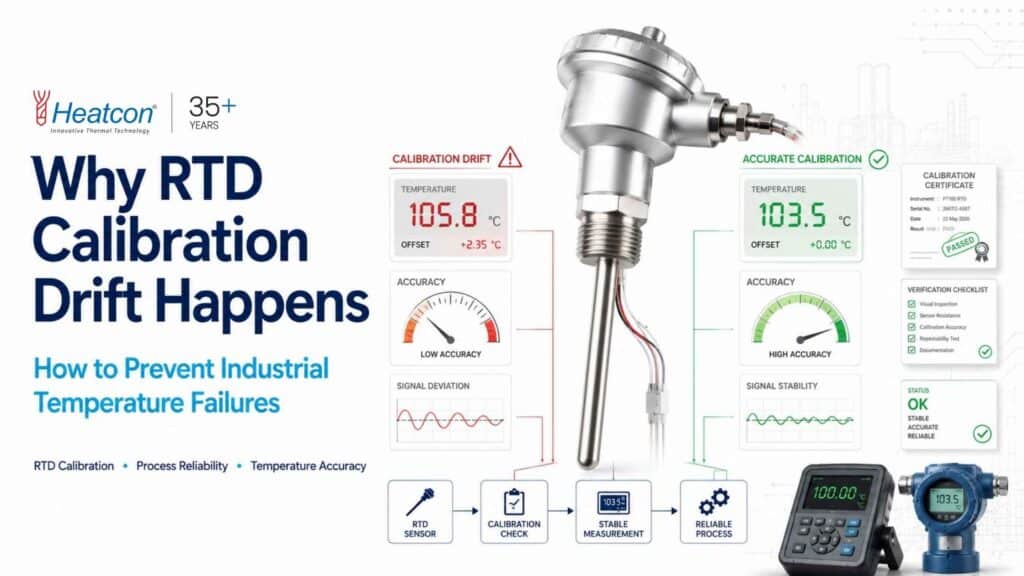
RTD calibration drift is a leading cause of unexpected industrial temperature failures, with research indicating that up to 60% of process deviations in temperature-sensitive industries are linked directly to sensor instability and drift over time. Understanding the reasons behind this drift and knowing how to mitigate its impact is crucial for maintaining production efficiency, product quality, and safety. Industrial operators worldwide, from India to the US, UAE, Germany, South Korea, Indonesia, Saudi Arabia, Russia, Bahrain, and Kuwait, must address this challenge to stay competitive and compliant.
What Is RTD Calibration Drift and Why Should You Care?
RTD calibration drift refers to the gradual change in the output signal of a resistance temperature detector (RTD) sensor, causing it to deviate from its original calibration. Over time, this drift results in RTD sensor accuracy loss, which can critically impact process control in industries such as pharmaceuticals, food processing, petrochemicals, and power generation.
- Drift leads to inaccurate temperature readings.
- It jeopardizes product quality and plant safety.
- Frequent equipment failures and costly downtime may arise.
For instance, even a small calibration drift of 0.5°C can result in major product spoilage, equipment malfunction, or regulatory compliance issues. This is why top-performing industries prioritize the management of RTD calibration drift, and why Heatcon Sensors has become the trusted partner for custom RTD solutions globally.
How Does RTD Calibration Drift Occur?
RTD calibration drift typically arises due to several factors that affect the sensor’s internal structure and performance:
- Thermal Cycling: Repeated heating and cooling cycles induce mechanical stress and microstructural changes in the sensing element, mainly in platinum RTDs.
- Contamination: Exposure to corrosive agents or moisture can cause chemical reactions, affecting the element’s resistance characteristics.
- Vibration and Mechanical Shock: Physical impacts can deform the sensing wire or disturb the insulation, leading to drift.
- Ageing: With time, even the highest quality RTDs experience slow changes in their physical properties, especially in harsh or variable environments.
- Electrical Overstress: Exposure to transient voltage spikes or static discharges can permanently alter the sensor’s resistance.
Specifically, platinum RTD stability is renowned compared to other materials, but even platinum RTDs are not immune to drift, especially under extreme or sustained usage.
What Are the Consequences of RTD Sensor Accuracy Loss?
The most immediate impact of RTD sensor accuracy loss is unreliable temperature measurement. This can manifest as:
- Product Quality Issues: Incorrect temperature control can spoil batches in food, pharmaceuticals, or chemical processes.
- System Failures: Overheating or underheating may damage sensitive equipment such as furnaces, ovens, hot air blowers, and electric furnaces.
- Increased Maintenance: Undetected drift can lead to unplanned shutdowns and costly repairs.
- Regulatory Non-Compliance: Industries with strict quality standards risk non-compliance, leading to recalls or legal penalties.
In industries with continuous operations, such as oil & gas or power plants, a single undetected drift event can result in losses amounting to millions.
How Can RTD Recalibration Prevent Industrial Temperature Failures?
RTD recalibration is the process of checking and adjusting the sensor to restore its output to the correct reference points. This is an essential maintenance activity to counteract RTD calibration drift and ensure ongoing accuracy.
- Regular recalibration detects drift early.
- It minimizes the risk of undetected errors in critical processes.
- Routine recalibration supports compliance with industry standards and audits.
Heatcon Sensors offers comprehensive industrial calibration services for RTDs and other temperature sensors, including on-site and laboratory calibration. Our expert team uses traceable standards and advanced equipment to guarantee reliable performance in even the harshest industrial environments.
How Often Should RTD Sensors Be Recalibrated?
The ideal frequency of RTD recalibration depends on application severity, regulatory requirements, and sensor environment. However, most industries follow these general guidelines:
- Critical Processes: Quarterly or even monthly recalibration may be required.
- General Industrial Use: Semi-annual or annual recalibration is common.
- After Major Events: Any unusual event (e.g., power surge, mechanical shock) should trigger immediate recalibration.
Custom schedules can be created for unique industrial needs, and Heatcon Sensors can assist in designing a recalibration program tailored to your operations.
What Measures Can Industries Take to Prevent RTD Calibration Drift?
While RTD calibration drift cannot be eliminated entirely, industries can significantly reduce its impact through a combination of best practices and partnering with expert manufacturers like Heatcon Sensors:
- Choose High-Quality Sensors: Invest in sensors with proven platinum RTD stability and robust construction, especially for high-temperature or corrosive environments.
- Implement Regular RTD Recalibration: Develop and follow a strict recalibration regimen, leveraging qualified industrial calibration services.
- Monitor Sensor Performance: Use diagnostic tools or redundancy to cross-check sensor outputs and catch drift early.
- Protect Against Environmental Hazards: Shield sensors from moisture, chemicals, and mechanical impacts.
- Partner with Experts: Work with trusted manufacturers like Heatcon Sensors who can design custom RTDs and systems for your specific needs.
These steps, when consistently applied, help industries mitigate the risk of catastrophic temperature-related failures and maintain optimal process control worldwide.
Why Choose Heatcon Sensors for Customized RTDs and Temperature Solutions?
Heatcon Sensors is a leading manufacturer and supplier of custom RTDs, thermocouples, and temperature solutions for industries across India and the globe—including the US, UAE, Indonesia, Germany, South Korea, Saudi Arabia, Russia, Bahrain, and Kuwait. We specialize in addressing the unique needs of challenging industrial environments, offering:
- Custom-designed RTDs with exceptional platinum RTD stability.
- Comprehensive industrial calibration services for all types of temperature sensors.
- Rapid delivery and support throughout India and worldwide.
- Expert engineering for integration with furnaces, ovens, hot air blowers, electric furnaces, high density cartridge heaters, and other heat generating equipment.
- Unmatched technical support pre- and post-installation.
Our sensors are meticulously crafted to withstand the rigors of your application, ensuring long-term reliability and minimal drift. Whether you operate in Mumbai, New York, Dubai, Jakarta, Berlin, Seoul, Riyadh, Moscow, Manama, or Kuwait City, Heatcon Sensors delivers uncompromising quality and support.
How to Reach Out to Heatcon Sensors for Your Custom Temperature Solutions?
Don’t let RTD calibration drift compromise your operations. Join the ranks of industry leaders who trust Heatcon Sensors for premium temperature measurement solutions. You can reach us in any of the following ways:
- Submit your information on the form at https://heatconsensors.com/contact-us/
- Leave a message on WhatsApp using the interface available on the Heatcon Sensors website
- Call us directly at +91 9164833027 or +91 9844233244 for immediate assistance
Take proactive steps now to prevent costly temperature failures and ensure lasting process accuracy. Choose Heatcon Sensors—where precision meets performance, every time.
About Heatcon Sensors
Heatcon Sensors is a premier manufacturer of customized temperature sensors, including RTDs and thermocouples, as well as heat generating equipment such as furnaces, ovens, hot air blowers, electric furnaces, and high density cartridge heaters. With over three decades of experience, an expert engineering team, and a global delivery network, Heatcon Sensors is the partner of choice for industries seeking reliability, innovation, and unmatched customer service. Our solutions are trusted by clients across India, the US, UAE, Indonesia, Germany, South Korea, Saudi Arabia, Russia, Bahrain, Kuwait, and beyond.
Frequently Asked Questions
What is RTD calibration drift and why does it happen?
RTD calibration drift refers to the gradual loss of accuracy in an RTD sensor’s temperature readings over time. This drift can be caused by factors such as mechanical shock, thermal cycling, contamination, aging of the sensor materials, or exposure to harsh industrial environments. As a result, the sensor’s resistance-to-temperature relationship changes, leading to incorrect temperature measurements.
How can I detect RTD sensor accuracy loss in my process?
RTD sensor accuracy loss is often identified through unexpected deviations in process temperatures, inconsistencies in data trends, or during scheduled calibration checks. Heatcon Sensors recommends regular comparisons with reference standards and monitoring for any unusual shifts or inconsistencies in readings, which could indicate the need for recalibration or sensor replacement.
What are the main causes of platinum RTD stability issues?
Platinum RTD stability can be affected by mechanical vibrations, repeated thermal cycling, contamination by chemicals or moisture, and prolonged exposure to temperatures outside the sensor’s specified range. In industrial settings, even minor contaminations or mechanical stresses can gradually degrade the platinum element, impacting the sensor’s accuracy and long-term performance.
How often should I schedule RTD recalibration to prevent failures?
The frequency of RTD recalibration depends on your application’s criticality, environmental conditions, and manufacturer recommendations. In most industrial applications, an annual recalibration is advisable, but high-stress environments may require more frequent checks. Heatcon Sensors offers tailored recalibration schedules as part of our industrial calibration services to ensure maximum reliability and safety.
What are the consequences of neglecting RTD calibration drift in industrial processes?
Neglecting RTD calibration drift can lead to inaccurate temperature control, reduced product quality, increased energy consumption, and even equipment failures. In critical industries, such errors can cause costly downtime, safety hazards, or regulatory compliance issues. Regular inspection and recalibration help prevent these risks and maintain process integrity.
How does Heatcon Sensors help maintain RTD sensor reliability?
Heatcon Sensors offers advanced industrial calibration services, onsite recalibration, and technical consultation to ensure your RTD sensors perform at their best. Our experienced team uses precision calibration equipment and follows stringent procedures to restore sensor accuracy, minimize downtime, and provide documentation for regulatory compliance.
What solutions does Heatcon Sensors recommend to minimize RTD calibration drift?
Heatcon Sensors recommends using high-quality, industrial-grade RTDs, proper installation techniques, protective sheaths, and scheduled RTD recalibration. Additionally, we advise routine inspections and the use of our industrial calibration services to quickly detect and correct calibration drift before it leads to process failures.
Can RTD calibration drift be completely eliminated?
While it is not possible to eliminate RTD calibration drift entirely due to the nature of sensor aging and environmental factors, it can be significantly minimized. By selecting stable platinum RTDs, following best installation practices, and utilizing regular calibration with Heatcon Sensors’ industrial calibration services, you can ensure long-term sensor performance and minimize the risks of temperature failures in your process.