
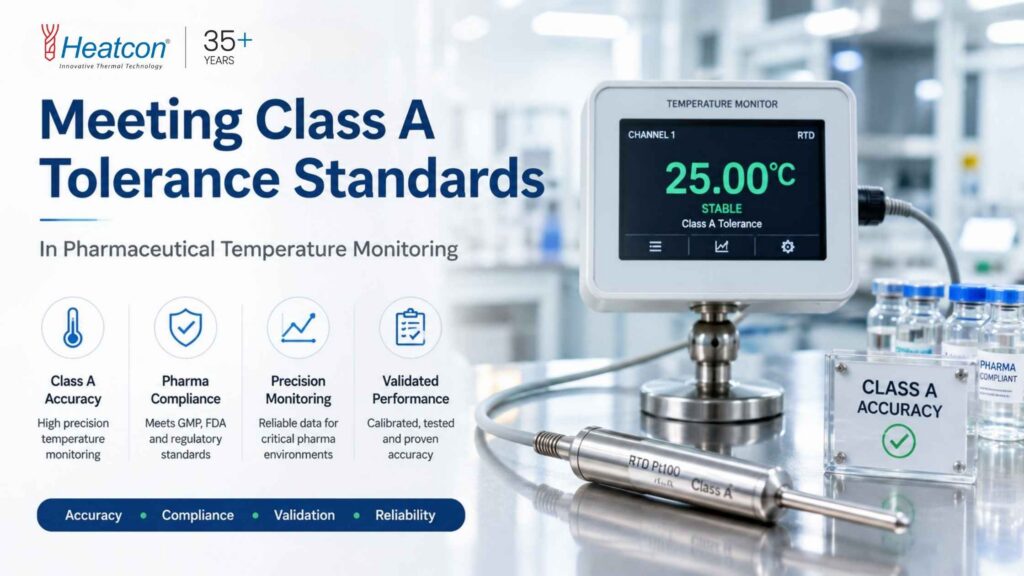
What is the most important requirement in pharmaceutical temperature monitoring? The answer is accuracy. Industry studies indicate that temperature excursions account for a significant percentage of pharmaceutical product quality deviations during manufacturing, storage, and transportation. Even a small measurement error can compromise product efficacy, patient safety, regulatory compliance, and operational profitability. This is why pharmaceutical facilities increasingly rely on highly accurate temperature sensors designed to meet stringent standards such as DIN EN 60751 and Class A accuracy requirements.
For pharmaceutical manufacturers, vaccine producers, biotechnology facilities, cleanrooms, laboratories, cold storage operators, and healthcare supply chains, maintaining precise temperatures is not merely a best practice—it is a regulatory necessity. Heatcon Sensors specializes in manufacturing customized RTDs, PT100 sensors, thermocouples, and advanced industrial temperature sensing solutions that help organizations achieve and maintain compliance with demanding pharmaceutical requirements. Whether the requirement is within India or anywhere across the globe, Heatcon Sensors can custom manufacture and supply temperature sensors designed specifically for the application.
What is pharmaceutical temperature monitoring and why is it critical?
Pharmaceutical temperature monitoring refers to the continuous measurement, recording, validation, and control of temperatures throughout pharmaceutical manufacturing, storage, transportation, and distribution processes.
Temperature-sensitive pharmaceutical products can lose effectiveness when exposed to temperatures outside approved limits. Vaccines, biologics, blood products, enzymes, active pharmaceutical ingredients (APIs), and specialty medications often require strict temperature control throughout their lifecycle.
Effective pharmaceutical temperature monitoring helps organizations:
- Protect product integrity and efficacy.
- Maintain regulatory compliance.
- Reduce batch rejection risks.
- Support GMP and validation requirements.
- Prevent costly recalls.
- Improve patient safety.
- Maintain audit readiness.
The foundation of every reliable monitoring system begins with selecting the right temperature sensor.
What are Class A tolerance standards?
Class A tolerance standards define the allowable measurement error for resistance temperature detectors (RTDs). These standards are widely used in pharmaceutical environments because of their superior measurement precision.
The internationally recognized standard governing RTD accuracy is DIN EN 60751. This standard establishes performance criteria, resistance values, tolerance classes, and testing requirements for platinum resistance thermometers.
When pharmaceutical facilities select a Class A PT100 sensor, they gain a significantly tighter tolerance band than standard industrial sensors. This increased precision becomes especially important in applications such as:
- Pharmaceutical cold rooms.
- Vaccine storage facilities.
- Stability chambers.
- Laboratory incubators.
- Bioreactors.
- Autoclaves.
- Lyophilization systems.
- Cleanroom HVAC systems.
- Ultra-low temperature freezers.
How does DIN EN 60751 influence pharmaceutical compliance?
DIN EN 60751 establishes internationally recognized performance requirements for platinum RTDs. Pharmaceutical quality teams often specify compliance with this standard because it provides a reliable framework for sensor accuracy and repeatability.
Key benefits include:
| Requirement | Benefit |
|---|---|
| Defined tolerance classes | Predictable measurement accuracy |
| Standardized resistance values | Interchangeability between sensors |
| Repeatable calibration procedures | Reliable validation results |
| Global acceptance | Simplified regulatory compliance |
| Documented performance standards | Improved audit readiness |
For pharmaceutical organizations operating globally, adherence to DIN EN 60751 helps ensure consistency across facilities in India, the United States, Germany, UAE, Saudi Arabia, Indonesia, South Korea, Russia, Bahrain, Kuwait, and other international markets.
What makes Class A PT100 sensors ideal for pharmaceutical applications?
A Class A PT100 sensor provides highly accurate temperature measurements using a platinum sensing element with a nominal resistance of 100 ohms at 0°C.
Pharmaceutical companies choose Class A PT100 sensors because they offer:
- Excellent long-term stability.
- Superior repeatability.
- High measurement precision.
- Wide operating temperature range.
- Regulatory acceptance.
- Compatibility with validation protocols.
- Excellent resistance to drift.
Heatcon Sensors manufactures customized Class A PT100 assemblies designed specifically for pharmaceutical processes. Sensor dimensions, sheath materials, cable configurations, connectors, mounting arrangements, and process connections can all be customized according to customer requirements.
What does a Class B RTD comparison reveal?
A proper Class B RTD comparison demonstrates why many pharmaceutical facilities prefer Class A sensors for critical applications.
Although Class B sensors may be suitable for general industrial processes, pharmaceutical environments often demand tighter tolerances and greater confidence in recorded data.
| Parameter | Class A | Class B |
|---|---|---|
| Accuracy | Higher | Lower |
| Validation confidence | Excellent | Moderate |
| Critical pharma processes | Highly suitable | Limited suitability |
| Temperature stability studies | Preferred | Less preferred |
| Cold chain monitoring | Recommended | Application dependent |
When product quality and patient safety depend on precise temperature control, the higher accuracy associated with Class A devices often justifies the investment.
How is RTD tolerance calculation performed?
RTD tolerance calculation helps determine the allowable measurement deviation of an RTD at a specific temperature.
Understanding tolerance calculations enables pharmaceutical engineers to:
- Select the correct sensor class.
- Validate measurement uncertainty.
- Support calibration programs.
- Meet GMP documentation requirements.
- Reduce compliance risks.
Accurate RTD tolerance calculation becomes especially important during qualification, validation, and periodic calibration activities where traceability and documented accuracy are essential.
Heatcon Sensors supports customers by providing temperature sensors manufactured to precise specifications and suitable for calibration programs required by regulated industries.
Why are pharma freezer sensors essential?
Pharma freezer sensors play a critical role in protecting temperature-sensitive products stored in freezers and ultra-low-temperature environments.
Many pharmaceutical products require storage temperatures ranging from -20°C to -80°C or even lower. Temperature deviations can result in:
- Product degradation.
- Loss of potency.
- Regulatory violations.
- Financial losses.
- Supply chain disruptions.
Heatcon Sensors manufactures customized pharma freezer sensors engineered for demanding low-temperature applications. These sensors are designed to provide stable, repeatable measurements even in extreme cold storage environments.
Why are Class A RTD Calibration Standards India becoming increasingly important?
The pharmaceutical industry in India continues to expand rapidly, serving domestic and international markets. Consequently, demand for accurate temperature measurement solutions aligned with Class A RTD Calibration Standards India continues to grow.
Organizations seeking international compliance increasingly require:
- Traceable calibration documentation.
- Accurate RTD performance.
- Validation support.
- Reliable manufacturing standards.
- Globally recognized sensor specifications.
Heatcon Sensors supports these requirements by manufacturing custom RTDs and temperature sensors suitable for pharmaceutical applications throughout India and global export markets.
How does Heatcon Sensors support pharmaceutical manufacturers worldwide?
Heatcon Sensors is a specialized manufacturer of customized temperature sensing solutions and thermal equipment for industrial applications.
The company manufactures:
- RTDs.
- PT100 sensors.
- PT1000 sensors.
- Thermocouples.
- Temperature transmitters.
- Surface temperature sensors.
- Mineral insulated sensors.
- Custom pharmaceutical sensors.
- Cold chain monitoring sensors.
- Cleanroom temperature sensors.
Beyond temperature sensors, Heatcon Sensors also manufactures:
- Industrial furnaces.
- Electric furnaces.
- Laboratory furnaces.
- Industrial ovens.
- Drying ovens.
- Hot air blowers.
- Cartridge heaters.
- High density cartridge heaters.
- Tubular heaters.
- Ceramic heaters.
- Immersion heaters.
- Infrared heating systems.
- Custom heat-generating equipment.
Every pharmaceutical process presents unique challenges. Standard sensors often fail to provide the exact dimensions, response times, mounting methods, materials, or environmental protection required. Heatcon Sensors addresses this challenge by manufacturing customized solutions tailored to customer specifications.
How can pharmaceutical facilities improve temperature monitoring reliability?
The most effective approach involves combining high-quality sensors, proper calibration, validation procedures, and ongoing monitoring.
- Select sensors designed for the application.
- Use Class A accuracy where required.
- Ensure compliance with DIN EN 60751.
- Implement regular calibration programs.
- Maintain complete validation records.
- Monitor sensor performance continuously.
- Partner with experienced manufacturers.
Organizations that invest in accurate temperature measurement infrastructure often experience improved compliance, reduced product losses, fewer deviations, and stronger audit performance.
About Heatcon Sensors
Heatcon Sensors is an industrial temperature sensor manufacturer specializing in customized RTDs, PT100 sensors, thermocouples, temperature probes, and thermal process equipment. The company serves pharmaceutical, biotechnology, healthcare, food processing, aerospace, automotive, energy, research, and manufacturing sectors.
Whether your facility is located in Bengaluru, Hyderabad, Mumbai, Delhi, Chennai, Ahmedabad, Pune, Dubai, Abu Dhabi, Riyadh, Jeddah, Dammam, Kuwait City, Manama, Jakarta, Seoul, Berlin, Moscow, New York, Houston, Chicago, Los Angeles, or any other location worldwide, Heatcon Sensors can custom manufacture and supply temperature sensors designed specifically for your application.
When compliance, product quality, and patient safety depend on precise temperature measurement, choosing the right sensor partner becomes a strategic decision. Heatcon Sensors provides the expertise, customization capabilities, manufacturing quality, and global supply support needed to meet demanding pharmaceutical requirements.
Contact Heatcon Sensors
To discuss customized RTDs, PT100 sensors, pharmaceutical monitoring solutions, calibration requirements, or specialized industrial temperature sensing applications:
- Submit your information through the contact form at https://heatconsensors.com/contact-us/
- Leave a message through the WhatsApp interface available on the Heatcon Sensors website.
- Call +91 9164833027 for immediate assistance.
- Call +91 9844233244 for immediate assistance.
The difference between compliance and costly deviations often begins with a single temperature measurement. Investing in precision-engineered sensing solutions today can help safeguard pharmaceutical quality, regulatory compliance, and operational confidence for years to come.
Frequently Asked Questions
What does Class A accuracy mean in pharmaceutical temperature monitoring?
Class A accuracy refers to a tighter tolerance specification for RTD sensors used in critical temperature measurement applications. In pharmaceutical temperature monitoring, maintaining precise readings is essential for product quality, regulatory compliance, cold-chain integrity, and validation processes.
Heatcon Sensors supplies precision RTD solutions designed for highly regulated pharmaceutical environments where even small temperature deviations can affect product stability, storage conditions, and audit readiness.
Why are Class A RTD sensors preferred in pharmaceutical facilities?
Pharmaceutical manufacturing, warehousing, laboratories, cleanrooms, incubators, cold rooms, and validation systems often require highly accurate and repeatable temperature measurements. A Class A PT100 sensor provides tighter tolerance limits than standard alternatives, helping organizations maintain process consistency and comply with strict quality standards.
Heatcon Sensors offers precision-engineered RTD assemblies that support critical pharmaceutical processes where reliable monitoring and documentation are essential.
How does DIN EN 60751 relate to RTD accuracy standards?
DIN EN 60751 is the internationally recognized standard that defines the resistance-temperature relationship and tolerance classifications for platinum resistance temperature detectors. It establishes the performance criteria commonly used to classify RTDs into accuracy categories such as Class A and Class B.
Heatcon Sensors manufactures RTD solutions in accordance with recognized industry requirements, helping pharmaceutical companies implement dependable temperature monitoring systems across production and storage environments.
What is the difference between Class A and Class B RTDs?
A Class B RTD comparison typically shows that Class B sensors have wider permissible tolerance limits than Class A sensors. While Class B sensors may be suitable for general industrial applications, pharmaceutical operations often favor Class A sensors because they provide higher measurement precision and reduced uncertainty.
Heatcon Sensors assists customers in selecting the most appropriate sensor class based on validation requirements, operating conditions, and regulatory expectations.
How is RTD tolerance calculated for pharmaceutical applications?
RTD tolerance calculation is based on the tolerance formulas specified within applicable RTD standards. The allowable deviation changes with temperature and determines how closely the sensor’s measured value can differ from the actual temperature while remaining within specification.
During pharmaceutical qualification and validation activities, understanding sensor tolerance helps quality teams evaluate measurement uncertainty, calibration intervals, and compliance requirements. Heatcon Sensors can support customers with accurate RTD solutions and calibration-focused guidance for regulated environments.
Why are calibration standards important for pharmaceutical compliance in India?
Calibration verifies that temperature sensors continue to perform within their specified accuracy limits. Organizations that follow Class A RTD Calibration Standards India practices can improve traceability, support audit requirements, and maintain confidence in temperature-sensitive operations.
Heatcon Sensors provides high-quality temperature sensing solutions that can be integrated into calibration and validation programs used throughout pharmaceutical manufacturing and storage facilities.
What temperature sensors are recommended for pharmaceutical freezers and cold storage?
Ultra-low freezers, vaccine storage units, cold rooms, and refrigerated warehouses require reliable sensors capable of delivering stable performance across demanding operating conditions. Specialized pharma freezer sensors are commonly used to monitor critical storage temperatures and help protect valuable pharmaceutical products.
Heatcon Sensors offers temperature monitoring solutions designed for cold-chain applications where accuracy, durability, and long-term reliability are essential.
How can Heatcon Sensors help pharmaceutical companies meet Class A tolerance requirements?
Heatcon Sensors provides precision RTD sensors, custom temperature assemblies, and application-focused support for regulated industries. By selecting appropriately specified sensors, implementing proper installation practices, and maintaining calibration programs, pharmaceutical organizations can improve measurement reliability and support compliance objectives.
Whether the requirement involves cleanroom monitoring, process equipment, cold storage facilities, validation studies, or critical pharmaceutical temperature monitoring systems, Heatcon Sensors delivers solutions engineered to support accurate and dependable temperature measurement.