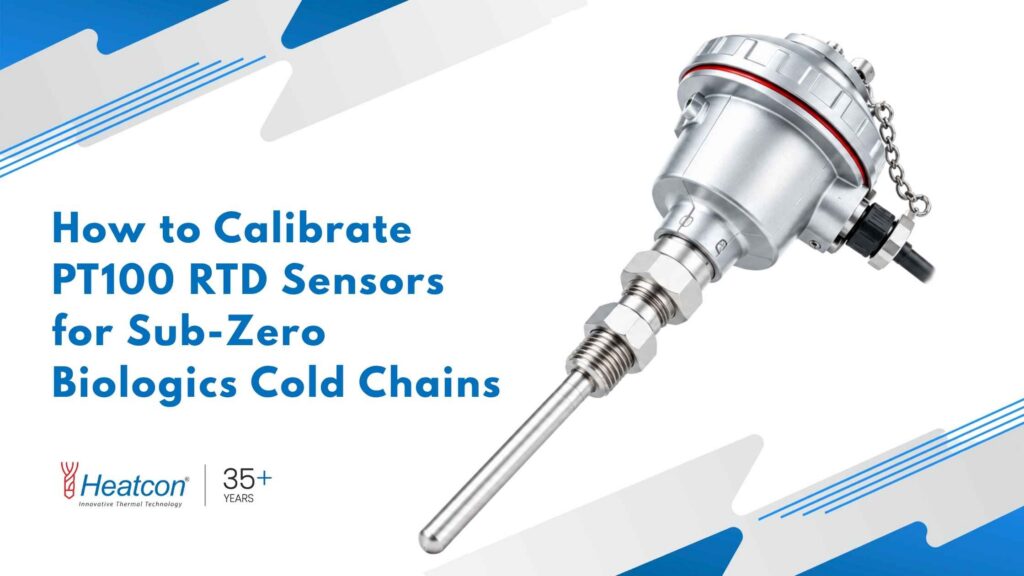
PT100 RTD sensors are among the most widely trusted temperature measurement technologies used in pharmaceutical and biologics cold chain environments, where even a temperature deviation of less than 1°C can affect product integrity. According to globally recognized vaccine storage and pharmaceutical cold chain standards, maintaining precise temperature control across storage, transportation, and distribution stages is critical for preserving efficacy and safety. This makes accurate calibration of PT100 sensors an essential component of every biologics cold chain monitoring strategy.
As biologics, vaccines, plasma products, cell therapies, and advanced pharmaceutical formulations increasingly rely on ultra-low storage temperatures, organizations cannot afford inaccurate sensor readings. Calibration ensures that PT100 RTD sensors provide dependable data throughout storage freezers, cryogenic chambers, refrigerated warehouses, and transport containers. Companies that neglect calibration often expose themselves to compliance risks, financial losses, product recalls, and compromised patient outcomes.
Heatcon Sensors specializes in manufacturing customized RTDs, thermocouples, temperature sensors, and industrial heating systems tailored to exact customer requirements. Whether the application involves pharmaceutical cold rooms, vaccine storage facilities, biotechnology laboratories, research institutions, cryogenic processing plants, or international cold chain logistics operations, Heatcon Sensors can design, manufacture, and supply customized temperature sensing solutions across India and worldwide.
What is PT100 RTD calibration and why is it important?
PT100 RTD calibration is the process of comparing sensor readings against a certified temperature reference to verify accuracy across specific operating ranges. In sub-zero environments, calibration becomes even more important because small measurement errors can translate into significant product quality risks.
Many biologics require storage temperatures ranging from -20°C to -80°C, while certain advanced therapies may require even lower temperatures. Accurate PT100 Calibration for Sub Zero Cold Chain India applications helps ensure compliance with pharmaceutical regulations and quality standards while protecting highly valuable inventory.
Calibration helps organizations:
- Maintain regulatory compliance
- Improve product safety
- Reduce temperature excursion risks
- Enhance traceability
- Increase confidence in monitoring systems
- Improve audit readiness
- Support long-term equipment reliability
How does sub-zero calibration differ from standard RTD calibration?
The answer is straightforward: lower temperatures create unique challenges that demand specialized procedures, equipment, and expertise.
During sub-zero RTD calibration, technicians must account for factors such as thermal gradients, response times, immersion depth effects, sensor self-heating characteristics, and environmental influences. Unlike standard industrial calibration, biologics cold chain applications often require validation across multiple temperature points to ensure complete confidence in operational performance.
Typical calibration points may include:
| Application | Temperature Range |
|---|---|
| Cold Rooms | 2°C to 8°C |
| Frozen Storage | -20°C to -30°C |
| Ultra-Low Freezers | -40°C to -86°C |
| Cryogenic Storage | Below -150°C |
How is calibration performed in biologics cold chain environments?
The calibration process begins with selecting a certified reference standard that offers greater accuracy than the device under test.
Step 1: Sensor inspection
Technicians inspect sensor construction, cable integrity, sheath condition, and connection quality before calibration begins.
Step 2: Controlled temperature stabilization
The sensor is placed inside a calibration chamber capable of maintaining highly stable sub-zero temperatures.
Step 3: Temperature comparison
Sensor readings are compared with certified reference instruments across multiple calibration points.
Step 4: Error determination
Differences between measured values and reference standards are documented and analyzed.
Step 5: Documentation and certification
Results are recorded in calibration certificates to support compliance requirements and quality audits.
This process forms the backbone of reliable biologics cold chain monitoring programs worldwide.
Why is PT100 cold storage calibration critical for vaccines and biologics?
Vaccines and biologics are highly temperature-sensitive products. Exposure to temperatures outside approved limits can reduce efficacy and result in substantial financial losses.
PT100 cold storage calibration helps ensure that storage freezers, refrigerated warehouses, insulated transport systems, and pharmaceutical storage facilities maintain required temperature conditions consistently.
Without proper calibration, facilities may unknowingly operate outside acceptable limits, creating hidden risks that only become apparent during inspections or product investigations.
How does calibration support vaccine temperature monitoring?
Accurate vaccine temperature monitoring depends entirely on trustworthy sensor measurements. Calibration validates sensor performance and confirms that recorded temperatures accurately represent storage conditions.
Healthcare providers, pharmaceutical manufacturers, government immunization programs, and logistics providers rely on calibrated PT100 sensors to maintain vaccine integrity from manufacturing through final administration.
Benefits include:
- Improved patient safety
- Reduced wastage
- Regulatory compliance support
- Enhanced inventory protection
- Reliable quality assurance records
What role does ultra-low temperature RTD testing play in modern biologics logistics?
As biotechnology advances, storage requirements continue to become more demanding. Many modern biologics require temperatures approaching -80°C or lower.
Ultra-low temperature RTD testing verifies that sensors continue delivering accurate measurements under these extreme operating conditions.
Testing evaluates:
- Measurement accuracy
- Repeatability
- Long-term stability
- Response time
- Environmental resistance
- Mechanical durability
Organizations that invest in proper testing often experience fewer temperature-related incidents and stronger compliance outcomes.
When are cryogenic calibration services necessary?
Cryogenic calibration services become necessary when applications involve extremely low temperatures, often below -150°C.
Examples include:
- Cell and gene therapy storage
- Biobanks
- Research laboratories
- Liquid nitrogen storage systems
- Cryogenic transportation containers
- Advanced pharmaceutical manufacturing
Because sensor behavior can change significantly at cryogenic temperatures, specialized calibration methodologies are required to maintain measurement confidence.
Why choose customized RTDs from Heatcon Sensors?
Not every application can be served effectively using standard catalog sensors. Many biologics facilities require unique probe dimensions, specialized cable materials, enhanced environmental protection, or custom connection configurations.
Heatcon Sensors manufactures customized RTDs engineered specifically for application requirements. The company produces:
- PT100 RTDs
- PT1000 RTDs
- Thermocouples
- Mineral insulated sensors
- Surface temperature sensors
- Cryogenic temperature sensors
- Industrial process sensors
- Custom sensor assemblies
Beyond temperature sensing solutions, Heatcon Sensors also manufactures industrial heating systems including electric furnaces, laboratory furnaces, industrial ovens, hot air blowers, cartridge heaters, high density cartridge heaters, immersion heaters, tubular heaters, infrared heating systems, duct heaters, and specialized thermal processing equipment.
Can Heatcon Sensors supply globally?
Yes. Heatcon Sensors serves customers across India and international markets. Whether customers are located in Bengaluru, Mumbai, Delhi, Hyderabad, Chennai, Ahmedabad, Dubai, Abu Dhabi, Riyadh, Jeddah, Seoul, Berlin, Moscow, Jakarta, Manama, Kuwait City, New York, Houston, Chicago, or other locations worldwide, customized RTDs and temperature sensing solutions can be manufactured and supplied according to project requirements.
This global supply capability allows pharmaceutical manufacturers, biotechnology firms, healthcare institutions, and industrial facilities to obtain purpose-built temperature measurement solutions regardless of location.
About Heatcon Sensors
Heatcon Sensors is a specialized manufacturer of customized RTDs, thermocouples, temperature sensors, industrial heating equipment, and thermal process solutions. The company supports pharmaceutical, biotechnology, healthcare, aerospace, automotive, food processing, laboratory, research, manufacturing, and industrial sectors with precision-engineered products designed for demanding operating environments.
With capabilities extending from sensor customization to industrial heating equipment manufacturing, Heatcon Sensors delivers solutions tailored to exact operational requirements while maintaining a commitment to quality, reliability, and technical excellence.
How can you contact Heatcon Sensors?
If your organization requires customized RTDs, PT100 calibration support, temperature sensing solutions for biologics cold chains, industrial heating equipment, or specialized thermal process systems, Heatcon Sensors can assist.
You may choose any of the following options:
- Submit your information through the contact form at https://heatconsensors.com/contact-us/
- Leave a message through the WhatsApp interface available on the website
- Call +91 9164833027
- Call +91 9844233244
In a world where temperature accuracy directly impacts product quality, patient safety, regulatory compliance, and operational success, investing in professionally manufactured and calibrated PT100 RTD solutions is not merely a technical decision—it is a strategic business requirement. Organizations that prioritize accurate temperature measurement today position themselves for stronger compliance, greater operational confidence, and improved protection of valuable biologics tomorrow.
Frequently Asked Questions
Why is calibration critical for PT100 RTD sensors used in sub-zero biologics cold chains?
Biologics, vaccines, cell therapies, and temperature-sensitive pharmaceutical products often require storage and transport at extremely low temperatures. Even small measurement deviations can compromise product efficacy, regulatory compliance, and product safety. Proper calibration verifies that a PT100 RTD sensor delivers accurate readings throughout the required operating range, helping organizations maintain reliable biologics cold chain monitoring and reduce the risk of temperature excursions during storage and transit.
What is involved in PT100 Calibration for Sub Zero Cold Chain India applications?
PT100 Calibration for Sub Zero Cold Chain India applications typically involves comparing the RTD sensor against traceable reference standards at multiple low-temperature points. The process evaluates sensor accuracy, repeatability, stability, and response characteristics under controlled laboratory conditions. Heatcon Sensors supports pharmaceutical, biotechnology, logistics, and research organizations by providing calibration solutions tailored to demanding cold-chain environments where accuracy is essential.
How often should sub-zero RTD sensors be recalibrated?
The ideal calibration interval depends on regulatory requirements, operating conditions, usage frequency, and internal quality procedures. Sensors exposed to repeated thermal cycling, harsh environments, or critical pharmaceutical operations may require more frequent verification. Regular sub-zero RTD calibration helps identify drift before it affects monitoring accuracy and supports consistent performance throughout the sensor’s service life.
Why is PT100 cold storage calibration important for vaccine and biologics facilities?
PT100 cold storage calibration helps ensure that temperature monitoring systems accurately reflect actual storage conditions inside cold rooms, freezers, and ultra-low temperature chambers. Accurate measurements are essential for vaccine temperature monitoring because vaccines and biologics can lose effectiveness when exposed to temperatures outside validated ranges. Calibration provides confidence that monitoring systems are performing as expected and supports audit readiness.
What temperatures can be evaluated during ultra-low temperature RTD testing?
Ultra-low temperature RTD testing can be performed across a range of sub-zero conditions depending on the sensor design, application requirements, and calibration facility capabilities. Testing may cover temperatures commonly encountered in pharmaceutical freezers, biologics storage systems, research laboratories, and specialized cold-chain logistics operations. Heatcon Sensors can help determine the most appropriate calibration points based on your validation and process requirements.
How do calibration services support compliance and quality assurance?
Traceable calibration records provide documented evidence that temperature measurement devices have been verified against recognized standards. This documentation is valuable during audits, qualification activities, validation programs, and quality reviews. By maintaining calibrated sensors, organizations can strengthen process control, reduce measurement uncertainty, and support regulatory expectations across pharmaceutical and biotechnology operations.
What cryogenic calibration services does Heatcon Sensors provide for low-temperature applications?
Heatcon Sensors offers specialized cryogenic calibration services designed for demanding low-temperature measurement environments. These services help verify sensor accuracy, measurement consistency, and traceability for applications involving biologics storage, pharmaceutical manufacturing, vaccine logistics, laboratory research, and industrial cold-chain operations. The objective is to ensure dependable sensor performance where temperature precision is critical.
Why should organizations choose Heatcon Sensors for PT100 RTD calibration support?
Heatcon Sensors combines temperature measurement expertise, application-focused support, and calibration capabilities to help customers maintain accurate cold-chain monitoring systems. Whether the requirement involves biologics cold chain monitoring, vaccine temperature monitoring, qualification projects, or routine calibration programs, Heatcon Sensors works with clients to deliver dependable calibration solutions that support product integrity and operational confidence.