
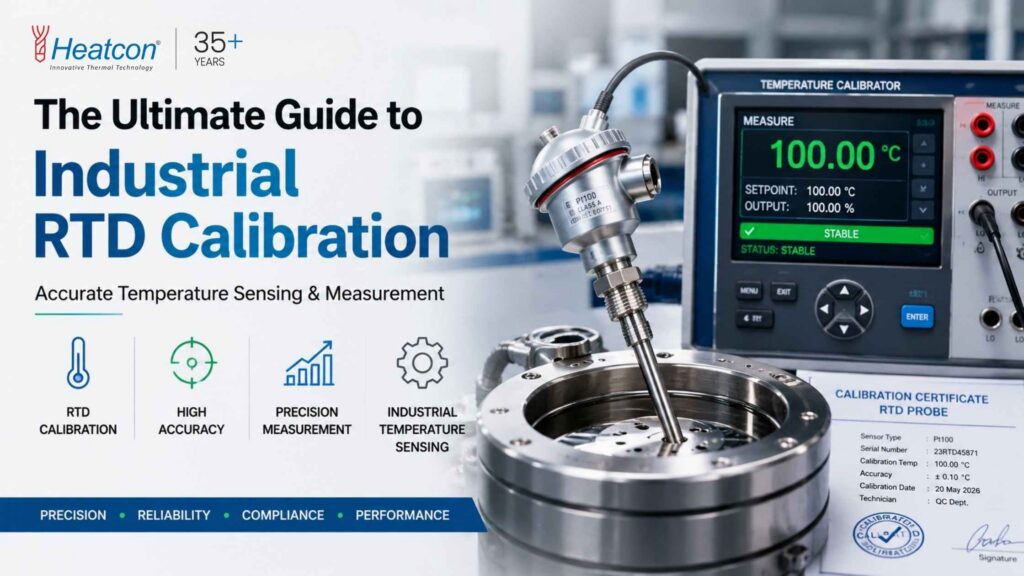
Studies across industrial process sectors indicate that temperature measurement errors of even 1°C can significantly affect product quality, process efficiency, energy consumption, and compliance outcomes. In industries such as pharmaceuticals, aerospace, food processing, petrochemicals, power generation, and specialty manufacturing, accurate temperature measurement is not merely desirable—it is essential. This is why Industrial RTD Calibration India has become a critical focus area for organizations seeking reliable process control, improved productivity, and reduced operational risk. Whether a facility operates a single production line or a global manufacturing network, the performance of its temperature sensing systems directly impacts profitability and operational excellence.
Heatcon Sensors is a leading manufacturer of customized RTDs, thermocouples, temperature sensors, and industrial heating solutions designed for demanding industrial applications. The company supplies temperature sensing products and custom-engineered solutions throughout India and to international markets including the United States, UAE, Indonesia, Germany, South Korea, Saudi Arabia, Russia, Bahrain, Kuwait, and many other regions worldwide.
What is industrial temperature sensing and why is it important?
Industrial temperature sensing refers to the measurement and monitoring of temperature within industrial processes using specialized sensors designed for accuracy, reliability, and durability. These measurements influence everything from product consistency and equipment safety to regulatory compliance and energy efficiency.
Modern industrial temperature sensing systems are deployed in:
- Steel and metal processing plants
- Chemical manufacturing facilities
- Food and beverage production units
- Pharmaceutical manufacturing environments
- Power generation facilities
- Oil and gas operations
- Automotive production plants
- Research laboratories and testing facilities
- HVAC and environmental control systems
- Semiconductor manufacturing facilities
Without accurate temperature data, manufacturers face production inconsistencies, equipment failures, higher operating costs, safety risks, and regulatory non-compliance.
What is an RTD and how does it work?
An RTD, or Resistance Temperature Detector, is a highly accurate temperature sensor that operates on the principle that electrical resistance changes predictably with temperature. The most widely used RTD element is the PT100, which has a resistance of 100 ohms at 0°C.
RTDs are preferred in many industrial applications because they offer:
- Excellent measurement accuracy
- Long-term stability
- Superior repeatability
- Wide operating temperature ranges
- Reliable performance in harsh environments
- Low drift characteristics
Heatcon Sensors manufactures customized RTDs tailored to specific industrial requirements. Whether customers require mineral insulated RTDs, surface-mounted RTDs, threaded RTDs, flanged assemblies, multipoint sensors, or specialized high-temperature designs, Heatcon Sensors delivers solutions engineered for precise industrial applications.
Why is temperature sensor calibration essential?
Temperature sensor calibration verifies that a sensor measures temperature accurately against a known standard. Over time, temperature sensors may drift due to environmental exposure, mechanical stress, thermal cycling, contamination, aging, and process conditions.
Regular temperature sensor calibration helps organizations:
- Maintain measurement accuracy
- Reduce production defects
- Ensure regulatory compliance
- Improve process consistency
- Increase equipment reliability
- Reduce waste and rework costs
- Support quality assurance initiatives
Organizations that neglect calibration frequently encounter hidden process deviations that gradually impact product quality and profitability.
What is PT100 calibration?
PT100 calibration is the process of comparing a PT100 sensor’s measured values against traceable reference standards across specified temperature points. The goal is to identify deviations and ensure the sensor performs within acceptable tolerance limits.
Calibration typically involves:
- Visual inspection of the sensor
- Electrical resistance verification
- Comparison against certified reference standards
- Data recording at multiple temperature points
- Error analysis and uncertainty calculations
- Documentation and certification
For critical industrial operations, periodic PT100 calibration ensures measurement confidence and minimizes process uncertainty.
How does RTD sensor testing improve reliability?
RTD sensor testing evaluates the electrical, mechanical, and thermal performance of RTDs before deployment and throughout their service life. Comprehensive testing helps identify potential issues before they affect production operations.
Typical RTD sensor testing procedures include:
- Insulation resistance testing
- Continuity testing
- Resistance verification
- Response time evaluation
- Environmental stress testing
- Mechanical durability assessment
- Thermal cycling validation
Heatcon Sensors conducts rigorous testing procedures during manufacturing to ensure every sensor meets demanding industrial performance requirements.
What role does ISO 17025 calibration play in industrial quality systems?
ISO 17025 calibration provides internationally recognized assurance that calibration activities are performed according to established technical and quality management standards. It demonstrates competence, traceability, and reliability within calibration processes.
Benefits include:
- International recognition of calibration results
- Enhanced confidence in measurement data
- Improved audit readiness
- Support for regulatory compliance
- Reduced measurement uncertainty
- Stronger quality management systems
Industries operating under strict quality standards often require calibration activities aligned with ISO 17025 principles to maintain operational credibility.
What should companies look for in a NABL RTD calibration lab?
A NABL RTD calibration lab offers calibration services with recognized accreditation and traceability standards. Selecting the right laboratory is essential for maintaining confidence in temperature measurements.
Key evaluation factors include:
- Accreditation scope and capabilities
- Measurement uncertainty specifications
- Traceability to national and international standards
- Technical expertise
- Calibration range coverage
- Turnaround time
- Documentation quality
- Industry-specific experience
Organizations that depend on precise temperature measurement should partner with reputable calibration providers to ensure consistent operational performance.
How do RTD calibration services India support industrial growth?
The demand for RTD calibration services India continues to grow as manufacturing sectors adopt stricter quality standards and advanced automation technologies. Calibration services help organizations maintain measurement integrity throughout their operations.
| Industry | Calibration Importance |
|---|---|
| Pharmaceuticals | Product safety and regulatory compliance |
| Food Processing | Quality control and hygiene standards |
| Power Generation | Equipment efficiency and safety |
| Chemicals | Process consistency and yield optimization |
| Automotive | Precision manufacturing requirements |
| Aerospace | Critical process validation |
As industrial automation expands across India, reliable calibration services become increasingly important for maintaining operational excellence.
How does Heatcon Sensors customize RTDs for industrial applications?
Many industrial processes require sensor configurations that standard catalog products cannot adequately address. Heatcon Sensors specializes in designing and manufacturing customized RTDs based on specific operating conditions and application requirements.
Customization options include:
- Custom probe lengths
- Special sheath materials
- High-temperature assemblies
- Food-grade sensor designs
- Chemical-resistant constructions
- Explosion-resistant configurations
- Multipoint RTD assemblies
- Surface sensing solutions
- Heavy-duty industrial probes
This engineering flexibility enables customers to obtain temperature sensing solutions precisely matched to their operational needs.
Beyond sensors: comprehensive thermal solutions from Heatcon Sensors
Heatcon Sensors is not limited to temperature sensors alone. The company also manufactures a wide range of industrial heating and thermal processing equipment that support manufacturing operations across multiple sectors.
Product offerings include:
- Industrial furnaces
- Electric furnaces
- Laboratory furnaces
- Industrial ovens
- Drying ovens
- Hot air blowers
- Cartridge heaters
- High density cartridge heaters
- Immersion heaters
- Tubular heaters
- Ceramic heaters
- Band heaters
- Muffle furnaces
- Heating chambers
- Thermal processing systems
This integrated expertise in both temperature measurement and heat generation allows Heatcon Sensors to provide comprehensive thermal solutions for industrial applications.
How can accurate calibration reduce operating costs?
Accurate temperature measurement helps facilities avoid hidden losses that often go unnoticed until they significantly affect profitability.
Benefits include:
- Reduced energy consumption
- Improved product consistency
- Lower scrap rates
- Fewer process deviations
- Reduced maintenance expenses
- Longer equipment life
- Enhanced production efficiency
- Improved customer satisfaction
Organizations that invest in reliable sensors and calibration programs often achieve measurable operational improvements over time.
Why choose Heatcon Sensors for temperature sensing solutions?
Heatcon Sensors combines manufacturing expertise, engineering knowledge, customization capabilities, and application-focused support to help industries achieve reliable temperature measurement and control.
Key advantages include:
- Custom RTD manufacturing capabilities
- Industry-specific sensor designs
- Worldwide supply capabilities
- Support for OEM and end-user applications
- Comprehensive thermal engineering expertise
- Industrial heating equipment manufacturing
- Quality-focused production processes
- Responsive customer support
Whether your facility is located in India, the United States, UAE, Indonesia, Germany, South Korea, Saudi Arabia, Russia, Bahrain, Kuwait, or virtually anywhere else in the world, Heatcon Sensors can manufacture and supply customized temperature sensing solutions designed around your exact requirements.
About Heatcon Sensors
Heatcon Sensors is a specialized manufacturer of customized RTDs, thermocouples, temperature sensors, industrial heaters, furnaces, ovens, hot air blowers, high density cartridge heaters, and thermal process equipment. Serving industries across India and global markets, the company focuses on delivering reliable temperature measurement and thermal engineering solutions that support productivity, quality, safety, and operational efficiency.
If your organization requires customized RTDs, temperature sensors, calibration-related support, or industrial heating solutions, you can connect with Heatcon Sensors by submitting your information through the contact form available at https://heatconsensors.com/contact-us/, leaving a message through the WhatsApp interface available on the website, or calling +91 9164833027 or +91 9844233244 for immediate assistance.
As industries continue advancing toward higher levels of automation, digitalization, and quality control, accurate temperature measurement remains a foundational requirement. Investing in reliable sensors, proper calibration practices, and expert engineering support is one of the most effective ways to protect product quality, improve efficiency, and maintain long-term operational success.
Frequently Asked Questions
Why is Industrial RTD Calibration India important for manufacturing and process industries?
Industrial RTD Calibration India plays a critical role in ensuring accurate temperature measurements across manufacturing, pharmaceuticals, food processing, power generation, petrochemicals, and other industrial sectors. Even small temperature deviations can affect product quality, energy efficiency, regulatory compliance, and equipment performance.
Heatcon Sensors helps organizations maintain reliable temperature measurement systems through precise calibration procedures, traceable standards, and documented results that support quality assurance programs and operational consistency.
How often should RTD sensors be calibrated?
Calibration frequency depends on the operating environment, process criticality, regulatory requirements, and manufacturer recommendations. In high-temperature or demanding industrial applications, sensors may require more frequent verification than those operating in stable environments.
Heatcon Sensors evaluates each application individually and recommends suitable calibration intervals. Regular RTD sensor testing helps identify drift, detect sensor degradation, and maintain long-term measurement accuracy before process performance is affected.
What is PT100 calibration and why is it commonly requested?
PT100 calibration is the process of comparing a PT100 resistance temperature detector against a traceable reference standard across specified temperature points. Since PT100 sensors are widely used for their accuracy, stability, and repeatability, they are among the most commonly calibrated temperature sensors in industrial environments.
Heatcon Sensors performs PT100 calibration to verify sensor performance, identify deviations from expected values, and provide documented calibration data that supports quality systems and process reliability.
What should businesses look for in RTD calibration services India?
When selecting RTD calibration services India, organizations should evaluate technical expertise, calibration capabilities, measurement uncertainty, traceability, turnaround time, documentation quality, and industry experience.
Heatcon Sensors offers comprehensive calibration support for a wide range of RTD assemblies and industrial temperature measurement systems. Detailed calibration reports and professional technical assistance help customers maintain confidence in their measurement processes.
What are the advantages of using a NABL RTD calibration lab?
A NABL RTD calibration lab follows recognized quality procedures, validated methods, and traceable measurement practices. This provides greater confidence in calibration results and helps organizations satisfy customer, audit, and regulatory requirements.
Choosing a qualified laboratory ensures that temperature measurements can be traced to recognized standards while maintaining documented evidence of calibration quality and measurement reliability.
How does temperature sensor calibration improve process performance?
temperature sensor calibration helps verify that temperature instruments are operating within acceptable tolerances. Accurate measurements reduce product variation, improve process control, minimize waste, and support compliance with quality standards.
Heatcon Sensors provides calibration solutions designed to help facilities maintain dependable measurement systems throughout their operations, ensuring that critical temperature-dependent processes remain under control.
Why is industrial temperature sensing essential in modern industries?
industrial temperature sensing is fundamental to controlling production quality, protecting equipment, optimizing energy consumption, and ensuring safety. Accurate temperature data allows operators to make informed decisions and maintain stable operating conditions.
Heatcon Sensors supports a wide range of industrial applications with RTDs, temperature probes, assemblies, and calibration services that help organizations achieve dependable measurement performance across diverse operating environments.
What is the significance of ISO 17025 calibration for RTD users?
ISO 17025 calibration demonstrates that calibration activities are performed using validated procedures, competent personnel, controlled environments, and traceable standards. This internationally recognized framework helps ensure confidence in measurement results.
For organizations operating under strict quality requirements, ISO 17025 calibration provides documented assurance that calibration results are technically sound and suitable for audit, regulatory, and customer verification purposes.