
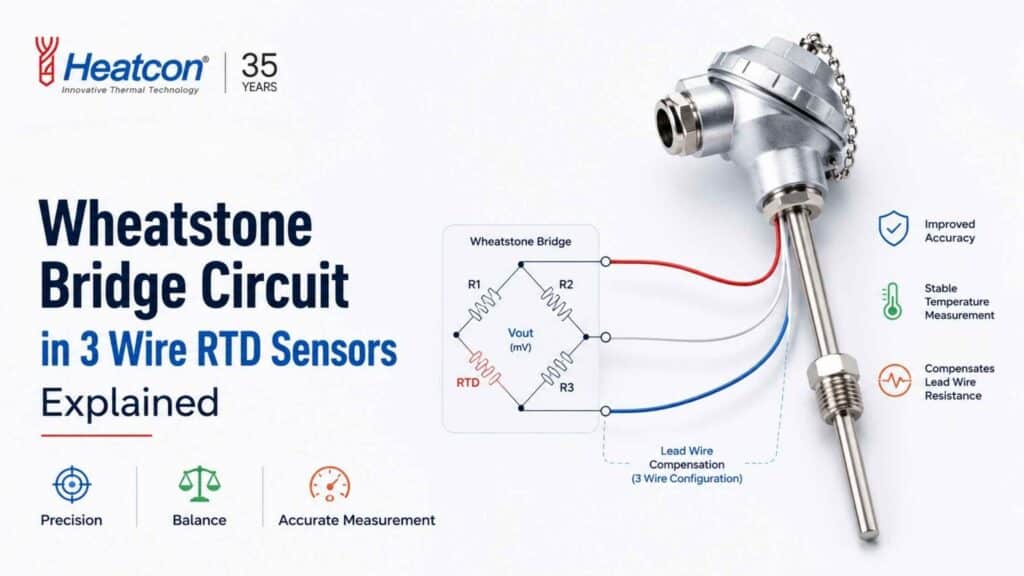
What Is The Wheatstone Bridge RTD Circuit And Why Is It Used In 3 Wire RTD Sensors?
A Wheatstone Bridge RTD Circuit is an electrical network that measures the resistance change of an RTD element with exceptional precision. It is widely used in 3 wire RTD sensors to compensate for wire resistance, eliminating measurement errors that could otherwise compromise process control. In essence, the Wheatstone Bridge circuit provides a reliable way to convert resistance changes—caused by temperature fluctuations—into readable voltage signals for accurate monitoring.
- It greatly improves measurement accuracy by compensating for lead wire resistance.
- It is the preferred method for industrial-grade temperature sensors, especially PT100 and PT1000 RTDs.
- Its configuration supports robust signal integrity even over long cable runs.
How Does The RTD Bridge Circuit Work?
The RTD bridge circuit operates by forming a balanced Wheatstone bridge, typically using four resistors: three fixed and one variable (the RTD sensor itself). As temperature changes, the RTD’s resistance shifts, unbalancing the bridge and generating a differential voltage. This voltage can be amplified and interpreted as a direct measure of temperature.
In a 3 wire RTD setup, two leads connect to one side of the RTD element, and the third to the other. This arrangement allows the circuit to cancel out the effects of lead wire resistance—a critical factor for precise temperature measurement in industrial settings.
| Function | Benefit |
|---|---|
| Lead Wire Compensation | Eliminates error from wire resistance |
| Signal Amplification | Enables accurate signal transmission over long distances |
| Noise Rejection | Improves stability and reduces false readings |
What Is PT100 Bridge Wiring And Why Does It Matter?
PT100 bridge wiring refers to the method of connecting a PT100 RTD sensor (which has a resistance of 100 ohms at 0°C) in a Wheatstone bridge configuration. Proper PT100 bridge wiring ensures that the sensor delivers precise temperature readings, especially when used in harsh or high-precision applications.
- It reduces temperature measurement errors to less than 0.1°C in most practical scenarios.
- It is critical for industries such as pharmaceuticals, food processing, petrochemicals, and power generation.
- PT100 bridge wiring can be customized for unique industrial requirements, ensuring seamless integration with existing systems.
How Does RTD Signal Conditioning Enhance Industrial Temperature Measurement?
RTD signal conditioning transforms the low-level voltage output of the Wheatstone Bridge RTD Circuit into a strong, stable signal suitable for digital or analog control systems. This process involves amplification, filtering, and sometimes linearization to ensure that the final output is both accurate and noise-resistant.
- Amplification: Boosts the small voltage difference for easier processing.
- Filtering: Removes electrical interference and noise, ensuring stable readings.
- Linearization: Corrects the slight non-linear response of RTD sensors, providing a proportional output to temperature.
The result is a clean, reliable signal that forms the foundation of advanced process automation and control, reducing costly errors and improving efficiency.
What Is RTD Analog Measurement And Why Is It Still Relevant?
RTD analog measurement refers to the direct conversion of the Wheatstone Bridge RTD Circuit output into a continuous voltage or current that can be read by analog instruments or controllers. Despite the rise of digital systems, analog measurement remains critical in many legacy and high-speed applications due to its simplicity, robustness, and real-time response.
Heatcon Sensors utilizes RTD analog measurement techniques in their custom temperature sensors to ensure compatibility with a wide range of industrial equipment, both modern and traditional. This flexibility allows industries to upgrade or retrofit their systems without expensive overhauls.
Why Choose Heatcon Sensors For Your Customized RTD And Temperature Sensing Needs?
Heatcon Sensors is a globally recognized manufacturer of customized RTDs and other temperature sensors, serving industries across India, the USA, UAE, Indonesia, Germany, South Korea, Saudi Arabia, Russia, Bahrain, Kuwait, and beyond. With over three decades of expertise, Heatcon Sensors stands out for its ability to tailor solutions to any specification—whether it’s for PT100 bridge wiring, advanced RTD bridge circuit designs, or state-of-the-art RTD signal conditioning.
- Custom manufacturing of RTDs, thermocouples, and temperature sensors for any industrial application.
- Capability to supply to any region, from major Indian metros to remote locations worldwide.
- Trusted by industries such as pharmaceuticals, oil & gas, power, aerospace, and process control.
- Comprehensive support and technical consultation throughout the project lifecycle.
Choosing Heatcon Sensors means leveraging world-class engineering, rapid delivery, and robust after-sales service—ensuring your operations never miss a beat.
What Heat Generating Equipment Does Heatcon Sensors Manufacture?
Beyond temperature sensors, Heatcon Sensors also leads in the design and manufacture of heat generating equipment, including:
- Industrial furnaces for heat treatment and laboratory applications
- Ovens for curing, drying, and baking processes
- Hot air blowers for continuous process applications
- Electric furnaces for specialized heating tasks
- High density cartridge heaters for localized or high-wattage heating
- Immersion heaters, tubular heaters, band heaters, and more
These products are engineered for efficiency, longevity, and safety, making Heatcon Sensors a one-stop solution for both temperature sensing and industrial heating needs.
How Can You Reach Out To Heatcon Sensors?
Ready to upgrade your temperature measurement systems or deploy the latest in industrial heating technology? Connect with Heatcon Sensors in any of these ways:
- Submit your requirements via the contact form.
- Leave a message on WhatsApp through the interface on our website for quick support.
- Call our expert team directly at +91 9164833027 or +91 9844233244 for immediate assistance.
Don’t let outdated or inaccurate temperature measurement hold your business back. Experience the precision and reliability that only Heatcon Sensors can deliver.
About Heatcon Sensors
Heatcon Sensors is a leading manufacturer and exporter of customized RTDs, thermocouples, temperature sensors, and heat generating equipment such as furnaces, ovens, and cartridge heaters. Based in India, Heatcon Sensors has established a global footprint with a reputation for quality, innovation, and customer-centric solutions. Whether you are in Mumbai, New York, Dubai, Jakarta, Berlin, Seoul, Riyadh, Moscow, Manama, Kuwait City, or anywhere else in the world, Heatcon Sensors is your trusted partner for industrial temperature solutions.
Frequently Asked Questions
What is a Wheatstone Bridge RTD Circuit and why is it used in 3 wire RTD sensors?
A Wheatstone Bridge RTD Circuit is an electrical arrangement that helps accurately measure the resistance of an RTD (Resistance Temperature Detector) element. In 3 wire RTD sensors, this circuit is used to compensate for the resistance of connecting wires, ensuring that only the resistance change caused by temperature is measured. This results in more reliable and precise temperature readings, which is essential for industrial process control.
How does the RTD bridge circuit work to eliminate lead wire errors?
The RTD bridge circuit utilizes three wires connected to the RTD element, with two wires carrying the measurement current and the third compensating for any voltage drop caused by the resistance in the wires themselves. By arranging the wires in the Wheatstone bridge, any extra resistance from the leads is effectively canceled out, allowing for accurate temperature measurement regardless of cable length.
What is PT100 bridge wiring and what are its benefits?
PT100 bridge wiring refers to the method of connecting a PT100 RTD sensor (which has a resistance of 100 ohms at 0°C) into a Wheatstone bridge using three wires. This setup ensures that both accuracy and stability are maintained over long distances by eliminating the impact of wire resistance. The benefit is more precise temperature monitoring, which is especially important in critical industrial environments.
Why is RTD signal conditioning important in Wheatstone bridge applications?
RTD signal conditioning refers to the amplification, filtering, and conversion of the raw signal from the RTD sensor. In Wheatstone bridge applications, proper signal conditioning is crucial to minimize noise, maximize measurement accuracy, and convert the small changes in resistance into usable voltage or current signals for controllers or data loggers. Heatcon Sensors provides advanced signal conditioning solutions to ensure reliable and stable temperature readings.
How does Heatcon Sensors support RTD analog measurement for industrial needs?
Heatcon Sensors offers a range of 3 wire RTD sensors designed for seamless integration with analog measurement systems. Their products ensure that the analog output from the RTD is precise, stable, and suitable for process automation, thanks to careful design, quality materials, and robust Wheatstone bridge circuits. This enables industries to achieve accurate analog measurement of temperature, even in challenging environments.
What makes Heatcon Sensors’ RTD solutions reliable for Wheatstone bridge setups?
Heatcon Sensors uses high-purity materials and precise manufacturing techniques to ensure minimal drift and high repeatability. Their RTD sensors are specifically engineered to work optimally in Wheatstone bridge setups, with attention to wire matching and insulation. This ensures dependable compensation of lead wire resistance and enhanced long-term stability for industrial temperature monitoring.
Can Heatcon Sensors provide custom RTD bridge circuit solutions?
Yes, Heatcon Sensors specializes in custom RTD solutions, including tailored RTD bridge circuit designs to meet specific application requirements. Whether you need unique probe configurations, cable lengths, or specific signal conditioning, the engineering team at Heatcon Sensors can deliver solutions that integrate seamlessly into your process.
How do I choose the right 3 wire RTD sensor and wiring for my application?
The selection depends on factors such as temperature range, environmental conditions, required accuracy, and distance from the measurement device. Heatcon Sensors provides technical support to help you choose the ideal 3 wire RTD sensor, appropriate PT100 bridge wiring, and compatible instrumentation to ensure optimal performance in your Wheatstone bridge RTD Circuit.
What are the maintenance considerations for a Wheatstone bridge RTD Circuit?
Regular inspection of wiring integrity, checking for corrosion, and verifying calibration are key. Using quality sensors and cable assemblies from Heatcon Sensors reduces the need for frequent maintenance. Proper installation and periodic testing help ensure the RTD bridge circuit continues to deliver accurate and stable readings over time.