
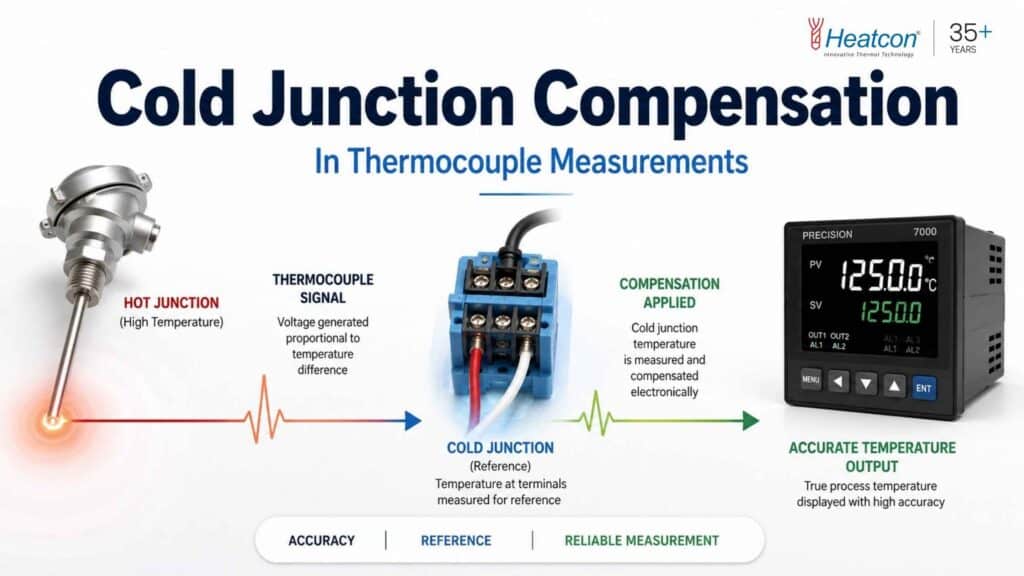
How does cold junction compensation work in thermocouple measurements?
Thermocouples generate a voltage based on the temperature difference between their two junctions: the measuring (hot) junction and the reference (cold) junction. However, since the cold junction is rarely at a fixed 0°C, its actual temperature must be measured and accounted for—a process called cold junction compensation. This ensures that the thermocouple measurement reflects the true temperature at the point of interest, not skewed by the ambient temperature at the reference end.
Cold junction compensation is typically implemented using precision sensors such as RTDs or thermistors placed near the cold junction. These sensors measure the actual temperature of the terminal block or connection point, allowing electronic systems to perform thermoelectric voltage correction and add or subtract the appropriate value to the thermocouple’s output. The result is a highly accurate temperature reading, regardless of fluctuations at the reference junction.
Why is cold junction compensation essential for thermocouple measurement accuracy?
Without cold junction compensation, even the highest-quality thermocouples would produce unreliable data. Thermocouple measurement accuracy depends not only on the sensor itself but also on the ability to accurately correct for the reference junction’s temperature. In a complex industrial environment, ambient temperatures can vary significantly—leading to potential errors that can disrupt process control, impact product quality, or even compromise safety.
- Ensures reliable process automation and quality control in manufacturing.
- Prevents costly downtime due to incorrect temperature readings.
- Is mandatory for compliance with many international standards in industries like pharmaceuticals, food processing, and aerospace.
At Heatcon Sensors, we make thermocouple measurement accuracy a priority by integrating advanced cold junction compensation techniques in every temperature sensor we manufacture.
What is thermocouple CJC and how does it function?
Thermocouple CJC stands for Cold Junction Compensation, a term often used to describe both the process and the specific hardware or circuitry responsible for compensation. The thermocouple CJC system typically involves:
- Temperature sensing at the reference junction using an RTD or thermistor.
- Analog or digital circuitry to calculate the required compensation value.
- Integration with the measurement device to provide a corrected, accurate temperature reading.
This system is fundamental in digital temperature controllers, data acquisition systems, and industrial automation platforms, ensuring seamless integration and dependable results in real-world conditions.
What is thermoelectric voltage correction and why is it important?
Thermoelectric voltage correction refers to the adjustment made to the raw output of a thermocouple to account for the temperature at the cold junction. Since a thermocouple only measures the difference in temperature between its two ends, the measured voltage must be corrected mathematically to provide the absolute temperature at the process end.
The importance of thermoelectric voltage correction cannot be overstated:
- It translates a differential voltage into a meaningful, usable temperature value.
- It ensures that process control systems receive precise data, reducing the risk of equipment malfunction or product spoilage.
- It is a foundational principle in the design of all professional-grade temperature measurement equipment.
Heatcon Sensors employs industry-leading correction algorithms and hardware, ensuring our thermocouples and temperature measurement systems deliver the reliability demanded by critical industries globally.
How does Heatcon Sensors deliver customized thermocouple solutions worldwide?
Heatcon Sensors is a globally recognized manufacturer of customized RTDs, thermocouples, and temperature sensors, catering to the unique requirements of industries in India, the United States, UAE, Indonesia, Germany, South Korea, Saudi Arabia, Russia, Bahrain, Kuwait, and beyond. We understand that every industrial process is unique, demanding tailored solutions for optimal temperature monitoring and control.
- Custom-built sensors for a range of applications—whether for steel plants, pharmaceuticals, food processing, or aerospace.
- Compliance with international standards to ensure compatibility and reliability.
- Rapid delivery across the globe, supporting clients in major cities and industrial hubs.
Our technical team works closely with clients, from concept to deployment, ensuring that every sensor integrates seamlessly into existing systems. Whether you need a single sensor or bulk orders for a new plant, Heatcon Sensors has the expertise, infrastructure, and global reach to deliver.
What other products does Heatcon Sensors manufacture?
Besides being an industry leader in temperature sensors, Heatcon Sensors also manufactures a comprehensive range of heat generating equipment crucial to industrial processes. Our product portfolio includes:
- Industrial furnaces and electric furnaces for metallurgy and material testing.
- Ovens for drying, curing, and heat treatment applications.
- Hot air blowers for controlled atmosphere heating.
- High density cartridge heaters for localized, high-temperature heating needs.
- Immersion heaters, band heaters, tubular heaters, and custom heating solutions for specialized requirements.
All our products are designed with reliability, longevity, and ease of integration in mind. We support industries ranging from automotive to chemicals, food & beverage to semiconductors, ensuring that every heat generating equipment matches the client’s process demands.
How to get in touch with Heatcon Sensors for your temperature sensing needs?
If you are looking for industry-leading cold junction compensation solutions, or need customized temperature sensors and heating equipment, Heatcon Sensors is your trusted partner. We offer multiple convenient ways to reach out:
- Online Form: Submit your requirements at https://heatconsensors.com/contact-us/.
- Whatsapp: Leave a message through the Whatsapp interface available on our website for quick and interactive support.
- Direct Call: For immediate assistance, call us at +91 9164833027 or +91 9844233244.
Our technical consultants are ready to provide expert guidance, from initial consultation through to technical support post-installation. Don’t let inaccurate temperature measurement put your operations at risk—partner with Heatcon Sensors for the ultimate in thermocouple measurement accuracy.
About Heatcon Sensors
Heatcon Sensors is a leading manufacturer and supplier of industrial temperature sensors, thermocouples, RTDs, and heat generating equipment based in India and serving clients worldwide. With decades of expertise and a commitment to innovation, we deliver solutions that set the standard for accuracy, reliability, and customer satisfaction. Our products are trusted by industries in India, US, UAE, Indonesia, Germany, South Korea, Saudi Arabia, Russia, Bahrain, Kuwait, and many more.
Experience the difference with Heatcon Sensors—where precision meets reliability, and your process safety is always our priority.
Summary table: Key concepts of cold junction compensation in thermocouple measurements
| Concept | Explanation |
|---|---|
| Cold junction compensation | Correction of the thermocouple reading to account for the temperature at the reference (cold) junction. |
| Thermocouple CJC | System or process that measures and compensates for the cold junction temperature in thermocouple circuits. |
| Thermocouple measurement accuracy | The degree to which the measured temperature matches the actual process temperature, greatly improved by CJC. |
| Thermoelectric voltage correction | Mathematical adjustment applied to the thermocouple’s voltage output to provide a true temperature reading. |
Frequently Asked Questions
What is cold junction compensation and why is it essential in thermocouple measurements?
Cold junction compensation is a critical technique used to ensure accurate temperature readings from thermocouples. Since a thermocouple creates a voltage based on the temperature difference between the measuring (hot) junction and the reference (cold) junction, accurately knowing the temperature of the cold junction is essential. Without proper compensation, errors from ambient temperature changes at the reference junction can significantly impact thermocouple measurement accuracy. By applying cold junction compensation, you can correct for these errors and achieve precise temperature readings.
How does thermocouple CJC (Cold Junction Compensation) work?
Thermocouple CJC involves measuring the temperature at the reference junction, usually with a precise electronic sensor such as a thermistor, RTD, or semiconductor sensor. This value is then used to mathematically correct the thermoelectric voltage generated by the thermocouple. The correction ensures that the displayed temperature reflects the true temperature at the measuring junction, not influenced by temperature variations at the reference point.
What happens if cold junction compensation is not applied?
If cold junction compensation is omitted, the output from the thermocouple will not account for changes in the reference junction temperature. This can introduce significant errors into your readings, especially in environments with fluctuating ambient temperatures. The result is compromised thermocouple measurement accuracy, which can lead to incorrect process control or quality issues in temperature-sensitive applications.
What is thermoelectric voltage correction in thermocouple systems?
Thermoelectric voltage correction refers to the adjustment made to the raw voltage signal produced by a thermocouple to account for the temperature at the cold junction. This correction uses the measured cold junction temperature to mathematically adjust the thermocouple’s output, ensuring that the final reading is accurate and representative of the process temperature you wish to measure.
How does Heatcon Sensors ensure reliable cold junction compensation?
Heatcon Sensors integrates high-precision cold junction sensing elements within its thermocouple measurement solutions. These elements, often digital or analog temperature sensors, are carefully placed at the reference junction and interfaced with microprocessor-based instruments. Advanced algorithms are used for thermoelectric voltage correction, guaranteeing optimal thermocouple measurement accuracy, even in challenging environments.
What types of thermocouples and compensation modules does Heatcon Sensors offer?
Heatcon Sensors provides a comprehensive range of thermocouples including Types K, J, T, E, N, R, S, and B, all designed with built-in or external cold junction compensation modules. Our compensation modules are engineered for compatibility with both standard and custom instrumentation, ensuring seamless integration and reliable thermoelectric voltage correction for every application.
Can Heatcon Sensors customize cold junction compensation solutions for unique applications?
Absolutely. Heatcon Sensors specializes in designing customized thermocouple CJC solutions tailored to your industry’s specific requirements. Whether you need compact modules for tight spaces, enhanced accuracy for laboratory use, or robust compensation in harsh industrial environments, our engineering team can deliver a solution that fits your needs.
How do I know if my system requires cold junction compensation?
If your temperature measurement application demands high accuracy or operates in environments where the reference junction temperature may change, you need cold junction compensation. For most industrial, laboratory, and process control scenarios, incorporating a reliable thermocouple CJC system—such as those offered by Heatcon Sensors—is essential for error-free data.
What are the benefits of using Heatcon Sensors’ cold junction compensation technology?
By choosing Heatcon Sensors, you benefit from industry-leading cold junction compensation technology that ensures maximum thermocouple measurement accuracy, robust design for diverse environments, and easy integration with your existing systems. Our expertise in thermoelectric voltage correction and CJC module design helps you achieve reliable, repeatable, and precise temperature readings for critical applications.