
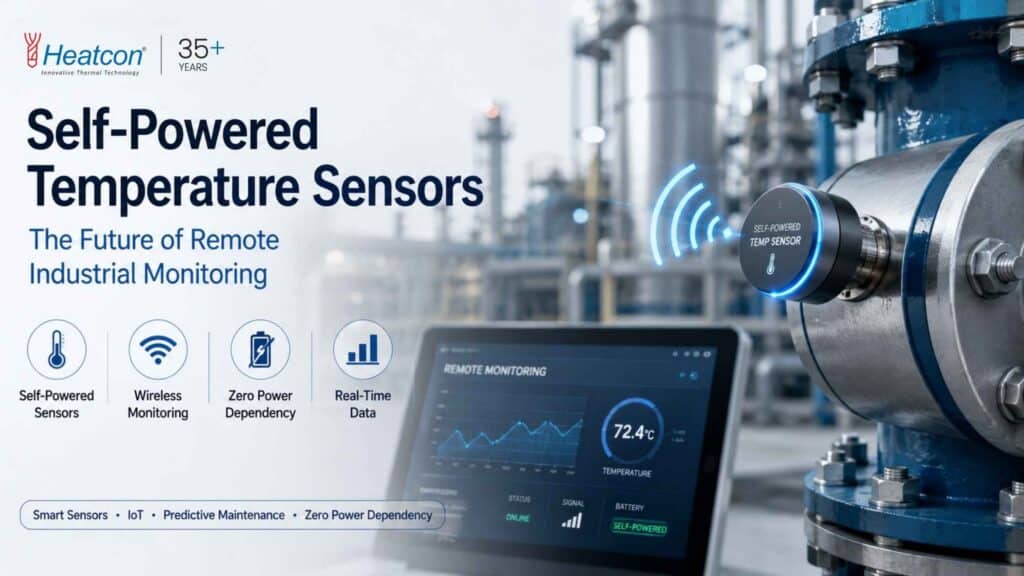
According to industry reports published in the public domain, the Industrial Internet of Things (IIoT) market is projected to surpass hundreds of billions of dollars globally before the end of this decade, with temperature sensing and predictive maintenance emerging as two of the biggest drivers of industrial automation. At the center of this transformation are self-powered temperature sensors, which are rapidly redefining how industries monitor critical thermal processes without dependence on conventional power systems. As industries seek smarter, more reliable, and maintenance-free monitoring solutions, companies that fail to adopt advanced sensing technology risk operational downtime, production losses, safety hazards, and increased maintenance expenditure.
Modern manufacturing facilities, oil and gas plants, pharmaceutical production lines, food processing units, aerospace facilities, steel industries, semiconductor plants, and chemical processing units require uninterrupted temperature monitoring to ensure precision, compliance, and operational continuity. Traditional wired systems and battery-dependent monitoring equipment often struggle in harsh industrial environments where accessibility is difficult, maintenance cycles are expensive, and equipment reliability directly impacts profitability.
This is precisely where Heatcon Sensors has positioned itself as a trusted industrial partner. Heatcon Sensors manufactures customized RTDs, thermocouples, industrial temperature sensors, and advanced thermal monitoring systems engineered for demanding industrial applications. The company also manufactures heat generating equipment including industrial furnaces, electric furnaces, laboratory furnaces, industrial ovens, hot air blowers, immersion heaters, duct heaters, ceramic heaters, tubular heaters, mica band heaters, infrared heaters, and high density cartridge heaters for industries across India and global markets.
What are self-powered temperature sensors?
Self-powered temperature sensors are advanced sensing devices capable of generating or harvesting the energy required for their own operation, eliminating the need for conventional external power sources or frequent battery replacements. These sensors are becoming essential for industries that require long-term, uninterrupted remote monitoring in inaccessible or hazardous environments.
Unlike conventional systems that depend heavily on wired infrastructure, self-powered temperature sensors utilize thermal gradients, vibration, motion, radio frequency signals, or ambient environmental energy to sustain operation. This innovation significantly reduces maintenance requirements while improving operational reliability.
For industries operating in remote oil fields, offshore platforms, chemical plants, high-temperature manufacturing zones, mining operations, or geographically distributed facilities, the shift toward autonomous sensing systems is no longer optional. It is becoming a competitive necessity.
Why are industries shifting toward wireless industrial monitoring?
Wireless industrial monitoring enables industries to gather real-time thermal data without extensive cabling, complicated infrastructure, or frequent maintenance interventions. The demand for wireless systems has increased because industries require faster decision-making, predictive maintenance capabilities, and scalable monitoring networks.
Traditional monitoring systems often face limitations such as:
- High installation costs
- Complex wiring infrastructure
- Frequent maintenance requirements
- Battery replacement challenges
- Limited accessibility in hazardous environments
- Downtime caused by cable damage or power interruptions
Wireless industrial monitoring solves these challenges by enabling seamless communication between sensors, control systems, cloud platforms, and predictive analytics software. With remote accessibility becoming critical for Industry 4.0 initiatives, industrial operators can now monitor temperature-sensitive operations from centralized control rooms or even from remote locations worldwide.
Heatcon Sensors supports industries by manufacturing customized temperature sensing solutions compatible with modern wireless industrial monitoring infrastructures. Their engineering expertise allows industries to deploy scalable monitoring systems tailored specifically for operational requirements.
How do energy harvesting sensors improve industrial efficiency?
Energy harvesting sensors convert ambient energy into usable electrical energy for powering industrial sensing systems. This capability dramatically improves operational efficiency because it minimizes manual intervention and reduces maintenance-related downtime.
Industries increasingly prefer energy harvesting sensors because they can operate continuously in difficult industrial environments where battery replacement is costly, unsafe, or practically impossible.
Common energy sources utilized by energy harvesting sensors include:
| Energy Source | Industrial Application |
|---|---|
| Thermal gradients | Furnaces, boilers, reactors, ovens |
| Mechanical vibration | Rotating machinery, turbines, compressors |
| Solar energy | Outdoor industrial installations |
| Radio frequency energy | Industrial communication systems |
| Airflow and motion | HVAC systems and process automation |
By integrating energy harvesting sensors into industrial systems, companies can reduce operational expenditure while improving monitoring continuity and equipment reliability.
Heatcon Sensors custom-manufactures industrial-grade RTDs, thermocouples, and sensor assemblies capable of integration into advanced thermal management and automation systems used across industries worldwide.
Why are battery-free sensors becoming essential in Industry 4.0?
Battery-free sensors are rapidly becoming the preferred solution for next-generation industrial automation because they eliminate one of the biggest maintenance burdens associated with remote monitoring systems: battery replacement.
In large-scale industrial facilities containing thousands of sensing points, battery replacement schedules can become operationally expensive and logistically complex. Industries operating in hazardous environments face even greater challenges because maintenance personnel may require shutdown procedures, safety approvals, and specialized access equipment.
Battery-free sensors help industries:
- Reduce maintenance costs
- Improve operational continuity
- Enhance workplace safety
- Enable long-term remote monitoring
- Support sustainability initiatives
- Reduce electronic waste generation
- Improve reliability in inaccessible locations
As factories evolve toward fully connected smart manufacturing ecosystems, battery-free sensors are expected to become standard components within predictive maintenance and industrial analytics frameworks.
What role do remote thermal sensors play in predictive maintenance?
Remote thermal sensors enable industries to detect abnormal temperature variations before equipment failures occur. This early-warning capability is one of the most important components of predictive maintenance strategies.
Temperature fluctuations often provide the first indication of:
- Bearing failures
- Electrical overload conditions
- Furnace inefficiencies
- Motor overheating
- Insulation degradation
- Process instability
- Thermal runaway conditions
Remote thermal sensors continuously transmit thermal data from critical equipment locations to centralized monitoring systems, allowing maintenance teams to identify potential issues before catastrophic failures occur.
For industries operating around-the-clock production environments, even a few hours of unplanned downtime can result in significant financial losses. Companies relying solely on traditional inspection methods may discover faults only after production has already been compromised.
Heatcon Sensors manufactures customized remote thermal sensors engineered for harsh industrial conditions involving high temperatures, corrosive environments, vibration-prone installations, and process-critical applications.
How does Heatcon Sensors support modern industrial monitoring requirements?
Heatcon Sensors is an industrial temperature sensing and thermal equipment manufacturer specializing in customized RTDs, thermocouples, industrial heaters, and thermal process solutions designed for demanding industrial applications.
The company manufactures and supplies:
- Customized RTDs
- Thermocouples
- Industrial temperature sensors
- Mineral insulated sensors
- Surface temperature sensors
- High-temperature thermocouples
- Industrial furnaces
- Electric furnaces
- Industrial ovens
- Hot air blowers
- High density cartridge heaters
- Immersion heaters
- Infrared heaters
- Duct heaters
- Tubular heaters
- Ceramic heaters
- Mica band heaters
Every industrial process has unique operational requirements. Heatcon Sensors focuses on engineering customized sensing solutions rather than forcing industries into standardized products that may not deliver optimal performance.
Whether a facility requires temperature monitoring for pharmaceutical manufacturing in India, semiconductor production in South Korea, petrochemical processing in Saudi Arabia, aerospace manufacturing in Germany, industrial automation in the United States, refinery applications in Kuwait, or energy infrastructure in the UAE, Heatcon Sensors can custom manufacture and supply industrial temperature sensing solutions globally.
Why is remote industrial monitoring critical for the future?
Remote industrial monitoring is no longer a futuristic concept. It is now a fundamental operational requirement for industries seeking higher efficiency, lower downtime, and improved process visibility.
Several industrial trends are accelerating adoption:
- Growing industrial automation initiatives
- Increasing labor shortages in technical maintenance roles
- Expansion of geographically distributed operations
- Rising focus on predictive maintenance
- Demand for energy efficiency optimization
- Need for regulatory compliance and traceability
- Rapid adoption of Industrial IoT ecosystems
Facilities that delay modernization often face:
- Unexpected equipment failures
- Increased maintenance expenditure
- Production inefficiencies
- Safety incidents
- Reduced operational competitiveness
Forward-thinking industries are increasingly investing in advanced sensing technologies because they understand that thermal data intelligence directly influences operational profitability.
How customized RTDs and temperature sensors improve industrial reliability
Not all industrial applications can rely on generic off-the-shelf temperature sensors. Harsh environments involving pressure fluctuations, corrosive chemicals, extreme temperatures, high vibration, or strict hygiene standards require application-specific sensor engineering.
Customized RTDs and thermocouples offer:
- Improved measurement accuracy
- Extended operational lifespan
- Better compatibility with industrial processes
- Enhanced thermal response time
- Superior environmental resistance
- Reduced maintenance frequency
- Higher process reliability
Heatcon Sensors works closely with industrial clients to manufacture custom-designed temperature sensing systems aligned precisely with operational conditions and process objectives.
About Heatcon Sensors
Heatcon Sensors is a specialized industrial manufacturer focused on customized RTDs, thermocouples, industrial temperature sensors, and thermal process equipment for diverse industrial sectors worldwide. The company serves industries requiring precision thermal monitoring, industrial heating systems, and advanced temperature management solutions.
With expertise spanning industrial automation, process heating, thermal engineering, and remote monitoring applications, Heatcon Sensors supports industries across India, the United States, UAE, Indonesia, Germany, South Korea, Saudi Arabia, Russia, Bahrain, Kuwait, and many other global markets.
Businesses looking to modernize industrial monitoring infrastructure, improve predictive maintenance capabilities, and enhance operational efficiency can reach Heatcon Sensors through any of the following methods:
- Submit your information through the contact form at https://heatconsensors.com/contact-us/
- Leave a message through the WhatsApp interface available on the Heatcon Sensors website
- Call +91 9164833027 for immediate assistance
- Call +91 9844233244 for technical guidance and product support
As industries continue transitioning toward smarter automation ecosystems, organizations that invest early in intelligent temperature monitoring technologies will position themselves ahead of competitors struggling with outdated infrastructure. The future of industrial monitoring belongs to intelligent, autonomous, reliable sensing systems — and Heatcon Sensors is helping industries build that future today.
Frequently Asked Questions
What are self-powered temperature sensors and why are they important for modern industries?
self-powered temperature sensors are advanced monitoring devices designed to generate their own operational energy without relying on traditional batteries or wired power sources. These systems are becoming increasingly important in industries where continuous thermal monitoring is critical but conventional wiring is expensive, impractical, or difficult to maintain.
Heatcon Sensors develops reliable sensor solutions that support long-term industrial efficiency, especially in remote or hazardous environments. These sensors help manufacturers reduce downtime, improve predictive maintenance, and maintain stable process conditions while minimizing maintenance requirements.
How do energy harvesting sensors work in industrial environments?
energy harvesting sensors capture small amounts of ambient energy from sources such as heat gradients, vibration, motion, or light and convert that energy into usable electrical power. This allows the sensors to operate independently for extended periods without frequent servicing.
In industrial settings, Heatcon Sensors integrates these technologies into monitoring systems that support high-temperature operations, rotating machinery, pipelines, and remote equipment installations. The result is a more sustainable and cost-effective monitoring infrastructure that reduces dependence on external power supplies.
Why is wireless industrial monitoring becoming essential in manufacturing plants?
wireless industrial monitoring enables industries to collect real-time operational data without extensive cabling or complicated installation procedures. As manufacturing plants move toward Industry 4.0 and smart automation, wireless systems provide greater flexibility, scalability, and faster deployment across multiple production zones.
Heatcon Sensors supports industrial clients with monitoring solutions that improve visibility into temperature fluctuations, equipment health, and environmental conditions. Wireless deployment also helps reduce installation disruptions and lowers long-term maintenance costs for expanding facilities.
What are the advantages of battery-free sensors in remote monitoring applications?
battery-free sensors eliminate the need for regular battery replacement, which is especially valuable in hard-to-access industrial locations such as offshore facilities, power plants, chemical processing units, and remote pipelines.
By removing battery dependency, industries can reduce maintenance interruptions, improve operational safety, and lower environmental waste associated with discarded batteries. Heatcon Sensors focuses on dependable sensing technologies that help organizations achieve continuous monitoring with reduced operational complexity.
How do remote thermal sensors improve predictive maintenance strategies?
remote thermal sensors continuously track temperature variations in industrial systems and equipment. Abnormal thermal patterns often indicate issues such as overheating, friction, insulation breakdown, or equipment fatigue before major failures occur.
Heatcon Sensors provides monitoring solutions that help maintenance teams identify these warning signs early, allowing timely intervention and minimizing costly production shutdowns. Real-time temperature intelligence also supports better asset management and improved equipment lifespan.
Which industries benefit the most from self-powered temperature monitoring technologies?
Industries that operate in demanding or distributed environments benefit significantly from self-powered monitoring systems. This includes oil and gas, power generation, steel manufacturing, pharmaceuticals, automotive production, mining, logistics, and chemical processing facilities.
Heatcon Sensors designs solutions suitable for environments where reliability, durability, and long-term performance are essential. These technologies are particularly useful in locations where wired infrastructure is expensive or ongoing maintenance access is limited.
Can Heatcon Sensors customize monitoring solutions for different industrial requirements?
Yes. Heatcon Sensors understands that industrial monitoring requirements vary depending on operational conditions, environmental exposure, temperature ranges, and compliance standards. The company offers customized sensing and monitoring solutions designed to align with specific industrial applications.
Whether the requirement involves high-temperature processes, outdoor installations, critical infrastructure, or automated manufacturing systems, tailored monitoring solutions help ensure accurate performance and seamless integration with existing industrial workflows.
What is the future of remote industrial monitoring with intelligent sensor technology?
The future of remote industrial monitoring is centered around intelligent, low-maintenance, and connected sensing systems that support automation and real-time analytics. Industries are increasingly adopting smart sensor networks that deliver accurate operational insights while reducing manual inspection requirements.
Heatcon Sensors continues to support this transition by developing reliable thermal monitoring solutions that align with modern industrial automation goals. As industrial facilities become more connected, advanced sensor technologies will play a key role in improving safety, sustainability, and operational efficiency.