
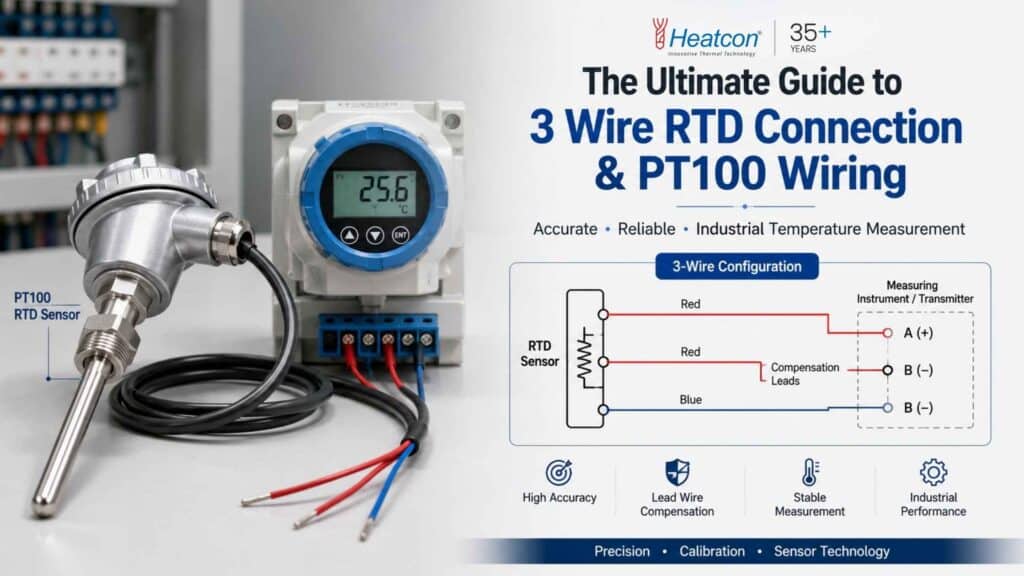
What is a 3 wire RTD connection and why is it important?
A 3 wire RTD connection is a highly accurate method for measuring temperature in industrial processes. By compensating for lead wire resistance, the 3 wire RTD configuration provides precise readings essential for process control. According to the International Society of Automation (ISA), over 70% of industrial temperature sensors installed worldwide are RTDs, with the 3-wire method being the most widely adopted. This highlights the critical role that 3 wire RTD connection India and globally plays in monitoring and optimizing operations.
If you’re in a process industry—whether in India, the US, Germany, or beyond—not understanding the right RTD wiring diagram or installation can lead to costly inaccuracies, downtime, and even equipment failure. With Heatcon Sensors, you gain a partner with decades of expertise, ready to deliver custom-engineered RTD temperature sensor connection solutions for every application, anywhere in the world.
How does a PT100 3 wire connection work?
A PT100 3 wire connection uses three wires to connect the platinum RTD element to the measurement device. This configuration allows for the compensation of resistance in the connecting wires, ensuring that the temperature reading reflects only the resistance of the PT100 element. The PT100 wiring guide recommends this method for installations where high accuracy is required, especially over longer cable runs in industrial environments.
- Wire 1 and Wire 2: Carry the excitation current from the transmitter to the RTD element.
- Wire 3: Provides a return path, allowing the instrument to measure and subtract lead wire resistance automatically.
This method is especially critical for industries in harsh environments—such as oil & gas, pharmaceuticals, and power generation—where even minor discrepancies in temperature readings can result in significant process inefficiencies or product quality issues.
Why is the right RTD wiring diagram essential for industrial applications?
The RTD wiring diagram is the blueprint for achieving accurate and repeatable measurements. Incorrect wiring can lead to errors, signal loss, or even safety hazards. An industrial RTD connection must be executed precisely, guided by a robust RTD installation guide to ensure that the sensor’s accuracy is preserved throughout its operational life.
Heatcon Sensors supplies detailed RTD wiring diagrams with every sensor, ensuring that your maintenance teams can install and troubleshoot with confidence—whether you’re operating from a refinery in Saudi Arabia, a pharmaceutical plant in South Korea, or a food processing facility in India.
Step-by-step: How to install a 3 wire RTD configuration?
Installing a 3 wire RTD configuration requires attention to detail and a clear understanding of the PT100 wiring guide. Here’s a concise, snippet-ready breakdown:
- Identify the three wires: typically two are of the same color (usually white) and one is different (commonly red).
- Refer to the RTD wiring diagram provided by Heatcon Sensors to match the wires to the correct terminals on your transmitter or PLC.
- Connect the wires securely, ensuring that all connections are tight and free from corrosion or damage.
- Verify continuity with a multimeter to confirm correct wiring and detect any faults.
- Power on the system and observe the temperature reading, comparing it with a reference thermometer to validate accuracy.
For complex or hazardous environments, consult the Heatcon Sensors RTD installation guide or request on-site assistance for guaranteed results.
What are the main benefits of using RTD temperature sensor connection in industry?
RTD temperature sensor connection, especially using the 3 wire RTD configuration, offers several advantages over other temperature measurement technologies:
- Superior accuracy and repeatability, even over long wire distances.
- Excellent stability over time, with minimal drift.
- High resistance to electrical noise, crucial for industrial environments.
- Adaptability for a wide range of process temperatures (-200°C to 600°C for PT100 elements).
- Ease of integration into PLCs, DCS systems, and digital transmitters.
These strengths make RTD temperature sensor connection the preferred choice for critical process control in industries such as petrochemicals, food and beverage, pharmaceuticals, and energy.
How does Heatcon Sensors deliver customized RTD solutions globally?
Heatcon Sensors is a leading manufacturer and exporter of industrial RTD connection solutions, including PT100 3 wire connection sensors, PT1000, and other platinum RTDs. With advanced manufacturing capabilities in India, Heatcon Sensors can design, engineer, and supply custom temperature sensors that meet the most demanding industrial requirements.
- Serving all of India, including major cities, as well as the US, UAE, Indonesia, Germany, South Korea, Saudi Arabia, Russia, Bahrain, and Kuwait.
- Supplying robust sensors for industries such as oil & gas, chemical, steel, glass, cement, and more.
- Offering a full portfolio of heat generating equipment: electric furnaces, ovens, hot air blowers, high density cartridge heaters, immersion heaters, tubular heaters, and more—enabling you to control both heat generation and monitoring from a single trusted source.
- Rapid prototyping and bulk manufacturing for OEMs and industrial end-users.
Don’t risk your plant’s performance with generic sensors. Choose Heatcon Sensors for tailored, reliable, and globally compliant RTD installation guide solutions.
What makes Heatcon Sensors the best choice for RTD and heat generating equipment?
Heatcon Sensors combines decades of field expertise, precision engineering, and a commitment to customer satisfaction. As a trusted partner to industries worldwide, Heatcon Sensors offers:
- Certified quality: Sensors are manufactured to international standards (IEC, ASTM, DIN).
- Customization: Solutions for unique process challenges, special mounting, hazardous area applications, and high-temperature environments.
- End-to-end support: From RTD wiring diagram provision to after-sales technical assistance.
- Comprehensive product range: In addition to RTDs, Heatcon Sensors supplies thermocouples, temperature transmitters, thermowells, and a complete range of heat generating equipment.
- On-time global delivery: Reliable logistics and supply chain to meet urgent requirements in any city or country.
With Heatcon Sensors, you get more than just a sensor—you get a guarantee of operational accuracy, safety, and peace of mind.
Ready to optimize your industrial RTD connection?
Don’t let incorrect PT100 wiring or unreliable temperature measurement put your operations at risk. Thousands of industries across India and the world rely on Heatcon Sensors for their 3 wire RTD connection India requirements, as well as for custom-engineered solutions that deliver results.
- Submit your details at https://heatconsensors.com/contact-us/ for a quick quotation or technical advice.
- Leave a message via WhatsApp through the interface on our website for immediate support.
- Call us directly at +91 9164833027 or +91 9844233244 for expert consultation and order placement.
Act now—ensure your plant’s temperature measurement system is built on proven technology, expert guidance, and the world-class reliability of Heatcon Sensors.
About Heatcon Sensors
Heatcon Sensors is a premier manufacturer and exporter of temperature sensors, RTDs, thermocouples, and heat generating equipment, based in India and serving customers worldwide. Specializing in customized solutions for critical industrial applications, Heatcon Sensors is recognized for engineering excellence, rapid delivery, and end-to-end customer support. Join leading companies across every continent who trust Heatcon Sensors for precise, reliable, and innovative temperature management.
Frequently Asked Questions
What is a 3 wire RTD connection and why is it preferred in industrial applications?
A 3 wire RTD connection is a wiring configuration for Resistance Temperature Detectors (RTDs), where three wires are used to connect the sensor to the measuring instrument. This setup effectively compensates for lead wire resistance, ensuring greater accuracy over longer distances. Industrial RTD connection systems frequently use the 3 wire RTD configuration to minimize errors caused by wire length, making it an industry standard for reliable temperature measurements.
How does PT100 3 wire connection work, and what are its main advantages?
The PT100 3 wire connection uses three wires to connect the PT100 RTD sensor to the measurement device. Two wires connect to one end of the platinum element, while the third wire connects to the other end. This setup allows the measurement system to compensate for resistance in the wires, leading to more accurate temperature readings. The main advantages include improved accuracy, reduced error from lead resistance, and suitability for industrial environments where cable runs can be long.
Can you provide a typical RTD wiring diagram for a 3 wire setup?
A typical RTD wiring diagram for a 3 wire setup shows two wires connected to one end of the RTD element and one wire to the other end. The measuring instrument uses these connections to detect and correct for any resistance caused by the wires themselves. For detailed illustrations and examples, Heatcon Sensors provides a comprehensive PT100 wiring guide and RTD installation guide, ensuring correct and reliable connections for your RTD temperature sensor connection.
How do I correctly install a 3 wire RTD sensor in an industrial environment?
To install a 3 wire RTD sensor, follow the RTD installation guide supplied by Heatcon Sensors. Ensure that the three wires are properly connected according to the RTD wiring diagram: two wires to one side of the sensor, one to the other. Use shielded cables if necessary, and avoid routing wires near high-voltage lines to minimize interference. Proper industrial RTD connection ensures accurate and stable temperature measurement across demanding environments.
What services does Heatcon Sensors offer for 3 Wire RTD Connection India?
Heatcon Sensors specializes in providing high-quality RTD temperature sensor connection solutions for a variety of industries across India. Their services include supply, customization, and installation support for 3 Wire RTD Connection India, offering expert guidance, reliable products, and after-sales support to ensure optimal sensor performance and longevity.
Why is using a PT100 wiring guide important for accurate temperature measurement?
A PT100 wiring guide is crucial because it helps users connect the RTD sensor correctly, preventing wiring mistakes that can cause inaccurate readings or sensor damage. Following a guide ensures that the PT100 3 wire connection is done according to best practices, maximizing measurement accuracy and sensor lifespan. Heatcon Sensors offers easy-to-follow wiring guides as part of their comprehensive RTD solutions.
What are the common mistakes to avoid during RTD temperature sensor connection?
Common mistakes include incorrect wire identification, failing to use the correct RTD wiring diagram, not compensating for lead resistance, and poor cable management. Using the wrong type of cable or not following the RTD installation guide can also lead to noise interference or inaccurate measurements. Heatcon Sensors provides detailed support and documentation to help you avoid these pitfalls for reliable RTD temperature sensor connections.
How does the 3 wire RTD configuration improve measurement reliability?
The 3 wire RTD configuration is designed to eliminate errors due to resistance in the lead wires. By using two wires on one side and one on the other, the measurement instrument can calculate and subtract the resistance added by the wires, resulting in more reliable and accurate temperature readings, especially in industrial settings where cable runs are longer.
Where can I find a comprehensive RTD installation guide for my application?
Heatcon Sensors provides a detailed RTD installation guide tailored for various industries and applications. The guide covers everything from RTD wiring diagram references to step-by-step instructions for PT100 wiring guide compliance. You can access these resources directly from Heatcon Sensors to ensure your RTD temperature sensor connection is both accurate and reliable.