
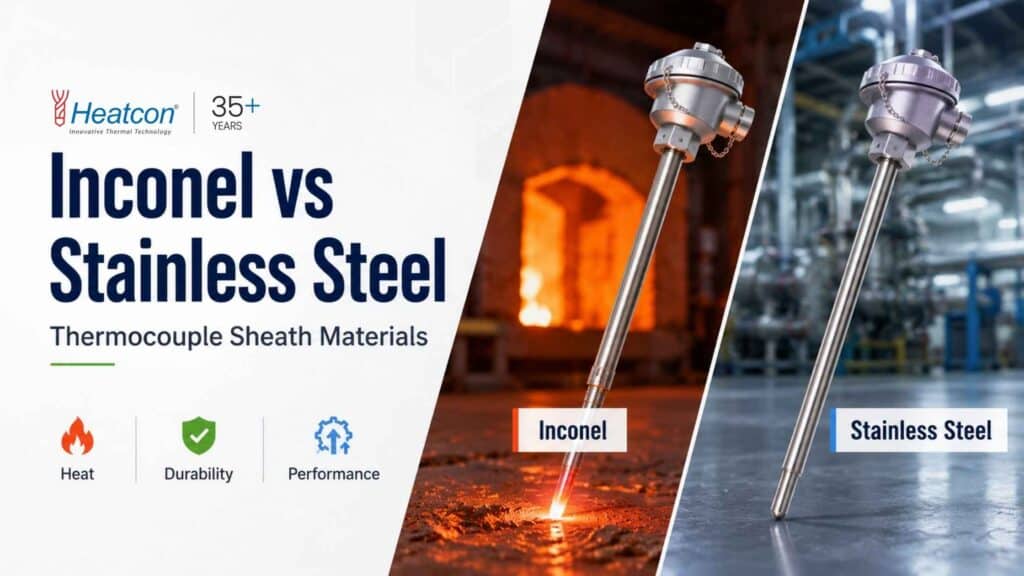
Choosing the right thermocouple sheath materials is critical for ensuring durability and accuracy in extreme environments. According to industry reports, up to 60% of thermocouple failures in industrial applications are attributed to unsuitable sheath material selection. This makes understanding the differences between Inconel and stainless steel essential for engineers, plant managers, and quality specialists. Whether you operate a refinery in India, a chemical plant in the US, or a research lab in Germany, the choice of sheath material can impact your process safety, equipment longevity, and measurement accuracy.
What Are Thermocouple Sheath Materials And Why Do They Matter?
Thermocouple sheath materials are the protective outer tubes that encase the sensitive thermoelectric wires inside a thermocouple. Their main role is to safeguard against harsh environmental factors, including high temperatures, corrosive chemicals, mechanical wear, and pressure fluctuations. The right sheath material ensures the sensor delivers accurate readings and remains reliable over time, especially in extreme conditions.
- Protects thermocouple wires from contamination and corrosion
- Enables deployment in aggressive industrial environments
- Directly impacts sensor lifespan and measurement accuracy
How To Choose Between Inconel Thermocouple And Stainless Steel Thermocouple Sheath?
The decision between an Inconel thermocouple and a stainless steel thermocouple sheath hinges on the specific challenges of your application. Here’s a concise comparison:
| Feature | Inconel Thermocouple | Stainless Steel Thermocouple Sheath |
|---|---|---|
| Temperature Range | Up to 1150°C (2100°F) | Up to 900°C (1650°F) |
| Corrosion Resistance | Excellent in acidic, alkaline, and high-salinity environments | Very good, but limited in high-chloride or acidic conditions |
| Mechanical Strength | Very high, maintains integrity at extreme temperatures | High, but may weaken at upper temperature limits |
| Cost | Higher initial investment | Economical, widely available |
| Typical Applications | Furnaces, petrochemical, aerospace, nuclear plants | Food processing, pharmaceuticals, general industry |
What Is Inconel And When Should You Use An Inconel Thermocouple?
Inconel is a family of nickel-chromium-based superalloys renowned for their exceptional resistance to heat, oxidation, and corrosion. Inconel thermocouple sheaths are the preferred choice in applications that demand the ultimate in durability and stability, such as:
- High-temperature furnaces and kilns
- Chemical and petrochemical reactors
- Marine and offshore environments
- Power generation (turbines, nuclear reactors)
- Heat-treating and metallurgy processes
The unique properties of Inconel allow these sensors to operate reliably at temperatures exceeding 1000°C, repel aggressive chemicals, and withstand cyclic heating and cooling. This makes Inconel thermocouple solutions indispensable for critical processes where sensor failure is not an option.
Why Choose Stainless Steel Thermocouple Sheath?
Stainless steel thermocouple sheath options are highly popular due to their favorable balance of cost, durability, and corrosion resistance. Stainless steel alloys such as SS304, SS316, and SS310 are widely used in:
- Food and beverage manufacturing
- Pharmaceutical and life sciences
- Oil and gas processing
- Water and wastewater treatment
- General industrial heating applications
Stainless steel thermocouple sheath is ideal for environments where moderate temperature resistance and general corrosion protection are required. While not as robust as Inconel in highly aggressive conditions, stainless steel remains a versatile and economical choice for many industries.
What Makes Corrosion-Resistant Thermocouples Essential?
Corrosion-resistant thermocouples are vital for maintaining process safety and product quality in industries exposed to aggressive chemicals, high humidity, or saline conditions. A corroded thermocouple can lead to inaccurate readings, unsafe operations, and costly downtime. To prevent these issues, selecting the right sheath material—be it Inconel or stainless steel—is crucial.
- Improves equipment uptime and process reliability
- Reduces maintenance costs and frequency of replacement
- Ensures compliance with industry safety standards
Heatcon Sensors offers a comprehensive range of corrosion-resistant thermocouples designed to perform in even the harshest industrial environments.
How Does Heatcon Sensors Deliver Customized Solutions Globally?
Heatcon Sensors is a trusted manufacturer of customized RTDs, thermocouples, and other advanced temperature sensors for industrial requirements. With decades of expertise, Heatcon Sensors caters to the unique demands of industries across India, the US, UAE, Indonesia, Germany, South Korea, Saudi Arabia, Russia, Bahrain, Kuwait, and beyond.
Why trust Heatcon Sensors?
- Custom manufacturing to exact specifications—length, sheath material, calibration, and more
- Global supply chain—delivering to any city or country worldwide
- Expert engineering support for application-specific guidance
- Comprehensive quality assurance and documentation
Whether you need an Inconel thermocouple for a petrochemical refinery in Saudi Arabia or a stainless steel thermocouple sheath for a pharmaceutical plant in the US, Heatcon Sensors guarantees rapid turnaround and international shipping.
What Other Heat Generating Equipment Does Heatcon Sensors Provide?
Beyond temperature sensors, Heatcon Sensors is a leading manufacturer and supplier of heat generating equipment, including:
- Industrial furnaces and electric furnaces
- High-efficiency ovens (batch and continuous)
- Hot air blowers for process heating and drying
- High density cartridge heaters
- Immersion heaters, tubular heaters, and band heaters
- Custom-engineered heating systems for specialized applications
This broad portfolio enables Heatcon Sensors to offer end-to-end solutions—integrating temperature sensing with advanced heating technology for optimal process control.
How To Connect With Heatcon Sensors For Your Temperature Sensing Needs?
Don’t leave your process safety and accuracy to chance. Secure the reliability, expertise, and global reach of Heatcon Sensors for your next thermocouple or temperature sensing requirement.
- Submit your information on the form at https://heatconsensors.com/contact-us/
- Leave a message on Whatsapp through the interface available on Heatcon Sensors’ website
- Call us directly at +91 9164833027 or +91 9844233244 for immediate assistance
Unlock the next level of precision, durability, and peace of mind for your industrial temperature measurement solutions. Don’t miss out—partner with Heatcon Sensors, the global experts in thermocouple sheath materials and industrial heating solutions.
About Heatcon Sensors
Heatcon Sensors is an industry-leading manufacturer and supplier of temperature sensors and industrial heating solutions, headquartered in India and serving clients worldwide. Specializing in customized thermocouples, RTDs, and corrosion-resistant thermocouples, as well as a full range of furnaces, ovens, and high density cartridge heaters, Heatcon Sensors delivers uncompromising quality and reliability for every client.
Frequently Asked Questions
What are the main differences between Inconel and stainless steel thermocouple sheath materials?
Inconel and stainless steel are both popular thermocouple sheath materials, but they differ significantly in performance for extreme environments. Inconel, a nickel-chromium-based alloy, offers exceptional resistance to oxidation, high temperatures, and corrosive atmospheres. Stainless steel, while highly durable and cost-effective, generally performs best in less aggressive environments and at lower temperatures compared to Inconel. Selecting the right sheath material depends on your application’s temperature range, atmospheric conditions, and required corrosion resistance.
When should I choose an Inconel thermocouple for my application?
An Inconel thermocouple is ideal for environments with extremely high temperatures (often above 1000°C), aggressive oxidation, or exposure to corrosive gases such as those found in furnaces, kilns, or chemical processing plants. Inconel sheaths provide enhanced stability and long service life where standard stainless steel options may degrade or fail prematurely.
What are the advantages of a stainless steel thermocouple sheath?
A stainless steel thermocouple sheath is valued for its mechanical strength, durability, and resistance to moderate corrosion and oxidation. It is well-suited for food processing, general industrial applications, and environments where temperatures are typically below 900°C and severe chemical exposure is not a concern. Stainless steel sheaths are also generally more affordable than Inconel options.
How do corrosion-resistant thermocouples benefit industrial processes?
Corrosion-resistant thermocouples ensure longer operational life, reduced maintenance costs, and reliable temperature measurements in harsh environments. By selecting the appropriate sheath material—such as Inconel or specialized grades of stainless steel—you minimize the risk of sheath degradation, sensor drift, or failure, which is critical for process safety and efficiency.
What factors should I consider when selecting thermocouple sheath materials for extreme environments?
Key factors include maximum operating temperature, type and concentration of corrosive agents, mechanical stresses, required response time, and cost. Heatcon Sensors provides expert guidance in selecting thermocouple sheath materials tailored to your unique process needs, ensuring measurement accuracy and durability in even the most challenging settings.
Can Heatcon Sensors customize thermocouples for specific environmental challenges?
Yes, Heatcon Sensors specializes in providing customized thermocouple solutions. Whether you need an Inconel thermocouple for high-temperature furnaces or a stainless steel thermocouple sheath for hygienic applications, our team can recommend and manufacture sensors with the optimal sheath material and configuration for your process.
How do I know if my process needs an upgrade to a more advanced thermocouple sheath material?
Signs that you might need to upgrade include frequent sensor failures, drift in temperature measurements, visible corrosion or pitting on sheaths, or changing process conditions (e.g., increased temperature, new chemicals). Heatcon Sensors can help assess your current setup and recommend suitable corrosion-resistant thermocouples for improved performance.
What support does Heatcon Sensors provide in choosing the right thermocouple sheath materials?
Heatcon Sensors offers technical consultations, material compatibility analysis, and recommendations based on your temperature, environment, and industry standards. Our experts work closely with you to ensure you select the most suitable thermocouple sheath materials for both new installations and replacements, maximizing sensor life and accuracy.