
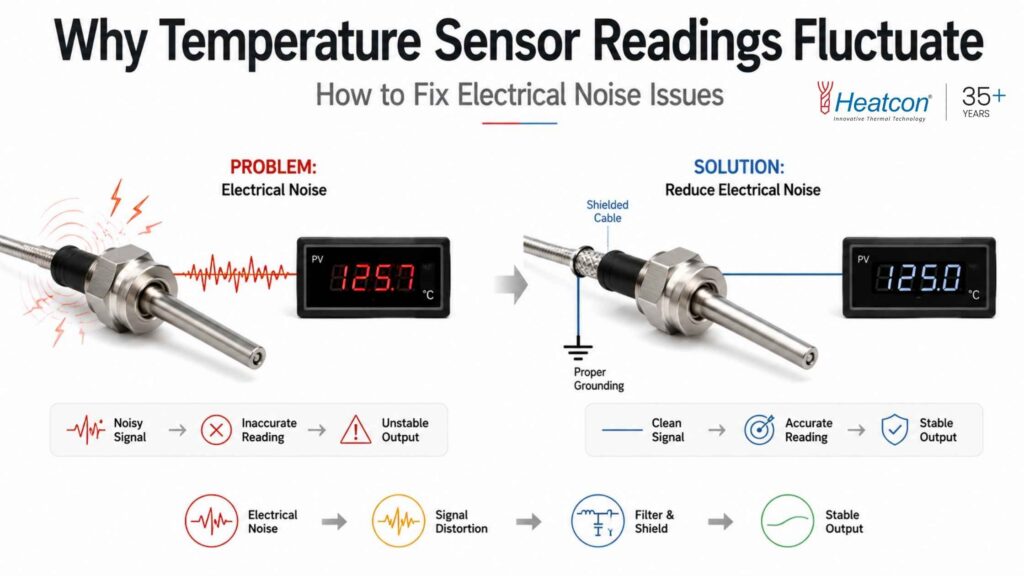
What causes temperature sensor reading fluctuations?
If you’ve ever noticed unexpected jumps or drops in your temperature readings, you’re not alone. According to industry studies, nearly 30% of industrial process interruptions are linked to sensor and instrumentation signal issues, with temperature sensor noise troubleshooting ranking among the top concerns. Fluctuating temperature readings aren’t just a minor inconvenience—they pose risks to product quality, equipment longevity, and even safety in critical industries. Understanding the root causes of these fluctuations is crucial for maintaining operational excellence.
- Electrical noise interference
- Poor sensor installation
- Improper shielding or grounding
- Wiring faults or loose connections
- Software or PLC configuration errors
Among these factors, electrical noise—often called electromagnetic interference (EMI)—is the most common culprit behind erratic readings in both thermocouples and RTDs. This guide will unravel the science behind sensor fluctuations, especially focusing on thermocouple electrical noise and RTD signal fluctuation, and provide actionable steps to resolve these issues.
How does electrical noise affect temperature sensor accuracy?
Electrical noise is unwanted interference from sources like motors, inverters, relays, contactors, wireless devices, or even improper wiring. When this noise infiltrates sensor wiring, it distorts the minute voltage or resistance signals that temperature sensors transmit. In advanced manufacturing environments, such as those using PLCs for automation, even a microvolt of noise can introduce significant PLC temperature instability, leading to misleading process control decisions.
Key sources of electrical noise:
- Nearby power lines or high-current equipment
- Variable frequency drives (VFDs) or inverters
- Electrically noisy machinery (motors, pumps, welders)
- Poorly shielded signal cables
- Ground loops in interconnected systems
Types of temperature sensors affected:
- Thermocouples (Type K, J, T, etc.)
- Resistance temperature detectors (RTDs)
- Thermistors and semiconductor sensors
When these sensors are exposed to electrical noise, their output can become erratic, leading to RTD signal fluctuation or unexplained oscillations in thermocouple readings.
What is temperature sensor noise troubleshooting?
Temperature sensor noise troubleshooting is a systematic approach to identifying, diagnosing, and resolving the causes of erratic temperature readings in industrial environments. The primary goal is to distinguish between genuine process temperature changes and false signals induced by noise or system faults.
Steps for effective troubleshooting:
- Verify sensor wiring and physical connections for looseness or corrosion.
- Inspect cable routing—ensure signal cables are separated from power cables.
- Check for proper grounding and shielding along the cable path.
- Use a multimeter or oscilloscope to detect noise spikes on signal lines.
- Temporarily disconnect the sensor and simulate with a resistance/voltage source to isolate the issue.
- Evaluate PLC or controller configuration for filtering or averaging settings.
By following these steps, maintenance teams can narrow down the source of instability and implement targeted solutions that restore reliable, consistent readings.
How does thermocouple electrical noise manifest in industry?
Thermocouples are among the most widely used temperature sensors in manufacturing, found in processes from metal casting to chemical refining. However, their low signal output (in the millivolt range) makes them particularly vulnerable to thermocouple electrical noise. This noise can manifest as random spikes, oscillating values, or step changes on monitoring systems.
Common signs of thermocouple electrical noise:
- Sudden jumps in temperature readings with no process cause
- Frequent triggering of alarms or safety shutoffs
- Inconsistent data logging or trending
- Unstable control loops in automated processes
If left unchecked, these issues can compromise product quality, increase downtime, and even pose safety hazards.
What are the effects of RTD signal fluctuation?
RTDs (Resistance Temperature Detectors) are prized for their accuracy and stability, yet they too can suffer from RTD signal fluctuation when exposed to electrical noise or installation faults. This is especially critical in pharmaceutical, food, and semiconductor industries where precise temperature control is non-negotiable.
Consequences of fluctuating RTD signals:
- Batch process inconsistencies
- Inaccurate quality control measurements
- False process alarms, leading to unnecessary interventions
- Difficulty in regulatory compliance audits
Ensuring a stable RTD signal is essential for industries where every degree counts.
Why does PLC temperature instability occur?
Programmable Logic Controllers (PLCs) are the brains of modern automation, interpreting temperature sensor signals to maintain precise control. However, PLC temperature instability can arise when noisy sensor signals, improper input module settings, or software misconfigurations disrupt accurate monitoring and control.
Key factors contributing to PLC temperature instability:
- Insufficient input filtering or signal averaging
- Incorrect sensor type or range configuration
- Poor isolation between analog and digital circuits
- Firmware or software bugs
Addressing these issues at both hardware and software levels is vital for achieving seamless automation and process reliability.
How to fix electrical noise issues in temperature sensors
Solving electrical noise issues requires a multi-pronged approach, targeting both the source of noise and the vulnerability of the sensor system.
- Use high-quality, shielded cables: Ensure signal cables are shielded and grounded at one end only to prevent ground loops.
- Separate sensor wiring from power cables: Route temperature sensor cables away from high-voltage or high-current conductors.
- Employ twisted pair wiring: Twisted pair cables help cancel out induced noise.
- Install proper grounding and bonding: All equipment must be properly grounded to a single point.
- Apply signal conditioning devices: Use isolation amplifiers, filters, or signal conditioners to clean up noisy signals.
- Upgrade to industrial-grade sensors and transmitters: Customized solutions from Heatcon Sensors are designed to withstand harsh industrial conditions.
- Configure PLC filters: Enable averaging or digital filtering in PLCs to smooth out transient noise.
Heatcon Sensors specializes in designing, manufacturing, and supplying robust temperature sensors and accessories engineered to overcome electrical noise challenges in a wide range of industries.
Why choose Heatcon Sensors for your industrial temperature sensing needs?
Heatcon Sensors is a leading manufacturer of customized RTDs, thermocouples, and temperature sensors engineered specifically for industrial requirements. With decades of expertise, our products deliver unmatched performance in the face of electrical noise, mechanical stress, and extreme temperatures.
Key advantages of partnering with Heatcon Sensors:
- Custom manufacturing for any application, including hazardous or high-EMI environments
- Global supply capability—serving all parts of India as well as the US, UAE, Indonesia, Germany, South Korea, Saudi Arabia, Russia, Bahrain, and Kuwait
- Comprehensive range of heat generating equipment: high density cartridge heaters, furnaces, ovens, hot air blowers, electric furnaces, and more
- Rapid turnaround for urgent requirements
- Technical support for installation, troubleshooting, and system integration
Our sensors are trusted worldwide for their reliability, precision, and resilience in the harshest industrial environments.
How to contact Heatcon Sensors for expert solutions?
Don’t let unreliable temperature readings compromise your process quality or safety. Reach out to Heatcon Sensors for tailored solutions, expert advice, and industry-leading products that guarantee dependable temperature measurement and control.
- Submit your information: Fill out the form at https://heatconsensors.com/contact-us/
- WhatsApp: Leave a message through the WhatsApp interface available on the Heatcon Sensors website.
- Call: +91 9164833027 or +91 9844233244 for immediate assistance.
Don’t risk downtime, product losses, or safety incidents—choose Heatcon Sensors for peace of mind and operational excellence.
About Heatcon Sensors
Heatcon Sensors is a distinguished manufacturer based in India and serving global markets, specializing in custom temperature sensors, RTDs, thermocouples, and industrial heating equipment. With an unwavering commitment to innovation, quality, and customer satisfaction, Heatcon Sensors is your trusted partner in industrial temperature sensing and process heating solutions.
Frequently Asked Questions
Why does my temperature sensor reading fluctuate unexpectedly?
Temperature sensor reading fluctuations are often caused by electrical noise, poor grounding, interference from nearby equipment, or improper cable routing. In industrial settings, these factors can introduce inaccuracies known as temperature sensor noise. Proper temperature sensor noise troubleshooting is essential to identify the root cause and restore reliable measurements.
What is thermocouple electrical noise and how does it affect my measurements?
Thermocouple electrical noise refers to unwanted voltage signals that interfere with the thermocouple’s output. These can be generated by electromagnetic interference (EMI) from motors, variable frequency drives, or power lines. The result is unstable or erratic readings, making it critical to address thermocouple electrical noise for accurate process control.
How can I identify and troubleshoot temperature sensor noise issues?
Temperature sensor noise troubleshooting involves checking for loose connections, verifying proper sensor installation, ensuring cables are shielded and grounded correctly, and isolating the sensor from high-voltage sources. Using quality sensors and certified cables from Heatcon Sensors can also minimize noise-related problems.
What causes RTD signal fluctuation in my temperature monitoring system?
RTD signal fluctuation is commonly caused by electrical interference, ground loops, and temperature gradients. Inferior wiring, inadequate shielding, or improper installation can also contribute to fluctuating signals. Heatcon Sensors offers precision RTDs with robust shielding to help reduce RTD signal fluctuation.
Why do I see PLC temperature instability on my automation system?
PLC temperature instability occurs when the input from the temperature sensor to the PLC is affected by noise, voltage drops, or incorrect wiring. Electrical noise from nearby equipment can cause rapid changes in readings. Heatcon Sensors recommends using proper signal conditioning and shielded sensor cables to minimize PLC temperature instability.
How does Heatcon Sensors help resolve electrical noise issues in temperature measurement?
Heatcon Sensors provides high-quality thermocouples, RTDs, and extension cables with superior shielding and insulation. Our solutions are designed to minimize electrical noise, ensuring stable and accurate temperature readings even in electrically noisy industrial environments. We also offer expert technical support for onsite troubleshooting and installation best practices.
What installation tips can prevent temperature sensor noise and instability?
To prevent temperature sensor noise and instability, use shielded cables, ground the shielding at one end only, avoid running sensor wires parallel to power cables, and keep sensor circuits physically separated from high voltage lines. Heatcon Sensors provides installation guides and onsite support to ensure optimal sensor performance.
Are there specific products from Heatcon Sensors that help reduce electrical noise?
Yes, Heatcon Sensors offers a range of noise-resistant thermocouples, RTDs, and extension wires with advanced shielding and insulation. These products are specifically designed to mitigate the effects of thermocouple electrical noise, RTD signal fluctuation, and other sources of instability in temperature measurement systems.
How can I contact Heatcon Sensors for support with temperature sensor noise troubleshooting?
You can reach out to Heatcon Sensors through our website contact form, email, or phone. Our technical team is equipped to assist you with temperature sensor noise troubleshooting, onsite diagnostics, and recommendations for upgrading to our latest noise-resistant sensor solutions.