
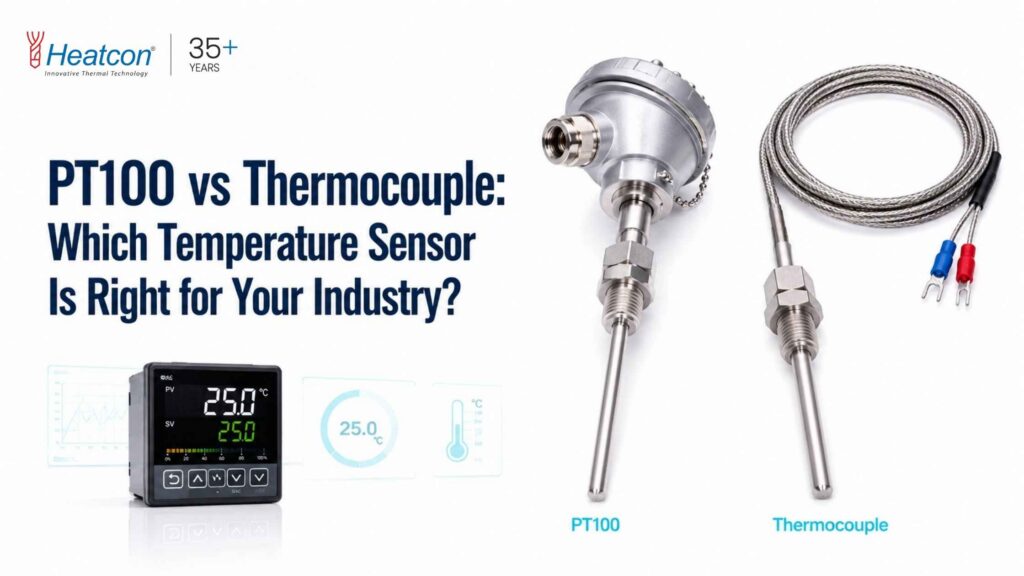
PT100 vs thermocouple is one of the most critical decisions in industrial temperature measurement, shaping process efficiency and product quality worldwide. According to research, the global temperature sensor market was valued at over USD 6.8 billion in 2022 and continues to expand as industries demand higher precision and reliability. With industrial temperature sensors at the core of automated manufacturing, food processing, energy, and pharmaceuticals, choosing between PT100 and thermocouple sensors can make a significant difference in operational outcomes and cost efficiency.
What is the difference between PT100 and thermocouple sensors?
Choosing the right sensor starts with understanding the PT100 vs thermocouple distinction. A PT100 is a type of Resistance Temperature Detector (RTD) that uses platinum to measure temperature by correlating the resistance of the platinum element with temperature. Thermocouples, on the other hand, are based on the Seebeck effect – generating a voltage from the junction of two different metals, which correlates with temperature.
- PT100 (RTD): Offers high accuracy, repeatability, and stability over time. Typical measurement range: -200°C to 650°C.
- Thermocouple: Provides a wider temperature measurement range (up to 1800°C for certain types), fast response, and robust construction for harsh environments.
Deciding between these two depends on your industry’s specific needs, such as temperature range, accuracy, response time, and environmental conditions.
How does RTD vs thermocouple comparison impact industrial temperature sensors?
The RTD vs thermocouple comparison is central to selecting the optimal sensor for your process. RTDs like PT100 excel in accuracy and long-term stability, making them ideal for applications where precise temperature control is necessary, such as pharmaceuticals, biotechnology, and food processing. Industrial temperature sensors built on thermocouple technology, meanwhile, thrive in extreme environments like metal processing, power plants, and glass manufacturing where high heat and mechanical durability are essential.
| Parameter | PT100 (RTD) | Thermocouple |
|---|---|---|
| Temperature Range | -200°C to 650°C | -200°C to 1800°C (type dependent) |
| Accuracy | High (±0.1°C to ±1°C) | Moderate (±1°C to ±5°C) |
| Stability | Excellent over time | Moderate, may drift |
| Response Time | Slower | Faster |
| Durability | Less robust for extreme environments | Very robust, ideal for harsh conditions |
| Initial Cost | Higher | Lower |
| Long-term Cost | Lower, less maintenance | May require recalibration or replacement |
What industries benefit most from PT100 and thermocouple sensors?
Industries with strict temperature accuracy comparison requirements, such as pharmaceuticals, chemical processing, and food manufacturing, typically choose PT100 RTDs. Their reliability and precision ensure compliance with regulatory standards and consistent product quality. Conversely, sectors like metallurgy, glass, ceramics, and power generation often depend on thermocouples due to their ability to withstand high temperatures, vibrations, and corrosive environments.
- Automotive: Engine testing, exhaust systems, climate chambers
- Aerospace: Jet engine monitoring, wind tunnel testing
- Oil & Gas: Refineries, drilling rigs, LNG terminals
- HVAC & Energy: Boilers, turbines, heat exchangers
- Steel & Glass: Furnaces, kilns, molten metal baths
- Pharma & Biotech: Cleanrooms, reactors, sterilization
Whether your requirement is for temperature accuracy comparison at ultra-low or ultra-high temperatures, Heatcon Sensors customizes industrial temperature sensors to fit every unique process demand, ensuring you never compromise on safety or efficiency.
How do you choose between PT100 and thermocouple for your application?
When selecting between PT100 vs thermocouple, consider these crucial factors:
- Temperature Range: For processes above 650°C, thermocouples typically outperform PT100.
- Required Accuracy: For laboratory or medical applications, PT100 sensors deliver superior accuracy.
- Environmental Conditions: Thermocouples withstand vibration, shock, and corrosive atmospheres better.
- Cost Considerations: While PT100 has a higher upfront cost, its long-term stability can reduce total ownership costs.
- Maintenance: PT100s require less frequent calibration and offer long-term reliability.
For complex requirements or unusual operating environments, Heatcon Sensors offers a comprehensive thermal sensing guide and expert consultation to help you make an informed decision tailored to your operational needs.
Why trust Heatcon Sensors for your industrial temperature sensors?
Heatcon Sensors is a premier manufacturer of industrial temperature sensors, including both PT100 and thermocouple types. Our expertise spans across India and globally, delivering custom-engineered sensors to industries in the US, UAE, Indonesia, Germany, South Korea, Saudi Arabia, Russia, Bahrain, Kuwait, and beyond. By leveraging advanced materials, precision engineering, and rigorous quality assurance, we ensure each sensor meets your exact specifications.
In addition to sensors, Heatcon Sensors manufactures high-performance heat generating equipment such as:
- Industrial furnaces
- Process ovens
- Hot air blowers
- Electric furnaces
- High density cartridge heaters
- Circulation heaters
- Immersion heaters
- Infrared heaters
Our products are engineered for maximum durability, energy efficiency, and safety, supporting a broad spectrum of industrial applications.
How does Heatcon Sensors deliver value globally?
No matter where your facility is located—whether in bustling metros like Mumbai, Bangalore, Delhi, Chennai, Kolkata, or in major global cities—Heatcon Sensors ensures prompt supply and technical support. Our logistics capabilities and strong partnerships enable us to deliver even the most complex custom sensor designs and heat generating equipment efficiently to any part of India or worldwide.
Partnering with Heatcon Sensors means you benefit from:
- Custom solutions tailored for your industry and application
- Comprehensive after-sales support and technical guidance
- Access to a complete thermal sensing guide for process optimization
- ISO-certified manufacturing standards
- Decades of industry expertise and innovation
What is the ultimate thermal sensing guide for your industry?
For those seeking a reliable, one-stop thermal sensing guide, Heatcon Sensors provides in-depth resources and consultation. Our technical experts help you navigate the RTD vs thermocouple comparison, offer temperature accuracy comparison charts, and recommend the best industrial temperature sensors and heat generating equipment for your unique requirements. This guidance ensures your processes are not only efficient and compliant but also future-proofed against evolving industry standards.
How to reach Heatcon Sensors for customized solutions?
Don’t let suboptimal temperature measurement compromise your operations. Connect with Heatcon Sensors today to discuss your needs, request a quote, or seek expert advice. Choose from any of the following contact options:
- Submit your details via our online form: Contact Us
- Leave a message on Whatsapp using the interface on our website
- Call us directly at +91 9164833027 or +91 9844233244 for immediate support
Our team is ready to help you achieve unmatched temperature control and process reliability, wherever you are in India or around the world.
About Heatcon Sensors
Heatcon Sensors is a recognized leader in the field of industrial temperature sensors and heat generating equipment, based in India with a global footprint. We specialize in custom design and manufacturing of PT100, thermocouples, RTDs, and advanced heating systems for a variety of industries. Our mission is to empower manufacturers and process industries with innovative, reliable, and precise temperature management solutions.
Don’t miss out on the superior performance and reliability that only Heatcon Sensors can deliver. Make the right choice for your process—partner with the experts in industrial temperature measurement and heating technology.
Frequently Asked Questions
What are the main differences between PT100 and thermocouple sensors?
PT100 sensors are platinum resistance temperature detectors (RTDs) known for their high accuracy, stability, and repeatability. Thermocouples, on the other hand, use two dissimilar metals to generate a voltage correlated to temperature and are valued for their wide temperature range and fast response. The core difference lies in their working principle, operational temperature range, and application suitability. For a detailed PT100 vs thermocouple breakdown, refer to Heatcon Sensors’ thermal sensing guide or contact our technical experts.
How do RTD vs thermocouple comparison results affect industrial temperature sensor selection?
RTD vs thermocouple comparison is crucial when selecting industrial temperature sensors because it highlights the strengths and limitations of each technology. RTDs like PT100 offer better accuracy and stability, making them ideal for quality-critical industrial processes. Thermocouples are better suited for applications requiring ruggedness and operation at extreme temperatures. Heatcon Sensors can help match the right sensor to your specific process requirements.
Which sensor provides better temperature accuracy: PT100 or thermocouple?
In a temperature accuracy comparison, PT100 RTDs generally outperform thermocouples, especially in the range of -200°C to 600°C. PT100 sensors have a stable and predictable resistance-temperature relationship, resulting in higher precision. Thermocouples, while excellent for higher temperatures, may suffer from drift and require regular calibration to maintain accuracy. Heatcon Sensors supplies both sensor types, optimized for accuracy in their respective working ranges.
When should I choose a PT100 sensor over a thermocouple for my industry?
Choose a PT100 sensor when your application demands high accuracy, repeatability, and stability, especially within the -200°C to 600°C temperature range. PT100s are ideal for pharmaceuticals, food processing, and laboratory environments. For industries like metallurgy, glass, or ceramics that require measurement in extreme temperatures, thermocouples are typically preferred. Heatcon Sensors provides custom solutions tailored to your industry’s needs.
Are thermocouples or PT100 sensors more cost-effective for industrial temperature monitoring?
Thermocouples are often more cost-effective upfront and are widely used for general-purpose industrial temperature monitoring, especially where high temperatures are involved. PT100 sensors, while more expensive, offer long-term savings due to their durability and reduced calibration needs in precise applications. Heatcon Sensors offers both economical and premium options, ensuring cost-effectiveness without compromising on quality.
What are the typical applications of PT100 and thermocouple temperature sensors?
PT100 sensors are commonly used in pharmaceutical manufacturing, food and beverage processing, HVAC systems, and laboratory research due to their high accuracy and stability. Thermocouples are favored in metal processing, kilns, furnaces, and exhaust monitoring where extreme temperatures or rapid temperature changes occur. Heatcon Sensors delivers a wide range of industrial temperature sensors tailored to these application environments.
How does Heatcon Sensors support industries with PT100 and thermocouple solutions?
Heatcon Sensors offers comprehensive design, manufacturing, and calibration services for both PT100 and thermocouple sensors. Our experts guide customers through the selection process using a detailed thermal sensing guide, ensuring you receive the optimal sensor for your process requirements. We also provide after-sales support, custom engineering, and fast delivery for all industrial temperature sensors.
What factors should be considered when using the PT100 vs thermocouple comparison for process optimization?
Key factors include the required temperature range, desired accuracy, environmental conditions (moisture, vibration, chemical exposure), response time, installation constraints, and long-term maintenance. The PT100 vs thermocouple comparison helps process engineers determine the most reliable and cost-effective sensor for process optimization. Heatcon Sensors can provide application-specific guidance to assist with this decision.
Where can I find a comprehensive thermal sensing guide for industrial applications?
Heatcon Sensors provides an in-depth thermal sensing guide covering PT100, RTD, and thermocouple technologies, including selection criteria, installation tips, and maintenance best practices. This guide is designed to help engineers and technicians make informed decisions about industrial temperature sensors for all types of industrial environments. Contact Heatcon Sensors or visit our website to access the guide or consult with our specialists.