
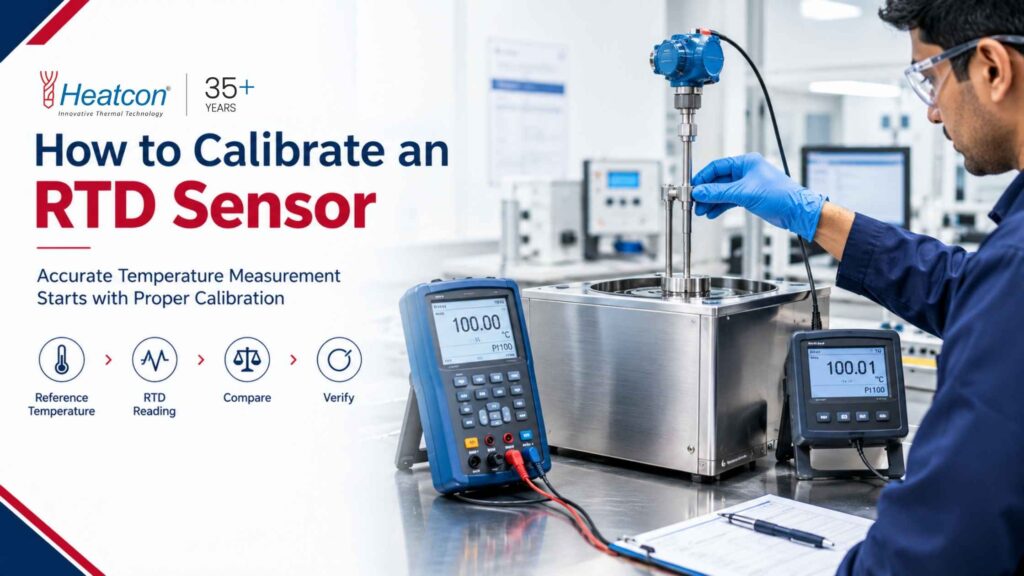
RTD sensor calibration is the process of verifying and adjusting the accuracy of a resistance temperature detector (RTD) to ensure reliable temperature measurements. According to the International Society of Automation, over 70% of industrial temperature measurements rely on RTDs due to their stability and precision. Ensuring proper calibration is vital—unreliable temperature data can lead to costly errors, safety risks, and product quality issues. This comprehensive guide covers the essential steps and best practices for RTD calibration, as well as why Heatcon Sensors is the trusted partner for customized, high-accuracy temperature sensors across India and globally.
What Is RTD Sensor Calibration And Why Is It Important?
RTD sensor calibration refers to the process of comparing an RTD’s output against a reference standard to ensure it accurately reflects the actual temperature. This process is foundational for industries such as manufacturing, pharmaceuticals, power generation, and food processing, where precise temperature control is non-negotiable.
- Improperly calibrated RTDs can cause errors of up to several degrees Celsius, leading to production defects, equipment malfunction, or safety hazards.
- Routine calibration ensures that your industrial RTD delivers trustworthy data, helping you maintain process integrity and regulatory compliance.
How To Calibrate An RTD Sensor: The Step-By-Step RTD Calibration Procedure
The RTD calibration procedure involves several key steps to achieve the highest possible RTD accuracy. Here’s a concise answer before we elaborate:
To calibrate an RTD sensor, immerse it in a stable temperature environment alongside a calibrated reference thermometer, measure the RTD’s resistance at multiple setpoints, and compare its readings to the standard. Adjust the RTD or signal conditioning electronics as needed to minimize deviation.
Essential Steps For RTD Sensor Calibration
- Prepare The RTD And Reference Equipment: Select the RTD to be calibrated and a high-precision reference thermometer or standard. Ensure both are clean and free of contaminants.
- Stabilize In A Calibration Bath Or Dry-Block: Place the RTD and the reference thermometer in a temperature-controlled bath or dry-block calibrator. Allow enough time for both to reach thermal equilibrium.
- Measure At Multiple Temperature Points: Typically, calibration is performed at three or more points (e.g., 0°C, 100°C, 200°C for Pt100 calibration). Record the resistance or temperature output from the RTD and reference at each point.
- Compare Readings And Calculate Error: Subtract the reference reading from the RTD reading at each point to determine the deviation.
- Adjust Or Document Results: If the deviations exceed acceptable limits, adjust the transmitter or document the error curve for future correction (especially for digital systems).
- Complete Documentation: Record all calibration data, methods, and any adjustments made for traceability and compliance.
This RTD calibration procedure applies to most platinum RTDs, including Pt100 and Pt1000 sensors, as well as custom solutions from Heatcon Sensors. The key is using high-quality reference standards and stable environments to achieve maximum RTD accuracy.
What Are The Differences Between Pt100 Calibration And Pt1000 Calibration?
Both Pt100 and Pt1000 RTDs use platinum as the sensing element, but they differ in nominal resistance—100 ohms at 0°C for Pt100 and 1000 ohms at 0°C for Pt1000. The calibration procedures are similar but with some distinctions:
| Feature | Pt100 Calibration | Pt1000 Calibration |
|---|---|---|
| Nominal Resistance | 100 Ω at 0°C | 1000 Ω at 0°C |
| Sensitivity | Higher relative error for long cable runs | Less sensitive to lead resistance, better for remote measurement |
| Application | Common in process industries | Used where higher signal levels or long cable runs are needed |
Whether you require Pt100 calibration or Pt1000 calibration, Heatcon Sensors can manufacture and calibrate both types to meet your exact process and location requirements.
How Is Resistance Temperature Detector Calibration Performed?
Resistance temperature detector calibration is performed by subjecting the RTD to known temperature points—often using triple-point cells, dry-block calibrators, or fluid baths—and comparing its resistance output to the reference. Calibration can be done as a full-range process (covering the RTD’s entire operating span) or as a spot-check at critical points.
- For industrial RTD applications, periodic calibration is often mandated by international standards such as IEC 60751.
- Automated calibration systems are available for high-throughput environments, minimizing human error and improving repeatability.
What Factors Affect RTD Accuracy?
RTD accuracy is influenced by several factors, including element purity, lead wire configuration, environmental conditions, and installation practices. Heatcon Sensors designs industrial RTDs using premium platinum wire and robust construction to minimize drift, noise, and mechanical stress.
- Element Quality: Higher purity platinum and precision winding increase accuracy.
- Lead Wire Compensation: 3-wire and 4-wire RTDs help negate errors from cable resistance.
- Signal Conditioning: Quality transmitters and signal processors preserve accuracy.
- Environmental Protection: Proper sheathing and housing reduce contamination and moisture ingress.
For critical applications, Heatcon Sensors can custom design RTDs with enhanced accuracy classes (Class AA, Class A, etc.), tailored to your industry and regulatory requirements.
How Do You Perform RTD Testing And Temperature Sensor Calibration?
RTD testing is typically performed before and after installation to ensure sensor health. This may include:
- Measuring insulation resistance to detect moisture or contamination
- Checking continuity and resistance at ambient temperatures
- Simulating temperature changes to verify response and repeatability
Temperature sensor calibration, whether for RTDs, thermocouples, or thermistors, follows similar principles: use a trusted temperature source, record outputs, compare to standards, and document results.
Why Choose Heatcon Sensors For Your Industrial RTD And Calibration Needs?
Heatcon Sensors is a leading manufacturer and global supplier of customized RTDs, thermocouples, and temperature sensing solutions for industrial applications. With decades of expertise, Heatcon Sensors delivers:
- Customized RTDs: Designed and built to your exact process requirements, from probe length to special sheathing and connectors
- Full Range Of Sensors: Including Pt100, Pt1000, multi-point RTDs, thermocouples, and other temperature sensors
- Temperature Sensor Calibration Services: In-house and on-site calibration and validation for all types of industrial RTDs
- Global Reach: Manufacturing and supplying to every city in India and worldwide, including the US, UAE, Indonesia, Germany, South Korea, Saudi Arabia, Russia, Bahrain, and Kuwait
- Complete Heating Solutions: Heat generating equipment such as furnaces, ovens, hot air blowers, electric furnaces, high density cartridge heaters, immersion heaters, and more
- Commitment to Quality: Every sensor undergoes rigorous RTD testing and inspection before dispatch
Don’t settle for off-the-shelf options that may not fit your process or environment. With Heatcon Sensors, you gain a partner who understands the unique challenges of your industry and delivers solutions engineered for reliability and compliance.
How To Reach Out To Heatcon Sensors For Your RTD And Calibration Needs?
If you’re ready to enhance your temperature measurement accuracy and reliability, connect with Heatcon Sensors through any of these convenient options:
- Submit your requirements via the contact form
- Leave a message on Whatsapp directly from the Heatcon Sensors website
- Call us for immediate assistance at +91 9164833027 or +91 9844233244
Take the next step towards uncompromising temperature control—your process deserves the best.
About Heatcon Sensors
Heatcon Sensors is an ISO-certified manufacturer based in India, specializing in the design, development, and supply of advanced temperature sensors and heating equipment for industrial automation, process control, laboratory research, and OEM requirements. With a reputation built on quality, precision, and customer responsiveness, Heatcon Sensors serves a global clientele, ensuring each solution is tailored to exacting standards.
For more information, visit heatconsensors.com.
Frequently Asked Questions
What is the purpose of calibrating an RTD sensor?
Calibrating an RTD sensor ensures that the temperature readings are accurate and reliable. Over time, factors like drift, contamination, or mechanical stress can impact readings. Regular RTD sensor calibration verifies that the sensor maintains the required RTD accuracy for industrial applications, helping you trust your measurements and meet quality standards.
How is the RTD calibration procedure typically performed?
The RTD calibration procedure involves comparing your sensor’s readings with a known temperature reference, such as a precision dry block calibrator or an oil bath with a standard thermometer. The sensor is placed at defined temperatures, and the output resistance or temperature values are recorded and compared. Any deviation is documented and, if necessary, corrections or adjustments are made. Heatcon Sensors offers both on-site and laboratory temperature sensor calibration services to ensure your sensors meet industry standards.
What is the difference between Pt100 calibration and Pt1000 calibration?
Pt100 and Pt1000 are two common types of RTDs, differing in their base resistance at 0°C (100 Ω for Pt100, 1000 Ω for Pt1000). Pt100 calibration and Pt1000 calibration follow similar principles, but the instruments and reference tables used must match the sensor type. Heatcon Sensors can calibrate both Pt100 and Pt1000 RTDs as part of their comprehensive resistance temperature detector calibration services.
How often should industrial RTD sensors be calibrated?
The recommended calibration interval for industrial RTD sensors depends on application, criticality, and environmental factors. Typically, annual calibration is sufficient for most processes, but demanding environments or regulatory requirements may dictate more frequent temperature sensor calibration. Heatcon Sensors can help establish an optimal calibration schedule for your facility.
What factors affect RTD accuracy over time?
RTD accuracy can be impacted by mechanical shock, vibration, contamination, oxidation, and electrical insulation breakdown. Prolonged exposure to extreme temperatures or harsh chemicals may also cause sensor drift. Regular RTD testing and calibration, as offered by Heatcon Sensors, can quickly identify and correct these issues to maintain measurement precision.
Can Heatcon Sensors calibrate RTDs on-site as well as in the lab?
Yes, Heatcon Sensors provides both on-site and laboratory resistance temperature detector calibration services. On-site calibration minimizes process downtime, while lab calibration offers the highest possible accuracy with traceable reference standards. Both methods ensure your industrial RTD sensors perform optimally.
How do I know if my RTD sensor needs recalibration?
Signs that your RTD sensor may require recalibration include unexpected temperature readings, process deviations, or failed quality checks. Regular RTD testing, especially after sensor installation, repairs, or exposure to harsh conditions, can help determine if recalibration is necessary. Heatcon Sensors can assist with diagnostics and recalibration.
What equipment is used during temperature sensor calibration?
Professional temperature sensor calibration utilizes precision temperature sources like dry block calibrators, stirred liquid baths, and reference thermometers. High-accuracy digital multimeters are used to measure resistance for RTD sensors. Heatcon Sensors uses industry-standard, traceable calibration equipment for all temperature sensor calibration processes.
How does Heatcon Sensors ensure traceability and compliance in RTD sensor calibration?
Heatcon Sensors provides detailed calibration certificates that document all results, reference standards, and procedures used. All reference equipment is traceable to national and international standards, ensuring compliance with industry and regulatory requirements for resistance temperature detector calibration and RTD accuracy.