
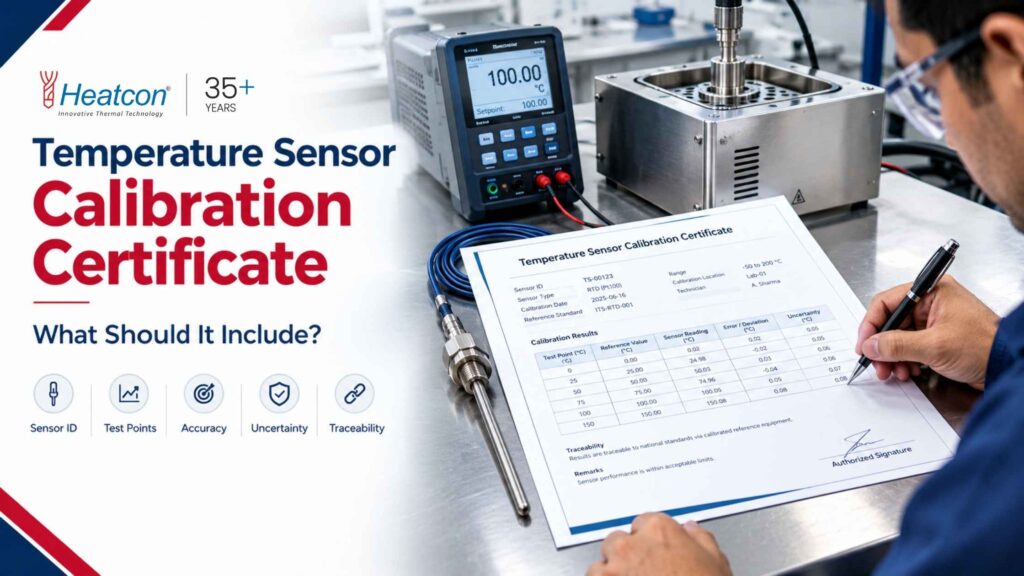
What Is a Temperature Sensor Calibration Certificate and Why Is It Important?
A temperature sensor calibration certificate is an official document that verifies the accuracy of a temperature sensor, proving it meets defined standards. According to recent industrial statistics, over 80% of critical manufacturing processes depend on reliable temperature measurement, making accurate calibration certificates indispensable for quality control, regulatory compliance, and safety. Missing or incomplete calibration documentation can expose businesses to regulatory penalties, product recalls, and even hazardous failures—risks no reputable operation can afford.
Heatcon Sensors, a leading manufacturer of customized RTDs, thermocouples, and a wide range of temperature sensors, offers complete calibration services and ensures that every sensor shipped, whether to India, the US, UAE, Indonesia, Germany, South Korea, Saudi Arabia, Russia, Bahrain, Kuwait, or anywhere else in the world, is accompanied by a robust calibration certificate that adheres to the highest industry standards.
How Does a Calibration Certificate Safeguard Your Operations?
A calibration certificate serves as your guarantee that the instrument you rely on delivers precise and traceable measurements. Here’s why this matters:
- Compliance: Many industries, such as pharmaceuticals, food processing, and aerospace, mandate calibrated temperature sensors for regulatory approval.
- Product Quality: Accurate temperature readings ensure consistent product quality and reduce the risk of costly rework or waste.
- Audit Readiness: Certificates provide documented proof for quality audits, customer demands, and regulatory inspections.
Without proper calibration documentation, you may face process disruptions, failed audits, or compromised safety—costly mistakes that are easily avoided with thorough calibration practices.
What Essential Information Should a Temperature Sensor Calibration Certificate Contain?
For a calibration certificate to be credible and useful, it must include specific, standardized information. Here’s what every robust temperature sensor calibration certificate from Heatcon Sensors contains:
-
Unique Identification:
- Certificate number and date of issue
- Sensor identification (type, model, serial number)
-
Calibration Details:
- Type of sensor calibrated (RTD, thermocouple, etc.)
- Calibration method and reference standards used
- Environmental conditions during calibration
-
Results and Measurement Data:
- Observed values vs. reference values at key temperature points
- Graphical representation or tabular format of results
- Measurement uncertainty and limits of detection
-
Calibration Traceability:
- Reference to national/international standards (e.g., SI units)
- Details of traceable standards and their certification
-
Laboratory Accreditation:
- Statement of accreditation, such as NABL calibration certificate reference
- Signature and credentials of the authorized calibrating engineer
-
Validity and Next Due Date:
- Clear indication of certificate validity and recommended recalibration date
-
Additional Notes:
- Remarks on sensor condition, adjustments made, or deviations detected
A complete temperature calibration report is crucial for ensuring your sensor’s performance and for meeting stringent industry requirements.
What Are the Differences Among RTD, Thermocouple, and General Sensor Calibration Certificates?
RTD calibration certificate: Specifically documents the calibration process for Resistance Temperature Detectors (RTDs), highlighting resistance values at specified temperatures and ensuring high-accuracy applications.
Thermocouple calibration certificate: Focuses on voltage output versus temperature, referencing standard thermocouple tables to verify sensor accuracy across its range.
General sensor calibration report: Applies to various sensor types, summarizing results, traceability, and compliance for non-specialized temperature sensors.
Heatcon Sensors provides all these calibration certificates, tailored to your sensor’s specific technology and industrial application.
How Does NABL Accreditation Strengthen Calibration Documentation?
NABL (National Accreditation Board for Testing and Calibration Laboratories) accreditation certifies that a calibration laboratory meets international standards (ISO/IEC 17025). A NABL calibration certificate is recognized globally, enhancing trust and acceptance of your calibration documentation by regulators, auditors, and customers.
- Ensures calibration traceability to national/international standards
- Confirms rigorous quality management and technical competence
- Simplifies compliance with both Indian and international regulations
When you choose Heatcon Sensors for calibration, you receive NABL-accredited certificates that stand up to scrutiny worldwide.
What Is the Process for Obtaining a Sensor Calibration Report from Heatcon Sensors?
Getting a sensor calibration report from Heatcon Sensors is simple, reliable, and fast. Here’s how you can proceed:
- Initiate Your Request: Submit your requirements via the contact form, WhatsApp on their website, or by calling +91 9164833027 or +91 9844233244.
- Custom Sensor Manufacturing (if needed): Heatcon Sensors manufactures RTDs, thermocouples, and other temperature sensors tailored to your industrial needs.
- Calibration and Documentation: Every sensor is calibrated in a controlled environment, with full calibration documentation and traceability, including NABL calibration certificate where required.
- Delivery: Sensors and certificates are shipped promptly to your location—whether in India or anywhere in the world, including the US, UAE, Indonesia, Germany, South Korea, Saudi Arabia, Russia, Bahrain, or Kuwait.
Heatcon Sensors also offers calibration services for existing sensors and heat-generating equipment such as furnaces, ovens, hot air blowers, electric furnaces, and high-density cartridge heaters.
How Does Calibration Traceability Protect Your Business?
Calibration traceability is the backbone of reliable measurement. It ensures that every calibration result can be linked, via an unbroken chain of comparisons, to recognized national or international standards. This means you can always prove that your readings are accurate and defensible.
With Heatcon Sensors, calibration traceability is guaranteed—every certificate explicitly references the calibration standards used and their own traceable documentation, ensuring peace of mind during audits.
What Risks Do You Face Without Proper Calibration Documentation?
Operating without accurate calibration documentation exposes your business to significant risks:
- Failed audits and regulatory penalties
- Product recalls or customer rejections
- Inaccurate process control, leading to quality and safety issues
- Loss of market reputation and competitive edge
Don’t risk your operations. Heatcon Sensors’ calibration certificates ensure you’re always prepared with the documentation needed for compliance and excellence.
About Heatcon Sensors
Heatcon Sensors is an ISO-certified manufacturer specializing in customized RTDs, thermocouples, temperature sensors, and heat-generating equipment, including furnaces, ovens, hot air blowers, electric furnaces, and high-density cartridge heaters. Trusted by industries worldwide, Heatcon Sensors delivers NABL-accredited calibration services and custom solutions to India, the US, UAE, Indonesia, Germany, South Korea, Saudi Arabia, Russia, Bahrain, Kuwait, and beyond.
Don’t leave your compliance, quality, or safety to chance. Contact Heatcon Sensors today by submitting your details on the online form, sending a WhatsApp message via their website, or calling +91 9164833027 or +91 9844233244 for immediate expert assistance.
Frequently Asked Questions
What information should a temperature sensor calibration certificate include?
A temperature sensor calibration certificate should include critical details such as the sensor identification, calibration procedure, reference standards used, calibration results, measurement uncertainty, environmental conditions during calibration, date of calibration, due date for next calibration, and the signature of the authorized personnel. These elements ensure the certificate is valid, traceable, and compliant with industry standards.
How does Heatcon Sensors ensure calibration traceability in their certificates?
Heatcon Sensors provides calibration traceability by linking every calibration certificate to reference standards that are traceable to national or international standards, such as those maintained by accredited bodies. This guarantees that the measurements reported in the certificate can be traced back to recognized sources, ensuring accuracy and reliability.
What’s the difference between an RTD calibration certificate and a thermocouple calibration certificate?
An RTD calibration certificate specifically documents the calibration data and performance of Resistance Temperature Detectors (RTDs), including resistance values at various temperatures. A thermocouple calibration certificate, on the other hand, focuses on the voltage output and temperature correlation of thermocouples. Both certificates should detail traceability, measurement uncertainty, and the conditions under which calibration was performed.
Does Heatcon Sensors provide a NABL calibration certificate for temperature sensors?
Yes, Heatcon Sensors can provide a NABL calibration certificate for temperature sensors upon request. A NABL calibration certificate is issued by laboratories accredited by the National Accreditation Board for Testing and Calibration Laboratories, ensuring compliance with ISO/IEC 17025 standards and international recognition of your calibration results.
What is a temperature calibration report, and how does it differ from a calibration certificate?
A temperature calibration report typically provides detailed raw data, graphs, and expanded analysis of the calibration process, while a calibration certificate summarizes the key findings, traceability, and conformity statement. Both documents are important, but the certificate is usually the official document required for regulatory or quality audits.
What calibration documentation is provided with new sensors from Heatcon Sensors?
With every new sensor, Heatcon Sensors provides comprehensive calibration documentation, which typically includes a sensor calibration report, temperature sensor calibration certificate, and details on calibration traceability. This ensures customers have all necessary records for compliance, audits, and ongoing quality assurance.
Why is measurement uncertainty included in the calibration certificate?
Measurement uncertainty quantifies the confidence in the calibration results. Including this information in the calibration certificate helps users assess if the sensor’s performance meets their specific accuracy requirements and complies with regulatory standards.
How often should I recalibrate my temperature sensors, and does Heatcon Sensors remind clients?
The recommended recalibration frequency depends on the application, sensor type, and industry requirements—typically every 6 to 12 months. Heatcon Sensors notes the due date for the next calibration on the sensor calibration report and offers reminders or calibration management services on request.
Can I request a digital copy of my calibration certificate from Heatcon Sensors?
Absolutely. Heatcon Sensors can provide both physical and digital copies of your calibration certificate and temperature calibration report, making it easier to store, access, and share your calibration documentation.