
Did you know? According to the International Electrotechnical Commission (IEC 60751), a well-calibrated Pt1000 temperature sensor can achieve measurement uncertainties as low as ±0.15°C, making it a global standard for precision in industrial temperature measurement. Yet, many industries unknowingly operate with sensors that are out-of-calibration, leading to significant process inefficiencies and product quality issues. If you’re in India, the US, UAE, Indonesia, Germany, South Korea, Saudi Arabia, Russia, Bahrain, Kuwait, or anywhere else in the world, understanding Pt1000 calibration is vital for accuracy, safety, and compliance.
What is a Pt1000 temperature sensor and why does its calibration matter?
A Pt1000 temperature sensor is a type of resistance temperature detector (RTD) that uses platinum as its sensing element; it has a resistance of 1000 ohms at 0°C. Due to its high sensitivity and stability, the Pt1000 is widely used in critical industrial applications, scientific research, HVAC, food processing, and more. However, even the most robust sensors drift over time due to environmental stress, cycling, and usage. This is why temperature calibration of Pt1000 sensors is not just a recommendation—it’s a necessity for reliable measurement and process control.
How does the Pt1000 calibration procedure work?
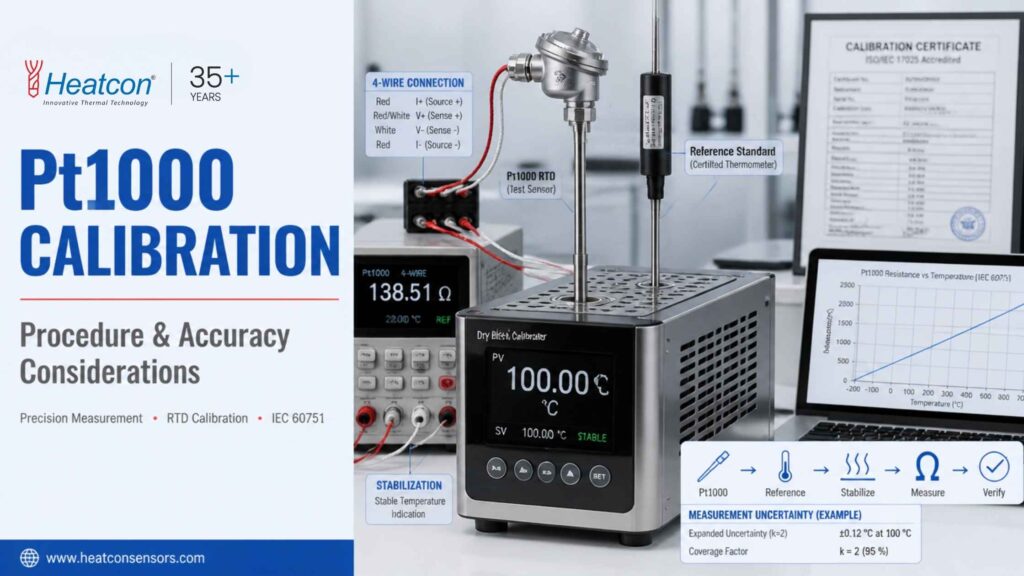
The Pt1000 calibration procedure is a systematic process designed to compare the sensor’s readings against a certified reference standard under controlled conditions. Here’s a step-by-step overview:
- Preparation: Clean the sensor and inspect it for physical damage. Record its identification details.
- Connection: Connect the Pt1000 sensor to a high-precision resistance meter or a calibrated readout instrument.
- Reference Setup: Place both the Pt1000 and a reference standard (usually a standard platinum resistance thermometer) in a stable calibration bath or dry block calibrator.
- Stabilization: Allow sufficient time for thermal equilibrium at each calibration point.
- Measurement: Record the resistance at key temperature points (such as 0°C, 100°C, and 200°C, or as per application requirements).
- Comparison & Adjustment: Compare the measured values to the reference. If deviations exceed permissible tolerance, note the Pt1000 errors and, if possible, apply corrections or recalibrate.
- Documentation: Record all readings, uncertainties, and adjustments. Generate a calibration certificate for traceability.
Heatcon Sensors offers a full spectrum of calibration services, from initial sensor verification through to detailed RTD calibration and documentation, ensuring compliance with international standards like IEC 60751 and ASTM E2877.
What are the key factors affecting PT1000 accuracy?
PT1000 accuracy is determined by several factors:
- Class of Sensor: Sensors are typically graded as Class A, B, or higher-precision classes. Class A sensors offer the tightest tolerances.
- Wiring Configuration: 2-wire, 3-wire, and 4-wire setups impact compensation for lead wire resistance. 4-wire configurations provide the highest accuracy.
- Calibration Interval: Regular industrial RTD calibration is essential to maintain accuracy, especially in harsh or critical environments.
- Mechanical Stress & Installation: Bending, vibration, or improper mounting can alter sensor characteristics.
- Environmental Conditions: Exposure to high humidity, corrosive chemicals, or extreme temperature cycles can accelerate sensor drift.
Heatcon Sensors manufactures Pt1000 and other RTDs using premium materials and robust construction, minimizing these issues and maximizing long-term performance.
How can you minimize Pt1000 errors?
Pt1000 errors can arise from calibration drift, connection faults, environmental factors, or even manufacturing defects. To reduce these errors:
- Choose certified sensors from reputable manufacturers like Heatcon Sensors.
- Follow recommended handling and installation practices.
- Schedule routine resistance temperature detector calibration to catch and correct deviations early.
- Use data loggers or transmitters with built-in calibration check features for continuous monitoring.
- Maintain proper wiring and shielding to avoid electrical interference.
Regular calibration, quality manufacturing, and expert support are your best defenses against costly measurement mistakes.
What is the role of industrial RTD calibration in process quality?
Industrial RTD calibration ensures that every measurement used for process control, safety, or compliance is accurate and traceable. In sectors such as pharmaceuticals, aerospace, food and beverage, and energy, a single miscalibrated sensor can lead to product recalls, regulatory non-compliance, or even safety incidents.
Heatcon Sensors partners with industries around the globe, offering calibration and custom-manufactured sensors delivered to any city or country—including India, the US, UAE, Indonesia, Germany, South Korea, Saudi Arabia, Russia, Bahrain, and Kuwait. Each calibration is backed by traceable documentation and expert technical support.
How does Heatcon Sensors support global temperature calibration needs?
Heatcon Sensors is a leading Indian manufacturer of customized RTDs, thermocouples, thermistors, and Pt1000 temperature sensor systems, as well as heat-generating equipment like industrial furnaces, ovens, hot air blowers, electric furnaces, and high-density cartridge heaters. Their global logistics network ensures prompt supply to any part of India and worldwide.
Why choose Heatcon Sensors?
- Customization: Sensors are engineered to your exact requirements, whether for a steel plant in Germany, a refinery in Saudi Arabia, or a research facility in South Korea.
- Global Reach: Fast delivery to all major cities and industrial hubs across India and internationally.
- Comprehensive Solutions: One-stop shop for sensors and precision heating equipment—improving process efficiency and reducing vendor complexity.
- Expert Calibration: End-to-end RTD calibration and temperature calibration services, including on-site support and annual maintenance contracts.
- Quality Assurance: Adherence to stringent ISO, ASTM, and IEC standards.
The cost of inaccuracy is too high to ignore. Partner with Heatcon Sensors and guarantee the reliability of your temperature measurements.
Key steps in resistance temperature detector calibration
The resistance temperature detector calibration process is at the heart of quality assurance for temperature sensors. Here is a concise table outlining the steps and their purpose:
| Step | Action | Purpose |
|---|---|---|
| 1 | Sensor Cleaning & Inspection | Remove contaminants and check for damage |
| 2 | Connection to Reference Instrument | Ensure accurate measurement interface |
| 3 | Use of Calibration Bath/Dry Block | Maintain stable, known temperature environment |
| 4 | Data Recording at Calibration Points | Document resistance readings vs. standard |
| 5 | Analysis & Adjustment | Identify and correct deviations |
| 6 | Certification & Documentation | Traceability and compliance |
This methodical approach, used by Heatcon Sensors, ensures every RTD or Pt1000 sensor shipped is ready for immediate, reliable use.
When should you recalibrate a Pt1000 temperature sensor?
Pt1000 sensors should be recalibrated at least once a year, or more frequently in high-stress or regulatory environments. Immediate recalibration is recommended after:
- Sensor exposure to extreme temperatures or shocks
- Process deviations or unexplained measurement anomalies
- Scheduled plant shutdowns or after major maintenance
- Before audits or certification renewals
Heatcon Sensors makes recalibration simple with both in-house and field support, tailored to your operational schedule.
Why choose Heatcon Sensors for Pt1000 calibration and temperature sensing solutions?
If you’re seeking unparalleled measurement accuracy and reliability, Heatcon Sensors stands out as a trusted partner for businesses in India and worldwide. Their commitment to quality, customization, and fast global delivery ensures you never have to compromise on process control or compliance.
- Submit your inquiry on the Heatcon Sensors contact form
- Message instantly via WhatsApp from the website
- Call for immediate assistance: +91 9164833027 or +91 9844233244
Don’t let inaccurate sensors put your operations or reputation at risk. Join the leaders in industrial temperature measurement—choose Heatcon Sensors today.
About Heatcon Sensors
Heatcon Sensors is a premier manufacturer based in India, specializing in custom-designed RTDs, thermocouples, and temperature sensors for diverse industrial applications. With a reputation for quality, innovation, and global reach, Heatcon Sensors also produces a wide range of heat-generating equipment such as industrial furnaces, ovens, hot air blowers, electric furnaces, and high-density cartridge heaters. Their products and services are trusted by leading companies across India, US, UAE, Indonesia, Germany, South Korea, Saudi Arabia, Russia, Bahrain, Kuwait, and beyond.
Frequently Asked Questions
What is Pt1000 calibration and why is it important?
Pt1000 calibration is the process of verifying and adjusting the measurement accuracy of a Pt1000 temperature sensor, which is a type of platinum resistance temperature detector (RTD). Accurate calibration ensures the sensor provides precise temperature readings, which is essential for maintaining process quality, safety, and compliance in industrial applications.
What does the Pt1000 calibration procedure typically involve?
The Pt1000 calibration procedure generally involves comparing the sensor’s resistance at various known temperatures to reference standards. This may include using a precision temperature bath or dry block calibrator, connecting the Pt1000 to a high-accuracy resistance meter, and recording readings at multiple temperature points. Adjustments or correction factors may then be applied to account for any deviations detected during the process.
How is PT1000 accuracy defined, and what factors influence it?
PT1000 accuracy refers to how closely the sensor’s measured values match the true temperature. Factors affecting accuracy include sensor quality, installation conditions, wiring, electronic interference, and the precision of the resistance temperature detector calibration. Regular calibration and using high-quality sensors, such as those provided by Heatcon Sensors, help ensure optimal accuracy.
How often should a Pt1000 temperature sensor be calibrated?
The recommended calibration interval depends on the application’s criticality and environmental conditions. For most industrial RTD calibration scenarios, an annual calibration is common. However, processes requiring stringent temperature control or those exposed to harsh environments may require more frequent temperature calibration. Heatcon Sensors can help develop a tailored calibration schedule based on your specific needs.
What are common Pt1000 errors, and how can they be minimized?
Common Pt1000 errors include drift over time, wiring issues, lead resistance, and electromagnetic interference. These can be minimized through regular RTD calibration, using proper wiring techniques (such as 3- or 4-wire configurations), shielding against EMI, and selecting robust, high-quality sensors. Heatcon Sensors offers reliable Pt1000 sensors and expert calibration support to help reduce errors.
What is the difference between RTD calibration and Pt1000 calibration?
RTD calibration refers to the general process of calibrating any resistance temperature detector, including various types such as Pt100 and Pt1000. Pt1000 calibration specifically addresses the calibration of a Pt1000 temperature sensor, which has a nominal resistance of 1000 ohms at 0°C. Both processes follow similar steps, but the reference tables and measurement ranges may differ.
How does Heatcon Sensors support industrial RTD calibration needs?
Heatcon Sensors offers comprehensive solutions for industrial RTD calibration, including high-quality Pt1000 sensors, calibration services, and expert technical support. Their offerings ensure compliance with industry standards and deliver precise measurements, minimizing downtime and enhancing process reliability across a wide range of industries.
Why choose Heatcon Sensors for temperature calibration solutions?
Heatcon Sensors is known for its expertise in temperature calibration and sensor technology. They provide certified calibration services, robust documentation, and ongoing customer support. Their commitment to quality ensures that your Pt1000 temperature sensor and other RTDs maintain high accuracy and reliability throughout their operational life.