
Thermocouple calibration is a critical process that ensures the reliability and precision of temperature measurement in industrial environments. In fact, according to the International Electrotechnical Commission (IEC), up to 40% of industrial temperature sensor inaccuracies stem from improper calibration or faulty sensors. With industries relying heavily on precise temperature data for efficient operation and quality control, mastering the calibration of thermocouple sensors is more essential than ever.
Whether you’re managing a large manufacturing plant in India, overseeing food processing in the UAE, or supporting scientific research in Germany, understanding the right thermocouple calibration procedure can save time, reduce wastage, and safeguard your processes. At the forefront of sensor technology, Heatcon Sensors stands as a trusted manufacturer of customized RTDs, thermocouples, and a host of temperature sensors and heat-generating equipment—including furnaces, ovens, hot air blowers, electric furnaces, and high-density cartridge heaters—serving industries worldwide.
What Is Thermocouple Calibration And Why Is It Important?
Thermocouple calibration is the process of verifying and adjusting the output of a thermocouple temperature sensor to match a known temperature reference. This ensures the sensor provides readings that are as close as possible to the true temperature, minimizing errors in critical industrial applications.
- Ensures process safety: Incorrect temperature readings can lead to hazardous conditions or substandard product quality.
- Improves efficiency: Accurate sensors allow for optimized process control, reducing energy consumption and material wastage.
- Maintains compliance: Many industries are governed by strict calibration standards for quality assurance and regulatory requirements.
The importance of reliable thermocouple calibration extends beyond compliance; it is a cornerstone for operational excellence across sectors such as pharmaceuticals, steel, food processing, and research laboratories.
How To Calibrate A Thermocouple Temperature Sensor: Step-By-Step Guide
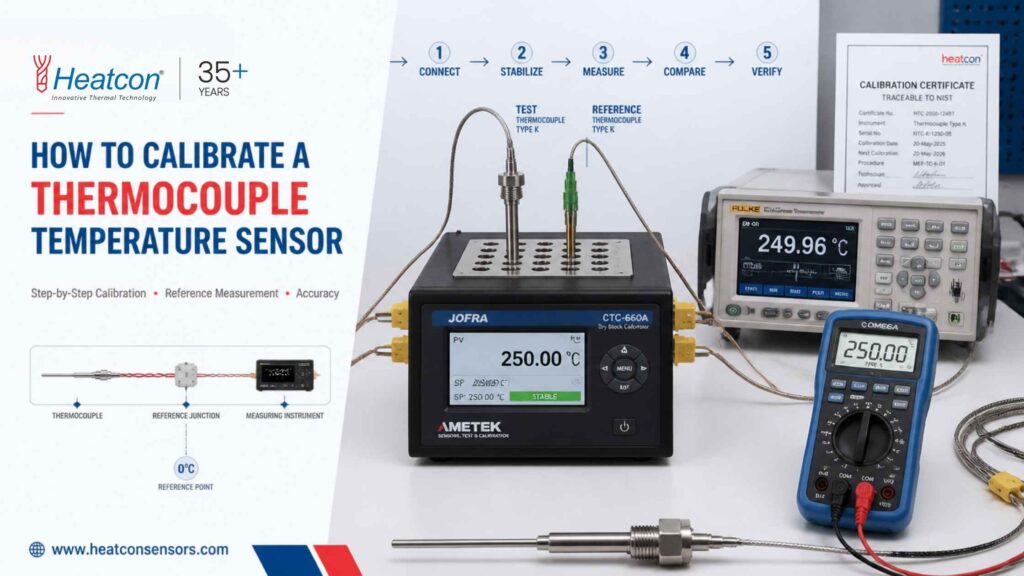
The most effective thermocouple calibration procedure combines preparation, execution, and documentation. Here’s a concise step-by-step guide to performing a basic calibration:
- Identify the thermocouple type (e.g., K, J, T, N, S) and its operating range.
- Gather necessary tools: a precision temperature source (such as a dry-well calibrator or temperature bath), a reference thermometer, and the thermocouple sensor to be calibrated.
- Connect both the reference thermometer and the thermocouple to the calibration source.
- Set the calibrator to a series of temperature points within the sensor’s operating range (e.g., 0°C, 100°C, 200°C, etc.).
- Allow stabilization at each point, then record the readings from both the reference and the thermocouple.
- Calculate the error at each point and compare against acceptable limits defined by relevant calibration standards.
- If necessary, adjust the sensor or record correction factors for future use.
- Document all results, including environmental conditions, equipment used, and any adjustments made.
This process forms the foundation for all thermocouple calibration methods, whether performed in-house or by accredited laboratories.
What Are The Main Thermocouple Calibration Methods?
There are several widely recognized thermocouple calibration methods, each suited to different accuracy requirements and industry standards. The three most common are:
- Comparison Method: The thermocouple under test is compared against a calibrated reference thermometer in a controlled temperature environment. This is the most common approach in industrial thermocouple calibration.
- Fixed-Point Method: The thermocouple is exposed to environments with well-defined temperatures, such as the melting points of pure metals (e.g., zinc, tin, or aluminum). This method offers the highest accuracy but is typically reserved for calibration laboratories.
- Simulation Method: Electrical simulators generate precise voltage signals equivalent to specific temperatures, enabling calibration without direct heat application. This is fast and convenient but relies on electronic simulation rather than actual temperature measurement.
The choice of method depends on your accuracy requirements, available equipment, and the criticality of the application.
What Are The Key Calibration Standards For Thermocouples?
Adhering to internationally recognized calibration standards is essential to guarantee the reliability and traceability of temperature measurements. Some of the leading standards include:
- IEC 60584: Specifies thermocouple types, tolerances, and reference tables for industrial use.
- ASTM E2877/E2877M: Guides the calibration of thermocouples for laboratory and industrial environments.
- NIST Monograph 175: Provides reference functions and tables for standard thermocouples in the United States.
Compliance with these calibration standards not only ensures regulatory acceptance but also enables seamless process audits and international trade.
How Does Thermocouple Accuracy Affect Industrial Processes?
Thermocouple accuracy is a crucial factor in temperature sensor calibration. Even minor inaccuracies can result in costly process deviations, reduced product quality, or equipment damage.
- Standard Tolerance: Most industrial thermocouples have a standard accuracy of ±2.2°C or ±0.75% (whichever is greater), but special grades can achieve tighter tolerances.
- Influencing Factors: Accuracy is affected by sensor aging, installation errors, electromagnetic interference, and periodic drift.
- Mitigation: Regular thermocouple testing and recalibration are essential to maintain system reliability and compliance with quality standards.
For mission-critical applications, partnering with a manufacturer like Heatcon Sensors—who provides both standard and custom solutions—ensures you never compromise on accuracy.
What Is The Role Of Industrial Thermocouple Calibration?
Industrial thermocouple calibration goes beyond the laboratory. It is an ongoing process that ensures sensors installed in furnaces, ovens, chemical reactors, and heat treatment equipment deliver precise, repeatable data over time.
Reliable temperature measurement underpins product consistency, energy efficiency, and operational safety in sectors such as:
- Metallurgy and steel manufacturing
- Ceramics and glass production
- Food and beverage processing
- Pharmaceutical manufacturing
- Petrochemical and power generation
Heatcon Sensors specializes in industrial thermocouple calibration, providing both on-site and laboratory services across India, the US, UAE, Indonesia, Germany, South Korea, Saudi Arabia, Russia, Bahrain, and Kuwait.
What Are The Best Practices For Thermocouple Testing And Maintenance?
Regular thermocouple testing is vital to extend sensor life and maintain high accuracy. Follow these best practices:
- Schedule routine calibration: Establish a calibration interval based on manufacturer recommendations and process criticality.
- Inspect wiring and connections: Loose or corroded connectors can introduce significant errors.
- Replace aging sensors promptly: Drift and degradation increase over time, particularly in high-temperature applications.
- Document all tests and calibrations: Traceability is essential for audits and troubleshooting.
Why Choose Heatcon Sensors For Custom Temperature Sensor Calibration Solutions?
Heatcon Sensors is a leading manufacturer of customized RTDs, thermocouples, and temperature sensors engineered for demanding industrial needs. With a proven track record of supplying to every corner of India and exporting worldwide—including the US, UAE, Indonesia, Germany, South Korea, Saudi Arabia, Russia, Bahrain, and Kuwait—Heatcon Sensors ensures the highest standards of thermocouple calibration and sensor reliability.
- Industry expertise: Decades of experience in designing, manufacturing, and calibrating sensors for various sectors.
- Comprehensive solutions: Full suite of products including furnaces, ovens, hot air blowers, electric furnaces, and high-density cartridge heaters.
- Global reach: Fast, dependable delivery to any location in India or across the globe.
- Custom engineering: Tailored sensor solutions for unique industrial requirements.
- Accredited calibration: Adherence to international calibration standards and best practices.
- Exceptional support: Dedicated assistance and technical guidance at every stage.
How To Reach Out To Heatcon Sensors
Don’t risk your process integrity with subpar sensors or outdated calibration methods. Join the ranks of leading companies who trust Heatcon Sensors for all their temperature measurement and heat-generating equipment needs.
Contact us today by:
- Submitting your information on the contact form.
- Leaving a message on WhatsApp through the interface available on our website.
- Calling us directly at +91 9164833027 or +91 9844233244 for immediate assistance.
Secure your operations, guarantee compliance, and stay ahead of your competition with Heatcon Sensors—the trusted name in temperature sensor calibration.
About Heatcon Sensors
Heatcon Sensors is a leading sensor manufacturer based in India, specializing in the custom design, production, and calibration of RTDs, thermocouples, and a full range of temperature sensors and heat-generating equipment. Our expertise, global reach, and commitment to quality make us the preferred partner for industries that demand precision and reliability in temperature measurement.
Frequently Asked Questions
What is thermocouple calibration and why is it important?
Thermocouple calibration is the process of verifying and adjusting the accuracy of a thermocouple temperature sensor by comparing its output to known calibration standards . This ensures reliable temperature measurement in industrial and laboratory applications. Regular calibration is crucial to maintain thermocouple accuracy and prevent errors that could impact processes or product quality.
How often should a thermocouple be calibrated?
The calibration frequency depends on factors such as the application, environmental conditions, required accuracy, and manufacturer recommendations. For most industrial settings, annual calibration is common, but critical processes may require more frequent checks. Heatcon Sensors can help determine the optimal schedule for your temperature sensor calibration needs.
What are the main thermocouple calibration methods?
Common thermocouple calibration methods include the comparison method (using a reference thermometer in a stable temperature environment), fixed-point calibration (using substances with known melting/freezing points), and calibration baths. Heatcon Sensors utilizes industry best practices and advanced equipment to ensure precise calibration for all types of thermocouples.
Can you describe a typical thermocouple calibration procedure?
A typical thermocouple calibration procedure involves placing the thermocouple and a calibrated reference sensor into a controlled temperature source (such as a dry block or bath). The output of the thermocouple is then compared to the reference at various temperatures. Any deviation is noted and, if necessary, adjustments or corrections are made. Documentation is provided to validate the calibration process, which Heatcon Sensors offers as part of its comprehensive service.
What factors affect thermocouple accuracy?
Thermocouple accuracy can be influenced by factors like sensor age, contamination, wire degradation, electrical interference, and installation errors. Regular thermocouple testing and proper calibration help mitigate these influences. Heatcon Sensors uses robust protocols to ensure consistent accuracy in temperature measurement for all customers.
What are calibration standards and why do they matter?
Calibration standards are reference materials or devices with known, precise properties used to ensure the validity of the thermocouple calibration process. Adhering to recognized standards guarantees that calibration results are traceable and internationally accepted. Heatcon Sensors follows national and international calibration standards to deliver reliable results.
How does Heatcon Sensors support industrial thermocouple calibration?
Heatcon Sensors offers comprehensive industrial thermocouple calibration services, including on-site and in-lab calibration, documentation, and consultation. Our experienced technicians use advanced equipment to ensure your thermocouples meet stringent accuracy requirements, supporting consistent temperature measurement and process control.
What are the signs that a thermocouple needs recalibration or replacement?
Signs include drifting readings, inconsistent or unstable output, visible damage, or failed thermocouple testing. If you notice any of these, it’s wise to schedule temperature sensor calibration or consider replacement. Heatcon Sensors can assess your devices and recommend the best course of action.
Why choose Heatcon Sensors for your thermocouple calibration needs?
Heatcon Sensors stands out for its commitment to accuracy, compliance with calibration standards, and tailored solutions for diverse industries. Our expertise covers all aspects of thermocouple calibration methods and procedures, ensuring your equipment delivers reliable temperature measurement every time.