
What Is The Difference Between Pt100 And Pt1000 RTD Sensors?
When it comes to precision temperature measurement in industrial environments, two of the most widely discussed and utilized sensors are Pt100 and Pt1000 RTDs. According to industry estimates, over 70% of process industries rely on RTD sensors for critical temperature monitoring and control. Understanding the pt100 vs pt1000 comparison is essential for anyone seeking reliable, accurate, and application-suited temperature measurement.
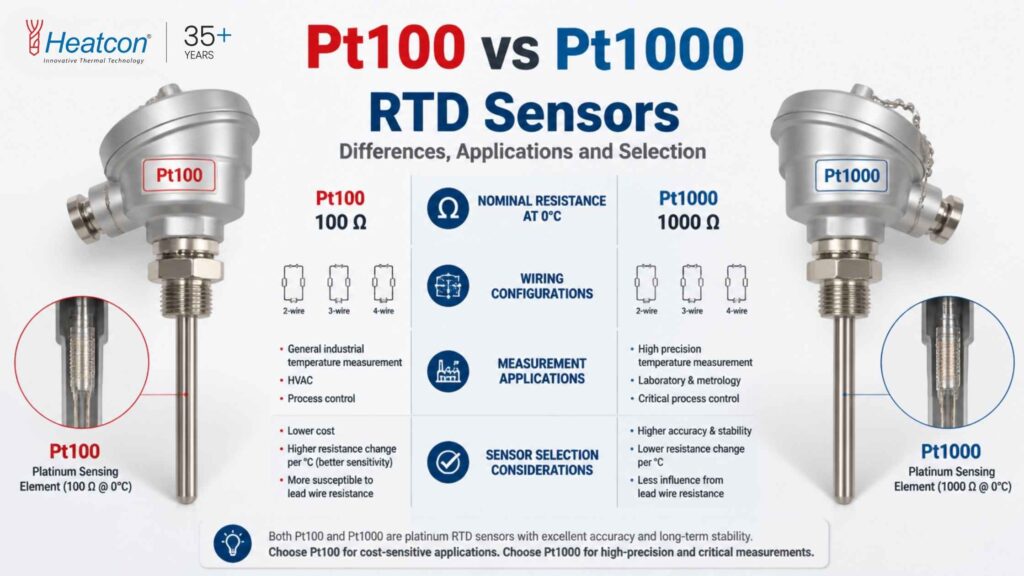
In essence, the primary distinction between Pt100 and Pt1000 RTD sensors lies in their nominal resistance values at 0°C: Pt100 sensors have a resistance of 100 Ω, while Pt1000 sensors have a resistance of 1000 Ω. This difference directly affects their signal output, noise immunity, wiring requirements, and suitability for various applications. But how does this translate into real-world performance, and which option is best for your unique industrial needs?
How Do RTD Sensors Work?
RTD (Resistance Temperature Detector) sensors, including the pt100 temperature sensor and pt1000 variants, operate on the principle that a metal’s electrical resistance changes predictably with temperature. Platinum is the preferred material due to its stability, linearity, and repeatability.
- Pt100 sensors: 100 Ω resistance at 0°C
- Pt1000 sensors: 1000 Ω resistance at 0°C
As temperature increases, the sensor’s resistance rises. This resistance change is measured and converted into a temperature reading, providing accurate monitoring for industrial processes.
Pt100 And Pt1000 Difference: A Detailed RTD Sensor Comparison
The pt100 and pt1000 difference extends beyond just their resistance values. Here’s a structured comparison to help you decide:
| Feature | Pt100 | Pt1000 |
|---|---|---|
| Nominal Resistance (0°C) | 100 Ω | 1000 Ω |
| Sensitivity | ~0.385 Ω/°C | ~3.85 Ω/°C |
| Signal-to-Noise Ratio | Lower (more affected by lead wire resistance) | Higher (less affected by lead wire resistance) |
| Wiring Complexity | Often requires 3 or 4-wire connection | 2-wire connection sufficient for many uses |
| Cost | Slightly lower | Slightly higher |
| Interchangeability | High (industry standard) | Good, but not as universally adopted |
| Common Applications | Process industries, laboratories, high accuracy | HVAC, building automation, long cable runs |
This rtd sensor comparison illustrates that while both sensors are platinum RTDs and deliver remarkable accuracy, selecting between them hinges on the requirements of your application—especially in terms of wiring, accuracy, and environmental factors.
What Is The Pt1000 Resistance Chart?
The pt1000 resistance chart is a reference table showing the resistance values of a Pt1000 RTD sensor at various temperatures. This chart is crucial for calibration, troubleshooting, and ensuring accurate temperature measurement.
| Temperature (°C) | Pt1000 Resistance (Ω) |
|---|---|
| -50 | 803.1 |
| 0 | 1000 |
| 50 | 1193.0 |
| 100 | 1385.0 |
| 200 | 1758.0 |
| 300 | 2131.0 |
| 400 | 2504.0 |
| 500 | 2877.0 |
This information allows engineers to cross-check readings and diagnose potential issues quickly, especially when integrating sensors with control systems or conducting field calibrations.
In Which Applications Is Pt1000 Preferred?
Pt1000 applications are expanding rapidly, especially in environments where wiring simplicity and noise immunity are critical. Some common areas where Pt1000 is preferred include:
- Building automation (HVAC systems, thermostats)
- Environmental monitoring (weather stations, greenhouses)
- Remote temperature sensing (long cable runs)
- Medical devices (incubators, laboratory equipment)
- Automotive electronics (battery management, climate control)
The higher base resistance means that Pt1000 sensors are less sensitive to errors from cable resistance, simplifying installation and enhancing reliability in complex or distributed systems.
How To Select Between Pt100 And Pt1000: Key Considerations
Selecting the right RTD sensor for your process is crucial for accuracy, reliability, and cost-effectiveness. Here’s how to decide between Pt100 and Pt1000:
- Wiring and Installation: If long cable runs are required and minimizing wiring complexity is a priority, Pt1000 is often the better choice.
- Accuracy Needs: Pt100 sensors are widely used in laboratory and industrial processes where the highest accuracy and interchangeability are required.
- System Compatibility: Check if your control or measurement system is designed for Pt100 or Pt1000 input; mismatched sensors may deliver incorrect readings.
- Cost and Availability: Pt100 is often more affordable and more universally available, but Pt1000 is becoming increasingly popular for modern electronics.
Still unsure? Heatcon Sensors can help you analyze your requirements and customize RTD sensors—whether Pt100, Pt1000, or another specification—to match your application perfectly.
Why Choose Heatcon Sensors For Customized RTD And Temperature Sensors?
When it comes to industrial temperature sensing, generic solutions often fall short. Heatcon Sensors, headquartered in India, stands out as a leading expert in designing, manufacturing, and supplying customized RTD sensors, thermocouples, and temperature sensing solutions for diverse industries.
- Tailored Solutions: Every process is unique. Heatcon Sensors offers bespoke designs to meet your specific requirements, from sensor length and sheath material to connection types and calibration standards.
- Global Reach: With advanced logistics, Heatcon Sensors can deliver temperature sensors to any part of India, as well as to the US, UAE, Indonesia, Germany, South Korea, Saudi Arabia, Russia, Bahrain, Kuwait, and worldwide.
- Comprehensive Product Range: In addition to RTDs, Heatcon Sensors manufactures thermocouples, thermowells, and a full suite of heat generating equipment—including industrial furnaces, electric ovens, hot air blowers, high density cartridge heaters, immersion heaters, duct heaters, heating mantles, and more.
- Quality & Reliability: All sensors are manufactured under stringent quality controls, ensuring high accuracy, repeatability, and long-term stability.
- Expert Technical Support: The Heatcon Sensors team assists with technical consultations, sensor selection, and troubleshooting, ensuring seamless integration with your process automation systems.
Don’t let inaccurate temperature measurement disrupt your operations or compromise product quality. Trust Heatcon Sensors for precision, reliability, and rapid support—no matter where your business is located.
How To Order Or Get Support From Heatcon Sensors?
Ready to upgrade your temperature measurement systems or need a custom RTD sensor, thermocouple, or industrial heater? You can reach Heatcon Sensors using any of the following options:
- Submit your requirements through the online form at https://heatconsensors.com/contact-us/
- Leave a message via Whatsapp directly from the Heatcon Sensors website
- Call for immediate assistance: +91 9164833027 or +91 9844233244
Don’t miss out on superior accuracy, custom solutions, and world-class support for all your temperature sensing and heating equipment needs.
About Heatcon Sensors
Heatcon Sensors is a premier manufacturer and supplier of industrial temperature sensors, RTDs, thermocouples, thermowells, and heat generating equipment based in India. With decades of experience, Heatcon Sensors serves industries across India, the US, UAE, Indonesia, Germany, South Korea, Saudi Arabia, Russia, Bahrain, Kuwait, and worldwide.
The company’s deep expertise, commitment to quality, and customer-focused approach have made it the trusted partner for thousands of process industries, laboratories, and OEMs globally.
Frequently Asked Questions
What is the difference between Pt100 and Pt1000 RTD sensors?
The main pt100 and pt1000 difference is their nominal resistance at 0°C: a Pt100 RTD sensor has 100 Ω, while a Pt1000 sensor has 1000 Ω. This results in different sensitivities, wiring requirements, and suitability for various environments. Pt100 sensors are often chosen for industrial settings requiring high accuracy and longer cable runs, whereas Pt1000 sensors offer easier circuit integration and lower wiring costs, making them ideal for building automation, HVAC, and applications where electromagnetic interference is a concern.
How do Pt100 and Pt1000 sensors compare in terms of accuracy and wiring?
In rtd sensor comparison , both Pt100 and Pt1000 sensors deliver high accuracy, but Pt100 sensors are typically favored in critical industrial applications due to their extensive standardization and proven stability. However, Pt1000 sensors, with their higher resistance, are less affected by lead wire resistance, allowing for simpler 2-wire connections without significant loss in accuracy. This makes Pt1000 more cost-effective for distributed or remote installations.
What is a Pt1000 resistance chart, and how is it used?
A pt1000 resistance chart lists the resistance values of a Pt1000 RTD sensor at various temperatures, typically from -200°C to +850°C. These charts help engineers and technicians convert measured resistance into temperature readings. Since Pt1000 sensors have a linear relationship between temperature and resistance, the chart is a vital reference for calibration, troubleshooting, and ensuring accurate measurements in the field.
In which applications are Pt1000 sensors preferred over Pt100?
Pt1000 applications are common in building automation, HVAC systems, energy management, and medical equipment. Their higher resistance reduces errors from lead wires, allowing for reliable temperature sensing with minimal wiring complexity. Pt1000 sensors are also chosen in battery-powered and distributed systems where low current draw and simple integration are essential.
Why would you select a Pt100 temperature sensor for industrial use?
The pt100 temperature sensor is the industry standard for process control, manufacturing, and laboratory environments due to its precision, robustness, and extensive compatibility with instrumentation. Its stable characteristics across a wide temperature range make it ideal for applications needing reliable and repeatable measurements, especially in harsh or high-temperature conditions.
What factors should I consider when choosing between Pt100 and Pt1000 sensors?
When deciding between the two, consider wiring length, installation costs, measurement accuracy, system compatibility, and the application’s susceptibility to electrical noise. For long cable runs or environments with significant electromagnetic interference, a Pt100 sensor may be preferred. For cost-sensitive or distributed installations, a Pt1000 sensor often provides a practical solution.
How does Heatcon Sensors support selection of the right RTD sensor?
Heatcon Sensors offers expert guidance on pt100 vs pt1000 selection, considering your application’s technical and environmental requirements. With a comprehensive range of both sensor types, Heatcon provides customization options, technical datasheets, and engineering support to ensure you receive a sensor that fits your process and budget.
Can Heatcon Sensors provide custom RTD solutions?
Yes, Heatcon Sensors specializes in custom RTD solutions, including both Pt100 and Pt1000 sensors. Whether you need unique probe lengths, sheath materials, connector types, or special calibration, their engineering team can deliver sensors tailored to your exact requirements, ensuring optimal performance and reliability.