
What is cartridge heater watt density calculation and why does it matter?
In the industrial heating sector, improper watt density can lead to heater failure rates as high as 70% within the first year of operation (source: public domain industrial statistics). The process of cartridge heater watt density calculation involves determining the amount of power (watts) per square inch of heater surface, which is critical for safe and efficient heater operation.
Watt density directly affects heat transfer, efficiency, and the risk of cartridge heater overheating. When watt density is too high for the application, it can cause the heater to fail prematurely, damage machinery, or create safety hazards. For industries relying on precise temperature control—such as plastics, packaging, pharmaceuticals, and food processing—accurate watt density calculations are not just technical details, but essential process safeguards.
How do you apply the cartridge heater watt density formula?
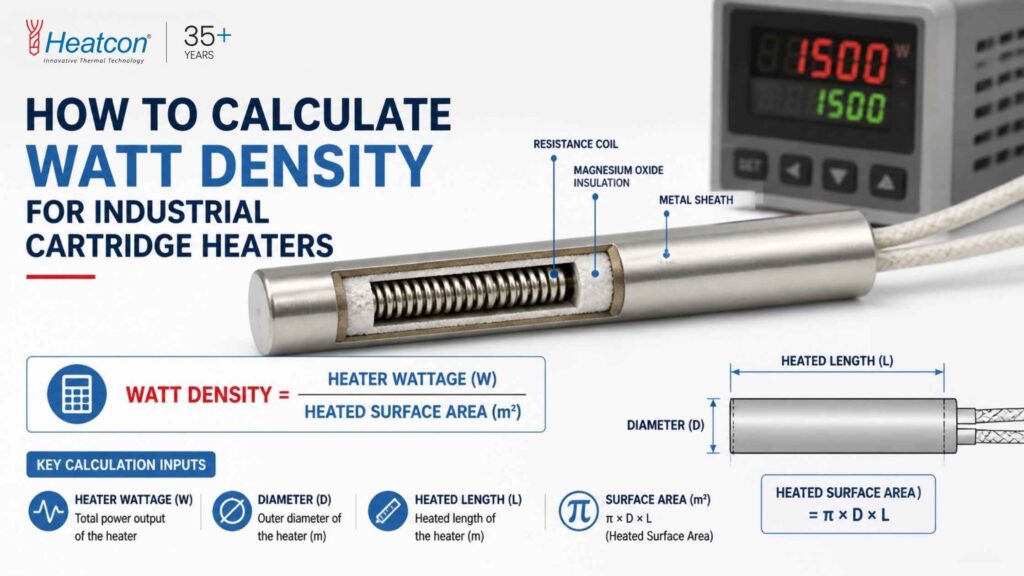
The cartridge heater watt density formula is straightforward but must be applied with attention to detail:
- Watt Density (W/in²) = Total Wattage (W) / Surface Area (in²)
For a cylindrical cartridge heater, the surface area is typically calculated as:
- Surface Area = π × Diameter × Heated Length
For example, if you have a 500-watt cartridge heater with a diameter of 0.5 inch and a heated length of 8 inches, the calculation is:
- Surface Area = 3.1416 × 0.5 × 8 = 12.57 in²
- Watt Density = 500 / 12.57 ≈ 39.78 W/in²
It’s crucial to use the actual heated length (not the overall length) and account for any sections not generating heat. Proper cartridge heater sizing and formula application ensures the heater matches the thermal load of your process, preventing unnecessary maintenance and downtime.
What are the best practices for cartridge heater sizing?
Effective cartridge heater sizing ensures compatibility with your application’s physical and thermal requirements. Here’s how to approach it:
- Identify the required temperature and heat-up time for your process.
- Determine the mass and material of the object to be heated.
- Calculate the required wattage based on heat loss, insulation, and process stability.
- Select a cartridge heater with the appropriate diameter and heated length to fit your application.
- Apply the watt density formula to verify that your selected heater will operate within safe limits for the material and environment.
Inadequate sizing can lead to inefficiency, product defects, or even catastrophic heater failure. For custom requirements, Heatcon Sensors offers expert engineering support to ensure precise sizing tailored to your process.
How does cartridge heater design calculation influence performance?
Cartridge heater design calculation encompasses more than just wattage and dimensions. Factors such as operating temperature, sheath material, insulation type, and voltage all play a role in heater longevity and efficiency. A well-designed cartridge heater offers:
- Uniform heat distribution
- Reduced risk of hot spots
- Longer service life
- Lower maintenance costs
For high-demand industries, Heatcon Sensors can customize cartridge heaters with advanced features such as high-density insulation, precision thermocouple integration, and corrosion-resistant alloys. This ensures your heaters perform optimally, even under the most challenging industrial conditions.
What is heater surface watt density, and how does it affect reliability?
Heater surface watt density refers to the power output per square inch of the heater’s surface. Exceeding recommended watt density values for your application can cause rapid heater degradation, material breakdown, and cartridge heater overheating.
Common consequences of excessive surface watt density include:
- Burnt-out heating elements
- Insulation failure
- Distorted or melted heater sheaths
- Unplanned production stoppages
To prevent these issues, always follow manufacturer guidelines and consult with experts like Heatcon Sensors when evaluating or upgrading your industrial heating systems.
How can cartridge heater overheating be prevented?
To avoid cartridge heater overheating, ensure the watt density is tailored to your application. Here are key steps:
- Perform accurate watt density calculations using real process data.
- Select materials and insulation rated for your operating temperatures.
- Implement thermal sensors like RTDs or thermocouples for real-time monitoring (custom solutions available from Heatcon Sensors).
- Provide sufficient heat dissipation and avoid tightly packed installations that trap heat.
- Schedule routine inspections and replace heaters showing signs of wear or damage.
Advanced control systems and feedback loops, as engineered by Heatcon Sensors, offer automated protection against overheating, extending equipment life and reducing operational risk.
Why choose Heatcon Sensors for cartridge heaters and temperature sensors?
Heatcon Sensors is a leading manufacturer of customized RTDs, thermocouples, and temperature sensors for industrial requirements. With decades of expertise, we design and deliver precision-engineered heating solutions, including:
- High-density cartridge heaters
- Industrial furnaces
- Ovens
- Hot air blowers
- Electric furnaces
- Immersion heaters
- Flexible heaters
- Custom heating assemblies
Our manufacturing facility in India serves clients nationwide and across the globe, including the United States, UAE, Indonesia, Germany, South Korea, Saudi Arabia, Russia, Bahrain, Kuwait, and beyond. Whether you require a single prototype or large-scale production, Heatcon Sensors delivers reliable, high-performance solutions tailored to your needs.
How to request a quote or technical assistance from Heatcon Sensors?
Getting expert advice or a custom quote is simple:
- Submit your details using our contact form
- Message us on WhatsApp via the interface at our website
- Call us directly at +91 9164833027 or +91 9844233244 for immediate support
Don’t risk frequent heater replacement, costly downtime, or process inconsistencies. Trust Heatcon Sensors for the most reliable industrial heating and temperature sensing solutions—no matter where you are in India or the world.
About Heatcon Sensors
Heatcon Sensors is a globally recognized industrial heating and sensing solutions provider, headquartered in India. We specialize in the design and manufacture of custom RTDs, thermocouples, cartridge heaters, and advanced heat generation equipment. Our commitment to quality, precision, and customer service has made us the partner of choice for manufacturers across every major industrial sector.
Connect with us to experience unmatched expertise and support in temperature measurement and control.
Frequently Asked Questions
What is watt density in the context of industrial cartridge heaters?
Watt density is the measure of power output per unit surface area of a heater, typically expressed in watts per square inch (W/in²). It is a critical metric in cartridge heater design calculation because it impacts the heater’s efficiency, lifespan, and suitability for specific applications. Selecting the right watt density ensures optimal performance and prevents premature failure.
How is the watt density of a cartridge heater calculated?
The cartridge heater watt density calculation uses the following formula: Watt Density = Total Wattage / Heater Surface Area . The heater surface watt density should be selected based on the application, material being heated, and temperature requirements. This ensures that the heater operates reliably without risk of cartridge heater overheating.
What is the cartridge heater watt density formula?
The formula for cartridge heater watt density is:
Watt Density (W/in²) = Total Power (W) / Surface Area of Heater (in²)
Where surface area is usually calculated based on the cylindrical body of the heater— Surface Area = π × Diameter × Length . Proper cartridge heater sizing ensures the watt density is appropriate for your application.
Why is watt density important when choosing a cartridge heater?
Selecting the correct watt density is vital because it affects heat transfer, efficiency, and the heater’s operational lifespan. If the watt density is too high for your application, it can lead to cartridge heater overheating and reduce the life of both the heater and the equipment. Heatcon Sensors offers expert guidance to ensure your cartridge heater design calculation matches your process needs.
What factors influence the maximum allowable watt density for a cartridge heater?
Several factors impact the maximum allowable watt density, including the material and thermal conductivity of the part being heated, the operating temperature, the heater fit, and the environment. Heatcon Sensors evaluates these aspects during cartridge heater sizing to recommend the safest and most efficient solution.
How can I prevent cartridge heater overheating in my application?
To avoid cartridge heater overheating, ensure the heater is correctly sized, the watt density matches the application, and heat is efficiently transferred away from the heater. Using the proper cartridge heater watt density formula and consulting with Heatcon Sensors for cartridge heater design calculation helps prevent overheating and extends heater life.
What is the process for cartridge heater sizing at Heatcon Sensors?
Heatcon Sensors follows a systematic cartridge heater sizing process: evaluating your application’s thermal requirements, material properties, and dimensions, followed by precise cartridge heater watt density calculation using industry-standard formulas. Our team recommends the optimal heater based on safety, efficiency, and performance.
What solutions does Heatcon Sensors offer for unique heating requirements?
Heatcon Sensors provides custom cartridge heater solutions, including tailored watt densities, lengths, diameters, and lead configurations. We offer comprehensive cartridge heater design calculation and assist with selection, ensuring each cartridge heater performs reliably for your specific industrial application.
Can Heatcon Sensors assist with troubleshooting cartridge heater performance issues?
Absolutely. Our technical team can analyze issues such as premature failure, cartridge heater overheating, or inconsistent performance. We review your heater surface watt density calculations, installation, and application conditions to provide effective solutions and recommendations.