In this comprehensive guide, we will answer your most pressing questions, provide actionable troubleshooting steps, and explain why choosing a reliable partner like Heatcon Sensors for your temperature sensors and heating solutions is essential for industrial success, whether you operate in India, the US, UAE, Indonesia, Germany, South Korea, Saudi Arabia, Russia, Bahrain, Kuwait, or anywhere across the globe.
What Is A Chemical Immersion Heater And Why Do Failures Occur?
A chemical immersion heater is an electrical device designed to heat liquids, typically by being submerged directly into the solution. They are engineered to withstand aggressive chemicals and high temperatures, but like any industrial asset, they are vulnerable to specific failure modes.
- Corrosion due to harsh chemicals
- Scaling from mineral buildup
- Electrical faults
- Mechanical damage or improper installation
- Lack of industrial heater maintenance
These issues can lead to chemical immersion heater failure, affecting process consistency, energy efficiency, and safety.
How To Troubleshoot Chemical Immersion Heater Failures?
Effective chemical immersion heater troubleshooting begins with a structured approach:
- Visual Inspection: Check for visible damage, discoloration, or residue on the heater sheath.
- Electrical Testing: Use a multimeter to measure resistance and check for continuity; deviations may indicate a failed element.
- Monitor Temperature Response: If your heater is slow to reach setpoint or shows erratic readings, there may be underlying industrial immersion heater problems such as sensor drift or control system errors.
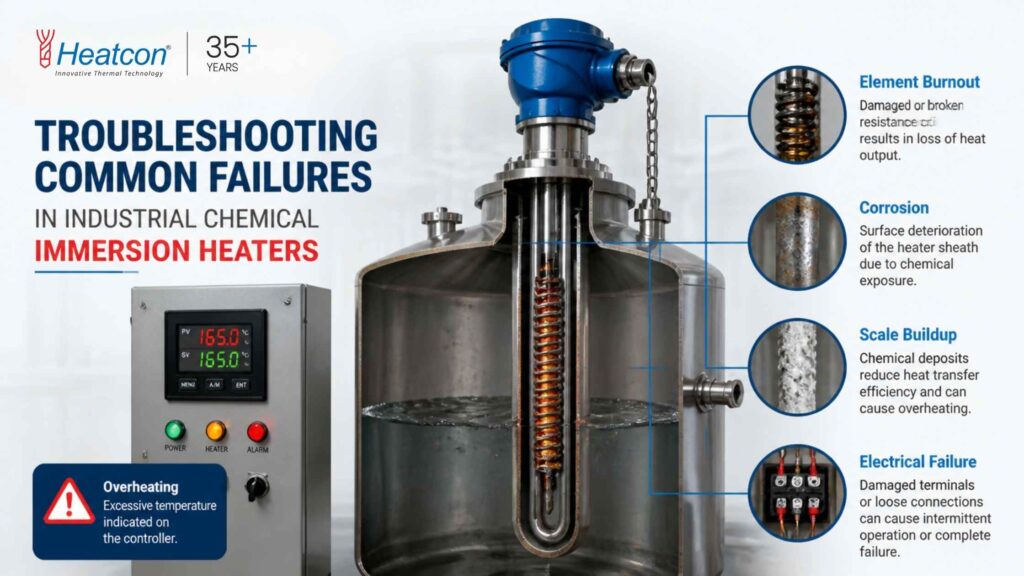
- Look For Corrosion Or Scaling: Surface deposits or pitting are tell-tale signs of chemical heater corrosion or immersion heater scaling.
- Check Control Systems: Faulty thermostats, sensors, or relays can mimic heater failure.
For each of these steps, it is critical to use proper safety protocols and consult the heater’s technical documentation.
What Are The Most Common Industrial Immersion Heater Problems?
The most prevalent issues that lead to downtime or inefficiency in chemical immersion heaters include:
- Chemical Heater Corrosion: Aggressive chemicals can rapidly deteriorate even high-alloy sheaths, leading to leaks and eventual heater short-circuit.
- Immersion Heater Scaling: Hard water or contaminated chemicals cause mineral buildup, insulating the heating element and drastically reducing heat transfer efficiency.
- Electrical Overloads: Fluctuations in supply voltage or ground faults can burn out the heating element.
- Sensor Inaccuracy: Poor-quality or degraded temperature sensors can mislead control systems, leading to overheating, underheating, and process instability.
- Improper Installation Or Poor Maintenance: Incorrect mounting, lack of periodic cleaning, or failure to follow manufacturer guidelines can all cause premature chemical immersion heater failure.
Many of these problems are preventable with robust industrial heater maintenance and the selection of appropriate, high-quality sensors and heating elements tailored to the process.
How Can You Prevent Chemical Immersion Heater Failure?
Preventing failure starts with a proactive maintenance routine and careful attention to process variables. Here are key strategies:
- Material Selection: Choose sheath materials compatible with the chemical composition of your process. Heatcon Sensors can guide you in selecting the ideal alloy for your application, whether it demands Incoloy, stainless steel, titanium, or specialized coatings.
- Regular Cleaning: Schedule periodic removal of buildup to prevent immersion heater scaling. Consider automated cleaning solutions for continuous processes.
- Monitor For Corrosion: Inspect heater elements for early signs of chemical heater corrosion. Address leaks or pitting before they escalate.
- Install Quality Sensors: Use precision RTDs or thermocouples, like those custom-manufactured by Heatcon Sensors, to ensure accurate temperature monitoring and control.
- Routine Electrical Checks: Test for insulation resistance, ground continuity, and circuit integrity to identify issues before they cause downtime.
Most importantly, work with a manufacturer who understands your specific needs and can offer custom solutions to optimize performance and reliability.
Why Is Industrial Heater Maintenance Critical?
Consistent industrial heater maintenance dramatically reduces the risk of unplanned shutdowns, enhances safety, and extends the operational life of your equipment. Regular inspections, sensor calibrations, and prompt repair of minor faults can save thousands in lost production and avoid costly emergency replacements.
- Downtime Prevention: Well-maintained heaters are less likely to fail unexpectedly, keeping your production schedule on track.
- Energy Efficiency: Clean, properly functioning heaters use less energy to achieve set temperatures.
- Safety Compliance: Industrial processes involving chemicals demand strict adherence to safety standards; maintenance is a key compliance pillar.
What Sets Heatcon Sensors Apart For Your Industrial Heating Needs?
Heatcon Sensors is a leading manufacturer specializing in customized RTDs, thermocouples, and temperature sensors tailored for industrial applications worldwide. With decades of experience, we understand the nuanced challenges of chemical immersion heater troubleshooting and industrial immersion heater problems. Our expertise ensures you receive solutions that are:
- Custom-engineered for your process requirements, whether you operate in India, the US, UAE, Indonesia, Germany, South Korea, Saudi Arabia, Russia, Bahrain, Kuwait, or globally.
- Manufactured to the highest standards, ensuring durability and accuracy in demanding environments.
- Supported by a wide portfolio of heat-generating equipment, including furnaces, ovens, hot air blowers, electric furnaces, and high density cartridge heaters.
- Delivered with expert technical guidance—from initial consultation to post-installation support.
Our sensors are not only used for immersion heaters but also for other critical heat applications in chemical, pharmaceutical, food processing, and heavy industries.
How To Select The Right Sensor And Heating Solution?
Choosing the right sensor or heater for your chemical process involves evaluating:
- The chemical composition and temperature range of the process fluid
- Required response time and accuracy
- Installation environment and physical constraints
- Integration with control systems
- Regulatory and safety requirements
Heatcon Sensors offers personalized recommendations and custom designs to meet even the most challenging requirements. Our technical team is available to collaborate with you from design to delivery, ensuring seamless integration and optimal performance.
What Should You Do If You Suspect A Heater Failure?
If you observe slow heating, temperature instability, or any sign of chemical immersion heater failure, act quickly:
- Shut down the system and isolate the heater from power sources.
- Perform a careful visual and electrical inspection.
- Check for scaling, corrosion, or physical damage.
- Test temperature sensors and control circuits.
- Contact a qualified technician or your heater supplier for further diagnostics and recommendations.
Remember, timely intervention is critical to prevent escalation and to protect both personnel and process integrity.
How Can You Get Help Or Order From Heatcon Sensors?
Don’t compromise on safety, efficiency, or reliability. Whether you need immediate troubleshooting, custom temperature sensors, or advanced heat-generating equipment, Heatcon Sensors is ready to support you. Choose from any of the following options to reach us:
- Submit your information on our contact form
- Leave a message on WhatsApp via our website
- Call us for immediate assistance at +91 9164833027 or +91 9844233244
Our team is committed to delivering precision, quality, and timely solutions—wherever you are in India or across the globe.
About Heatcon Sensors
Heatcon Sensors is a globally trusted manufacturer of customized temperature sensors, RTDs, thermocouples, and industrial heating equipment. Based in India, we serve a worldwide clientele in sectors such as chemicals, pharmaceuticals, energy, food processing, and manufacturing. Our commitment to quality, technical innovation, and customer satisfaction sets us apart as the partner of choice for reliable, high-performance process solutions.
Frequently Asked Questions
What are the most common causes of chemical immersion heater failure in industrial applications?
Chemical immersion heater failure often results from issues such as excessive scaling, corrosion caused by aggressive chemicals, improper installation, and lack of regular maintenance. Heatcon Sensors addresses these problems with robust material selection, anti-corrosion coatings, and expert guidance to ensure compatibility with specific chemicals and operational conditions.
How can I identify and troubleshoot industrial immersion heater problems effectively?
Signs of industrial immersion heater problems include slow heating, tripping of safety devices, visible scaling, or uneven temperature distribution. Heatcon Sensors recommends regular inspections, monitoring electrical parameters, and checking for physical deformities. Their technical support team can assist with chemical immersion heater troubleshooting to quickly identify and fix issues.
What are the primary reasons for chemical heater corrosion, and how does Heatcon Sensors address them?
Chemical heater corrosion typically occurs due to direct exposure to harsh chemicals or incompatible heater sheath materials. Heatcon Sensors counteracts this by offering heaters with high-grade alloys, specialized coatings, and tailored designs to withstand corrosive environments, thereby extending equipment lifespan and reducing downtime.
How does immersion heater scaling affect performance, and what solutions are available?
Immersion heater scaling leads to reduced heat transfer efficiency, increased energy consumption, and potential overheating. Heatcon Sensors suggests using scale-resistant sheath materials, regular cleaning procedures, and water treatment systems. Their team can recommend solutions based on your process fluid and heating requirements.
What steps should be included in routine industrial heater maintenance?
Routine industrial heater maintenance should involve inspecting for corrosion and scaling, checking electrical connections, verifying thermostat function, and ensuring there are no signs of physical damage. Heatcon Sensors provides maintenance guidelines and support to maximize operational safety and heater longevity.
How does Heatcon Sensors support customers facing recurring chemical immersion heater troubleshooting issues?
Heatcon Sensors offers technical consultation, on-site diagnostics, and customized heater designs to help resolve recurring chemical immersion heater troubleshooting scenarios. Their expertise ensures the root causes are addressed, whether related to process compatibility, installation, or material selection.
What measures can reduce downtime caused by industrial immersion heater problems?
Preventive maintenance, prompt replacement of faulty components, and using heaters engineered for the specific chemical environment can significantly reduce downtime. Heatcon Sensors provides rapid response support and reliable spares to minimize interruption in your operations.
Can incorrect installation contribute to chemical immersion heater failure?
Yes, incorrect installation can directly lead to chemical immersion heater failure by causing leaks, electrical faults, or inadequate immersion depth. Heatcon Sensors offers detailed installation guidelines and after-sales support to ensure heaters are installed correctly for optimal performance.
What advantages do Heatcon Sensors’ heaters offer for challenging chemical environments?
Heatcon Sensors’ heaters are engineered with advanced materials and coatings, custom designs, and rigorous testing to handle tough chemical environments. This reduces risks of chemical heater corrosion, scaling, and premature failure, ensuring reliable, long-term operation for various industrial processes.