
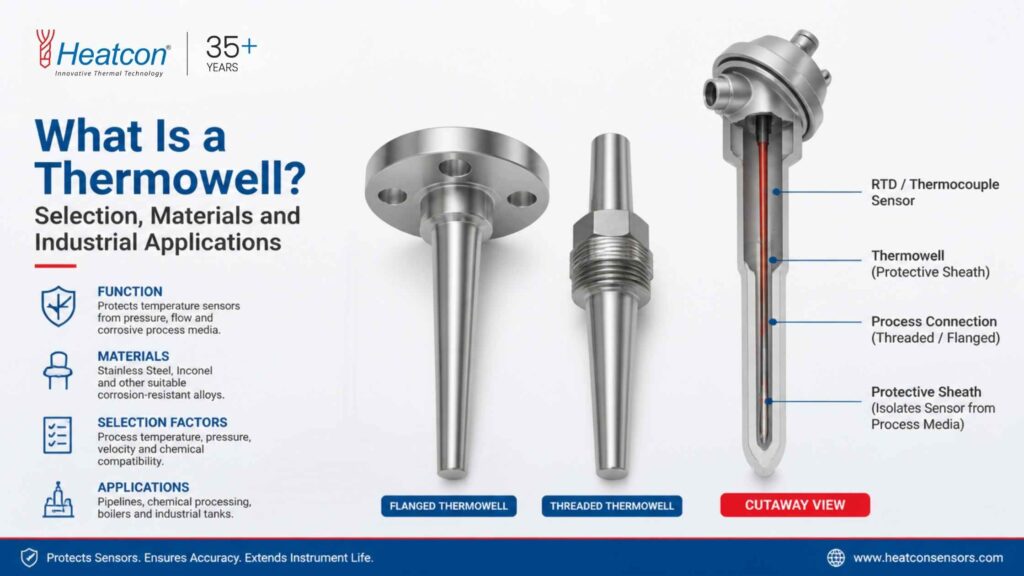
A thermowell is a protective enclosure designed to shield temperature sensors from harsh process environments, ensuring accurate and reliable temperature measurement in industrial applications. According to industry reports, over 80% of industrial temperature sensors are installed with thermowells to safeguard against corrosion, pressure, and mechanical damage—demonstrating their critical role in process safety and equipment longevity. If you’re seeking robust temperature sensing solutions, understanding thermowells is essential for optimal process control and efficiency.
What is a thermowell and why is it important?
A thermowell is a cylindrical fitting installed into pipelines, tanks, or vessels that houses and protects a temperature sensor (like an RTD or thermocouple) from direct exposure to process fluids. This allows for sensor maintenance or replacement without shutting down the process and shields delicate sensors from pressure, flow-induced vibration, and corrosive or abrasive materials. By acting as a barrier, a thermowell enhances sensor lifespan and measurement reliability—critical for industries such as oil & gas, chemicals, pharmaceuticals, energy, water treatment, and food processing.
How do you select the right thermowell? (Thermowell selection guide)
Choosing the correct thermowell is crucial to ensure process integrity and sensor durability. A comprehensive thermowell selection guide considers several factors:
- Process Conditions: Assess maximum temperature, pressure, and corrosiveness of the process medium.
- Fluid Velocity: Higher flow rates increase vibration and risk of failure; proper sizing and thermowell wake frequency calculation are vital.
- Insertion Length: Sufficient immersion is needed for accurate measurement, but excessive length may increase vibration concerns.
- Material Compatibility: Choose materials resistant to chemical attack or erosion by the process medium.
- Mounting Style: Flanged, threaded, or welded connections must suit process piping standards.
- Sensor Compatibility: Ensure the thermowell fits the required thermowell temperature sensor (RTD, thermocouple, etc.).
- Industry Standards: Follow ASME PTC 19.3 TW-2016 and local regulations for safe and reliable design.
At Heatcon Sensors, our engineers guide clients through this process, providing custom and standard solutions that precisely match your plant’s needs.
What are the main thermowell types and their applications?
There are several thermowell types designed for various industrial scenarios:
- Threaded Thermowells: Easy to install and remove; ideal for moderate pressures and removable sensors.
- Flanged Thermowells: Robust and suitable for high-pressure or corrosive environments; commonly used in petrochemical and power industries.
- Weld-in Thermowells: Provide maximum strength and leak protection; ideal for high-pressure steam or critical applications.
- Socket Weld Thermowells: Blend of strength and ease of installation, often used in pipelines with smaller diameters.
- Van Stone/Lap Joint Thermowells: Allow for easy removal and replacement without disturbing pipe flanges.
- Sanitary Thermowells: Designed for hygienic applications in food, beverage, and pharmaceutical industries, meeting stringent cleanliness standards.
Heatcon Sensors manufactures and supplies all major thermowell types and can custom-engineer variants for unique process demands anywhere in India or internationally.
What factors influence thermowell design?
Effective thermowell design balances mechanical strength, responsiveness, and compatibility with the process environment. Key design considerations include:
- Shank Profile: Tapered, straight, or stepped—each impacts vibration resistance and response time.
- Bore Size: Must accommodate the chosen temperature sensor snugly for efficient heat transfer.
- Root and Tip Diameter: Affect strength and response speed—larger roots for pressure, smaller tips for faster sensing.
- Surface Finish: Smooth finishes reduce fouling in viscous or sanitary processes.
- Mounting Connections: Standards like ASME, DIN, and others must be matched for global compatibility.
- Special Features: Helical strakes or special coatings for extreme environments.
As a leader in custom thermowell and sensor solutions, Heatcon Sensors leverages decades of experience to deliver optimal designs for both standard and challenging applications.
How is thermowell material selection performed?
Thermowell material selection is pivotal for process safety and longevity. Materials must withstand process chemistry, temperature, and mechanical stresses. Common choices include:
| Material | Max Temp (°C) | Corrosion Resistance | Typical Application |
|---|---|---|---|
| Stainless Steel 316/316L | ~870 | Excellent | General chemical, food, pharma |
| Inconel 600/625 | ~1100 | Superb (chlorides, acids) | Power, oil & gas, marine |
| Hastelloy C276 | ~1100 | Outstanding (acids, alkalis) | Chemical processing |
| Monel 400 | ~820 | Good (hydrofluoric acid, seawater) | Petrochemical, marine |
| Carbon Steel | ~425 | Basic | Water, non-corrosive |
| PTFE/Polymer Coated | ~250 | Excellent (non-stick) | Highly corrosive, low temp |
Selecting the wrong material can lead to catastrophic failure. Heatcon Sensors provides expert guidance in material selection, ensuring your investment is protected.
What is a thermowell temperature sensor and why is it used?
A thermowell temperature sensor refers to the combination of a temperature sensor (like an RTD or thermocouple) inserted within a thermowell. This pairing is essential in industrial environments to:
- Protect the sensor from direct process exposure
- Allow for sensor replacement without process interruption
- Ensure stable, repeatable temperature readings
- Withstand high pressures, velocities, and aggressive chemicals
Heatcon Sensors specializes in manufacturing highly accurate and robust RTDs and thermocouples tailored for thermowell use, meeting the most demanding industrial requirements.
Why is thermowell wake frequency calculation necessary?
Thermowell wake frequency calculation is a critical step that evaluates the risk of flow-induced vibration and potential fatigue failure in thermowells. When fluid flows past a thermowell, vortices are shed, inducing vibrations. If these vibrations match the thermowell’s natural frequency, resonance occurs—leading to catastrophic failure.
This calculation, as specified in ASME PTC 19.3 TW-2016, determines safe operating conditions and acceptable insertion lengths. Heatcon Sensors performs wake frequency analysis for every custom design, ensuring safe and reliable operation in even the harshest process environments.
What are the industrial applications of thermowells?
Thermowells play a vital role across a broad spectrum of industries. Some key applications include:
- Oil & Gas: High-pressure, high-temperature protection in refineries, pipelines, and offshore platforms
- Chemicals & Petrochemicals: Corrosion-resistant monitoring in reactors and distillation columns
- Power Generation: Steam and water temperature measurement in turbines and boilers
- Pharmaceuticals & Food Processing: Sanitary thermowells for hygienic and accurate process control
- Water & Wastewater: Rugged solutions for water treatment plants
- HVAC & Building Automation: Reliable temperature sensing in heating and cooling systems
With the ability to customize solutions for any process, Heatcon Sensors delivers thermowells and sensors to industries in India, the US, UAE, Indonesia, Germany, South Korea, Saudi Arabia, Russia, Bahrain, Kuwait, and worldwide.
Why choose Heatcon Sensors for thermowells and temperature sensing solutions?
Heatcon Sensors is an internationally recognized manufacturer specializing in custom-engineered RTDs, thermocouples, thermowells, and heat-generating equipment such as industrial furnaces, ovens, hot air blowers, electric furnaces, and high density cartridge heaters. Our highly skilled team combines deep technical knowledge with cutting-edge manufacturing capabilities to deliver solutions that exceed industry standards.
Here’s why leading industries trust Heatcon Sensors:
- Custom design and engineering for every application
- Comprehensive range of thermowell types and materials
- Precision manufacturing for global standards compliance
- Expert guidance through the entire thermowell selection guide process
- Worldwide delivery and support, including India, US, UAE, Indonesia, Germany, South Korea, Saudi Arabia, Russia, Bahrain, and Kuwait
- In-house engineering for thermowell wake frequency calculation and safety assurance
- Unmatched after-sales support and technical assistance
Ready to enhance your process safety and efficiency?
Trust Heatcon Sensors to deliver reliable, high-performance thermowells and temperature sensors customized for your application. Contact us today via one of these options:
- Submit your information on our online contact form
- Leave a message on Whatsapp using the interface on our website
- Call us directly at +91 9164833027 or +91 9844233244
Don’t compromise on process reliability—partner with Heatcon Sensors, your global expert in temperature measurement and control.
About Heatcon Sensors
Heatcon Sensors is a leading manufacturer of industrial temperature sensors and heat-generating equipment based in India, with a decades-long legacy of serving process industries worldwide. Our portfolio includes RTDs, thermocouples, thermowells, industrial furnaces, ovens, hot air blowers, electric furnaces, high density cartridge heaters, and a wide range of custom-engineered solutions. We are committed to innovation, quality, and customer satisfaction, delivering excellence to clients in India, the US, UAE, Indonesia, Germany, South Korea, Saudi Arabia, Russia, Bahrain, Kuwait, and beyond.
For more information, visit heatconsensors.com.
Frequently Asked Questions
What is a thermowell and why is it important in industrial temperature measurement?
A thermowell is a protective tubular fitting installed in industrial piping or vessels to shield a temperature sensor, such as a thermometer or thermocouple, from harsh process conditions. The thermowell allows the thermowell temperature sensor to be removed or replaced without shutting down the process. This protection ensures longer sensor life, maintains process integrity, and improves safety—making thermowells a critical part of temperature monitoring in industries like power plants, oil & gas, chemical processing, and pharmaceuticals.
What factors should be considered during thermowell selection?
When using a thermowell selection guide , key considerations include process temperature and pressure, velocity of the fluid, chemical compatibility, immersion length, and the type of sensor being used. Proper selection ensures reliable measurement, extends equipment lifespan, and minimizes risk of failure. Heatcon Sensors provides expert guidance to help you choose the right thermowell for your application.
What are the main types of thermowells available?
There are several thermowell types , including threaded, flanged, socket weld, and weld-in thermowells. Each type is suited for specific installation requirements and pressure ratings. For example, flanged thermowells are ideal for high-pressure applications, while threaded types offer easy installation and replacement. Heatcon Sensors manufactures a wide range of thermowell types to suit diverse industrial needs.
How does thermowell material selection impact performance?
Thermowell material selection is crucial for ensuring durability and compatibility with the process media. Materials like stainless steel, Inconel, Monel, and Hastelloy are commonly used based on corrosion resistance, temperature tolerance, and mechanical strength. Heatcon Sensors assists clients in choosing the optimal material for each application, balancing cost and performance.
What is thermowell design and why does it matter?
Thermowell design refers to the geometry, wall thickness, stem length, and mounting style of the thermowell. The design affects vibration resistance, response time, and the ability to withstand process pressures. Proper design helps prevent failures such as fatigue or breakage, especially in high-velocity or high-pressure environments. Heatcon Sensors customizes thermowell design to meet specific process conditions.
What is thermowell wake frequency calculation and when is it required?
Thermowell wake frequency calculation is an engineering analysis used to determine if the thermowell will resonate with the frequency of vortex shedding caused by fluid flow. If resonance occurs, it can lead to fatigue failure. This calculation is especially important for applications with high-velocity fluids. Heatcon Sensors can assist with wake frequency calculations to ensure safe and reliable thermowell installation.
How do I choose the right thermowell for corrosive or high-temperature applications?
For corrosive or high-temperature environments, it is important to reference a thermowell selection guide and select materials with proven resistance, such as Hastelloy or Inconel. The design should also allow for sufficient immersion and mechanical strength. Heatcon Sensors offers expert advice and a broad portfolio of materials designed for challenging industrial applications.
Can Heatcon Sensors provide custom thermowell solutions?
Yes, Heatcon Sensors specializes in custom thermowell solutions tailored to your process requirements. Whether you need unique thermowell types , specialized thermowell material selection , or compliance with strict industry standards, our team can design, engineer, and manufacture thermowells to your exact specifications.
What support does Heatcon Sensors offer for thermowell installation and maintenance?
Heatcon Sensors provides comprehensive support, including guidance on thermowell design , installation best practices, wake frequency calculations, and ongoing maintenance. Our specialists ensure your thermowell temperature sensor system operates safely and efficiently throughout its lifecycle.