
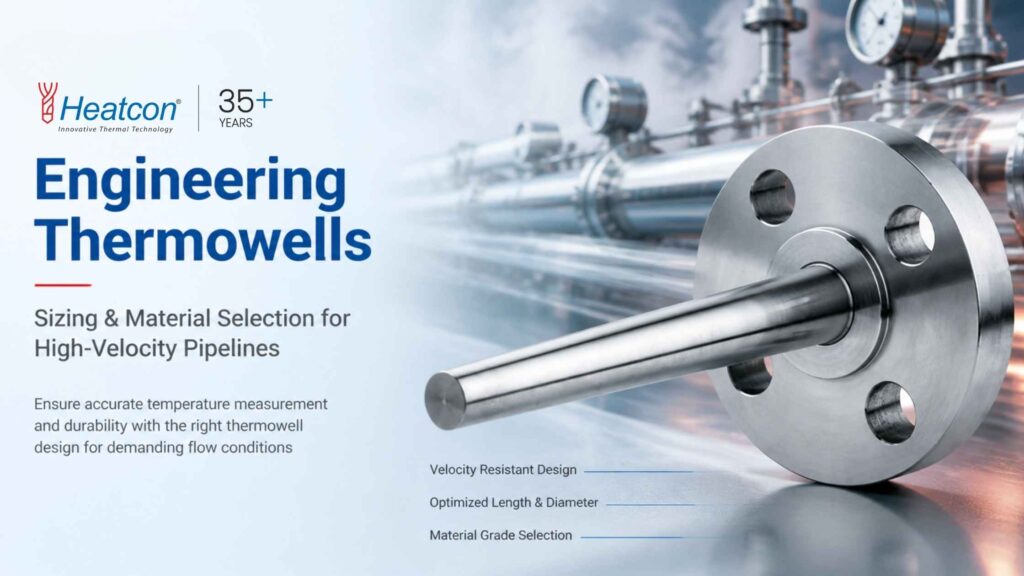
What Is Industrial Thermowell Design And Why Is It Critical For High-Velocity Pipelines?
Industrial thermowell design is the backbone of reliable temperature measurement in high-velocity pipelines. According to the International Society of Automation (ISA), nearly 80% of industrial temperature sensors operate with thermowells for process protection and measurement accuracy. In high-velocity or high-pressure pipelines, a robust thermowell is not just a luxury—it is essential for safety, precision, and longevity.
A thermowell acts as a protective barrier between the process fluid and the temperature sensor, such as an RTD or thermocouple, shielding the sensor from harsh conditions while allowing accurate temperature readings. When designed and sized correctly, thermowells prevent sensor damage, minimize risk of accidental leaks, and maximize system uptime. This is especially vital in industries like oil & gas, chemical processing, and power generation, where pipeline velocities can be extreme and downtime is costly.
- Key takeaway: Selecting the right thermowell for high-velocity applications is a blend of engineering, safety standards, and practical experience.
How Does A Thermowell Work And What Are The Main Types?
A thermowell is a closed-end metal tube inserted into a process stream, providing a sealed cavity for a temperature sensor. It transmits heat by conduction while protecting the sensor from direct exposure to chemicals, pressure, and velocity forces.
- Threaded thermowells: Screw into the process connection; common in lower-pressure systems.
- Flanged thermowells: Bolted to the pipeline flange; ideal for high-pressure or corrosive environments.
- Weld-in thermowells: Welded directly to the vessel or pipe for maximum strength.
- Van Stone (Lap Joint) thermowells: Feature a slip-on flange; useful when frequent removal is needed.
The choice of thermowell type is just the starting point; correct sizing and material selection are equally crucial, especially in pipelines with high fluid velocities.
How To Size A Thermowell For High-Velocity Pipelines?
Sizing a thermowell involves balancing immersion length for measurement accuracy against mechanical strength to withstand process forces. This is where tapered thermowell dimensions come into play. Tapered thermowells, which have a decreasing diameter towards the tip, offer superior resistance to vortex-induced vibrations compared to straight-shank designs.
- Determine immersion length: The sensor tip should be at least 1/3 into the stream, ideally at the center, to avoid boundary layer effects.
- Assess process velocity: High-velocity fluids induce vibrations; longer and thinner thermowells are more prone to failure.
- Apply ASME PTC 19.3 velocity limits: This globally recognized standard provides formulas and acceptance criteria for safe thermowell operation under dynamic loads.
- Perform thermowell design calculation: Consider wake frequency, natural frequency, and material fatigue limits. Use software or tools based on ASME PTC 19.3 TW-2016 guidelines for best results.
| Pipe Size (inches) | Tip Diameter (mm) | Shank Diameter (mm) | Recommended Immersion (mm) |
|---|---|---|---|
| 1 | 7 | 19 | 100-150 |
| 2 | 9 | 22 | 150-200 |
| 4 | 11 | 25 | 200-250 |
Snippet Answer: To size a thermowell for high-velocity pipelines, use the ASME PTC 19.3 velocity limits, select suitable tapered thermowell dimensions, and apply detailed thermowell design calculation to ensure the thermowell’s resonant frequency exceeds the wake frequency induced by fluid flow.
What Is Thermowell Material Selection And Why Does It Matter?
Thermowell material selection is the process of choosing the optimal alloy or metal for your operating environment. It’s a critical decision impacting the thermowell’s corrosion resistance, mechanical strength, and service life.
- Stainless Steel (SS304/SS316): Widely used for general-purpose, non-corrosive applications.
- Inconel: Ideal for high-temperature and aggressive chemical environments.
- Hastelloy, Monel, Titanium: Used in highly corrosive or exotic chemical processes.
- Carbon Steel: Suitable for low-cost, non-corrosive duties but limited by temperature and corrosion resistance.
Incorrect material selection can lead to rapid failure, leaks, and costly downtime. Always consider process media, temperature range, pressure, and regulatory requirements.
Why Is Adhering To ASME PTC 19.3 Velocity Limits Essential?
The ASME PTC 19.3 velocity limits are industry benchmarks for ensuring thermowell safety and durability in vibrating, high-velocity environments. Exceeding these limits increases the risk of vortex-induced vibration, which can cause catastrophic thermowell failure.
- Protects operators and assets from process leaks or sensor ejection.
- Ensures compliance with insurance and industry safety standards.
- Maximizes sensor accuracy and lifespan in demanding conditions.
Quick Fact: ASME PTC 19.3 TW-2016 calculations are now a mandatory part of design approval in many regulated industries, especially in oil & gas and chemical sectors.
How To Perform A Thermowell Design Calculation For High-Velocity Pipelines?
A thorough thermowell design calculation includes:
- Calculating process fluid velocity and density
- Determining thermowell’s natural frequency
- Estimating wake frequency from vortex shedding
- Evaluating static and dynamic stresses
- Comparing calculated values with ASME PTC 19.3 velocity limits
Modern engineering tools and spreadsheets based on ASME standards can automate this process, but expert review is recommended to account for real-world factors like support, installation, and process transients.
Why Choose Heatcon Sensors For Industrial Thermowell Design And Custom Temperature Solutions?
Heatcon Sensors is a world-class manufacturer of RTDs, thermocouples, and complete temperature measurement assemblies, including custom-engineered thermowells. With decades of expertise serving industries across India, the US, UAE, Indonesia, Germany, South Korea, Saudi Arabia, Russia, Bahrain, and Kuwait, Heatcon Sensors delivers:
- Tailored solutions: Custom thermowell sizing, material selection, and engineering to meet unique process challenges.
- Global reach: Efficient supply chain to deliver temperature sensors and assemblies anywhere in India or worldwide.
- Comprehensive product portfolio: In addition to thermowells and sensors, Heatcon manufactures heat generating equipment like electric furnaces, industrial ovens, hot air blowers, high density cartridge heaters, immersion heaters, and more.
- Unmatched quality: Adherence to global standards (ASME, IEC, ISO) and rigorous in-house quality checks.
- Fast, responsive support: Dedicated application engineers and a customer-centric approach ensure you’re never left waiting for answers or solutions.
Whether you operate in Mumbai, Houston, Dubai, Jakarta, Berlin, Seoul, Riyadh, Moscow, Manama, or Kuwait City, Heatcon Sensors stands ready to deliver precision-engineered thermowells and temperature solutions to your doorstep.
What Are The Steps To Select The Right Thermowell For Your Application?
Selecting the right thermowell involves several key steps:
- Identify the process conditions: temperature, pressure, fluid type, and maximum velocity.
- Choose the appropriate thermowell type: threaded, flanged, weld-in, or Van Stone.
- Select the correct immersion length and shank style (tapered, stepped, or straight).
- Choose the right material for corrosion and temperature resistance.
- Perform thermowell design calculation using ASME PTC 19.3 or equivalent standards.
- Consult with a thermowell specialist, such as Heatcon Sensors, to validate your choice and ensure compliance with safety standards.
Tip: Never compromise on material quality or design calculations—these are the most common causes of thermowell failure in the field.
About Heatcon Sensors
Heatcon Sensors is an industry leader in temperature measurement and heating solutions, headquartered in India and serving clients globally. Our expertise spans custom RTDs, thermocouples, thermowells, and a full range of heat generating equipment such as electric furnaces, ovens, hot air blowers, high density cartridge heaters, and immersion heaters. We empower industries to operate safely and efficiently by delivering products engineered to the highest standards.
Contact Heatcon Sensors today:
- Submit your information on the contact form
- Use the WhatsApp chat interface on our website
- Call us directly at +91 9164833027 or +91 9844233244 for immediate assistance
Don’t leave your process safety and efficiency to chance. Trust Heatcon Sensors for reliable, engineered thermowell and temperature solutions—wherever your industry operates.
Frequently Asked Questions
What is the importance of correct thermowell sizing in high-velocity pipelines?
Proper thermowell sizing is crucial in high-velocity pipelines to prevent mechanical failure due to vibration and excessive stress. Incorrect sizing can result in resonance, leading to fatigue or even catastrophic failure. Heatcon Sensors uses advanced thermowell design calculation methods to ensure that each thermowell meets the service requirements, balancing strength, response time, and safety in demanding industrial applications.
How does industrial thermowell design address both safety and measurement accuracy?
Industrial thermowell design must consider process conditions, fluid velocity, and vibration to ensure safety and measurement accuracy. By optimizing the shape, length, and material of the thermowell, Heatcon Sensors ensures minimal deflection and rapid thermal response. Our designs comply with industry standards, providing accurate readings while maintaining robust mechanical integrity.
What are tapered thermowell dimensions, and when should they be used?
Tapered thermowells feature a shaft that narrows from the process connection to the tip, enhancing their resistance to dynamic forces and vibration. Tapered thermowell dimensions are ideal for high-velocity or high-pressure applications, as they reduce the risk of resonance while maintaining fast response times. Heatcon Sensors offers a range of tapered thermowell dimensions tailored to specific pipeline requirements.
What are the ASME PTC 19.3 velocity limits, and why do they matter?
The ASME PTC 19.3 velocity limits specify the maximum allowable fluid velocity for a given thermowell design to prevent excessive vibration and fatigue failure. Adhering to these velocity limits is essential for safe operation and longevity of the thermowell. Heatcon Sensors utilizes the latest ASME PTC 19.3 TW-2016 code for all sizing and verification to ensure compliance and reliability.
How is thermowell material selection performed for corrosive or high-temperature applications?
Thermowell material selection involves assessing the process fluid, temperature, pressure, and corrosion potential. Materials like stainless steel, Monel, Inconel, or Hastelloy are chosen based on compatibility and durability in harsh environments. Heatcon Sensors provides expert guidance on thermowell material selection, ensuring the chosen alloy meets both the mechanical and chemical demands of each application.
Can Heatcon Sensors assist with custom thermowell design calculation and verification?
Yes, Heatcon Sensors offers comprehensive thermowell design calculation services, including vibration and stress analysis, to ensure each thermowell meets ASME and customer specifications. Our engineering team uses advanced software and years of expertise to deliver reliable, validated designs for both standard and bespoke applications.
What information is required to specify the optimal thermowell for a pipeline?
To specify the optimal thermowell, details such as process temperature, pressure, fluid velocity, pipeline size, insertion length, and corrosion considerations are needed. Heatcon Sensors works closely with clients to gather all necessary data and recommend the best industrial thermowell design for each unique application.
How do Heatcon Sensors’ solutions ensure compliance with international standards?
Heatcon Sensors designs and manufactures thermowells in strict accordance with ASME PTC 19.3 TW-2016 and other relevant international codes. Each thermowell undergoes rigorous quality control and design verification, ensuring compliance with velocity, vibration, and material requirements for safe, long-term operation in high-velocity pipelines.
What additional support does Heatcon Sensors provide for thermowell installations in critical service?
Heatcon Sensors offers end-to-end support, including on-site assessment, custom engineering, material selection guidance, and installation recommendations. Our team can also provide validation documentation and post-installation reviews to ensure ongoing reliability and compliance in critical, high-velocity service environments.