
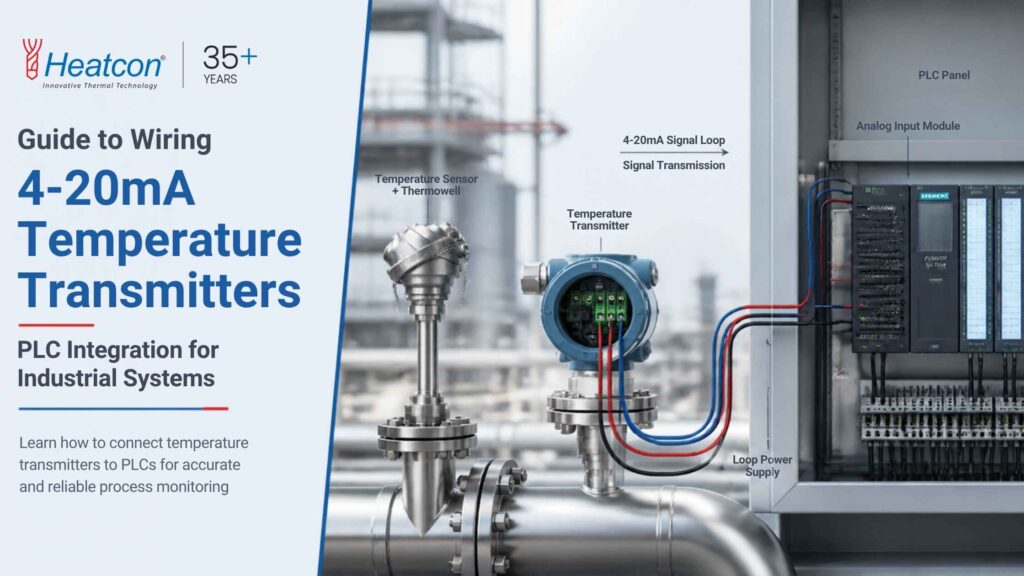
How can you ensure accurate temperature monitoring and robust control in your industrial processes? By mastering the wiring of 4-20mA temperature transmitters to PLC systems, you unlock the potential for up to 40% reduction in process downtime and maintenance costs, according to industry surveys. In today’s highly automated world, the reliability of temperature data drives not just product quality but also plant safety and operational efficiency.
What is an industrial temperature transmitter and why is it essential?
An industrial temperature transmitter is a vital device that converts signals from a temperature sensor (such as an RTD or thermocouple) into a standardized output—most commonly the 4-20mA current loop. This signal acts as the “language” for process controllers and PLCs, enabling real-time monitoring and automation of heating, cooling, and safety systems. Without precise temperature data, processes in industries such as chemicals, pharmaceuticals, food & beverage, power, and oil & gas risk inefficiency and hazards.
- Accuracy: Transmitters translate minute temperature changes into robust electrical signals immune to noise.
- Safety: Automated alarms and shutdowns depend on reliable temperature readings.
- Scalability: 4-20mA loops can be run over long distances with minimal signal loss, ideal for large plants.
How does a 4-20mA temperature transmitter work?
A 4-20mA temperature transmitter receives the raw signal from a sensor, conditions it, and outputs a linear current proportional to the measured temperature. The 4mA represents the lowest temperature (zero scale), while 20mA represents the highest (full scale). This method is preferred globally for its simplicity, resistance to electrical interference, and ease of troubleshooting. Most industrial PLC systems are natively compatible with 4-20mA analog inputs, making integration seamless.
- 4mA: Indicates minimum or zero temperature.
- 20mA: Indicates maximum temperature of the calibrated range.
- Live Zero: 4mA (not 0mA) allows for wire break detection.
What are the main types of temperature transmitters?
Choosing the right transmitter for your application is critical. Here are the main types:
| Transmitter Type | Description | Common Applications |
|---|---|---|
| Head Mount Temperature Transmitter | Installed in the sensor’s connection head for compact, field-ready installation. | Process vessels, pipelines, outdoor installations |
| DIN Rail/Field Mounted | Mounted on control panels or near the process for easy maintenance. | PLC panels, distributed control systems |
| HART Protocol Sensors | Enable smart diagnostics and remote calibration via the HART digital protocol. | Smart plants, digital transformation projects |
How to wire a 4-20mA temperature transmitter to a PLC?
Wiring a 4-20mA temperature transmitter to a PLC temperature transmitter input is a straightforward process, but requires attention to detail for safe and accurate operation. Here’s a quick overview:
- Identify the transmitter type (e.g., head mount temperature transmitter or DIN rail type).
- Check PLC input compatibility: Ensure your PLC analog input card is designed for 4-20mA.
- Connect sensor to transmitter: Wire your RTD or thermocouple to the transmitter terminals as per the manufacturer’s diagram.
- Power the loop: Most transmitters are loop-powered (powered by the same 2 wires carrying the signal).
- Wire loop to PLC: Connect the transmitter’s output (+) to the PLC analog input (+), and transmitter (-) to the PLC analog input (-). If using barrier or isolator, wire as per its diagram.
- Configure PLC: Set the input scaling to match the temperature range of the transmitter.
Always refer to wiring diagrams and follow proper safety procedures. If you’re unsure, Heatcon Sensors’ technical team is ready to guide you step-by-step.
What are HART protocol sensors and their advantages?
HART protocol sensors are advanced temperature transmitters that superimpose digital communication on the standard 4-20mA loop. This allows for:
- Remote calibration and configuration
- Advanced diagnostics and health monitoring
- Device identification and asset management
HART-enabled transmitters are widely used in smart manufacturing plants across India, UAE, US, Germany, Indonesia, South Korea, Saudi Arabia, Russia, Bahrain, and Kuwait, as digital transformation and Industry 4.0 adoption accelerate globally.
Why is choosing the right PLC temperature transmitter crucial?
PLC temperature transmitters act as the bridge between field temperature sensors and your plant automation system. Choosing the right transmitter ensures:
- Precise and reliable temperature data
- Fewer false alarms and downtime
- Seamless integration with existing PLC infrastructure
- Cost-effective maintenance and troubleshooting
Heatcon Sensors can custom design PLC-compatible transmitters for any process, environment, or protocol—including 4-20mA, HART, Profibus, and more.
Why partner with Heatcon Sensors for your temperature transmitter needs?
Heatcon Sensors is a globally respected specialist in manufacturing industrial temperature transmitters, customized RTDs, thermocouples, and sensor assemblies for every industrial need. With a deep presence in India and exports to the US, UAE, Indonesia, Germany, South Korea, Saudi Arabia, Russia, Bahrain, Kuwait, and beyond, Heatcon Sensors delivers unmatched reliability and tailored solutions for every application.
- Customization: Get RTDs and transmitters built to your exact specifications and process requirements.
- Full Range: From head mount temperature transmitter models to HART protocol sensors and PLC temperature transmitters, all under one roof.
- Global Delivery: Trusted by leading industries worldwide, Heatcon Sensors ships to any location—urban or remote.
- Expert Support: Receive technical guidance, installation support, and after-sales service from seasoned automation professionals.
- Beyond Sensors: Heatcon Sensors also manufactures heat generating equipment such as industrial furnaces, ovens, hot air blowers, electric furnaces, high density cartridge heaters, immersion heaters, tubular heaters, and more—making it your one-stop destination for complete thermal solutions.
What sets Heatcon Sensors apart?
- Experience: Decades of expertise in the design and deployment of industrial temperature transmitter systems for demanding environments.
- Quality Assurance: Rigorous testing and calibration ensure every product meets or exceeds international standards.
- Innovation: Regular upgrades and adoption of latest technology, including HART protocol sensors and IIoT-ready devices.
- Responsiveness: Fast quotations, rapid prototyping, and on-time delivery—no matter where you are in the world.
About Heatcon Sensors
Heatcon Sensors is an ISO-certified leader in the design and manufacture of industrial temperature transmitters, customized RTDs, thermocouples, and a complete range of thermal solutions. Based in India and serving clients worldwide—including the US, UAE, Indonesia, Germany, South Korea, Saudi Arabia, Russia, Bahrain, and Kuwait—Heatcon Sensors is committed to delivering quality, innovation, and reliable service in every project. For more information, visit heatconsensors.com.
Frequently Asked Questions
What is a 4-20mA temperature transmitter and why is it widely used for PLC integration?
A 4-20mA temperature transmitter is an industrial device that converts a temperature sensor signal (like RTD or thermocouple) into a standardized 4-20mA current output. This signal is ideal for industrial environments and PLC systems because it is less susceptible to electrical noise and voltage drops over long cable runs. The 4-20mA range also allows for easy fault detection, as any value below 4mA or above 20mA indicates a wiring or sensor issue.
How do I wire a temperature transmitter to a PLC temperature transmitter input module?
Wiring a temperature transmitter to a PLC is straightforward: connect the positive output of the transmitter to the positive terminal of the PLC analog input, and the negative output to the negative terminal. Make sure to supply the correct loop power (usually 24V DC) if required. Heatcon Sensors provides wiring diagrams and technical support for a smooth installation process, ensuring compatibility with most PLC temperature transmitter input cards.
What’s the difference between a head mount temperature transmitter and a DIN rail mount transmitter?
A head mount temperature transmitter is designed to be installed directly in the sensor connection head, providing a compact and integrated solution at the measurement point. A DIN rail mount transmitter is intended for installation inside a control panel on a standard DIN rail. Heatcon Sensors offers both styles to suit different installation environments and space requirements.
Can Heatcon Sensors supply transmitters with HART protocol sensors support for advanced diagnostics?
Yes, Heatcon Sensors offers transmitters compatible with HART protocol sensors, enabling advanced configuration and diagnostics via a HART communicator. This feature allows operators to access device parameters, calibration, and health status remotely, enhancing system reliability and maintenance efficiency within industrial automation setups.
What are the key advantages of using an industrial temperature transmitter from Heatcon Sensors?
Industrial temperature transmitters from Heatcon Sensors are designed for high accuracy, robust performance, and easy integration with PLC systems. They are available in various configurations, including head mount and DIN rail types, support a range of sensor inputs (RTDs, thermocouples), and offer features like HART communication, sensor burnout detection, and excellent long-term stability.
How do I troubleshoot if my PLC is not receiving the correct signal from the temperature transmitter?
First, check the wiring connections for continuity and polarity. Use a multimeter to verify that the transmitter is outputting between 4 and 20mA corresponding to the measured temperature. If the signal is out of range, inspect the sensor, transmitter configuration, and power supply. Heatcon Sensors also offers technical assistance and documentation to help resolve common issues quickly.
Are Heatcon Sensors’ transmitters compatible with most PLC brands and systems?
Absolutely. Heatcon Sensors’ 4-20mA temperature transmitter models are engineered to integrate seamlessly with leading PLC and DCS brands. Our transmitters provide industry-standard outputs and support features like HART for broad compatibility, making them suitable for both new installations and system upgrades.
What support does Heatcon Sensors provide for selecting and installing temperature transmitters?
Heatcon Sensors provides expert selection guidance, product datasheets, wiring diagrams, and after-sales technical support to ensure the right solution for your application. Whether you need a head mount temperature transmitter, a DIN rail module, or advanced HART protocol sensors, our team can help with commissioning and troubleshooting as well.