
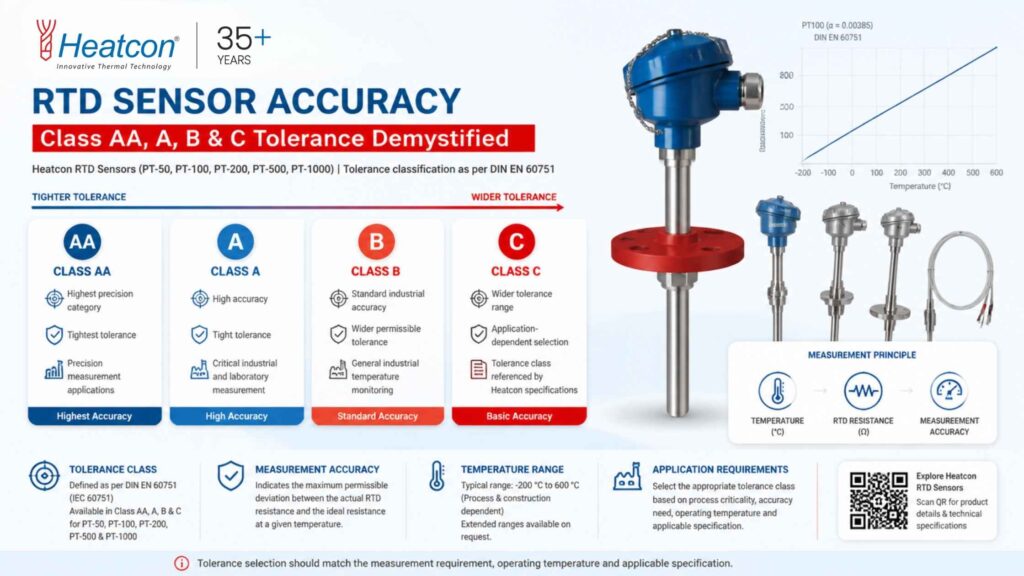
What is RTD sensor accuracy and why does it matter for your industry? Precision in temperature measurement can make or break your process quality and safety. According to the International Society of Automation, over 70% of industrial temperature measurements rely on RTDs (Resistance Temperature Detectors), making their accuracy a cornerstone of manufacturing, research, and process automation worldwide. In this guide, you’ll uncover how to interpret the Pt100 accuracy chart, differentiate between classes AA, A, B, and C, and make informed decisions for your business—especially with Heatcon Sensors as your trusted partner in custom RTD manufacturing and supply across India, the US, UAE, Indonesia, Germany, South Korea, Saudi Arabia, Russia, Bahrain, Kuwait, and beyond.
How to interpret RTD sensor accuracy classes (AA, A, B, C): Fast answers
RTD sensor accuracy classes—AA, A, B, and C—define the maximum permissible deviation between the measured and true temperature. The classes are determined by international RTD sensor tolerance standards, notably IEC 60751, and are essential for industries that require stringent temperature control. Class AA offers the tightest tolerance, followed by A, B, and then C, impacting both precision and cost.
- Class AA: Highest accuracy, for critical applications
- Class A: High accuracy, for controlled process environments
- Class B: Standard industrial accuracy
- Class C: General purpose, where high precision is not crucial
Choosing the right class directly affects product quality, energy efficiency, and compliance with industry regulations.
What is a Pt100 accuracy chart and how do you use it?
A Pt100 accuracy chart visually represents the permissible error (in °C or Ω) for each RTD class across a range of temperatures. This chart allows engineers to select the optimal sensor for their application by balancing accuracy needs and cost constraints.
For instance, if your process requires a maximum error of ±0.15°C at 0°C, you would select a Class AA sensor. The chart is based on the reference values defined by IEC 60751.
Sample Pt100 accuracy table (IEC 60751)
| Class | Tolerance at 0°C (±°C) | Tolerance Formula |
|---|---|---|
| AA | 0.10 | ±(0.10 + 0.0017|t|) |
| A | 0.15 | ±(0.15 + 0.002|t|) |
| B | 0.30 | ±(0.30 + 0.005|t|) |
| C | 0.60 | ±(0.60 + 0.01|t|) |
Use this Pt100 accuracy table to match your application’s accuracy demands—a crucial step in industries like pharmaceuticals, petrochemicals, and food processing.
Why are RTD sensor tolerance standards critical in industry?
RTD sensor tolerance standards ensure that temperature measurements are reliable and consistent, regardless of where or by whom a sensor is manufactured. The most widely recognized standards—IEC 60751 and ASTM E1137—define the resistance-temperature characteristics and allowed deviation for each class.
- Promote global interoperability and quality assurance
- Allow easy comparison between suppliers and sensor models
- Provide a baseline for regulatory compliance and audits
With Heatcon Sensors, you can rest assured your custom RTDs are manufactured to the highest international standards, ensuring seamless integration into your system—whether you operate in India, the US, or anywhere across Europe, Asia, or the Middle East.
How do precision resistance temperature detectors improve your process?
Precision resistance temperature detectors (RTDs) are engineered for exceptional stability, repeatability, and low drift, which is vital for applications demanding exact temperature control. These sensors, especially when custom-manufactured by Heatcon Sensors, deliver:
- Superior accuracy and minimal uncertainty
- Excellent long-term reliability, even in harsh environments
- Reduced calibration and maintenance costs
Whether you require miniature sensors for laboratory use or robust assemblies for furnaces and ovens, precision RTDs from Heatcon Sensors can be tailored for your unique process, boosting both productivity and product quality.
What is IEC 60751 and why should you care?
IEC 60751 is the international standard defining the electrical and accuracy characteristics of industrial platinum RTDs—most notably, the Pt100 type. It prescribes the temperature coefficient, resistance values, and tolerance formulas for each class (AA, A, B, C).
- Ensures sensors perform as expected across global industries
- Enables seamless system upgrades and replacements
- Guarantees alignment with regulatory and quality requirements
Adhering to IEC 60751 is non-negotiable for critical applications in pharmaceuticals, power generation, food processing, and HVAC—domains where Heatcon Sensors routinely supplies custom RTDs built to these standards.
How to choose the right RTD class for your application?
Selecting the correct accuracy class saves costs while ensuring product integrity. Here’s how to decide:
- Assess process requirements: How critical is temperature accuracy?
- Check regulatory demands: Are ISO, FDA, or customer standards involved?
- Evaluate environment: Will the sensor face vibration, moisture, or chemicals?
- Balance cost vs. benefit: Higher accuracy classes cost more but may reduce waste or downtime.
Need expert guidance? Heatcon Sensors’ technical team will help you analyze your process and recommend the optimal RTD configuration, including sheath material, element type, and wiring method.
Why Heatcon Sensors is your ideal partner for custom RTDs and temperature solutions
Heatcon Sensors is a leading Indian manufacturer specializing in precision resistance temperature detectors, custom RTDs, and advanced temperature sensing solutions. Our expertise extends beyond sensors—we also design and manufacture heat generating equipment such as:
- Industrial furnaces (electric, gas, and specialty atmospheres)
- Ovens (batch, conveyor, laboratory, and curing types)
- Hot air blowers for process heating
- High density cartridge heaters for plastic, packaging, and die heating
- Immersion heaters, tubular heaters, and custom assemblies
With state-of-the-art facilities and a proven track record, Heatcon Sensors can meet your requirements—no matter how demanding—across India, the US, UAE, Indonesia, Germany, South Korea, Saudi Arabia, Russia, Bahrain, Kuwait, and other global markets.
Don’t let inaccurate temperature readings jeopardize your process! Choose Heatcon Sensors for unmatched reliability and custom engineering.
About Heatcon Sensors
Heatcon Sensors is an ISO-certified, globally recognized manufacturer of RTDs, thermocouples, temperature sensors, and industrial heating equipment. Based in India, we supply and support clients worldwide with tailored solutions for every industry, from energy to pharmaceuticals to food and beverage.
- Global supply capabilities—shipping anywhere in India and internationally
- Custom design and engineering support for every project
- Comprehensive after-sales service and technical support
Heatcon Sensors is your trusted partner for precision temperature measurement—wherever your operations are located.
How to contact Heatcon Sensors for your custom RTD and temperature sensing requirements
Ready to experience the Heatcon Sensors difference? Choose from any of these easy options to get started:
- Submit your information on our secure form at Contact Us
- Leave a message on WhatsApp through the interface on our website
- Call us directly at +91 9164833027 or +91 9844233244 for immediate assistance
Don’t risk costly errors or compliance failures—partner with Heatcon Sensors and elevate your process accuracy today!
Frequently Asked Questions
What do the tolerance classes AA, A, B, and C mean for RTD sensors?
Tolerance classes for RTD sensors—namely, Class AA, A, B, and C—define the permissible deviation between the actual resistance and the nominal value at a given temperature. These classes are specified under IEC 60751 , the international standard for platinum resistance thermometers. Class AA offers the highest accuracy, followed by A, B, and then C, with each step down allowing for greater deviation. The selection of the class depends on the precision requirements of your application.
How does the Pt100 accuracy table help in selecting an RTD sensor?
The Pt100 accuracy table provides a quick reference for the allowable deviation (in °C or Ω) at various temperatures for each tolerance class. By consulting this table, engineers can match the measurement requirements of their process with the appropriate RTD class, ensuring the right balance between accuracy and cost.
What is the significance of IEC 60751 in RTD sensor tolerance standards?
IEC 60751 is the international standard that defines the characteristics, tolerances, and calibration procedures for platinum RTD sensors. It establishes the RTD sensor tolerance standards that manufacturers and users rely on to ensure consistency, reliability, and global compatibility in temperature measurement.
Can you explain the Pt100 accuracy chart and how it is used?
The Pt100 accuracy chart visually represents the maximum permissible error for each tolerance class over a range of temperatures. This chart makes it easy to compare different classes side-by-side and determine which class is suitable for your specific temperature range and accuracy requirements.
What are precision resistance temperature detectors, and when should they be used?
Precision resistance temperature detectors are specially manufactured RTDs that offer superior accuracy, stability, and repeatability, often meeting or exceeding Class AA specifications. They are ideal for applications where even minor temperature deviations can impact product quality or process safety, such as in pharmaceuticals, aerospace, or laboratory research.
How does Heatcon Sensors ensure the quality and accuracy of their RTD sensors?
Heatcon Sensors follows rigorous testing and calibration procedures in compliance with IEC 60751 . Each RTD undergoes strict quality assurance to meet the specified tolerance class. Heatcon Sensors also provides traceable calibration certificates and technical support to help you select the ideal sensor for your accuracy needs.
What factors can affect RTD sensor accuracy in real-world applications?
Sensor accuracy can be influenced by factors such as lead wire resistance, installation technique, thermal gradients, vibration, and environmental conditions. Heatcon Sensors offers custom solutions, including 3-wire and 4-wire configurations, to minimize these effects and maintain high measurement accuracy.
How can Heatcon Sensors help with selecting the right RTD for my application?
Heatcon Sensors provides expert guidance in interpreting the Pt100 accuracy chart and Pt100 accuracy table to help you choose the most suitable RTD class for your process. Their team can recommend the appropriate configuration, materials, and calibration options to ensure optimal performance in your specific environment.
Where can I find detailed RTD sensor tolerance standards for reference?
Detailed RTD sensor tolerance standards can be found in the official IEC 60751 documentation. Additionally, Heatcon Sensors provides comprehensive data sheets and technical resources that summarize these standards and offer practical advice for implementation in industrial settings.