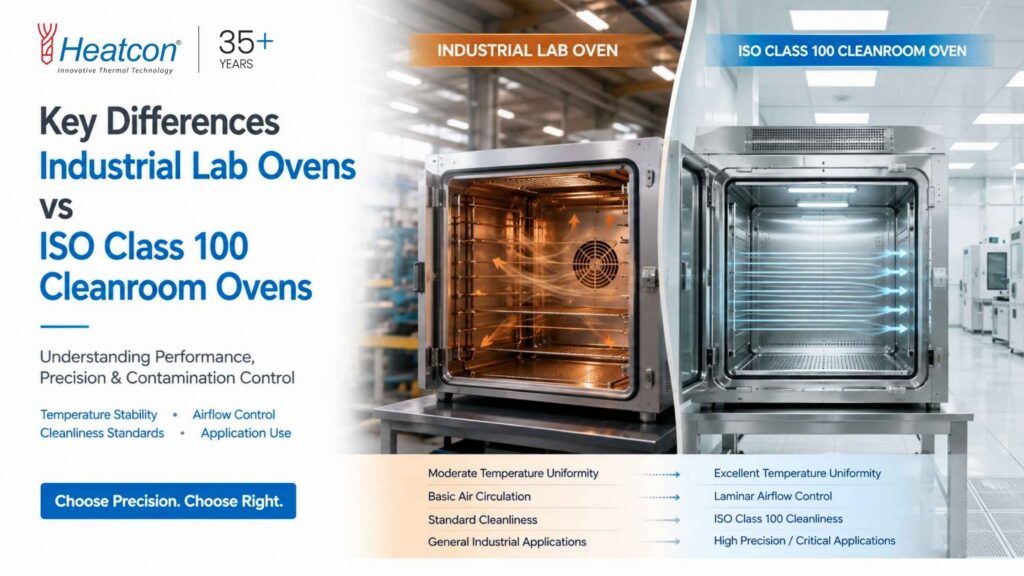
What is the difference between industrial ovens and ISO Class 100 cleanroom ovens? In today’s world, where contamination control and precision heating are essential, the global industrial oven market is projected to reach over USD 12 billion by 2027, fueled by diverse applications from pharmaceuticals to electronics. This surge highlights the crucial importance of selecting the right oven type for your unique process—and why a thorough lab oven comparison matters more than ever.
Understanding Industrial Ovens and Class 100 Cleanroom Ovens
Industrial ovens are robust heat-generating equipment designed for high-volume, repeated thermal processing tasks such as drying, curing, annealing, and sterilizing across sectors such as automotive, aerospace, metal treatment, and food processing. In contrast, a Class 100 cleanroom oven, also known as an ISO Class 100 oven, is engineered for ultra-clean environments, maintaining particulate levels below 100 particles (≥0.5 microns) per cubic foot, making it essential for industries like semiconductor manufacturing, pharmaceuticals, and biotechnology.
- Industrial ovens: Emphasize durability, capacity, and uniform heat distribution.
- Class 100 cleanroom oven: Prioritizes ultra-clean operation, filtration, and contamination control.
Importance of Comparing Lab Ovens for Sensitive Applications
A lab oven comparison is essential because even the smallest environmental contaminants can compromise product quality in sensitive industries. For example, microelectronics assembly and pharmaceutical labs require ovens that not only maintain precise temperatures but also minimize airborne particles and cross-contamination risks. In these applications, only an ISO Class 100 cleanroom oven can ensure compliance with international standards and protect your critical processes.
ISO Class 100 Standards and Their Significance
ISO Class 100 refers to the International Organization for Standardization’s classification (ISO 14644-1) for cleanrooms and controlled environments. An ISO Class 100 environment allows a maximum of 100 particles per cubic foot, ensuring a pristine atmosphere for high-precision manufacturing. Ovens designed for these standards are equipped with HEPA or ULPA filters, stainless steel interiors, and special airflow systems to uphold stringent cleanliness benchmarks.
Comparison Table: Industrial Ovens vs ISO Class 100 Cleanroom Ovens
| Feature | Industrial Ovens | Class 100 Cleanroom Oven |
|---|---|---|
| Primary Use | General heating, drying, curing, and baking in uncontrolled environments | Precision heating in ultra-clean, contamination-free environments |
| Air Filtration | Standard, basic filtration or none | HEPA/ULPA filters for ISO Class 100 compliance |
| Construction Material | Variety of metals, painted surfaces | Stainless steel, smooth and crevice-free for easy cleaning |
| Particle Control | No specific control | Maintains less than 100 particles (≥0.5 micron) per cubic foot |
| Application Example | Automotive parts drying, food baking, paint curing | Semiconductor wafer processing, sterile pharmaceutical production |
| Cost | Lower initial investment | Higher, due to advanced filtration and construction |
Choosing the Right Oven for Your Application
The choice depends on:
- Nature of your process: If contamination sensitivity is paramount, a Class 100 cleanroom oven is essential.
- Compliance requirements: Regulated industries must meet ISO Class 100 or higher standards.
- Budget and volume: Industrial ovens are cost-effective for large-scale, less-sensitive processes.
- Customization needs: Custom temperature sensors and heating profiles, available from Heatcon Sensors, can optimize any oven’s performance, ensuring the right fit for your application.
Heatcon Sensors: Expertise in Temperature Measurement and Heating Solutions
Heatcon Sensors is a global leader in the design and manufacture of customized RTDs, thermocouples, and temperature sensors tailored for all industrial requirements. With extensive experience in supplying to world-class companies across India, the US, UAE, Indonesia, Germany, South Korea, Saudi Arabia, Russia, Bahrain, Kuwait, and beyond, Heatcon Sensors provides solutions built for precision, reliability, and compliance.
- Custom RTDs and temperature sensors for any oven type or process
- Manufactured to meet international standards and certifications
- Ability to supply anywhere in India or worldwide, including major cities and industrial hubs
- Expertise in integrating sensors with lab ovens, industrial ovens, and Class 100 cleanroom oven systems
Additional Heat Generating Equipment by Heatcon Sensors
In addition to temperature sensors, Heatcon Sensors manufactures a broad array of heat-generating equipment to meet diverse industry needs:
- Electric furnaces (for annealing, tempering, melting, and more)
- Laboratory ovens and industrial ovens with advanced control systems
- Hot air blowers for rapid heating and drying
- High density cartridge heaters for localized, high-intensity heating
- Custom heating mantles, tubular heaters, and immersion heaters
- Process-specific solutions for unique industrial challenges
All equipment is engineered for durability, energy efficiency, and precise temperature control, backed by Heatcon Sensors’ reputation for quality and after-sales support.
Serving Clients Worldwide
No matter where your facility is located—be it Mumbai, Chennai, New York, Dubai, Jakarta, Berlin, Seoul, Riyadh, Moscow, Manama, or Kuwait City—Heatcon Sensors is equipped to deliver. The company offers rapid prototyping, on-time delivery, and expert technical support to ensure your process runs smoothly from day one.
- Submit your information on the contact form
- Leave a message on WhatsApp via the interface on Heatcon Sensors’ website
- Call Heatcon Sensors directly at +91 9164833027 or +91 9844233244 for immediate assistance
Do not let inadequate thermal solutions limit your productivity or compliance. By choosing Heatcon Sensors, you are ensuring your process benefits from the latest innovations in temperature measurement and heat generation—anywhere in the world.
About Heatcon Sensors
Heatcon Sensors is an ISO-certified manufacturer based in India, specializing in custom RTDs, thermocouples, temperature sensors, and high-performance heating equipment. With decades of expertise, Heatcon Sensors stands as a trusted partner for industries demanding precision, reliability, and global delivery capabilities. The company’s solutions power critical processes across sectors including pharmaceuticals, electronics, automotive, aerospace, and beyond.
Summary: Make the Right Choice for Your Process
Understanding the differences between industrial ovens and ISO Class 100 cleanroom ovens is critical for process integrity and quality assurance. A lab oven comparison reveals that only ISO Class 100 compliant ovens can meet the highest standards of cleanliness required in modern high-tech and life science industries. Heatcon Sensors not only delivers the customized temperature measurement and heating solutions you need, but also provides global support to ensure your process excels, wherever you are.
Don’t leave your thermal process to chance—reach out to Heatcon Sensors today and experience the difference true expertise can make.
Frequently Asked Questions
What is the main difference between industrial ovens and a class 100 cleanroom oven?
The core difference lies in the level of air cleanliness and contamination control. Industrial ovens are designed for general-purpose or heavy-duty heat processing and are not required to meet strict airborne particle limits. In contrast, a class 100 cleanroom oven is engineered for environments where air cleanliness must not exceed 100 particles (≥0.5 μm) per cubic foot, adhering to ISO class 100 standards. This makes cleanroom ovens essential for industries like semiconductor, aerospace, and pharmaceuticals, where even microscopic contamination can compromise product quality.
How does an ISO class 100 oven control contamination compared to standard industrial lab ovens?
An ISO class 100 oven incorporates advanced HEPA or ULPA filtration systems, positive pressure airflow, and specialized construction materials to prevent particle generation and ingress. Standard industrial lab ovens, while robust and precise, generally lack these features and are not suitable for ultra-clean applications. The lab oven comparison between the two highlights that only ISO class 100 ovens can guarantee the air cleanliness required for sensitive processes.
Which industries require a class 100 cleanroom oven over regular industrial ovens?
Industries such as semiconductor manufacturing, medical device production, aerospace, optics, and pharmaceutical research often require a class 100 cleanroom oven. These sectors demand extremely low levels of particulate contamination to ensure product reliability and compliance with international standards, which regular industrial ovens cannot provide.
What are the key specifications to look for in a lab oven comparison for cleanroom use?
When conducting a lab oven comparison for cleanroom suitability, focus on air filtration efficiency (HEPA/ULPA), ability to maintain ISO class 100 air quality, temperature uniformity, and construction materials that minimize outgassing or particle shedding. Also, consider automated controls and monitoring features for process validation, all of which are offered in Heatcon Sensors’ cleanroom oven solutions.
Can Heatcon Sensors provide custom solutions for both industrial and cleanroom ovens?
Yes, Heatcon Sensors specializes in designing and manufacturing both standard industrial ovens and custom class 100 cleanroom oven solutions. Their team works closely with clients to engineer ovens tailored to specific industry requirements, ensuring compliance with ISO class 100 or other relevant standards as needed.
What makes Heatcon Sensors’ class 100 cleanroom ovens different from typical market offerings?
Heatcon Sensors integrates high-efficiency filtration, precision temperature control, and specialized chamber design to minimize contamination risks. Each class 100 cleanroom oven is manufactured with attention to detail and strict quality control, meeting the stringent requirements of ISO class 100 environments. Additionally, their ovens can be customized with advanced monitoring and data logging for full process traceability.
Are industrial ovens from Heatcon Sensors suitable for heavy-duty applications?
Absolutely. Heatcon Sensors’ industrial ovens are built for durability, high-temperature operation, and reliable performance across a range of manufacturing and laboratory applications. They offer various sizes and configurations to accommodate different workloads and processes, ensuring optimal results for heavy-duty and continuous-use scenarios.
How do I decide if I need an ISO class 100 oven or a standard industrial lab oven?
The decision depends on your process requirements. If your application involves materials or products that are highly sensitive to even minimal airborne contamination (such as electronics, optics, or medical devices), an ISO class 100 oven is essential. For less-sensitive thermal processing, a standard industrial oven or lab oven may suffice. Heatcon Sensors can help assess your needs and recommend the right solution.
Does Heatcon Sensors offer support and validation for cleanroom oven installations?
Yes, Heatcon Sensors provides comprehensive support, including installation, commissioning, validation, and ongoing maintenance for their class 100 cleanroom oven and industrial ovens. Their team ensures all equipment meets performance criteria and industry regulations, giving clients peace of mind and reliable operation.