
What Is Solvent Evaporation And Why Is It Critical In Hazardous Processing?
Solvent evaporation is the process of removing liquid solvents from samples through controlled heating, typically to isolate desired compounds or to prepare materials for further processing. This operation is essential in pharmaceutical manufacturing, chemical synthesis, electronics, food processing, and research laboratories. However, it becomes a high-risk activity in hazardous processing environments, especially when volatile organic compounds (VOCs) are used, due to their potential to form explosive atmospheres.
- Key challenge: Preventing ignition of flammable vapors during evaporation.
- Solution: Using an explosion proof cleanroom oven equipped with advanced safety systems and precise temperature control.
How Does An Explosion Proof Cleanroom Oven Enhance Safety?
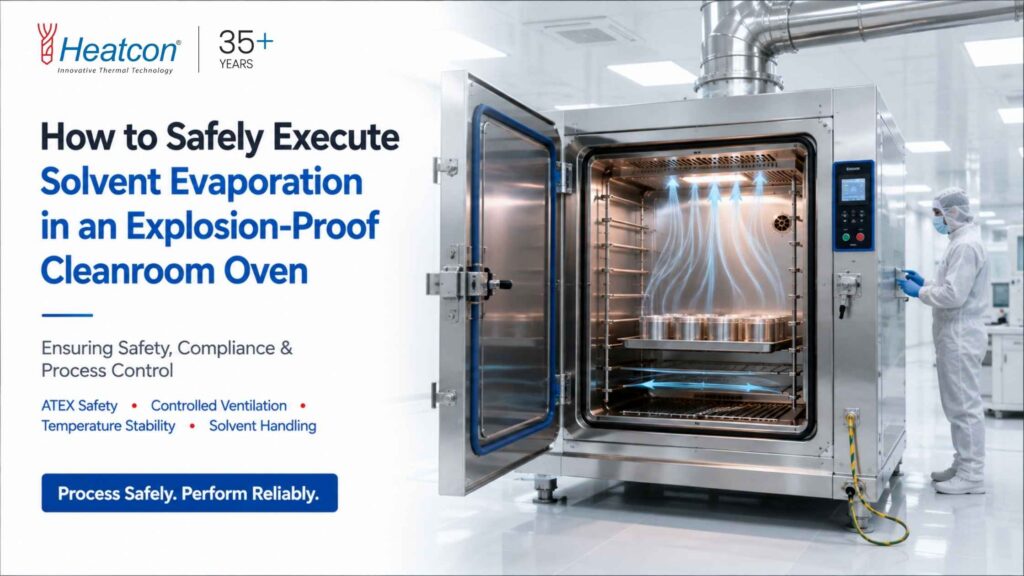
An explosion proof cleanroom oven is specifically designed to contain and eliminate potential ignition sources, ensuring that flammable vapors generated during solvent evaporation do not result in catastrophic incidents. These ovens comply with rigorous international standards such as ATEX and IECEx, making them indispensable in industries dealing with hazardous processing.
Explosion proof cleanroom oven features:
- Sealed electrical components to prevent spark generation
- Continuous purge systems to clear flammable vapors
- Antistatic construction and internal grounding
- Redundant temperature monitoring with high-accuracy sensors
- Emergency shutdown and alarm integration
These features not only provide protection but also instill confidence in operators that processes are running within defined safety margins.
What Are The Key Safety Systems For Solvent Evaporation?
To execute solvent evaporation safely, it is crucial to integrate layered safety systems within the explosion proof cleanroom oven environment. Here’s how Heatcon Sensors ensures comprehensive risk mitigation:
- Redundant temperature sensors: Dual or triple customized RTDs and thermocouples continuously monitor oven temperature, instantly detecting deviations to avoid overheating and vapor ignition.
- Automated shutdown controls: Programmable logic controllers (PLCs) automatically halt the process if unsafe conditions are detected.
- Real-time ventilation monitoring: Integrated airflow sensors verify that exhaust and purge systems are operating effectively.
- Continuous data logging: All process parameters are logged and analyzed for predictive maintenance and regulatory compliance.
These integrated safety systems are the cornerstone for safe operation, especially when processing flammable or toxic solvents.
How To Execute Solvent Evaporation Safely In An Explosion Proof Cleanroom Oven: Step-By-Step Guide
The following guide outlines industry best practices to ensure that solvent evaporation in an explosion proof cleanroom oven is safe, efficient, and compliant with global standards.
- Pre-operational checks:
- Verify the oven’s explosion proof certification and inspect all seals and grounding connections.
- Ensure all temperature sensors are calibrated and functioning.
- Confirm the oven is free from any combustible residue or previous solvent vapors.
- Sample preparation:
- Use appropriate containment vessels that withstand pressure and temperature variations.
- Minimize sample volume to reduce vapor generation.
- Process initiation:
- Set the oven temperature using precise controls connected to Heatcon Sensors’ RTDs or thermocouples.
- Gradually ramp up the temperature to avoid sudden vaporization.
- Activate purge and ventilation systems prior to heating.
- Monitoring and control:
- Continuously monitor temperature, pressure, and vapor concentrations.
- Respond to alarms or abnormal readings immediately by engaging emergency shutdown.
- Post-process procedures:
- Allow the oven to cool completely before opening.
- Ventilate the chamber thoroughly to disperse residual vapors.
- Document the process parameters for traceability and compliance.
Why Is Hazardous Processing Dependent On Reliable Temperature Measurement?
Hazardous processing involves working with chemicals and procedures that can quickly escalate into dangerous situations if not closely monitored. Reliable temperature measurement—using customized RTDs and thermocouples designed for hazardous environments—minimizes risk by ensuring the process stays within safe operating limits. Inadequate measurement can result in overheating, incomplete solvent evaporation, or uncontrolled reactions, potentially causing explosions, fires, or toxic releases.
Heatcon Sensors offers tailor-made solutions for every hazardous processing scenario, ensuring that temperature accuracy is never compromised, whether you operate in India, the US, UAE, Indonesia, Germany, South Korea, Saudi Arabia, Russia, Bahrain, Kuwait, or beyond.
What Heat Generating Equipment Does Heatcon Sensors Manufacture?
Beyond manufacturing world-class RTDs and temperature sensors, Heatcon Sensors produces a broad range of heat generating equipment designed for industrial and laboratory use, including:
- Explosion proof cleanroom ovens
- Electric furnaces (box, tube, muffle, and high-temperature variants)
- Hot air blowers
- High density cartridge heaters
- Industrial dryers
- Process heating mantles
- Custom heating jackets and flexible heaters
Each product is engineered for reliability, energy efficiency, and seamless integration with safety systems, offering complete solutions for hazardous processing applications.
How Does Heatcon Sensors Support Customers Worldwide?
No matter where your facility is located—be it a pharmaceutical plant in Mumbai, a research lab in Berlin, a refinery in Saudi Arabia, or a chemical plant in Houston—Heatcon Sensors is equipped to custom-manufacture, rigorously test, and rapidly deliver temperature sensors and heating equipment to any part of India or the world. With decades of experience, outstanding engineering excellence, and a robust global logistics network, Heatcon Sensors ensures that your process safety and productivity are never compromised.
| Region | Major Cities Served |
|---|---|
| India | Mumbai, Bangalore, Delhi, Hyderabad, Chennai, Ahmedabad |
| United States | Houston, New York, Los Angeles, Chicago, Boston |
| UAE | Dubai, Abu Dhabi |
| Indonesia | Jakarta, Surabaya |
| Germany | Berlin, Munich, Hamburg |
| South Korea | Seoul, Busan |
| Saudi Arabia | Riyadh, Jeddah |
| Russia | Moscow, St. Petersburg |
| Bahrain | Manama |
| Kuwait | Kuwait City |
Why Choose Heatcon Sensors For Your Explosion Proof Cleanroom Oven And Process Needs?
When safety, compliance, and reliability are at stake, choosing the right partner is non-negotiable. Heatcon Sensors stands out because:
- All products are customizable for your unique industrial requirements.
- Stringent quality control, backed by international certifications.
- Expert engineering support at every step—from consultation to installation.
- Rapid delivery and on-site support anywhere in India or worldwide.
- Continuous innovation in safety systems and hazardous processing solutions.
Don’t risk your process integrity or the safety of your people—choose a partner trusted by leading companies across the globe.
How To Contact Heatcon Sensors For Custom Solutions?
Ready to elevate your safety standards and process efficiency? Contact Heatcon Sensors for expert consultation, custom solutions, and rapid delivery of explosion proof cleanroom ovens, temperature sensors, and heat generating equipment.
- Submit your requirements through the contact form.
- Leave a message on Whatsapp via the interface on the Heatcon Sensors website.
- Call us directly at +91 9164833027 or +91 9844233244 for immediate assistance.
Don’t let outdated or unsafe systems compromise your process—reach out to Heatcon Sensors and experience the peace of mind that only industry leaders can provide.
About Heatcon Sensors
Heatcon Sensors is a globally recognized industrial solutions provider based in India, specializing in the design, customization, and manufacturing of temperature sensors, RTDs, thermocouples, and heat generating equipment including explosion proof cleanroom ovens, electric furnaces, hot air blowers, and high density cartridge heaters. Heatcon Sensors is trusted by pharmaceutical, chemical, electronics, food processing, and research industries across India, the US, UAE, Indonesia, Germany, South Korea, Saudi Arabia, Russia, Bahrain, Kuwait, and many other countries. Their unwavering commitment to safety, innovation, and client support ensures that every customer receives solutions tailored to their most demanding requirements.
Frequently Asked Questions
What is an explosion proof cleanroom oven and why is it essential for solvent evaporation?
An explosion proof cleanroom oven is a specialized thermal processing unit designed to safely handle flammable or volatile substances, such as solvents, within controlled environments. It is essential for solvent evaporation because it minimizes the risk of ignition and explosion during hazardous processing, protecting both personnel and the facility from combustible vapor incidents.
How does Heatcon Sensors enhance safety systems for hazardous processing?
Heatcon Sensors integrates advanced safety systems such as intrinsically safe temperature sensors, continuous monitoring, and automated shut-off mechanisms. These features provide real-time alerts and immediate response capabilities, significantly reducing the chances of accidents during hazardous processing in explosion proof cleanroom ovens.
What are the best practices for solvent evaporation in an explosion proof cleanroom oven?
Best practices include using properly calibrated sensors, ensuring all oven components are explosion proof rated, maintaining optimal airflow, and following precise temperature profiles. Routine inspection and adherence to manufacturer guidelines, like those provided by Heatcon Sensors, help ensure safe solvent evaporation and minimize hazardous risks.
How do Heatcon Sensors’ solutions support regulatory compliance for hazardous processing?
Heatcon Sensors’ explosion proof sensors and control systems are designed to meet stringent industry regulations (such as ATEX and IECEx). Their solutions help users comply with legal and safety requirements for hazardous processing, ensuring peace of mind and audit readiness.
What types of sensors does Heatcon recommend for monitoring solvent evaporation?
For solvent evaporation, Heatcon recommends using explosion proof RTDs or thermocouples with high chemical resistance and rapid response times. These sensors are designed to maintain accuracy and reliability in volatile environments, supporting continuous process monitoring and enhanced safety.
How can automated control systems improve safety during solvent evaporation?
Automated control systems from Heatcon Sensors can monitor temperature, pressure, and vapor concentration in real time. If any unsafe condition is detected, the system triggers alarms or initiates a safe shutdown, sharply reducing the risk of accidents in explosion proof cleanroom ovens during hazardous processing.
What routine maintenance is required to ensure safe operation of explosion proof ovens?
Routine maintenance includes regular sensor calibration, inspection of wiring and enclosures, and verification of all safety systems. Heatcon Sensors provides maintenance guidance and support to help ensure that explosion proof cleanroom ovens remain compliant and safe for ongoing solvent evaporation.
Can Heatcon Sensors assist with custom solutions for unique hazardous processing needs?
Yes, Heatcon Sensors specializes in designing and engineering custom sensor and control solutions for unique hazardous processing applications. Their team works closely with customers to address specific challenges related to solvent evaporation and explosion proof cleanroom oven integration.
What are the signs that safety systems in an explosion proof cleanroom oven need upgrading?
Warning signs include frequent alarms, inconsistent temperature readings, or visible wear on oven components. If your hazardous processing environment has changed or regulations have been updated, consult with Heatcon Sensors to evaluate and upgrade safety systems for continued safe solvent evaporation.