
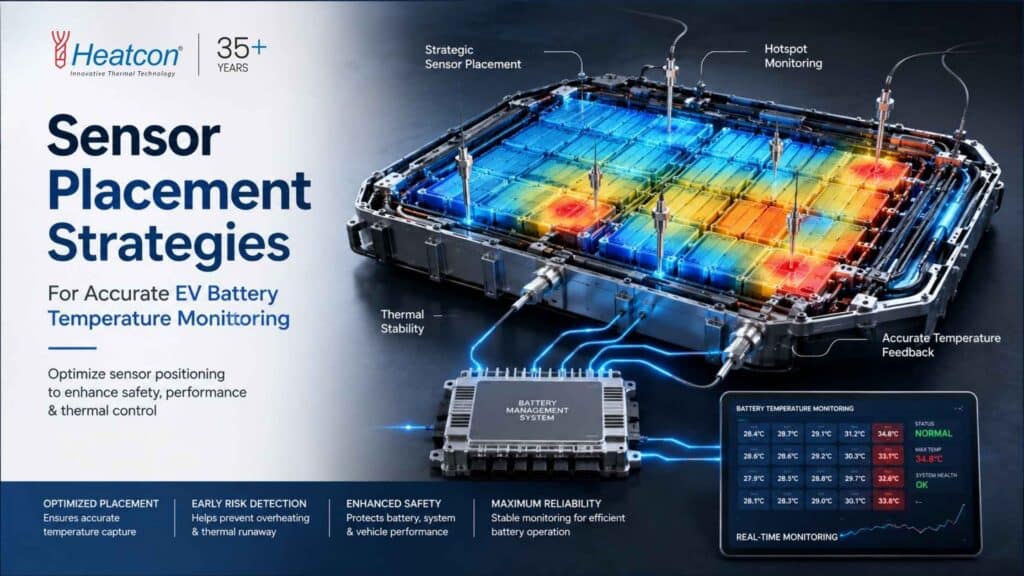
What Is The Importance Of EV Battery Sensor Placement?
EV battery sensor placement involves strategically positioning temperature sensors throughout the battery system to capture accurate and real-time thermal data. This sensor data is crucial for the battery management system (BMS) to control charging, discharging, and cooling operations. Poor sensor placement can create blind spots, causing undetected hotspots that may lead to safety incidents or premature battery aging. For automotive OEMs, fleet operators, and battery system integrators, the stakes are high—optimized sensor placement is non-negotiable.
How Do Battery Module Sensors Enhance Battery Safety?
Battery module sensors are specialized temperature sensors embedded within each module of an EV battery pack. Their primary purpose is to monitor local temperature variations, enabling the BMS to identify problematic cells or sections before they escalate into major faults.
- Improved detection of localized overheating
- Early warning for thermal runaway risks
- Greater insight for adaptive thermal management
Heatcon Sensors, a leading manufacturer of industrial RTDs and specialized sensors, offers customized battery module sensors tailored to specific EV battery designs. Whether your requirements call for robust RTDs or thermocouples, Heatcon Sensors ensures each unit is engineered for accuracy and reliability, no matter the application or geography.
Why Is Battery Pack Sensors Configuration Critical?
Battery pack sensors are deployed across the entirety of a battery pack to provide a holistic view of thermal conditions. Their strategic placement helps the BMS manage pack-level cooling, ensuring the overall system remains within safe operating temperatures.
- Uniform temperature profiling across the pack
- Identifying discrepancies between modules or strings
- Supporting predictive maintenance and health diagnostics
With Heatcon Sensors, you have access to globally compliant battery pack sensor solutions that can be custom-fitted for any pack architecture—whether you’re manufacturing in India, the US, or expanding to markets in UAE, Indonesia, Germany, South Korea, Saudi Arabia, Russia, Bahrain, or Kuwait.
What Are The Best Practices For RTD Installation In EV Batteries?
RTD installation plays a pivotal role in the precision of temperature measurement in EV batteries. Resistance temperature detectors (RTDs) are known for their stability and accuracy, making them the sensor of choice for many battery manufacturers.
- Direct contact with cell or module surfaces for optimal heat transfer
- Secure mounting to prevent sensor drift or vibration-induced errors
- Use of high-quality insulation to protect against electrical interference
- Cable routing that avoids high-voltage lines and minimizes electromagnetic interference
Heatcon Sensors’ engineers work closely with clients to develop RTD installation protocols that match the unique needs of each EV battery design. Each RTD sensor is calibrated for the specific temperature ranges encountered in automotive and industrial battery applications.
Where Should Battery Monitoring Points Be Located?
Battery monitoring points are the designated locations within the battery system where sensors are installed to capture critical data. Choosing the right monitoring points is essential for comprehensive thermal management.
- Near high-current busbars where heating is most intense
- At cell terminals and interconnects prone to resistance heating
- Within the core of densely packed modules for real-time core temperature
- On cooling plate interfaces to monitor heat extraction efficiency
The engineering team at Heatcon Sensors utilizes advanced simulation and field data to recommend optimal battery monitoring points, ensuring your EV battery system achieves the highest levels of safety and performance.
How Does Thermal Mapping Improve Battery Performance?
Thermal mapping is the process of creating a detailed temperature profile of a battery system under various operating conditions. By deploying multiple sensors and collecting granular data, engineers can visualize hotspots, thermal gradients, and cooling effectiveness.
- Identifies critical hotspots before they become safety issues
- Enables optimization of cooling system design
- Facilitates predictive maintenance and longevity analysis
Heatcon Sensors offers complete thermal mapping solutions—including sensor selection, data acquisition systems, and post-processing tools—so you have the insights needed for iterative EV battery design improvements.
What Is The Role Of Battery Cell Monitoring In Sensor Placement?
Battery cell monitoring ensures each individual cell’s temperature is tracked, which is vital for early detection of cell-level faults or imbalances. Effective sensor placement at the cell level can be the difference between safe operation and catastrophic failure.
- Direct temperature measurement on critical or high-risk cells
- Distributed sensors for statistical monitoring across the battery
- Integration with BMS for rapid response to abnormal conditions
Heatcon Sensors customizes battery cell monitoring solutions for high-precision, low-profile sensor arrays that fit even the most compact battery modules.
How Does EV Battery Design Influence Sensor Strategy?
Each EV battery design presents unique challenges for sensor placement. Factors such as module size, cell format (cylindrical, prismatic, pouch), and cooling strategy all dictate the number, type, and location of sensors.
- High energy-density designs require more granular sensor coverage
- Complex cooling architectures necessitate more frequent monitoring points
- Compact module layouts demand miniaturized sensors with flexible installation options
Heatcon Sensors collaborates with battery designers and OEMs to ensure that every EV battery design is paired with a tailored sensor solution—resulting in optimal temperature measurement, safety, and efficiency.
What Is The Impact Of Accurate Temperature Measurement On EV Batteries?
Temperature measurement is the foundation of battery management, influencing every aspect from safety to performance. Accurate data enables:
- Faster and safer charging cycles
- Longer battery lifespan
- Prevention of thermal runaway and fire hazards
- Enhanced warranty and reliability for OEMs
With Heatcon Sensors’ advanced temperature measurement solutions, OEMs and system integrators can achieve the accuracy and repeatability required for next-generation EV battery systems.
Why Choose Heatcon Sensors For Your EV Battery Sensor Needs?
Heatcon Sensors is a trusted manufacturer and supplier of customized RTDs, thermocouples, and other temperature sensors for industrial and EV applications. With a track record spanning decades, Heatcon Sensors has supported clients across India, the US, UAE, Indonesia, Germany, South Korea, Saudi Arabia, Russia, Bahrain, Kuwait, and beyond.
- Customized sensor solutions for any EV battery design
- Global reach with fast turnaround for orders
- In-house engineering support for sensor placement, calibration, and installation
- Comprehensive product line including heat generating equipment: industrial furnaces, ovens, hot air blowers, electric furnaces, and high density cartridge heaters
By choosing Heatcon Sensors, you ensure your EV battery system is equipped with the most accurate, reliable, and durable sensor solutions available—giving you the competitive edge in a rapidly evolving market.
How Can You Get Started With Heatcon Sensors?
Don’t compromise on the thermal safety and performance of your EV battery systems. Connect with Heatcon Sensors today for a free consultation and discover how our custom sensor solutions can transform your project:
- Submit your requirements through the form at https://heatconsensors.com/contact-us/
- Message us directly via Whatsapp using the interface on our website
- Call us for immediate assistance at +91 9164833027 or +91 9844233244
Secure the future of your EV battery technology—partner with Heatcon Sensors today.
About Heatcon Sensors
Heatcon Sensors is a globally recognized manufacturer and exporter based in India, specializing in custom temperature sensors, RTDs, thermocouples, thermal mapping systems, and industrial heating equipment. Serving clients across major automotive and industrial hubs around the world, Heatcon Sensors delivers high-quality, reliable, and innovative solutions to meet the evolving demands of modern battery technology.
Frequently Asked Questions
Why is accurate EV Battery Sensor Placement crucial for temperature monitoring?
Proper EV Battery Sensor Placement ensures that temperature readings accurately reflect the conditions inside the battery pack. Inaccurate placement can lead to undetected hot spots, reduced battery life, or even safety hazards. By strategically positioning sensors, Heatcon Sensors helps capture real-time thermal behavior, supporting both optimal performance and safety.
What are the main strategies for installing battery module sensors in EV batteries?
Battery module sensors are often installed near the cell terminals or in locations most prone to heat accumulation. Heatcon Sensors recommends placing sensors at both the center and edges of each module to detect thermal gradients. Our solutions also support flexible sensor layouts to adapt to various EV battery designs and module architectures.
How does Heatcon Sensors approach battery pack sensors for comprehensive monitoring?
For complete battery pack sensors coverage, Heatcon Sensors suggests a combination of surface and embedded sensors. This approach allows for monitoring both the internal temperature of cells and the overall pack surface. Our sensor solutions are tailored to fit pack-specific geometries, ensuring robust and accurate temperature measurement throughout the lifecycle of the battery.
What are the best practices for RTD installation in EV battery systems?
RTD installation should prioritize direct thermal contact with the area of interest, minimal wiring length, and mechanical stability to avoid vibration-related failures. Heatcon Sensors provides specialized RTD assemblies designed for simple and secure integration within battery modules and packs, ensuring long-term reliability and high-precision temperature measurement.
How are battery monitoring points selected for optimal sensor coverage?
Battery monitoring points are chosen based on thermal mapping studies, simulation data, and known heat generation zones within the pack. Heatcon Sensors collaborates with OEMs to analyze the thermal profile of each EV battery design, ensuring sensors are placed at the most informative and critical locations for early fault detection and efficient thermal management.
What role does thermal mapping play in sensor placement strategies?
Thermal mapping is essential for identifying areas within the battery where temperature variations are most likely to occur. By conducting detailed thermal mapping, Heatcon Sensors helps clients determine the best sensor locations to capture representative data, which enhances both the accuracy of battery cell monitoring and the overall safety of the EV system.
How does battery cell monitoring differ from module or pack level monitoring?
Battery cell monitoring focuses on capturing temperature data at the individual cell level, revealing early signs of cell imbalance or degradation. In contrast, module and pack level monitoring provides a broader view of the overall system. Heatcon Sensors offers scalable solutions that cover all levels, helping manufacturers meet stringent safety and performance standards.
How are sensor placement strategies adapted for different EV battery designs?
No two EV battery designs are exactly alike. Heatcon Sensors collaborates closely with engineering teams to understand the unique geometry, cell arrangement, and cooling requirements of each project. Our experts develop custom sensor layouts and mounting solutions, ensuring optimal sensor coverage regardless of the battery architecture.
What unique solutions does Heatcon Sensors offer for accurate temperature measurement in EV batteries?
Heatcon Sensors specializes in precision-engineered sensors, including RTDs and thermistors, designed for harsh automotive environments. Our offerings include custom sensor assemblies, rapid prototyping, and technical support for seamless integration. We also provide guidance on sensor placement strategies and ongoing support to ensure long-term, reliable temperature measurement in electric vehicle applications.