
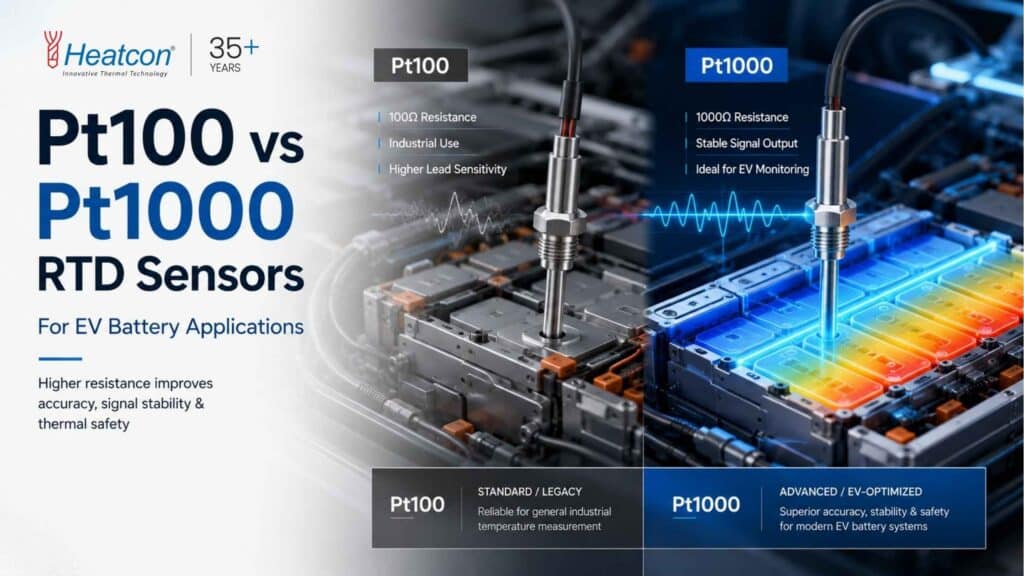
What Is The Difference Between Pt100 And Pt1000 RTD Sensors For EV Battery Applications?
When it comes to electric vehicle (EV) battery safety and performance, temperature monitoring is non-negotiable. According to the International Energy Agency, over 10 million EVs were on the road globally in 2022, and this number is rapidly climbing. As demand soars, the need for robust, reliable, and accurate battery monitoring sensors becomes more critical than ever. The choice between Pt100 vs Pt1000 for EV Battery applications directly impacts not only the efficiency and lifespan of EV batteries but also passenger safety and operational reliability.
In this article, we offer an in-depth look at Pt100 RTD and Pt1000 RTD sensors, specifically for EV battery temperature management. We unravel the technical differences, standards such as IEC 60751, and practical considerations for EV sensor selection. You’ll also discover why Heatcon Sensors is the trusted partner for custom-designed RTDs and other temperature detection solutions in India and worldwide.
Why Is Temperature Monitoring Crucial For EV Batteries?
Effective battery management systems hinge on precise temperature sensing. Accurate thermal data prevents overheating, optimizes charging, and extends battery life. Modern lithium-ion batteries operate best within a narrow temperature band—typically between 20°C and 40°C. Deviations risk not only performance drops but also catastrophic failures like thermal runaway or fires.
This is where battery monitoring sensors come into play. By integrating advanced resistance temperature detector technology, EV manufacturers can precisely control battery pack temperatures, ensure passenger safety, and meet regulatory standards.
What Is An RTD Sensor And How Does It Work?
An RTD comparison starts with understanding the basics. A resistance temperature detector (RTD) is a sensor whose resistance changes predictably with temperature. The most common materials are platinum (Pt), nickel, and copper, but platinum dominates due to its exceptional stability and repeatability.
- Pt100 RTD: Has a resistance of 100 ohms at 0°C.
- Pt1000 RTD: Has a resistance of 1000 ohms at 0°C.
Both types are governed by the IEC 60751 international standard, which defines their resistance/temperature characteristics. RTDs are prized in EV battery monitoring for their high temperature accuracy, long-term stability, and fast response.
Pt100 Vs Pt1000 For EV Battery: The Technical RTD Comparison
Making the right EV sensor selection often comes down to comparing the Pt100 and Pt1000 RTD variants. Here’s a concise breakdown:
| Feature | Pt100 RTD | Pt1000 RTD |
|---|---|---|
| Nominal Resistance at 0°C | 100 Ω | 1000 Ω |
| Sensitivity | ~0.385 Ω/°C | ~3.85 Ω/°C |
| Signal-to-Noise Ratio | Lower | Higher |
| Lead Wire Effect | Greater impact, especially for long cables | Minimized, ideal for distributed sensors |
| Cost | Slightly higher (sensor + signal conditioning) | Lower overall (simpler electronics) |
| Compatibility | Industry standard, legacy systems | Modern, compact EV battery packs |
In summary, Pt1000 RTD sensors are increasingly favored for modern battery monitoring sensors due to their higher resistance, which makes them less susceptible to errors from cable resistance—crucial in large battery packs where sensor wiring can be extensive.
How Does IEC 60751 Impact RTD Selection For EV Applications?
The IEC 60751 standard provides the key reference for platinum RTDs, defining the resistance-temperature relationship and tolerances. For EV manufacturers and battery system integrators, this ensures consistency, interoperability, and accuracy across different sensor brands and models.
- Defines classes (A, B, etc.) based on permissible error margins
- Facilitates global sourcing and standardization
- Supports quality assurance and regulatory compliance
Heatcon Sensors rigorously tests and certifies all custom RTDs against IEC 60751, ensuring dependable temperature accuracy for every EV battery monitoring application.
What Makes Pt1000 RTD Ideal For Next-Gen EV Battery Monitoring?
The shift toward Pt1000 RTD sensors is driven by several technical and practical advantages:
- Improved signal integrity: Higher base resistance minimizes error from long conductor runs—vital for modular and distributed battery packs.
- Lower current requirement: Reduces self-heating, improving measurement fidelity.
- Compact electronics: Simplifies input circuitry, reducing cost and PCB space in battery management systems.
- Enhanced noise immunity: Better suited for electrically noisy automotive environments.
For EV manufacturers seeking compact, reliable, and precise battery monitoring sensors, Pt1000 RTD sensors deliver a superior balance of performance and cost-effectiveness.
How To Choose The Right RTD Sensor For Your EV Battery Application?
EV sensor selection is not just about the sensor element, but the complete system—cabling, connectors, ingress protection, and integration with battery management electronics. Key factors to consider include:
- Required temperature accuracy and operating range
- Physical constraints (size, mounting style, vibration tolerance)
- Electrical noise and cable lengths
- Compliance with IEC 60751 and automotive standards
- Scalability for large battery packs
Partnering with a specialist like Heatcon Sensors ensures your sensors are not only high quality, but also tailored for your unique EV platform—delivered anywhere in India, the US, UAE, Indonesia, Germany, South Korea, Saudi Arabia, Russia, Bahrain, Kuwait, or globally.
Why Heatcon Sensors Is The Preferred Choice For Battery Monitoring Sensors?
Heatcon Sensors is a leading manufacturer of customized temperature sensors and resistance temperature detector solutions for industrial and automotive sectors. With decades of expertise, Heatcon Sensors offers:
- Custom manufacturing of Pt100 RTD and Pt1000 RTD sensors for precise EV battery applications
- Capability to supply sensors anywhere in India—including major cities—and to international markets such as the US, UAE, Indonesia, Germany, South Korea, Saudi Arabia, Russia, Bahrain, and Kuwait
- Compliance with global standards, including IEC 60751
- Comprehensive support for sensor integration, calibration, and after-sales service
- Expertise in supplying sensors for both low- and high-volume production runs
Beyond temperature sensors, Heatcon Sensors also manufactures a wide selection of heat-generating equipment, including electric furnaces, industrial ovens, hot air blowers, high-density cartridge heaters, and more—enabling one-stop solutions for thermal management.
How To Get Expert Advice Or Place An Order With Heatcon Sensors?
Don’t let a suboptimal sensor choice jeopardize your EV battery’s performance or safety. For personalized guidance, rapid prototyping, or bulk supply of advanced RTD sensors and temperature solutions:
- Submit your information here for a detailed consultation and quick quote.
- Leave a message on WhatsApp directly from the Heatcon Sensors website for immediate support.
- Call +91 9164833027 or +91 9844233244 for instant technical assistance from our sensor experts.
Choosing Pt100 vs Pt1000 for EV Battery is a critical engineering decision. With Heatcon Sensors as your partner, you gain not only world-class products but also the peace of mind that comes with industry-leading technical support, rapid customization, and global logistics.
About Heatcon Sensors
Heatcon Sensors is an ISO-certified manufacturer based in India, specializing in the design and supply of temperature sensors—including resistance temperature detector devices and RTDs—for automotive, industrial, and process applications. With a strong export presence to the US, UAE, Germany, South Korea, Saudi Arabia, Russia, Bahrain, Kuwait, and Indonesia, Heatcon Sensors ensures reliable, customized thermal solutions on a global scale.
For more details, visit heatconsensors.com.
Frequently Asked Questions
What is the main difference between Pt100 and Pt1000 RTD sensors for EV battery applications?
The primary difference between Pt100 RTD and Pt1000 RTD sensors lies in their nominal resistance at 0°C—100 ohms for Pt100 and 1000 ohms for Pt1000. In the context of Pt100 vs Pt1000 for EV Battery monitoring, Pt1000 sensors offer higher resistance, resulting in lower current and reduced self-heating. This makes Pt1000 a popular choice for EV applications where minimizing power consumption and maximizing signal strength over long cable runs is critical.
Which standard governs the performance and accuracy of Pt100 and Pt1000 RTDs?
Both Pt100 and Pt1000 sensors used in battery monitoring adhere to the IEC 60751 standard. This international standard specifies temperature-resistance characteristics, tolerances, and mechanical requirements for platinum resistance temperature detectors, ensuring reliable and accurate temperature measurements in electric vehicle systems.
How do Pt100 and Pt1000 RTDs compare in terms of temperature accuracy for EV battery monitoring?
Both sensor types offer excellent temperature accuracy as defined by IEC 60751. However, due to their higher resistance, Pt1000 RTDs are less affected by lead wire resistance, which can improve accuracy in distributed battery systems with long wiring. For applications where precise temperature control is essential, both Pt100 and Pt1000 can be specified in high-accuracy classes (e.g., Class A or Class B).
What are the key factors to consider in RTD comparison for EV sensor selection?
Critical factors in RTD comparison for EV sensor selection include resistance value, temperature range, tolerance class, wiring configuration, power consumption, and susceptibility to electrical noise. Pt1000 RTDs often have an advantage in larger battery systems due to their higher signal-to-noise ratio and reduced cable effect, while Pt100 RTDs remain a solid choice for legacy systems and applications with shorter cable runs. Heatcon Sensors provides comprehensive support to help select the ideal RTD type for your unique requirements.
Why are resistance temperature detector (RTD) sensors preferred for EV battery monitoring?
Resistance temperature detector (RTD) sensors, like Pt100 and Pt1000, are preferred in EV battery packs due to their high stability, linear temperature response, and long-term reliability. Their ability to provide precise readings makes them ideal as battery monitoring sensors to safeguard against overheating, optimize performance, and extend battery life in electric vehicles.
How does Heatcon Sensors support EV manufacturers in sensor selection and customization?
Heatcon Sensors delivers tailored solutions for EV sensor selection , providing both Pt100 and Pt1000 RTDs in various configurations and accuracy classes. Our engineering team assists with application-specific design, connector choices, and custom probe assemblies, ensuring reliable operation in demanding automotive environments. We also offer technical guidance to ensure full compliance with IEC 60751 and other global standards.
Are Pt1000 RTDs more energy efficient than Pt100 RTDs in battery management systems?
Yes, Pt1000 RTDs draw less current for the same excitation voltage due to their higher resistance, which reduces heat generation and power loss. This makes Pt1000 sensors more energy efficient and suitable for compact or high-channel-count battery monitoring sensors in electric vehicles.
What installation considerations should be kept in mind for Pt100 vs Pt1000 for EV Battery applications?
When deploying Pt100 vs Pt1000 for EV Battery monitoring, consider the wiring length, electromagnetic environment, and required accuracy. Pt1000 RTDs are often favored in large battery packs with long wires due to their inherent resistance to signal degradation. Heatcon Sensors can supply RTDs with shielded cables, robust connectors, and custom mounting options for optimal integration in EV battery systems.
How do Heatcon Sensors ensure quality and compliance for RTDs in EV battery applications?
All Heatcon Sensors RTDs, including both Pt100 and Pt1000 variants, are manufactured to strict quality standards and tested for conformity with IEC 60751. Our rigorous quality control processes, calibration capabilities, and documentation support ensure that every resistance temperature detector meets the demanding requirements of modern EV battery management systems.