
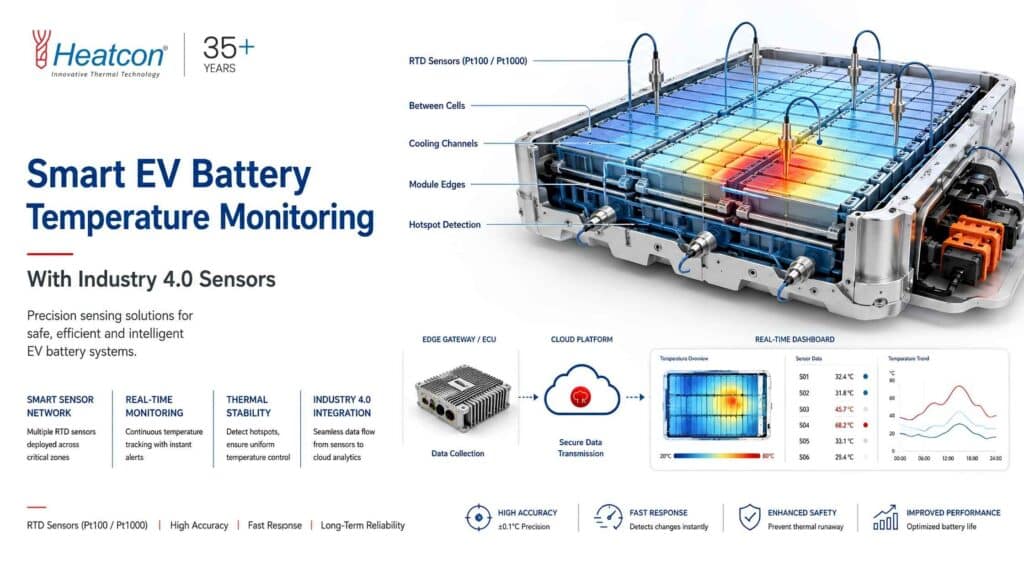
What Is Smart EV Battery Monitoring And Why Is It Critical?
Smart EV Battery Monitoring is the backbone of electric vehicle (EV) safety and performance. According to the International Energy Agency’s 2023 Global EV Outlook, the global EV stock surpassed 26 million, highlighting the urgent need for reliable battery management. Without robust monitoring systems, EV batteries risk overheating, reduced lifespan, and even hazardous thermal runaway events.
Smart EV Battery Monitoring uses advanced sensors and digital technologies to constantly track and manage battery temperature, ensuring optimal performance and safety. As EV adoption rises rapidly in India, the US, UAE, Indonesia, Germany, South Korea, Saudi Arabia, Russia, Bahrain, Kuwait, and globally, sophisticated monitoring is becoming a key differentiator for manufacturers, fleet operators, and end users.
How Do Industry 4.0 Sensors Transform EV Battery Monitoring?
Industry 4.0 sensors are revolutionizing temperature monitoring in EVs by enabling real-time data acquisition, remote analytics, and seamless integration with smart grids and industrial systems. In essence, these sensors bring intelligence, connectivity, and automation to what was once a passive, analog process.
- Real-Time Insights: Industry 4.0 sensors provide continuous and granular data about battery temperature and health, allowing instant detection of anomalies.
- Remote Monitoring: With cloud integration, engineers and operators can monitor battery health from anywhere in the world.
- Data-Driven Decisions: Historical data enables predictive maintenance, reducing unplanned downtimes and lowering operating costs.
- Integration With Industrial Automation: These sensors connect effortlessly with PLCs, SCADA, and MES systems, streamlining battery management within broader manufacturing and operational workflows.
What Role Do Wireless RTD Sensors And IIoT Temperature Sensors Play?
Wireless RTD sensors and IIoT temperature sensors are at the heart of modern smart battery monitoring architectures. These devices deliver accurate, fast, and interference-free measurements, even in harsh industrial and automotive environments.
Wireless RTD Sensors: These sensors eliminate the need for complex wiring harnesses, reducing installation complexity in EV battery packs. With wireless connectivity, data transmission is secure, robust, and supports flexible system design.
IIoT Temperature Sensors: Industrial Internet of Things (IIoT) temperature sensors allow for massive scalability—monitoring thousands of battery cells simultaneously and funneling data into centralized dashboards. This supports global operations, from Bangalore to Berlin, Riyadh to Moscow, and beyond.
How Smart Battery Monitoring Prevents Failures And Enables Predictive Maintenance
Smart battery monitoring is essential for predictive maintenance, a proactive approach that forecasts and prevents equipment failures before they occur. By using data collected by Industry 4.0 sensors, wireless RTD sensors, and IIoT temperature sensors, operators can identify early warning signs of battery degradation or overheating.
- Immediate Alerts: If a specific cell’s temperature deviates from the norm, the system triggers instant alerts, allowing for swift intervention.
- Trend Analysis: Continuous data collection helps identify slow-developing faults, such as internal shorts or thermal imbalances, long before they result in costly breakdowns.
- Optimized Lifespan: By maintaining optimal battery temperatures, overall lifespan and reliability are maximized, reducing replacement frequencies and lifecycle costs.
This predictive maintenance paradigm is not only vital for EVs, but also for stationary battery storage, industrial automation, and even renewable energy applications.
The Importance of Modbus RTD in Industrial Applications
Modbus RTD refers to RTD (Resistance Temperature Detector) sensors that use the Modbus communication protocol to transmit temperature data. This protocol is widely used in industrial environments due to its simplicity, interoperability, and reliability.
In the context of Smart EV Battery Monitoring, Modbus RTD sensors allow seamless integration with existing control systems, such as PLCs and SCADA, enabling centralized monitoring and control. This makes them ideal not just for EVs, but also for process industries, power plants, and any sector requiring precise temperature control for safety and efficiency.
How IoT Battery Sensors Enhance Safety and Efficiency
IoT battery sensors extend the capabilities of traditional monitoring by leveraging the power of the Internet of Things. These sensors collect, transmit, and analyze temperature, voltage, and current data at the individual cell level.
- Enhanced Safety: Early detection of thermal anomalies prevents catastrophic failures, protecting both assets and lives.
- Operational Efficiency: Automated data collection and analysis minimize manual intervention, streamlining operations for EV manufacturers, fleet operators, and large-scale battery deployments worldwide.
- Global Connectivity: IoT battery sensors can be monitored and managed from anywhere—whether in India, the US, UAE, Indonesia, Germany, South Korea, Saudi Arabia, Russia, Bahrain, or Kuwait.
Custom Temperature Monitoring Solutions from Heatcon Sensors
Heatcon Sensors is a leading manufacturer of customized RTDs and temperature sensors, serving diverse industrial requirements with precision and dedication. With decades of expertise, Heatcon Sensors caters to industries across India and around the globe, offering tailored solutions that meet the demands of Smart EV Battery Monitoring, industrial automation, and beyond.
- Custom Manufacturing: Heatcon Sensors can design and produce bespoke sensors, including wireless RTD sensors, IIoT temperature sensors, and Modbus RTD solutions, to fit any application or form factor.
- Global Reach: Whether your operations are in Bangalore, Mumbai, New York, Dubai, Jakarta, Berlin, Seoul, Riyadh, Moscow, Manama, or Kuwait City, Heatcon Sensors delivers world-class products to your doorstep swiftly and reliably.
- Comprehensive Product Range: In addition to sensors, Heatcon Sensors manufactures advanced heat generating equipment including furnaces, ovens, hot air blowers, electric furnaces, high density cartridge heaters, and more, supporting complete thermal management for any industrial process.
- Expert Support: The Heatcon Sensors team offers deep technical expertise, rapid prototyping, and responsive after-sales support, ensuring your monitoring systems operate flawlessly in every environment.
Getting the Right Custom Temperature Sensors
Selecting the appropriate sensors is essential for reliable performance in demanding EV, industrial, or automation environments. By choosing Heatcon Sensors, you secure solutions that are reliable, accurate, and proven in diverse industries and locations.
To explore Smart EV Battery Monitoring, predictive maintenance, and advanced temperature sensing, reach out to Heatcon Sensors through any of the following options:
- Submit your requirements on the online contact form.
- Leave a message via WhatsApp directly on the Heatcon Sensors website.
- Call for immediate assistance: +91 9164833027 or +91 9844233244.
With Heatcon Sensors as your technology partner, you gain an advantage in battery safety, efficiency, and longevity—wherever you operate in the world.
About Heatcon Sensors
Heatcon Sensors is a globally recognized manufacturer and supplier of precision temperature sensors, customized RTDs, thermocouples, and heat generating equipment. Based in India with international reach, Heatcon Sensors serves clients in automotive, EV, process industries, power, pharmaceuticals, food, and more. Their solutions support the latest advancements in smart battery monitoring, Industry 4.0 sensors, industrial automation, and predictive maintenance, helping businesses achieve superior safety, efficiency, and control.
Frequently Asked Questions
What is Smart EV Battery Monitoring and why is it important?
Smart EV Battery Monitoring refers to the use of advanced sensors and analytics to continuously track the temperature, health, and performance of electric vehicle (EV) batteries. This approach ensures batteries operate within safe temperature ranges, thus prolonging their lifespan, optimizing performance, and reducing the risk of thermal runaway or unexpected failures. Heatcon Sensors provides integrated solutions for real-time monitoring, making EV battery management safer and smarter.
How do Industry 4.0 sensors enhance EV battery temperature monitoring?
Industry 4.0 sensors bring digital intelligence and connectivity to EV battery monitoring. These sensors enable real-time data acquisition, wireless communication, and integration with industrial automation systems. By leveraging Industry 4.0 technologies, Heatcon Sensors’ solutions can provide advanced analytics, remote diagnostics, and seamless integration with IIoT platforms for smart battery monitoring in modern manufacturing environments.
What are the advantages of using wireless RTD sensors for EV battery systems?
Wireless RTD sensors eliminate the need for extensive cabling, making installation quicker and more flexible, especially in complex EV battery assemblies. They offer reliable, real-time temperature data transmission to centralized monitoring systems. Heatcon Sensors’ wireless RTD solutions ensure accurate measurements, minimize maintenance, and facilitate easy scalability for expanding EV fleets or retrofitting existing battery packs.
How do IIoT temperature sensors contribute to predictive maintenance in EV applications?
IIoT temperature sensors provide continuous, remote monitoring of battery temperatures, allowing operators to detect early signs of overheating, degradation, or abnormal patterns. This data-driven approach enables predictive maintenance, helping to schedule interventions before failures occur. Heatcon Sensors’ IIoT-enabled solutions reduce downtime, extend battery life, and improve the reliability of EV fleets through actionable insights.
What role does Modbus RTD play in industrial automation for battery monitoring?
Modbus RTD is a widely used industrial protocol that enables seamless communication between temperature sensors and automation controllers. In the context of industrial automation, Modbus RTD devices from Heatcon Sensors allow for easy integration into SCADA, PLC, and DCS systems, ensuring precise temperature monitoring and control across EV battery manufacturing and testing environments.
What makes Heatcon Sensors’ smart battery monitoring solutions unique?
Heatcon Sensors combines advanced sensor engineering with the latest in connectivity and analytics. Our smart battery monitoring solutions feature robust, high-accuracy sensors (including wireless RTD and IIoT temperature sensors), flexible integration options like Modbus RTD, and real-time data visualization. This comprehensive approach empowers customers to achieve reliable, scalable, and future-ready battery monitoring for both new and existing EV systems.
How do IoT battery sensors improve safety and efficiency in EV fleets?
IoT battery sensors enable remote, continuous tracking of battery status and temperature across multiple vehicles. This connectivity allows fleet operators to respond proactively to issues, optimize charging cycles, and avoid hazardous situations, thereby enhancing both safety and operational efficiency. Heatcon Sensors’ IoT battery sensors are designed for reliability and seamless integration with fleet management platforms.
Can Heatcon Sensors’ solutions be integrated with existing industrial automation systems?
Yes, Heatcon Sensors’ products are fully compatible with major industrial automation systems. With standard communication protocols such as Modbus RTD and modern IIoT interfaces, our temperature sensors and monitoring solutions can be seamlessly integrated into PLCs, SCADA, MES, and cloud-based analytics systems, supporting both greenfield and brownfield industrial environments.
How does predictive maintenance powered by smart EV battery monitoring reduce operational costs?
Predictive maintenance utilizes continuous data from smart EV battery monitoring systems to anticipate issues before they escalate into costly failures. By leveraging real-time insights from Industry 4.0 sensors and IIoT temperature sensors, operators can reduce unplanned downtime, schedule maintenance efficiently, and extend battery lifespans. This proactive approach from Heatcon Sensors leads to significant cost savings over the battery’s operational life.