What Is The Difference Between Vertical And Horizontal Airflow In Cleanroom Convection Ovens?
The primary distinction between vertical and horizontal airflow in cleanroom convection ovens lies in the direction and uniformity of heated air circulation, directly impacting contamination control, process efficiency, and product quality. According to industry studies, nearly 75% of contamination incidents in cleanroom environments can be traced back to improper or suboptimal airflow design. For companies aiming for flawless production and compliance, choosing the right cleanroom oven airflow directions is not just a technical decision—it’s a mission-critical investment.
In this article, we delve deep into the science and engineering behind airflow design in cleanroom convection ovens, helping you make informed decisions that drive both quality and compliance. Whether you operate in pharmaceuticals, electronics, aerospace, or life sciences, understanding the implications of cleanroom oven airflow directions can mean the difference between operational excellence and costly downtime.
How Does Airflow Design Influence Contamination Control In Cleanroom Ovens?
Airflow design is the backbone of effective contamination control in any cleanroom convection oven. The direction, velocity, and uniformity of airflow determine how particles, gases, and heat are distributed or removed from the oven environment. A well-engineered airflow design significantly reduces the risk of cross-contamination, ensuring that sensitive processes remain uncompromised.
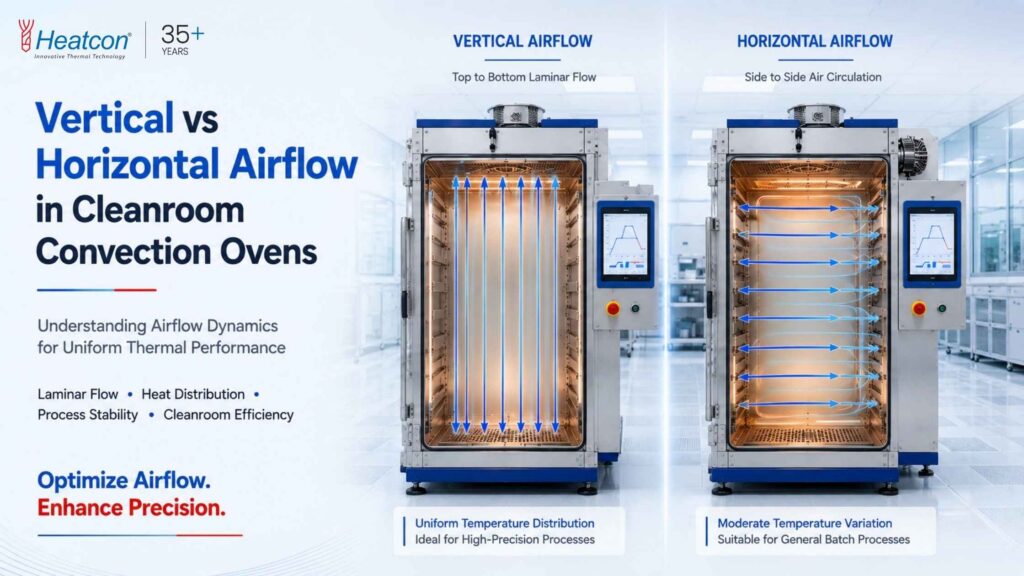
- Vertical airflow: Heated air enters from the top of the oven and flows downward, creating a laminar (unidirectional) flow. This design is particularly effective in critical environments that demand stringent contamination control.
- Horizontal airflow: Air is introduced from one side and exits through the opposite, sweeping across the chamber. This method is suited for processes where uniform heat exposure and rapid drying are prioritized.
The choice between these airflow directions should be guided by your specific contamination control requirements, the nature of the materials being processed, and regulatory guidelines.
What Are The Core Principles Of Convection Oven Engineering?
Convection oven engineering is a multidisciplinary domain, integrating principles of thermodynamics, fluid mechanics, and material science. At Heatcon Sensors, we apply state-of-the-art convection oven engineering to ensure that each oven delivers precise temperature control, uniform heat distribution, and robust contamination control.
- Airflow uniformity: Both vertical and horizontal designs must ensure that the temperature across all zones of the oven is consistent, minimizing hotspots and cold spots.
- Heat transfer efficiency: Optimized airflow design maximizes heat transfer, ensuring rapid and controlled heating or drying of products.
- Sensor integration: High-accuracy temperature sensors (such as custom RTDs and thermocouples from Heatcon Sensors) are embedded for real-time monitoring, guaranteeing process reliability and safety.
By leveraging advanced convection oven engineering, Heatcon Sensors delivers ovens that exceed industry standards, supporting a wide spectrum of high-precision applications.
Why Is Cleanroom Oven Airflow Directions Critical In Sensitive Manufacturing?
Cleanroom oven airflow directions dictate the path and consistency of heat and contaminants within the chamber. In sensitive industries—such as semiconductor fabrication, medical device manufacturing, and aerospace—any deviation in airflow can result in product defects, regulatory non-compliance, or even catastrophic process failures.
| Feature | Vertical Airflow | Horizontal Airflow |
|---|---|---|
| Airflow Path | Top to bottom | Side to side |
| Contamination Control | Superior for critical environments | Moderate for less sensitive applications |
| Heat Uniformity | Excellent | Good |
| Application Suitability | Pharmaceuticals, electronics, optics | General drying, paint curing, annealing |
| Maintenance | Easy filter replacement | May require more frequent cleaning |
Choosing the correct cleanroom oven airflow directions is thus central to achieving the highest levels of contamination control, especially when handling ultra-sensitive materials and processes.
How Does Heatcon Sensors Advance Airflow Design And Sensor Integration?
Heatcon Sensors is a leading manufacturer and exporter specializing in custom RTDs, thermocouples, and other temperature sensors tailored specifically for industrial requirements. The company also designs and manufactures advanced heat generating equipment such as convection ovens, electric furnaces, hot air blowers, high-density cartridge heaters, and more—serving industries across India, the US, UAE, Indonesia, Germany, South Korea, Saudi Arabia, Russia, Bahrain, Kuwait, and globally.
Our expertise lies in understanding your unique process needs and delivering highly customized solutions:
- Custom sensor manufacturing: From precision RTDs to high-temperature thermocouples, Heatcon Sensors ensures accurate, real-time monitoring.
- Global supply capabilities: Regardless of your location—be it Bengaluru, Mumbai, New York, Dubai, Jakarta, Berlin, Seoul, Riyadh, Moscow, Manama, or Kuwait City—we can manufacture and supply temperature sensors and heat-generating equipment to your doorstep.
- Integrated engineering: Our convection oven engineering team works closely with you to optimize airflow design for your cleanroom, ensuring maximum contamination control and energy efficiency.
- Comprehensive support: Our experts are just a call or message away, providing technical support, installation guidance, and after-sales service worldwide.
When you choose Heatcon Sensors, you are not just purchasing a product—you are investing in decades of engineering excellence, global reach, and a relentless commitment to your success.
What Are The Key Benefits Of Optimized Convection Oven Engineering?
Investing in optimized convection oven engineering brings you tangible, measurable benefits:
- Enhanced product quality: Uniform heating and controlled airflow design reduce defects and improve yield rates.
- Stronger contamination control: Proper cleanroom oven airflow directions, combined with the right filtration, minimize particle and microbial contamination.
- Energy savings: Efficient airflow reduces energy consumption, lowering operational costs.
- Regulatory compliance: Achieve and maintain compliance with international standards for cleanroom manufacturing.
Leading manufacturers worldwide rely on Heatcon Sensors for both standard and custom-engineered ovens—each meticulously designed for your specific industry and regional compliance needs.
How To Select The Right Airflow Design For Your Cleanroom Oven?
Selecting the best airflow design for your cleanroom oven should begin with a clear assessment of your process requirements:
- Analyze the type and sensitivity of products being processed.
- Determine contamination control needs based on industry regulations.
- Evaluate the size and configuration of your cleanroom or production line.
- Assess energy consumption targets and maintenance preferences.
- Consult with an experienced manufacturer like Heatcon Sensors to customize airflow design and sensor integration.
Contacting industry leaders ensures that your convection oven engineering not only meets technical specs but also delivers long-term peace of mind. Remember, every process is unique—don’t settle for one-size-fits-all solutions.
About Heatcon Sensors
Heatcon Sensors is a globally trusted manufacturer and exporter of customized temperature sensors, including RTDs, thermocouples, and an array of heat-generating equipment such as industrial ovens, electric furnaces, hot air blowers, and high-density cartridge heaters. Based in India, our reach extends to the US, UAE, Indonesia, Germany, South Korea, Saudi Arabia, Russia, Bahrain, Kuwait, and beyond.
We are committed to providing world-class airflow design and contamination control solutions, backed by innovation, reliability, and customer-centric service. Our products are engineered to meet the highest standards in convection oven engineering for demanding industries around the world.
Don’t let suboptimal airflow design compromise your process—connect with the experts at Heatcon Sensors for customized solutions that drive productivity, compliance, and competitive advantage.
- Submit your information on our contact form
- Leave a message on WhatsApp via our website
- Call us now at +91 9164833027 or +91 9844233244 for immediate assistance
Frequently Asked Questions
What are the main differences between vertical and horizontal cleanroom oven airflow directions?
Vertical airflows direct heated air from the top of the oven downwards, enveloping products for uniform temperature distribution. Horizontal airflows move air side-to-side across shelves or racks. The choice between these cleanroom oven airflow directions affects temperature uniformity, drying speed, and contamination control. Heatcon Sensors can advise on the optimal configuration for process requirements and product safety.
How does airflow design impact contamination control in cleanroom convection ovens?
Airflow design is critical for maintaining stringent contamination control in cleanroom environments. Vertical airflow helps sweep away particles from product surfaces, while horizontal airflow can minimize cross-contamination between shelves. Heatcon Sensors offers tailored convection oven engineering solutions to optimize airflow and minimize contamination risks.
Which airflow configuration provides better temperature uniformity?
Vertical airflow typically offers superior temperature uniformity, especially in tall or multi-level ovens, by ensuring an even distribution of heat over all trays. However, for certain applications with sensitive products or specific load arrangements, horizontal airflow may be preferable. Heatcon Sensors’ experts can help analyze your application to recommend the best solution.
What are the advantages of horizontal airflow in cleanroom ovens?
Horizontal airflow is ideal when products are placed on multiple shelves or require minimal airflow disturbance. It can help prevent lightweight items from being disturbed and can also reduce the potential for particles settling on critical components. Heatcon Sensors supports both airflow orientations in their convection oven engineering solutions.
How does Heatcon Sensors customize airflow design for specific cleanroom oven applications?
Heatcon Sensors evaluates factors such as product load, geometry, process requirements, and contamination control needs to design the most effective airflow system. Their engineering team uses advanced modeling and testing to ensure optimal performance, whether your process demands vertical or horizontal airflow.
Can the airflow configuration affect energy efficiency?
Yes, the chosen airflow configuration directly impacts energy consumption. Efficient cleanroom oven airflow directions minimize heat loss and reduce cycle times. Heatcon Sensors designs ovens to maximize thermal efficiency without compromising on contamination control or product quality.
Are there specific industries or applications that favor vertical or horizontal airflow?
Pharmaceutical, semiconductor, and aerospace industries often prefer vertical airflow for its superior contamination control, while medical device and electronics assembly may opt for horizontal airflow in certain situations. Heatcon Sensors can engineer ovens to meet the standards and regulations of specific industries.
How does Heatcon Sensors ensure reliability and compliance in their convection oven engineering?
Heatcon Sensors uses high-precision sensors, robust construction, and rigorous testing to guarantee temperature accuracy, uniformity, and compliance with industry regulations. Their convection oven engineering integrates customer-specific requirements for cleanroom oven airflow directions and contamination control.
Can Heatcon Sensors retrofit existing ovens with improved airflow design?
Absolutely. Heatcon Sensors provides retrofitting services to upgrade or modify existing ovens, enhancing their airflow design for better temperature uniformity and contamination control. This can extend equipment life and improve process outcomes without the need for a complete replacement.