
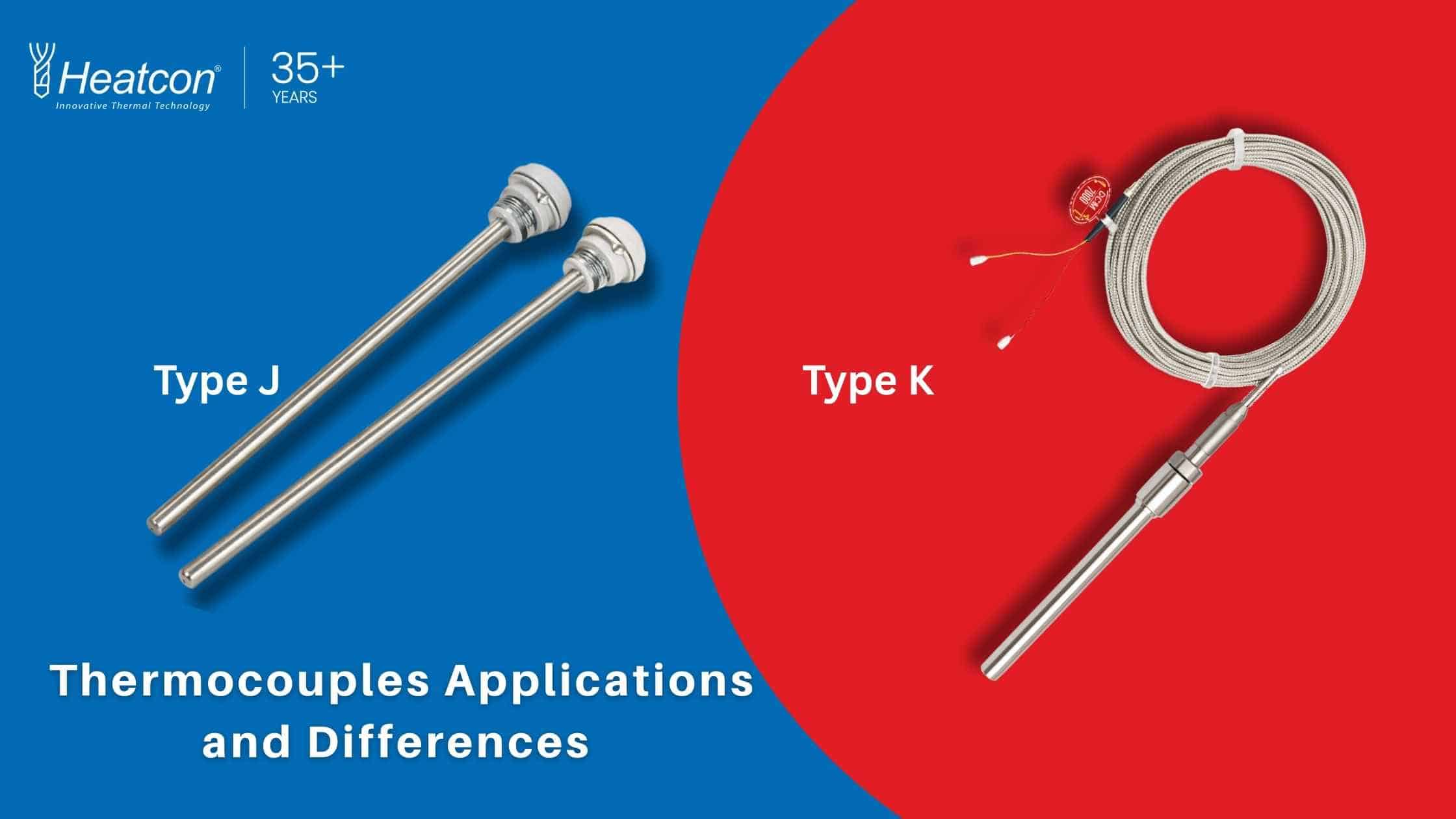
Over 70% of industrial temperature measurement applications worldwide rely on thermocouples due to their durability, fast response time, and wide temperature range capability. When evaluating Type J vs Type K thermocouples, engineers often face a critical decision that directly impacts process accuracy, equipment longevity, and operational safety. Selecting the wrong thermocouple can lead to measurement drift, premature failure, or costly downtime.
This guide provides a detailed comparison of thermocouple classification types, explores thermocouple metal composition, explains thermocouple letter designation systems, and highlights how Heatcon Sensors delivers customized temperature solutions across India and globally.
What Are Thermocouple Classification Types?
Thermocouple classification types refer to standardized categories of thermocouples based on their metal combinations and temperature ranges. Each type is identified by a letter under international standards such as IEC and ANSI.
The most common thermocouple classification types include:
- Type J (Iron–Constantan)
- Type K (Chromel–Alumel)
- Type T
- Type E
- Type N
- Type R, S, and B (Noble metal thermocouples)
Among these, Type J and Type K dominate industrial use due to affordability, reliability, and broad applicability in furnaces, ovens, reactors, and process plants.
What Is Thermocouple Letter Designation?
The thermocouple letter designation is a standardized system assigning letters (J, K, T, E, etc.) to specific metal pair combinations. This system simplifies identification, calibration, and interchangeability across global industries.
For example:
- J = Iron and Constantan
- K = Chromel and Alumel
This standardized thermocouple letter designation ensures engineers in India, the US, Germany, South Korea, Saudi Arabia, and beyond can specify sensors without ambiguity.
Understanding Thermocouple Metal Composition
The thermocouple metal composition determines temperature range, corrosion resistance, durability, and response time. The two dissimilar metals create a voltage when exposed to temperature differences — known as the Seebeck effect.
Type J Metal Composition
- Positive leg: Iron
- Negative leg: Constantan (Copper-Nickel alloy)
- Temperature range: -40°C to 750°C (up to 1000°C in controlled environments)
Type K Metal Composition
- Positive leg: Chromel (Nickel-Chromium alloy)
- Negative leg: Alumel (Nickel-Aluminum alloy)
- Temperature range: -200°C to 1260°C
This difference in thermocouple metal composition is the foundation of the Type J vs Type K thermocouples debate.
Type J Vs Type K Thermocouples – Key Differences
| Parameter | Type J | Type K |
|---|---|---|
| Temperature Range | Up to 750°C | Up to 1260°C |
| Oxidation Resistance | Moderate | Excellent |
| Best For | Reducing environments | Oxidizing environments |
| Cost | Generally lower | Slightly higher |
If your application involves high-temperature furnaces, kilns, or gas turbines, Type K is typically preferred. For vacuum furnaces or inert atmospheres, Type J can be highly effective.
How To Choose Between Type J Vs Type K Thermocouples?
The choice depends on temperature range, environmental conditions, required lifespan, and cost constraints.
- Evaluate maximum process temperature.
- Assess oxidation or reducing atmosphere exposure.
- Determine mechanical stress and vibration levels.
- Consider budget and lifecycle cost.
- Consult a manufacturer for custom engineering support.
This is where Heatcon Sensors becomes indispensable.
Why Industrial Buyers Trust Heatcon Sensors
Heatcon Sensors is a leading manufacturer of customized RTDs, thermocouples, and industrial temperature sensors based in India, serving industries across the United States, UAE, Indonesia, Germany, South Korea, Saudi Arabia, Russia, Bahrain, Kuwait, and beyond.
Unlike standard catalog suppliers, Heatcon Sensors engineers tailor thermocouple assemblies according to:
- Sheath material (SS304, SS316, Inconel, ceramic)
- Probe diameter and length
- Mounting type (flanged, threaded, bayonet)
- Head enclosure (weatherproof, explosion-proof)
- Calibration tolerance
Failing to customize your temperature sensing solution can result in inaccurate data, production losses, and safety risks. Many plants unknowingly lose efficiency due to generic sensors that do not match exact process requirements.
Heatcon Sensors not only manufactures thermocouples but also produces:
- Industrial furnaces
- Electric furnaces
- Laboratory ovens
- Hot air blowers
- High density cartridge heaters
- Industrial heaters and heating elements
This integrated expertise allows Heatcon Sensors to design sensors optimized for real-world heating systems, not just laboratory conditions.
Applications Of Type J And Type K Thermocouples
Type J Applications
- Plastic extrusion machines
- Food processing equipment
- Heat treatment in controlled atmospheres
- Industrial ovens under 750°C
Type K Applications
- Steel and metal industries
- High-temperature furnaces
- Power plants
- Chemical processing units
- Glass manufacturing
Industries across India and globally increasingly demand durable and reliable sensors due to stricter quality regulations and automation growth. Choosing the right thermocouple classification types directly impacts compliance and product quality.
Global Supply And Custom Manufacturing Capability
Heatcon Sensors can custom manufacture and supply temperature sensors to any part of India or worldwide. Whether your facility is in Mumbai, Dubai, Berlin, Jakarta, Seoul, Riyadh, Moscow, Manama, Kuwait City, or Houston, engineered thermocouple solutions can be delivered with precision and speed.
Delaying sensor upgrades or relying on imported generic probes can expose your operations to unexpected downtime. In contrast, working with a manufacturer who understands both thermocouple metal composition and application-specific design ensures long-term reliability.
About Heatcon Sensors
Heatcon Sensors is an industrial temperature sensor manufacturer specializing in thermocouples, RTDs, customized temperature probes, industrial furnaces, ovens, and heating equipment. With advanced fabrication capability and engineering expertise, the company supports OEMs, EPC contractors, and manufacturing plants worldwide.
From initial design consultation to global shipment, Heatcon Sensors ensures quality, durability, and compliance with international standards.
Take The Next Step
If you are evaluating Type J vs Type K thermocouples for your industrial process, do not rely on assumptions. Every application demands engineering precision.
You can reach Heatcon Sensors through any of the following:
- Submit your information via the contact form at https://heatconsensors.com/contact-us/
- Leave a message on WhatsApp through the website interface
- Call +91 9164833027 or +91 9844233244 for immediate assistance
In high-temperature industrial environments, precision is not optional — it is critical. Choosing the correct thermocouple today could prevent tomorrow’s shutdown.
Frequently Asked Questions – Type J vs Type K Thermocouples
The primary difference in Type J vs Type K thermocouples lies in their temperature range, durability, and thermocouple metal composition. Type J is made from iron and constantan, while Type K uses chromel and alumel. Because of this difference in thermocouple metal composition, Type K generally handles higher temperatures and oxidizing environments better than Type J.
At Heatcon Sensors, we help customers select the correct type based on operating temperature, atmosphere, mechanical stress, and required lifespan. Our engineers also customize probe design, sheath material, and junction type to ensure optimal performance in real industrial conditions.
Thermocouple classification types refer to standardized categories based on temperature range, accuracy tolerance, and material combination. These classifications simplify selection by ensuring compatibility with industry standards such as IEC and ANSI.
Heatcon Sensors manufactures and calibrates sensors according to internationally accepted thermocouple classification types, allowing clients in heat treatment, plastics processing, power generation, and furnace manufacturing to confidently integrate our sensors into their control systems.
The thermocouple letter designation—such as J, K, T, or E—identifies the specific combination of metals used and its standardized performance characteristics. For example, J represents iron-constantan, while K represents chromel-alumel.
This thermocouple letter designation system ensures consistency across manufacturers and industries. Heatcon Sensors strictly adheres to these standards while also offering custom-built assemblies for specialized industrial requirements.
Type J thermocouples are typically selected for lower temperature applications, especially in vacuum or reducing atmospheres. They are often used in plastic extrusion, injection molding, and older furnace systems.
If cost efficiency is important and the temperature range does not exceed its limits, Type J can be an excellent choice. Heatcon Sensors evaluates process temperature, environmental exposure, and response time requirements before recommending the most suitable configuration.
Type K thermocouples are widely regarded as versatile because they operate effectively across a broad temperature range and perform well in oxidizing environments. Their thermocouple metal composition makes them resistant to scaling and oxidation at elevated temperatures.
Heatcon Sensors supplies Type K assemblies for furnaces, kilns, gas turbines, and industrial heaters, offering mineral insulated (MI) construction and heavy-duty protection tubes for long service life.
Yes. Heatcon Sensors specializes in fully customized thermocouple solutions, including Type J and Type K probes with specific sheath materials, diameters, cable lengths, mounting threads, and terminal heads.
Whether you require grounded, ungrounded, or exposed junctions, we design assemblies to match process control accuracy, vibration tolerance, and environmental resistance requirements.
Regular calibration ensures temperature accuracy and prevents costly process deviations. Over time, exposure to extreme heat and chemical environments can affect sensor stability.
Heatcon Sensors offers calibration support and technical guidance to maintain measurement reliability. By understanding the correct thermocouple classification types and application conditions, we help extend sensor life and reduce downtime.
Type J is frequently used in plastics, packaging, and moderate-temperature furnace systems. Type K is common in high-temperature industrial processing, petrochemical plants, power stations, and metal heat treatment.
Understanding Type J vs Type K thermocouples helps industries choose sensors that deliver long-term accuracy and durability. Heatcon Sensors supports OEMs, EPC contractors, and maintenance teams with application-specific engineering and rapid supply capabilities.