
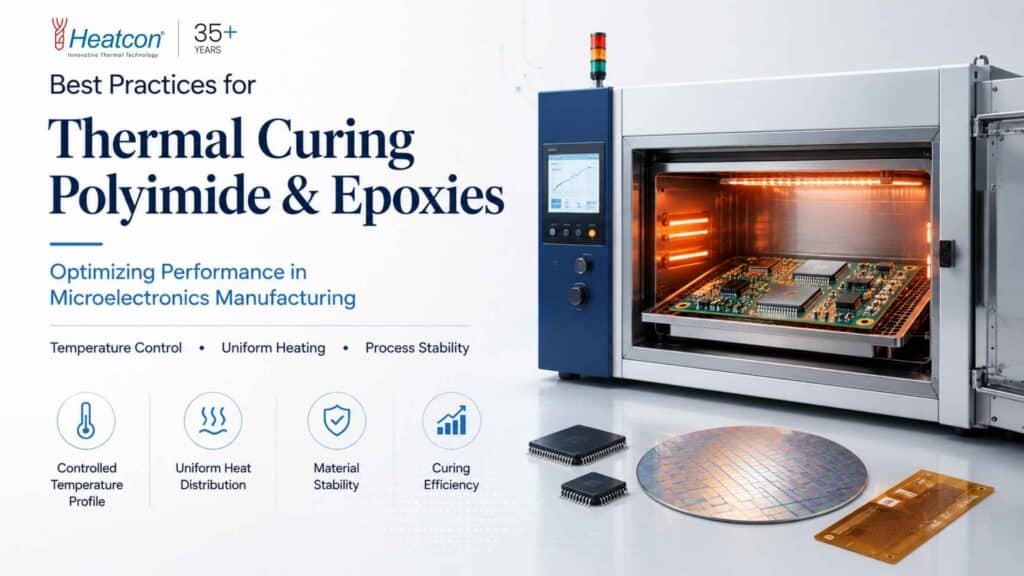
What Is Thermal Curing In Microelectronics?
Thermal curing is a cornerstone process in microelectronics, vital for achieving high-performance and reliability in devices. According to the International Technology Roadmap for Semiconductors, over 90% of advanced microelectronic components undergo some form of thermal curing during manufacturing. This process is especially critical when working with materials like polyimide and epoxy, which are commonly used as dielectric layers and encapsulants. Mastering this process is essential for manufacturers seeking to deliver flawless, high-yield products to the global market.
- Thermal curing solidifies polymers, ensuring mechanical strength and chemical resistance.
- It directly impacts device longevity, yield, and miniaturization capabilities.
- Precise temperature control is mandatory to prevent defects such as voids, incomplete cure, or delamination.
Why Is Polyimide Curing Cleanroom Oven Essential?
Polyimide curing cleanroom oven is a specialized equipment designed to facilitate the controlled heating of polyimide layers in a contaminant-free environment. The cleanroom setting ensures that no particulates settle onto sensitive microelectronic surfaces during the thermal curing cycles, which could otherwise lead to device failure.
Polyimides are favored in microelectronics for their exceptional thermal stability and insulating properties. However, improper curing can result in suboptimal mechanical properties or even catastrophic failure under operational stresses. The use of a polyimide curing cleanroom oven addresses these issues by:
- Maintaining uniform temperature distribution across wafers or substrates.
- Ensuring minimal contamination risk, crucial for high-density microelectronics processing.
- Allowing programmable thermal curing cycles for material-specific profiles.
Heatcon Sensors understands these requirements and offers custom temperature sensors—such as RTDs and thermocouples—designed specifically for integration with cleanroom ovens. These sensors deliver real-time, high-precision temperature monitoring, enabling process engineers to maintain tight control and ensure consistent polyimide properties batch after batch.
How To Achieve Effective Epoxy Curing In Microelectronics?
Epoxy curing is the process of crosslinking epoxy resins to form robust, chemically resistant encapsulants and adhesives in microelectronics. Precise thermal management is needed to achieve a full cure without inducing internal stresses or warping delicate components.
- Temperature Profiling: Each epoxy formulation has a specific cure temperature and time. Monitoring with custom RTDs from Heatcon Sensors ensures the epoxy receives the right heat exposure without overshoot or undershoot.
- Ramp Rate Control: Too rapid heating can cause bubble formation or thermal shock. Gradual ramp rates, monitored by reliable sensors, guarantee defect-free cure.
- Uniformity: Uniform temperature throughout the oven or hot plate is crucial. Heatcon Sensors’ temperature probes can be distributed at multiple points to verify and adjust for uniformity in real time.
- Post-Cure Management: Some applications require a multi-step cure (gel, then post-cure at higher temperature). Sequencing these steps via programmable controllers and trusted sensors secures the integrity of the final product.
By integrating Heatcon Sensors’ solutions, manufacturers in India, the US, UAE, Germany, South Korea, and beyond can assure that epoxy curing meets international reliability standards.
What Are The Key Steps In Microelectronics Processing With Thermal Curing?
Microelectronics processing involves a sequence of high-precision steps where thermal curing cycles play a vital role. Here’s how to optimize for maximum performance:
- Preparation: Substrates and wafers must be meticulously cleaned. Any residue can affect adhesion and cure uniformity.
- Material Application: Spin-coating, dispensing, or screen printing of polyimide or epoxy onto the substrate. Thickness uniformity is critical.
- Soft Bake: A preliminary low-temperature bake to remove solvents, generally at 80-120°C.
- Thermal Cure: Using programmable ovens or furnaces, the material is subjected to elevated temperatures for a defined period. This is the key stage where custom RTDs from Heatcon Sensors ensure the temperature profile matches exact material requirements.
- Cool Down: Controlled cooling prevents thermal shock and preserves mechanical integrity.
Each step is monitored and controlled with precise feedback loops made possible by Heatcon Sensors’ custom solutions, ensuring defect-free products whether you are manufacturing in Bangalore, New York, Dubai, Seoul, or Munich.
How To Optimize Thermal Curing Cycles?
Optimizing thermal curing cycles means fine-tuning temperature, time, and atmospheric conditions to maximize yield and minimize defects. Here’s how Heatcon Sensors helps you do it right:
- Custom Sensor Integration: Heatcon Sensors’ RTDs and thermocouples can be tailored to fit any oven, furnace, or hot plate configuration—guaranteeing accurate, real-time data acquisition.
- Advanced Controllers: Pairing sensors with programmable controllers allows for complex, multi-phase curing cycles—critical for advanced microelectronics processing.
- Data Logging & Analysis: Real-time data can be logged and analyzed, identifying anomalies or drift in your process for continuous improvement.
- Calibration Services: Heatcon Sensors provides calibration and maintenance, ensuring ongoing accuracy and compliance with international standards.
| Parameter | Polyimide Curing | Epoxy Curing |
|---|---|---|
| Typical Temperature Range | 200-400°C | 80-180°C |
| Atmosphere | Nitrogen or Clean Dry Air | Ambient or Nitrogen |
| Duration | 30-90 min | 1-3 hours |
| Required Uniformity | ±2°C | ±3°C |
With the right sensors and automation, you can achieve these tight specifications every time, regardless of location or batch size.
What Heat Generating Equipment Are Used In Thermal Curing?
The success of thermal curing cycles depends not only on the chemistry but also on the reliability of heat generating equipment. Heatcon Sensors manufactures and supplies:
- Polyimide curing cleanroom ovens
- Epoxy curing chambers
- High-precision industrial furnaces
- Hot air blowers
- Electric furnaces
- High density cartridge heaters
- Conveyor ovens for continuous microelectronics processing
- Customized batch ovens
Each of these is supported by Heatcon Sensors’ robust temperature monitoring and control systems, ensuring that every heat treatment step is executed with maximum precision.
Why Choose Heatcon Sensors For Your Thermal Curing Needs?
Heatcon Sensors is a recognized leader in the design and manufacture of custom RTDs, thermocouples, and advanced temperature sensors tailored for industrial applications. With decades of expertise and a strong presence across India and internationally—including the US, UAE, Indonesia, Germany, South Korea, Saudi Arabia, Russia, Bahrain, and Kuwait—Heatcon Sensors ensures that your microelectronics processing is always at the cutting edge.
By choosing Heatcon Sensors, you gain:
- Access to custom-engineered sensors that fit your exact process requirements
- Assurance of international quality standards in all equipment and sensors
- Expert guidance on optimizing thermal curing cycles for polyimide and epoxy materials
- Prompt delivery and support to any location in India or globally
Don’t risk defects, yield loss, or downtime—choose Heatcon Sensors for unmatched reliability and support.
How To Reach Heatcon Sensors For Custom Solutions?
Ready to elevate your microelectronics processing with the most reliable temperature sensors and heat generating equipment? Reach out to Heatcon Sensors today for a consultation or quotation:
- Submit your requirements on the online contact form
- Leave a message via WhatsApp using the interface at heatconsensors.com
- Call for immediate assistance: +91 9164833027 or +91 9844233244
Don’t let your competitors outpace you with subpar process controls—Heatcon Sensors provides the edge you need for flawless thermal curing, anywhere in the world.
About Heatcon Sensors
Heatcon Sensors is a technology-driven manufacturer based in India, specializing in custom temperature sensors such as RTDs, thermocouples, and advanced sensor systems for a wide range of industrial applications. In addition to world-class sensors, Heatcon Sensors designs and manufactures heat generating equipment including ovens, furnaces, hot air blowers, and high density cartridge heaters—serving clients across India, the United States, Europe, the Middle East, and Southeast Asia.
With an unwavering commitment to quality, innovation, and customer satisfaction, Heatcon Sensors stands as your trusted partner for all thermal processing solutions.
Frequently Asked Questions
What are the key considerations for thermal curing cycles in microelectronics?
Thermal curing cycles are critical in microelectronics processing to ensure the desired mechanical, electrical, and chemical properties of polyimide and epoxy materials. Key considerations include precise temperature control, uniform heat distribution, ramp rates, dwell times, and atmosphere control to prevent contamination or oxidation. Heatcon Sensors supports these requirements by offering advanced temperature sensors and control systems designed for high-reliability environments.
Why is a polyimide curing cleanroom oven important for device reliability?
A polyimide curing cleanroom oven is essential because it maintains a controlled, contaminant-free environment during the curing process. Polyimides are sensitive to particles and moisture, and exposure can compromise adhesion and electrical insulation. Heatcon Sensors offers sensor solutions that integrate seamlessly with cleanroom ovens, enabling real-time monitoring and optimal process control for consistent, high-quality results.
What are the challenges of epoxy curing in microelectronics?
Epoxy curing in microelectronics requires tight control over temperature profiles to avoid incomplete curing, shrinkage, or thermal stress, which can lead to mechanical failure or electrical issues. Variations in batch size, component geometry, and ambient conditions add complexity. Heatcon Sensors provides robust thermal sensors and data acquisition systems to accurately track and manage the epoxy curing process, ensuring repeatable and reliable outcomes.
How do Heatcon Sensors’ products improve microelectronics processing?
Heatcon Sensors delivers precision temperature measurement solutions that are integral to microelectronics processing. Their sensors are engineered for fast response, stability, and durability in high-purity environments. By ensuring accurate feedback and control during thermal curing cycles, Heatcon Sensors enhances process consistency, reduces scrap rates, and helps achieve stringent industry specifications.
What best practices should be followed for thermal curing polyimide films?
Best practices for thermal curing of polyimide films include using cleanroom-grade ovens, gradual temperature ramp-up to avoid thermal shock, precise dwell times at curing temperature, and slow cool-down phases to minimize stress. Regular calibration of temperature sensors, as offered by Heatcon Sensors, helps maintain process accuracy and repeatability.
How can sensor placement impact the results of thermal curing cycles?
Proper sensor placement ensures accurate temperature readings of both the environment and the product being cured. Incorrect placement can lead to temperature gradients, uneven curing, or undetected hot/cold spots. Heatcon Sensors provides guidance and a range of sensor configurations to ensure optimal placement for reliable monitoring during all stages of thermal curing cycles.
What solutions does Heatcon Sensors offer for high-throughput polyimide and epoxy curing?
For high-throughput applications, Heatcon Sensors offers multi-point temperature monitoring systems, robust sensor arrays, and data logging solutions tailored for integration with automated ovens and batch processing equipment. These solutions help maintain uniformity and traceability in both polyimide and epoxy curing processes, critical for volume manufacturing.
How can Heatcon Sensors help with validation and documentation in microelectronics processing?
Heatcon Sensors’ data acquisition and monitoring systems provide real-time tracking, alarm functions, and comprehensive data records. This supports process validation, quality assurance, and regulatory compliance in microelectronics processing. Detailed, timestamped thermal profiles help manufacturers meet industry and customer documentation requirements.
What ongoing support does Heatcon Sensors provide for thermal curing applications?
Heatcon Sensors offers expert technical support, calibration services, and custom sensor development to address evolving process needs in polyimide and epoxy curing. Their team assists with system integration, troubleshooting, and optimization to ensure peak performance of curing equipment and long-term reliability in microelectronics manufacturing.