
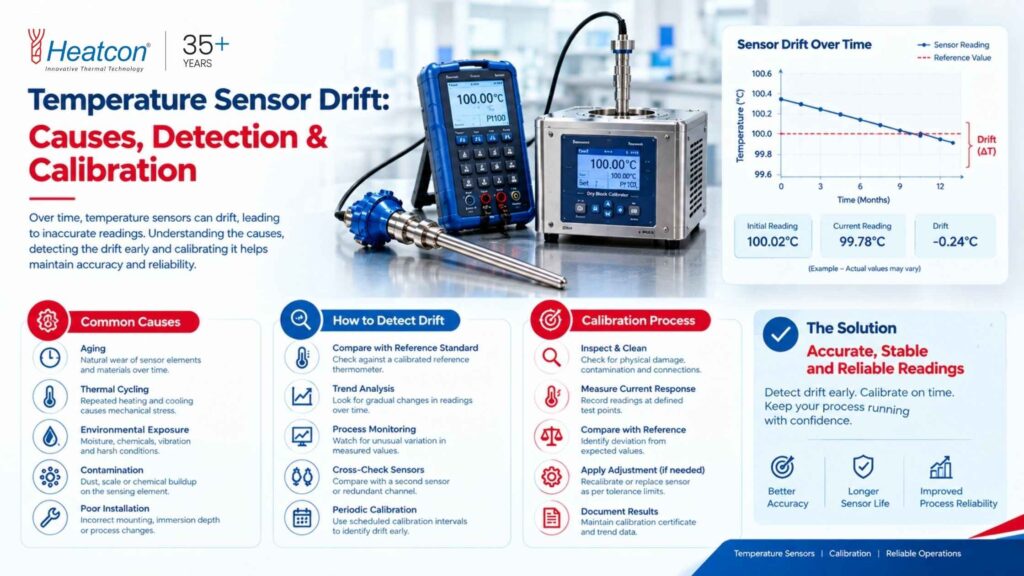
What Is Temperature Sensor Drift And Why Should You Care?
Temperature sensor drift is the gradual loss of accuracy in sensors such as RTDs and thermocouples over time, leading to unreliable temperature measurements. According to the International Society of Automation, over 60% of process errors in critical industries can be traced back to sensor drift and lack of proper calibration. If left unchecked, temperature sensor drift can result in costly downtime, product spoilage, safety risks, and regulatory non-compliance. This makes understanding and controlling sensor drift essential for every industrial process using temperature monitoring.
How Does Temperature Sensor Drift Occur?
Temperature sensor drift can manifest in any sensor, but is most commonly seen in resistance temperature detectors (RTDs) and thermocouples. Drift refers to the deviation of a sensor’s readings from the true process temperature, increasing as the sensor ages or is exposed to harsh conditions.
- RTD drift happens as the resistance element (often platinum) undergoes physical and chemical changes, such as oxidation, contamination, or strain from vibration.
- Thermocouple drift stems from changes in the wire composition, corrosion at junctions, and diffusion of metals, especially at high temperatures.
Ultimately, both RTD drift and thermocouple drift result in sensor accuracy degradation, impacting the quality and safety of your processes.
What Causes Temperature Sensor Drift?
The root causes of temperature sensor drift are usually a combination of environmental, operational, and sensor-specific factors:
- High Temperature Exposure: Prolonged or repeated exposure to high temperatures can accelerate drift, especially in sensors used in furnaces, ovens, electric furnaces, hot air blowers, and high density cartridge heaters.
- Mechanical Stress: Vibration, shock, and improper installation can physically deform the sensing element.
- Chemical Contamination: Process gas, moisture ingress, and corrosive environments can alter the sensor element or wiring.
- Electrical Interference: Electromagnetic fields can affect sensor signals, leading to false drift symptoms.
- Ageing: Over time, all sensors exhibit some degree of drift due to material fatigue and microscopic changes.
Each of these factors can be mitigated through sensor selection, environment control, and maintenance strategies—areas in which Heatcon Sensors specializes.
How Can You Detect Sensor Drift In Temperature Sensors?
Early and reliable sensor drift detection is vital to maintaining process accuracy. The most effective methods include:
- Regular Comparison: Compare the suspect sensor’s readings with a recently calibrated reference sensor under the same conditions.
- In-situ Testing: Use built-in self-checks or dual-sensor configurations for continuous monitoring.
- Data Trending: Analyze historical sensor data for gradual changes or sudden shifts in readings.
- Automated Alerts: Use software to flag deviations outside of expected tolerances.
Heatcon Sensors supports industries with integrated sensor drift detection solutions, ensuring that process deviations are caught before they lead to failures or non-compliance.
Why Does Sensor Accuracy Degradation Matter?
Sensor accuracy degradation can have severe consequences:
- Product Quality: Inaccurate temperature readings can lead to undercooked or overcooked products, defective parts, or unsafe pharmaceuticals.
- Safety Risks: Unchecked drift in safety-critical applications, such as reactors or food processing, can lead to hazardous situations.
- Regulatory Compliance: Many industries demand strict adherence to temperature control standards. Drifting sensors can cause audit failures or legal penalties.
- Increased Costs: Wasted energy, reprocessing, or batch rejection drive up costs unnecessarily.
For these reasons, proactive temperature sensor calibration and maintenance are essential.
How To Calibrate Temperature Sensors And Set Calibration Intervals?
Temperature sensor calibration is the process of comparing a sensor’s output to a known reference and making adjustments to minimize error. The optimal calibration intervals depend on the sensor type, application criticality, and operating environment.
- Initial Calibration: All new or repaired sensors must be calibrated before deployment.
- Regular Calibration: Most industrial sensors require calibration at least once a year, but high-precision or high-risk applications may need it quarterly or even monthly.
- Event-Driven Calibration: After any suspected event—such as a process upset, major maintenance, or environmental anomaly—prompt calibration is advised.
Heatcon Sensors provides traceable calibration for all sensor types and can recommend calibration intervals tailored to your process and risk profile.
How Does Industrial Sensor Maintenance Prevent Drift?
Industrial sensor maintenance involves a series of proactive steps to extend sensor life and control drift:
- Routine cleaning and inspection to remove contaminants.
- Verifying wiring integrity and connection tightness.
- Environmental controls to limit exposure to corrosives or excessive heat.
- Periodic in-situ calibration checks.
- Prompt replacement of aged or drifting sensors.
With a dedicated industrial sensor maintenance program, such as those enabled by Heatcon Sensors, you can maximize process reliability and product quality.
Why Choose Heatcon Sensors For Your Temperature Sensing And Calibration Needs?
Heatcon Sensors is a globally recognized manufacturer, specializing in customized RTDs, thermocouples, and specialized temperature sensing solutions for industries. With a robust presence in India and proven supply capabilities to the US, UAE, Indonesia, Germany, South Korea, Saudi Arabia, Russia, Bahrain, Kuwait, and beyond, Heatcon Sensors is your ideal partner for precision measurement and heat generation.
- Custom Manufacturing: RTDs, thermocouples, and sensors tailored to your exact process and installation needs.
- Global Reach: Fast, reliable delivery to any city in India or international destinations.
- Turnkey Solutions: Integration with heat generating equipment such as furnaces, ovens, electric furnaces, hot air blowers, and high density cartridge heaters.
- Expert Calibration Services: Traceable, in-house or on-site temperature sensor calibration and sensor drift detection.
- Full Lifecycle Support: End-to-end industrial sensor maintenance, troubleshooting, and drift mitigation strategies.
With decades of technical expertise and a commitment to customer success, Heatcon Sensors ensures your production stays accurate, efficient, and compliant—wherever you operate.
How To Get Support Or Order Custom Temperature Sensors?
Don’t risk costly downtime or compliance issues due to temperature sensor drift. For immediate assistance, or to order custom RTDs, thermocouples, calibration services, or industrial heat equipment:
- Submit your requirements on the contact form.
- Message via WhatsApp using the green chat button at heatconsensors.com.
- Call us directly at +91 9164833027 or +91 9844233244 for expert assistance.
Choose Heatcon Sensors—the trusted name in temperature sensing and calibration. Stay ahead of drift, and ensure your process reliability anywhere in the world.
About Heatcon Sensors
Heatcon Sensors is an ISO-certified manufacturer based in India, dedicated to delivering high-accuracy temperature sensors, RTDs, thermocouples, calibration services, and industrial heating solutions worldwide. With extensive experience, advanced manufacturing, and a global logistics network, Heatcon Sensors is the first choice for industries demanding precision and reliability in temperature measurement and control.
| Expertise | Customized RTDs, Thermocouples, Sensor Calibration, Heat Equipment |
|---|---|
| Industries Served | Pharmaceutical, Food, Chemical, Petrochemical, Power, Research, and more |
| Regions | India, US, UAE, Indonesia, Germany, South Korea, Saudi Arabia, Russia, Bahrain, Kuwait, Global |
| Contact |
Contact Form | +91 9164833027, +91 9844233244 |
Frequently Asked Questions
What is temperature sensor drift and why does it occur?
Temperature sensor drift refers to the gradual change in a sensor’s output when measuring a stable temperature over time. This phenomenon occurs due to factors such as aging of sensor materials, exposure to extreme temperatures, mechanical stress, contamination, and electrical interference. Both RTDs and thermocouples can experience drift, which can lead to inaccurate readings if not addressed through proper maintenance and calibration.
How can I detect sensor drift in my temperature sensors?
Sensor drift detection involves regular comparison of sensor outputs against a known reference or standard. Deviations from expected values indicate possible drift. Heatcon Sensors recommends scheduled sensor drift detection as part of industrial sensor maintenance routines to catch issues early and maintain process accuracy.
What are the main causes of RTD drift and thermocouple drift?
RTD drift is often caused by factors such as contamination, mechanical strain, and changes in the crystalline structure of the resistance wire over time. For thermocouples, drift commonly results from oxidation, contamination of the junction, or changes in alloy composition due to prolonged exposure to high temperatures. Both types of drift contribute to sensor accuracy degradation if not managed proactively.
How does sensor accuracy degradation impact industrial processes?
Sensor accuracy degradation can lead to incorrect temperature measurements, affecting process control, product quality, safety, and energy efficiency. In critical applications, even minor inaccuracies caused by temperature sensor drift can result in costly downtime or product defects. Regular calibration and maintenance are essential to prevent these issues.
What is the recommended frequency for temperature sensor calibration?
The ideal calibration intervals depend on the application, operating environment, and required accuracy. Heatcon Sensors generally recommends annual temperature sensor calibration for most industrial environments. However, sensors exposed to harsh conditions or critical processes may require more frequent calibration to ensure reliability and compliance.
What solutions does Heatcon Sensors offer to manage and correct sensor drift?
Heatcon Sensors provides comprehensive temperature sensor calibration services, including in-house and on-site options. Our experts use precision calibration equipment to identify and correct sensor drift, ensuring your devices perform within specified tolerances. We also offer guidance on establishing practical calibration intervals and best practices for industrial sensor maintenance.
Can sensor drift be completely eliminated?
While it is not possible to entirely eliminate temperature sensor drift due to inherent material and environmental factors, it can be significantly minimized. Routine sensor drift detection, scheduled calibration, and proper industrial sensor maintenance, as provided by Heatcon Sensors, help maintain optimal sensor performance and extend service life.
How does Heatcon Sensors help in setting up calibration intervals for my facility?
Heatcon Sensors works closely with clients to evaluate their process requirements, sensor types, and operating environments. Based on these factors, we recommend tailored calibration intervals to maintain accuracy and compliance. Our documentation and support ensure you have a reliable schedule for temperature sensor calibration and drift prevention.