
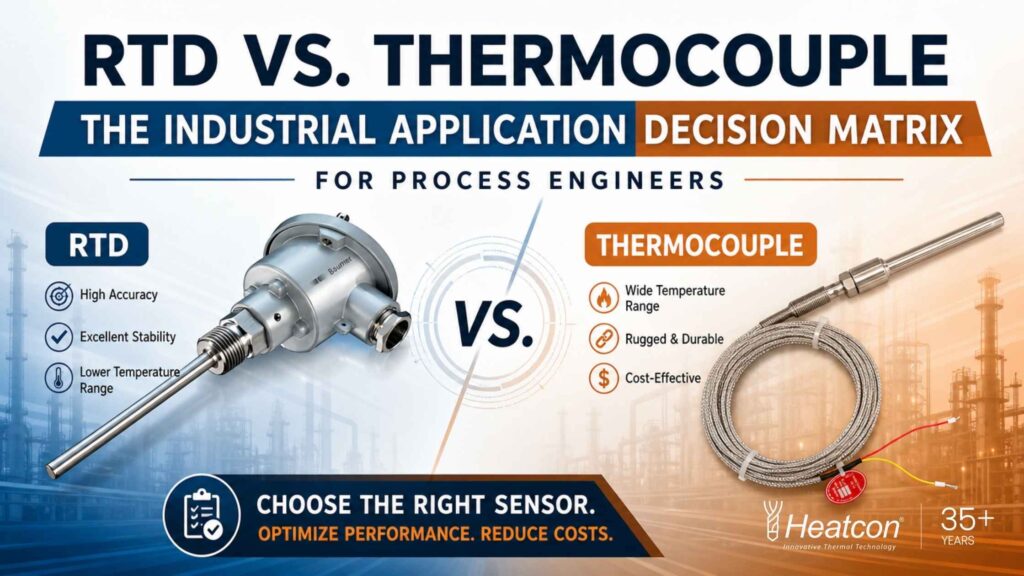
What Is The Difference Between RTD And Thermocouple In Industrial Applications?
Choosing between RTD vs thermocouple is one of the most crucial decisions process engineers face in industrial settings. According to a recent market research report, over 65% of industrial temperature measurements worldwide rely on either RTDs or thermocouples, underscoring their dominance in industrial temperature control systems. This decision not only impacts the precision and reliability of temperature monitoring, but also operational efficiency, safety, and compliance with quality standards. Understanding the unique strengths and limitations of both technologies is essential for optimizing your process, reducing downtime, and ensuring product consistency.
In this comprehensive guide, you’ll discover how to navigate the temperature sensor selection guide, compare industrial thermocouple types, and evaluate precision RTD sensors to suit your process needs. Whether you’re operating in India, the US, UAE, Indonesia, Germany, South Korea, Saudi Arabia, Russia, Bahrain, or Kuwait, the principles remain the same, and Heatcon Sensors stands ready to deliver custom solutions to your doorstep worldwide.
How To Choose The Right Temperature Sensor: RTD Vs Thermocouple Decision Matrix
The core of the temperature sensor selection guide lies in matching the sensor technology to your specific application environment, process conditions, and accuracy requirements. Both RTDs (Resistance Temperature Detectors) and thermocouples are widely used industrial temperature sensors, but their operating principles, performance, and best-use scenarios differ significantly.
- RTDs measure temperature by correlating the resistance of a metal (usually platinum) with temperature changes, offering high accuracy and stability.
- Thermocouples generate a voltage at the junction of two dissimilar metals, which is related to temperature. Their broad temperature range and ruggedness make them ideal for harsh environments.
A quick overview:
| Parameter | RTDs | Thermocouples |
|---|---|---|
| Temperature Range | -200°C to +600°C (RTD temperature range) | -200°C to +1800°C (thermocouple temperature range) |
| Accuracy | High (RTD accuracy: ±0.1°C to ±1°C) | Moderate (±1°C to ±2°C) |
| Response Time | Slower | Fast (thermocouple response time) |
| Cost | Higher | Lower |
| Stability | Excellent long-term | Can drift over time |
Which Sensor Is Best For Your Process? Analyzing Use Cases And Performance
RTDs: Precision, Stability, And Industrial Excellence
RTDs are the preferred choice for applications where precision and long-term stability are paramount. Industries such as pharmaceuticals, food processing, and chemical manufacturing depend on precision RTD sensors for critical temperature monitoring, especially in controlled processes and calibration systems.
- RTD temperature range is ideal for most industrial processes (-200°C to +600°C).
- RTD accuracy ensures product quality and process repeatability.
- They offer exceptional repeatability and minimal drift over time.
- Suitable for clean environments and where contamination must be avoided.
Heatcon Sensors manufactures customized RTDs with options for various sheath materials, mounting styles, and electrical connections, ensuring a perfect fit for your unique requirements, regardless of your global location.
Thermocouples: Versatility, Speed, And Extreme Environments
Thermocouples excel in harsh, high-temperature, or rapidly changing environments, such as metal foundries, glass manufacturing, and petrochemical plants. The extended thermocouple temperature range up to 1800°C makes them indispensable for extreme heat applications.
- Various industrial thermocouple types (Type K, J, T, N, S, R, B) to match process conditions.
- Fast thermocouple response time is crucial for processes with rapid temperature fluctuations.
- Rugged construction tolerates vibration, shock, and chemical exposure.
- Cost-effective for distributed installations and high-temperature zones.
Heatcon Sensors offers a comprehensive range of industrial thermocouple types, custom-built to withstand the most demanding industrial environments, shipped rapidly to any part of India or the world.
What Factors Should Process Engineers Consider When Selecting Industrial Temperature Sensors?
Making the right choice in the RTD vs thermocouple debate hinges on a nuanced understanding of your process demands and sensor capabilities. Consider the following factors using the decision matrix below:
- Temperature Range: Match your maximum and minimum process temperatures with the RTD temperature range or thermocouple temperature range.
- Accuracy And Stability: For high-precision or critical control, lean towards RTDs for their superior RTD accuracy.
- Response Time: For rapidly changing temperatures, prioritize thermocouple response time.
- Process Environment: Assess the presence of vibration, corrosive agents, electrical noise, and mechanical stress.
- Installation And Maintenance: Evaluate accessibility, replacement frequency, and wiring complexity.
- Cost And Lifecycle: Factor in initial investment and long-term maintenance costs.
Heatcon Sensors collaborates with you to analyze all these variables, offering a tailored temperature sensor selection guide that incorporates your specific operating parameters—no matter your industry or location.
Why Is Heatcon Sensors The Preferred Partner For Custom Industrial Temperature Sensors?
In the competitive landscape of industrial process control, partnering with the right sensor supplier can make a measurable difference in plant performance and reliability. Heatcon Sensors is a global leader in designing, manufacturing, and supplying industrial temperature sensors, including both precision RTD sensors and all industrial thermocouple types.
- Decades of expertise in custom-engineered sensor solutions for diverse industries and processes.
- Full compliance with global quality standards and industry certifications.
- Rapid turnaround and shipping to India, US, UAE, Indonesia, Germany, South Korea, Saudi Arabia, Russia, Bahrain, Kuwait, and beyond.
- Comprehensive support—from selection guidance to installation and after-sales service.
With Heatcon Sensors, you are assured of reliable, accurate, and long-lasting temperature sensing solutions—engineered specifically for your needs.
What Other Industrial Solutions Does Heatcon Sensors Offer?
Beyond industrial temperature sensors, Heatcon Sensors is a provider of heat generating equipment, offering a range of customized solutions for industrial heating requirements:
- Electric and gas-fired furnaces
- Industrial ovens for curing, drying, and baking
- Hot air blowers and air heaters
- High density cartridge heaters for localized heating
- Immersion heaters, band heaters, and tubular heaters
- Specialty heating equipment designed for unique process needs
Every product is engineered and manufactured with the same commitment to quality and customization that defines Heatcon Sensors’ temperature sensor offerings.
Contacting Heatcon Sensors for Orders or Guidance
To discuss your requirements or to place an order, you can reach out to Heatcon Sensors in several convenient ways:
- Submit your information on the form at https://heatconsensors.com/contact-us/
- Leave a message on WhatsApp through the interface on the Heatcon Sensors website
- Call +91 9164833027 or +91 9844233244 for immediate assistance
Selecting the appropriate sensor or heating solution can improve your process performance and reliability.
About Heatcon Sensors
Heatcon Sensors is a leading manufacturer and global supplier of industrial temperature sensors, precision RTD sensors, industrial thermocouple types, and a broad spectrum of heat generating equipment. Based in India and serving clients worldwide, Heatcon Sensors is known for its commitment to quality, customization, and customer-focused solutions.
Trusted by process engineers and industry leaders in India, the US, UAE, Indonesia, Germany, South Korea, Saudi Arabia, Russia, Bahrain, Kuwait, and across the globe, Heatcon Sensors is your partner for all temperature measurement and industrial heating needs.
Frequently Asked Questions
What is the main difference between RTD and thermocouple sensors in industrial applications?
In the context of rtd vs thermocouple , the main difference lies in the sensing principle and operating range. RTDs (Resistance Temperature Detectors) use the predictable change in electrical resistance of metals (typically platinum) with temperature, providing high accuracy and stability. Thermocouples generate a voltage due to the Seebeck effect from two dissimilar metals joined together, offering a wider temperature range and faster response. The selection between the two depends on requirements such as accuracy, temperature range, speed of response, and environmental conditions.
How do I choose the right temperature sensor for my industrial process?
Heatcon Sensors recommends following a temperature sensor selection guide that assesses factors such as the required temperature range, accuracy, response time, environment (corrosive, vibration, etc.), installation constraints, and budget. RTDs are ideal for applications needing high accuracy and stability at moderate temperatures, while thermocouples are suited for wide temperature spans and rapid response in harsh environments. Consulting with Heatcon’s experts can help you tailor the solution to your process needs.
What are the most common industrial thermocouple types, and where are they used?
The most widely used industrial thermocouple types include Type K (Nickel-Chromium/Nickel-Alumel), Type J (Iron/Constantan), Type T (Copper/Constantan), and Type N (Nicrosil/Nisil). Type K is popular due to its broad temperature range and durability, Type J for lower temperatures, and Type T for cryogenic applications. Heatcon Sensors supplies all major types, with custom sheath and insulation options for compatibility with various industrial environments.
What makes Heatcon’s precision RTD sensors suitable for critical industrial processes?
Precision RTD sensors from Heatcon are engineered with high-purity platinum elements, ensuring exceptional accuracy and repeatability. Their robust construction and calibration to IEC or ASTM standards make them ideal for industries such as pharmaceuticals, food processing, and chemical manufacturing, where tight temperature control is crucial. Heatcon offers customization in probe dimensions, sheath material, and lead wire configuration to fit unique application requirements.
What is the typical RTD temperature range, and how does it compare to thermocouples?
The standard RTD temperature range for platinum RTDs (Pt100/Pt1000) is -200°C to +600°C, with optimal accuracy and stability up to about 400°C. In contrast, the thermocouple temperature range can extend from -200°C to +1800°C depending on the thermocouple type, making them suitable for high-temperature industrial processes like metal and glass manufacturing. Heatcon Sensors offers both RTDs and thermocouples to address various temperature demands.
Which sensor offers higher accuracy: RTD or thermocouple?
RTD accuracy is generally superior to thermocouples, especially within moderate temperature ranges. RTDs can achieve accuracies as fine as ±0.1°C, while thermocouples typically have tolerances in the range of ±1°C or higher. For processes where precision is critical, such as laboratory or pharmaceutical applications, Heatcon’s RTDs are the preferred choice.
How does thermocouple response time compare to RTD response time?
Thermocouples are known for their fast response to temperature changes. Thermocouple response time is generally quicker than RTDs due to their small thermal mass. However, Heatcon Sensors can manufacture both thermocouples and RTDs with specialized designs (like exposed or reduced-tip elements) to optimize response time for demanding applications such as plastics extrusion or rapid thermal cycling.
What role do industrial temperature sensors play in process optimization?
Industrial temperature sensors are fundamental to process control and optimization. They ensure safety, product quality, energy efficiency, and compliance by providing reliable temperature data to automation and control systems. Heatcon Sensors partners with industries worldwide to deliver robust, accurate, and application-specific temperature measurement solutions that drive operational excellence.
How does Heatcon Sensors support process engineers in selecting and integrating temperature sensors?
Heatcon Sensors offers comprehensive assistance to process engineers, from consultation based on the temperature sensor selection guide to on-site evaluation and after-sales support. Their engineering team helps with sensor selection, customization, documentation, calibration, and integration with plant control systems, ensuring optimal performance and reliability for every application.