
Want to ensure the safety and longevity of your electric vehicle (EV) batteries? According to the International Energy Agency, precise battery temperature monitoring can increase EV battery lifespan by up to 40%, making reliable sensor choice critical for manufacturers and end-users alike. This article delivers a thorough RTD vs Thermocouple for EV Battery analysis, delving into sensor accuracy, battery sensor comparison, and practical temperature sensor selection to help you make an informed decision. Discover why Heatcon Sensors is the go-to name for customized, high-performance thermal sensors, serving India, the US, the UAE, Indonesia, Germany, South Korea, Saudi Arabia, Russia, Bahrain, Kuwait, and beyond.
What Is The Role Of Temperature Sensors In EV Battery Monitoring?
Reliable EV battery sensors are crucial for safety, performance, and battery life optimization. Battery packs in electric vehicles are sensitive to temperature; overheating or suboptimal thermal management can result in reduced efficiency, faster degradation, or catastrophic failure. Real-time temperature sensing is essential to:
- Prevent battery thermal runaway and associated hazards.
- Optimize charging/discharging cycles by monitoring cell temperatures.
- Enable advanced battery management systems for extended battery lifespan.
- Ensure compliance with automotive safety standards worldwide.
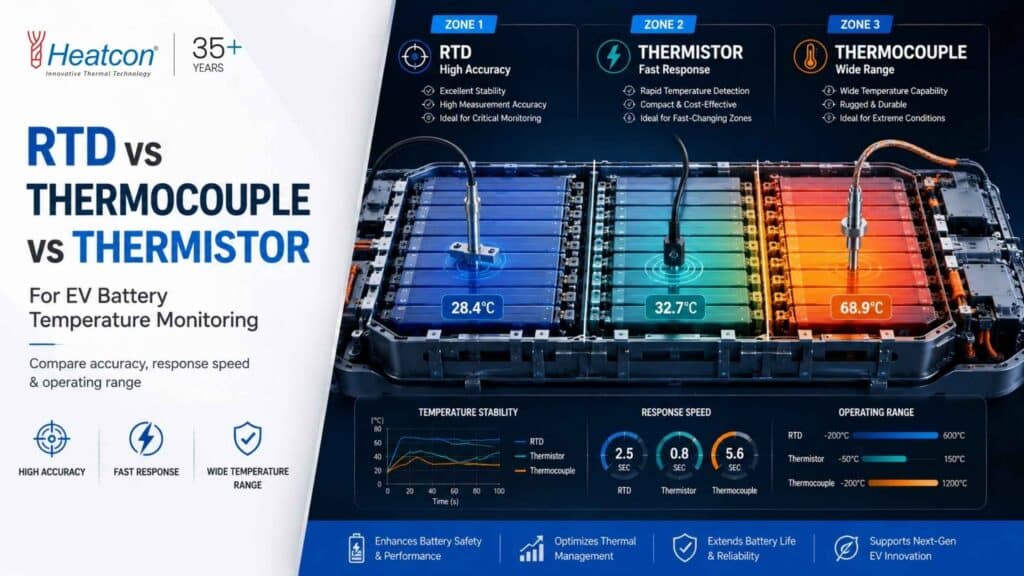
The most common thermal sensors for this application are Resistance Temperature Detectors (RTDs), thermocouples, and thermistors, each with distinct advantages and limitations.
Comparing RTDs and Thermocouples for EV Battery Monitoring
The primary debate in the industry is often framed as RTD vs Thermocouple for EV Battery. Both are proven technologies, but their operational principles, sensor accuracy, and suitability differ.
| Feature | RTD | Thermocouple |
|---|---|---|
| Operating Principle | Changes resistance with temperature (typically platinum-based, e.g., Pt100) | Generates a voltage due to the junction of two different metals |
| Temperature Range | -200°C to +600°C | -200°C to +1800°C (depending on type) |
| Sensor Accuracy | High (±0.1°C to ±0.5°C) | Moderate (±0.5°C to ±2°C) |
| Stability & Repeatability | Excellent | Good, but can drift over time |
| Response Time | Moderate | Fast |
| Durability | Robust, but sensitive to mechanical stress | Very robust, ideal for harsh environments |
| Cost | Higher (especially for platinum elements) | Lower |
| Interchangeability | Excellent (especially with Pt100 type) | Variable |
In summary, RTDs offer superior accuracy and stability, making them ideal for sensitive EV battery monitoring, while thermocouples excel in environments where extreme temperatures or ruggedness are required.
Comparing Thermistors and RTDs for EV Battery Applications
The thermistor vs RTD debate centers on response time, cost, and operating temperature range. Thermistors are highly sensitive and offer rapid response, but their non-linearity and narrower temperature range can be limiting.
- Thermistors: Fast response, highly sensitive, low cost, but limited to -100°C to +300°C and less linear response.
- RTDs: Slower response, more expensive, but highly linear and accurate over a wide range.
For battery sensor comparison, thermistors might be chosen for rapid detection of temperature spikes, whereas RTDs are preferred where long-term stability and precision are prioritized.
Pt100 and Thermocouple Sensor Accuracy in EV Batteries
The Pt100 vs thermocouple question is pivotal in the context of sensor accuracy and interchangeability. Pt100 RTDs, made from platinum, provide exceptional repeatability and a nearly linear response, making them a gold standard in industrial RTDs.
- Pt100 (RTD): ±0.1°C accuracy, stable calibration, and excellent long-term drift resistance.
- Thermocouple: Generally ±1°C accuracy, faster response, but can drift and needs frequent recalibration.
For EV battery sensors where precise temperature control is crucial, Pt100 RTDs are often recommended.
Key Criteria for Selecting Temperature Sensors in EV Battery Packs
When it comes to temperature sensor selection for EV batteries, consider the following:
- Required accuracy and stability – For critical functions, opt for RTDs (especially Pt100).
- Operating temperature range – Thermocouples are better for higher temperatures.
- Response time – Thermistors are the fastest, critical for rapid fault detection.
- Durability and environmental conditions – Thermocouples withstand vibration and harsh conditions best.
- Installation and form factor – Customization may be needed for compact battery modules.
- Cost constraints – Thermistors and thermocouples are usually less expensive than RTDs.
A holistic battery sensor comparison will weigh these factors against the specific needs of your EV design, regulatory requirements, and expected usage environment.
Custom Solutions for EV Battery Sensors from Heatcon Sensors
Heatcon Sensors is a leading manufacturer specializing in industrial RTDs, thermocouples, thermistors, and custom thermal sensors for EV battery monitoring and industrial temperature measurement. With decades of experience, Heatcon Sensors understands the nuanced requirements of the automotive, battery, and renewable energy industries.
- Custom design and manufacturing of RTDs, thermocouples, and thermistors for battery modules of any size or configuration.
- Unmatched sensor accuracy, with calibration traceable to international standards.
- Solutions for extreme environments, from cryogenic cells to high-heat battery packs.
- Support for global supply, serving clients in India, the US, UAE, Indonesia, Germany, South Korea, Saudi Arabia, Russia, Bahrain, Kuwait, and other regions.
- Comprehensive after-sales support, technical consultancy, and rapid prototyping.
Heatcon Sensors is also a trusted partner for heat-generating equipment, including furnaces, ovens, hot air blowers, electric furnaces, high density cartridge heaters, immersion heaters, and more. This makes them a one-stop solution for both temperature measurement and thermal management needs.
Reasons to Choose Heatcon Sensors for EV Battery Temperature Monitoring
Choosing the right EV battery sensors is not just about technology—it’s about trust, reliability, and future-proofing your investment. Here’s what sets Heatcon Sensors apart:
- Expertise: Decades of experience in designing industrial RTDs and thermal sensors for automotive and high-tech industries.
- Customization: Tailor-made sensors and assemblies for unique battery pack geometries and performance needs.
- Global Reach: Efficient manufacturing and logistics to any location in India or worldwide, including major EV hubs.
- Quality: Rigorous testing for sensor accuracy and durability, ensuring zero compromise on safety or performance.
- Comprehensive Offerings: From battery sensor comparison consultancy to thermal sensor installation, Heatcon Sensors is your all-in-one partner.
Don’t risk your EV project’s success with off-the-shelf, generic sensors. Unlock the advantages of expert temperature sensor selection and customized engineering by partnering with Heatcon Sensors.
Contacting Heatcon Sensors for Your Customized Sensor Needs
Ready to elevate your EV battery temperature monitoring with the best-in-class sensors and thermal solutions? Reach out to Heatcon Sensors through any of the following convenient options:
- Submit your requirements via the contact form.
- Leave a message on WhatsApp through the interface available on Heatcon Sensors’ website.
- Call directly for immediate assistance at +91 9164833027 or +91 9844233244.
Secure your place at the forefront of EV safety and performance—contact Heatcon Sensors today and ensure your battery systems are protected by the most reliable, accurate, and customized sensors available.
About Heatcon Sensors
Heatcon Sensors is a premier manufacturer of industrial RTDs, thermocouples, thermistors, and other temperature sensors based in India, serving industries worldwide with a strong reputation for quality and customization. Heatcon Sensors also offers a complete range of heat-generating equipment, including industrial furnaces, ovens, hot air blowers, electric furnaces, and high-density cartridge heaters. With a commitment to innovation, precision, and customer satisfaction, Heatcon Sensors is your trusted partner for all temperature sensing and thermal management needs.
Frequently Asked Questions
What are the main differences between RTD, thermocouple, and thermistor sensors for EV battery temperature monitoring?
The main differences lie in their sensing elements, temperature ranges, accuracy, and application suitability. RTDs (Resistance Temperature Detectors) such as Pt100 offer high sensor accuracy and stability, making them ideal for precise EV battery sensors. Thermocouples are robust and handle higher temperatures, but are less accurate at the lower ranges common in battery systems. Thermistors are highly sensitive to small temperature changes, but typically have a limited temperature range and can be less stable over time. Your temperature sensor selection should be based on your application’s accuracy, range, and durability requirements.
How do I decide between RTD vs Thermocouple for EV Battery applications?
When considering RTD vs Thermocouple for EV Battery monitoring, RTDs are generally preferred due to their greater accuracy and stability at the operating temperatures typical of batteries. Thermocouples are often chosen for environments with extreme conditions, but may introduce more error in the narrow, moderate temperature bands of EV batteries. Heatcon Sensors can recommend the right sensor based on your system’s needs, environmental factors, and required precision.
What are the advantages of thermistor vs RTD for EV battery monitoring?
Comparing thermistor vs RTD, thermistors are highly responsive and more cost-effective for detecting rapid temperature changes, which can be beneficial for battery thermal management. However, RTDs offer better long-term stability, repeatability, and linearity, making them the preferred choice for high-precision battery sensor comparison and when consistent readings over time are critical. Heatcon Sensors provides both solutions tailored to your application.
Why is Pt100 vs thermocouple comparison important for EV battery systems?
The Pt100 vs thermocouple comparison is crucial because Pt100 RTDs offer superior accuracy and repeatability at the moderate temperatures experienced in EV batteries, whereas thermocouples are better suited for extreme temperature applications. For EV battery systems, Pt100 sensors from Heatcon Sensors provide precise, reliable temperature measurement, which is vital for battery safety and efficiency.
What should I consider during temperature sensor selection for EV battery packs?
Key considerations for temperature sensor selection include accuracy, response time, durability, operating temperature range, and ease of integration. For EV battery sensors, Heatcon Sensors recommends industrial RTDs like Pt100 for their robustness and high sensor accuracy, but also offers thermistors and thermocouples to meet specific OEM or custom requirements.
Are there any differences in sensor accuracy among RTDs, thermocouples, and thermistors for EV batteries?
Yes, RTDs—especially Pt100 types—generally provide the highest sensor accuracy and long-term stability. Thermistors can be very accurate within a limited range but may drift over time. Thermocouples are less precise in the lower temperature ranges relevant to battery monitoring. Heatcon Sensors specializes in high-accuracy thermal sensors for critical EV battery applications.
How do Heatcon Sensors’ solutions support reliable EV battery temperature monitoring?
Heatcon Sensors offers a full range of EV battery sensors—including industrial RTDs, thermocouples, and thermistors—engineered for high reliability, accuracy, and easy integration into battery management systems. Our solutions are customized for each application, ensuring optimal battery sensor comparison and performance for safe, efficient electric vehicles.
What role do industrial RTDs play in advanced battery management systems?
Industrial RTDs are preferred in advanced battery management systems due to their robust construction, exceptional accuracy, and minimal drift over time. They are ideal for continuous monitoring in demanding automotive environments, ensuring that EV batteries operate within their safe temperature limits. Heatcon Sensors’ industrial RTDs are designed for easy integration into modern BMS architectures.
Can Heatcon Sensors provide custom thermal sensors for unique EV battery designs?
Absolutely. Heatcon Sensors specializes in designing and manufacturing custom thermal sensors—including RTDs, thermocouples, and thermistors—to fit unique battery geometries, mounting requirements, and integration needs. Our engineering team works closely with OEMs to ensure the right temperature sensor selection for every EV battery application.