
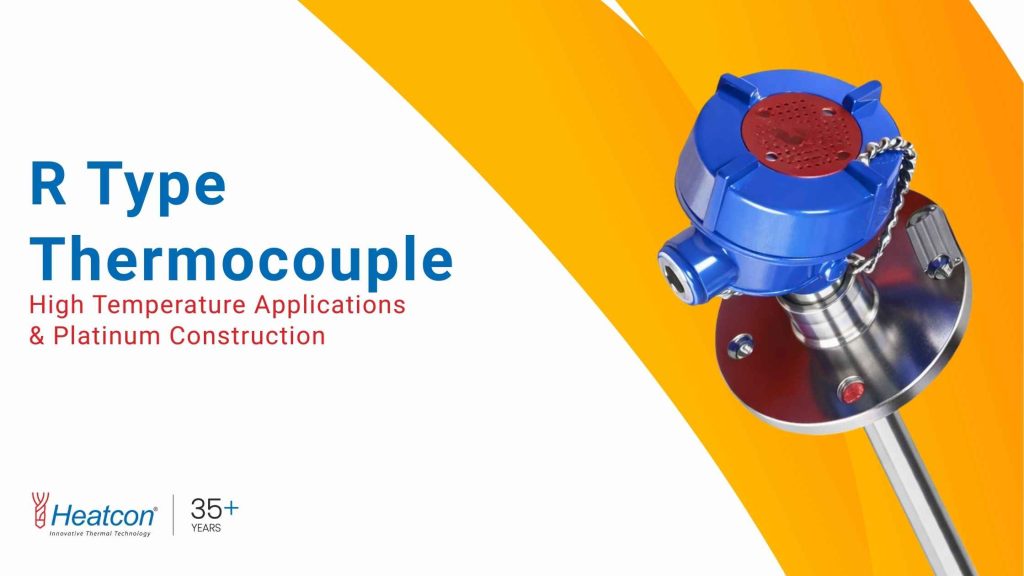
An R Type Thermocouple is one of the most trusted temperature sensing technologies for extremely hot industrial processes, primarily because it is built on platinum-based metallurgy and delivers stable readings at high temperatures. According to publicly available industrial instrumentation references, R-type thermocouples are commonly used up to approximately 1600°C in continuous applications and can tolerate higher peak exposure depending on installation conditions—making them a benchmark choice whenever process reliability matters more than cost.
If your production quality depends on accurate heat control—whether you’re operating heat treatment lines, ceramic kilns, glass processing, metallurgical chambers, or critical laboratory systems—this guide will help you understand what makes R type sensors different, how to select them correctly, and why Heatcon Sensors is a preferred manufacturer for custom-built temperature sensors and heat generating equipment in India and globally.
What is an R type thermocouple and why is it used in high temperature zones?
A type r thermocouple is a noble-metal thermocouple made from platinum and platinum-rhodium alloys. It is engineered for accurate measurement in high-temperature environments where base metal sensors (like K type) may drift, oxidize, or degrade. In many mission-critical thermal processes, R type is chosen not only for maximum temperature capability but also for its long-term stability and repeatability.
In simple terms, an r type thermocouple converts heat into a measurable electrical signal (millivoltage) using two dissimilar conductors. Because its materials are noble and oxidation-resistant, it performs consistently in heat zones that would rapidly age standard thermocouples.
Where R type is typically applied
- Continuous high-temperature heat treatment
- Glass furnaces, ceramic kilns, and sintering systems
- Metallurgical operations and controlled-atmosphere heating
- Research labs and calibration environments
- Critical process validation and quality-driven manufacturing
Why platinum construction changes everything in temperature measurement
The key differentiator of R type technology is its noble metal composition. A platinum thermocouple is designed to withstand intense thermal stress while maintaining predictable electrical characteristics over time. In practical industrial terms, that means:
- Lower drift than many base metal thermocouples at elevated temperatures
- Better oxidation resistance in harsh hot zones
- Improved process stability, supporting consistent product quality
- Reduced recalibration frequency when installed correctly
In industries where every degree matters—hardness consistency, microstructure outcomes, shrinkage control, firing profiles, or metallurgical integrity—platinum-based sensing reduces the risk of expensive quality losses.
Understanding thermocouple wire selection for R type
While sensor grade matters, the right lead and extension wiring is equally important. Using incorrect wire types can introduce error and signal instability. For noble metal sensors, specialized materials are used; in procurement and technical discussions you may encounter the term thermocouple wire platinum. That phrase highlights a critical point: the wiring and connection integrity must match the thermocouple system design to protect accuracy.
What makes R type a preferred option among high temp sensors?
In modern manufacturing, temperature isn’t just a reading—it’s a quality decision. Among industrial high temp sensors, R type is selected when plants prioritize:
- High maximum operating range
- Stable output at sustained high heat
- Resistance to harsh furnace conditions
- Lower measurement drift that can degrade product consistency
That said, choosing R type is only the first step. The second step—and the one most teams overlook—is getting the construction details right: sheath material, insulation, junction type, head connection, mounting geometry, and protection tube suitability for the operating atmosphere.
How does an R type thermocouple work in industrial furnaces?
Industrial furnaces present one of the toughest environments for temperature measurement. There’s radiative heat, thermal cycling, vibration, aggressive gases, and mechanical abrasion. In such conditions, even a premium sensor can fail if the assembly isn’t engineered for the actual application.
Heatcon Sensors supports furnace operators with robust thermocouple assemblies tailored to site conditions, ensuring high temperature measurement remains stable across process cycles. Whether you need a ceramic protection tube, high purity insulation, customized insertion lengths, or special mounting arrangements, customization is often the difference between a sensor that lasts weeks and one that performs reliably for much longer.
Common installation risks in furnace thermocouples
- Incorrect immersion depth leading to radiant error
- Improper sealing causing contamination ingress
- Wrong sheath or protection tube material for furnace atmosphere
- Cold junction compensation errors
- Mechanical stress from vibration or thermal expansion
How to choose the right R type thermocouple for your process
Selecting a platinum thermocouple is not a one-line purchase decision. The best results come from matching the sensor to your temperature profile, furnace design, and process chemistry. Use the checklist below to ensure your selection supports both performance and longevity.
Selection checklist for R type thermocouple assemblies
- Temperature range: define continuous and peak temperatures
- Atmosphere: oxidizing, inert, vacuum, reducing, carburizing, etc.
- Mechanical constraints: mounting, vibration, bending, insertion length
- Response time: required speed vs protection requirement
- Accuracy and drift tolerance: production grade vs calibration-grade requirements
- Connection and signal path: head type, terminal block, cables
Quick comparison table: R type vs typical base-metal thermocouples
| Parameter | R type thermocouple | Typical base-metal thermocouple |
|---|---|---|
| Material | Platinum / Platinum-Rhodium (noble metal) | Nickel-based alloys (base metal) |
| Best use case | High-temperature stability and precision | General-purpose temperature measurement |
| Drift resistance | Typically higher stability in extreme heat | More drift risk at sustained high temperatures |
| Cost | Higher | Lower |
Why Heatcon Sensors is the preferred partner for customized temperature sensors
Heatcon Sensors is a specialized manufacturer focused on industrial temperature measurement—supporting customers who cannot afford uncertainty in critical thermal processes. Instead of selling generic one-size-fits-all sensors, Heatcon Sensors manufactures customized RTDs and other temperature sensors built to match real plant conditions.
This matters because high-temperature measurement isn’t only about the sensor type—it’s about the complete engineered assembly. When plants choose a generic product, they often face early failure, unstable readings, or frequent replacements. That leads to:
- Unplanned shutdowns and line stoppages
- Scrap or rework due to temperature drift
- Higher maintenance burden
- Inconsistent process outcomes and quality concerns
Heatcon Sensors solves this problem by building the correct thermocouple construction for the application, with the right protection system, mounting configuration, insulation, and termination design—so you get stable readings and better sensor life.
Customized supply across India and worldwide (including key industrial regions)
One of the biggest advantages of working with Heatcon Sensors is scale of support. Heatcon Sensors can custom manufacture and supply temperature sensors to any part of India—or to global industrial hubs across the world. This includes customers in the US, UAE, Indonesia, Germany, South Korea, Saudi Arabia, Russia, Bahrain, Kuwait, and other international regions where high-performance temperature instrumentation is essential.
Whether your plant requires a single specialized R type assembly for a test furnace or bulk supply for multi-zone production furnaces, Heatcon Sensors supports both one-off customization and repeatable production-grade manufacturing.
Beyond sensors: heat generating equipment built for industrial performance
Temperature measurement and heat generation are two sides of the same performance equation. Heatcon Sensors also manufactures heat generating equipment for industrial requirements, enabling customers to source both sensing and heating solutions from a technically aligned supplier.
Heat generating equipment available
- Furnaces
- Ovens
- Hot air blowers
- Electric furnaces
- High density cartridge heaters
- Band heaters, tubular heaters, immersion heaters (as applicable for industrial heating)
When heating systems and sensors are engineered together, plants gain better thermal uniformity, faster commissioning, and improved long-term reliability.
How Heatcon Sensors improves reliability in high temperature applications
When your process temperature crosses into extreme ranges, sensor quality becomes a business safeguard—not just a component. Heatcon Sensors focuses on performance drivers that protect uptime and product quality:
- Application-led design: sensor geometry aligned with furnace zone behavior
- Material correctness: suitable insulation and protection for your atmosphere
- Repeatable manufacturing: consistent builds for multi-sensor projects
- Support mindset: guidance to avoid installation errors that reduce sensor life
The result is better control, fewer surprises, and a measurable reduction in temperature-related risk across production.
How to order the right R type thermocouple from Heatcon Sensors
Ordering the correct build is simple when you share the key parameters. Heatcon Sensors can guide you through selection and recommend the best-fit assembly for your operation.
Information to share for fast customization
- Max continuous temperature and peak temperature
- Furnace type, zone count, and installation location
- Atmosphere details (air/inert/vacuum/reducing)
- Insertion length, diameter constraints, mounting style
- Required termination: head type, connector, cable length
- Quantity and project timeline
Getting this right upfront prevents repeated procurement cycles and ensures that you receive a sensor that performs like it was designed for your plant—because it is.
About Heatcon Sensors
Heatcon Sensors is an industrial temperature instrumentation manufacturer specializing in customized RTDs, thermocouples, and engineered temperature measurement solutions for demanding industrial environments. With manufacturing focused on customization and reliability, Heatcon Sensors supports industries that rely on precision heating—supplying across India and worldwide with application-specific builds designed to reduce downtime and improve process control.
Get immediate assistance from Heatcon Sensors
If you are selecting an R type thermocouple for a high-temperature zone, the cost of choosing the wrong build is often far greater than the cost of choosing the right supplier. The fastest path to reliable temperature measurement is to share your operating conditions and let Heatcon Sensors recommend the right assembly for your furnace or process line.
You can reach out to Heatcon Sensors in any of the following ways:
- Submit your information on the form at https://heatconsensors.com/contact-us/
- Leave a message on Whatsapp through the interface available on Heatcon Sensor’s website
- Call for immediate assistance: +91 9164833027 / +91 9844233244
If you are serious about stable high-temperature measurement, dependable lead times, and custom engineering support, Heatcon Sensors is the partner that ensures your process heat stays under control—before a preventable temperature error becomes a costly production problem.
Frequently Asked Questions: R Type Thermocouple (Heatcon Sensors)
Thermocouple R Type is a high-temperature thermocouple made from platinum-rhodium alloys, designed for precise temperature measurement in extreme heat. It is commonly selected when long-term stability, repeatability, and accuracy matter more than cost.
Typical applications include glass processing, heat treatment, kilns, and other continuous high-temperature processes where sensor drift must be minimized.
A type r thermocouple is generally chosen for very high temperatures, especially in the upper ranges where base-metal thermocouples (like K type) can drift faster. For sustained operations, it performs best when installed correctly with appropriate protection tubes and kept away from contamination sources.
Heatcon Sensors helps customers match the right construction (wire diameter, sheath/protection, insulation, termination) for reliability in real operating conditions.
An r type thermocouple is built using two dissimilar noble-metal conductors: one leg is typically Platinum-13% Rhodium and the other is pure Platinum. This noble metal combination gives excellent oxidation resistance and stable output at elevated temperatures.
Because these are precious metals, build quality (junction quality, insulation purity, protection selection) becomes critical. Heatcon Sensors focuses on construction consistency to help ensure accurate readings over long service cycles.
R Type sensors are classified as high temp sensors because they maintain stability at temperatures where many base-metal thermocouples begin to oxidize, drift, or become unreliable over time.
They are preferred when process control must remain consistent across long furnace campaigns, product batches, or continuous runs. This is especially important in operations where even small temperature errors can affect product quality, yield, or energy efficiency.
A platinum thermocouple (like R or S Type) is often the best solution for demanding high-temperature measurements, but not always. The right choice depends on the temperature range, atmosphere (oxidizing/reducing), vibration, thermal cycling, installation depth, and cost limits.
Heatcon Sensors typically recommends R Type when the process temperature is high and stable accuracy is needed. If the environment is harsh or corrosive, they may suggest specialized protection assemblies to extend sensor life.
In industrial furnaces, R Type thermocouples are used to measure zone temperatures, product temperatures (when appropriate), and critical control points where the most stable readings are required.
Heatcon Sensors supplies custom-built assemblies for furnace mounting, including suitable protection tubes, termination heads, and installation configurations to suit different furnace designs and maintenance schedules.
thermocouple wire platinum refers to the noble-metal conductors used to form the thermoelectric junction in R Type thermocouples. Purity matters because impurities and contamination can change thermoelectric output and accelerate drift—especially at high temperatures.
Heatcon Sensors emphasizes controlled manufacturing practices and appropriate insulation/protection selection to minimize contamination risks and maintain stable sensor performance.
Heatcon Sensors offers application-specific R Type thermocouple solutions designed to improve temperature stability and service life. This includes selecting suitable protection tubes, robust terminations, correct mounting styles, and reliable junction construction based on the operating atmosphere and thermal profile.
For customers running high-temperature processes, Heatcon Sensors can also support repeat orders with consistent specifications to maintain calibration continuity across replacements.