
Did you know that over 70% of industrial temperature sensing applications worldwide utilize PT100 resistance temperature detectors (RTDs) due to their accuracy, reliability, and versatility? The pt100 wire configuration you select can have a profound impact on measurement precision and process efficiency. In this detailed breakdown, you’ll discover the engineering science behind PT100 2-wire, 3-wire, and 4-wire configurations, how to interpret wiring diagrams, and why the right choice for your process could save you thousands in maintenance and improve product quality.
What is the PT100 wire configuration and why does it matter?
The PT100 RTD is a platinum resistance thermometer with a base resistance of 100 ohms at 0°C. The “wire configuration” refers to the number and arrangement of wires used to connect the PT100 element to your measuring instrument. The choice between 2-wire, 3-wire, or 4-wire setup affects how accurately the system compensates for errors, especially those caused by rtd lead wire resistance, which can distort temperature readings if not managed correctly.
- 2-wire: Simplest, but most prone to errors.
- 3-wire: Balances accuracy with practicality.
- 4-wire: Delivers the highest precision, ideal for critical processes.
How does rtd lead wire resistance affect PT100 readings?
Every wire adds its own resistance to the circuit, known as lead wire resistance. In PT100 RTDs, even a few ohms of extra resistance from the wires can cause significant temperature errors. For instance, a 1-ohm lead resistance can introduce an error of approximately 2.6°C. This is crucial in precision industries like pharmaceuticals, semiconductors, and food processing, where accuracy is non-negotiable.
PT100 2 wire vs 3 wire: Which configuration is right for you?
When comparing pt100 2 wire vs 3 wire setups, it’s all about balancing installation simplicity with measurement reliability.
- 2-Wire Configuration:
- Uses two wires to connect the sensor to the instrument.
- Any resistance in the wires is indistinguishable from the PT100’s own resistance.
- Best for short wiring runs or where high accuracy isn’t essential.
- 3-Wire Configuration:
- Adds a third wire, allowing the system to compensate for lead resistance (assuming all wires are identical).
- Industry standard for most process applications.
- Offers a significant improvement in accuracy for minimal additional cost.
For example, in a plant where sensors are located hundreds of meters from the control room, the 3-wire option is almost always the minimum recommended for reliable temperature control.
PT100 3 wire vs 4 wire: When is ultra-precision necessary?
When considering pt100 3 wire vs 4 wire configurations, the main difference comes down to eliminating even the smallest sources of error.
- 3-Wire: Compensates for equal lead resistance, suitable for most industrial use.
- 4-Wire:
- Uses four wires to completely negate the effect of wire resistance—no assumptions needed about wire equality.
- Delivers laboratory-grade accuracy, crucial in R&D, calibration labs, and wherever every fraction of a degree matters.
If your process involves regulatory compliance, product certification, or batch consistency at the highest level, the 4-wire PT100 is the gold standard.
How to read a PT100 wiring diagram
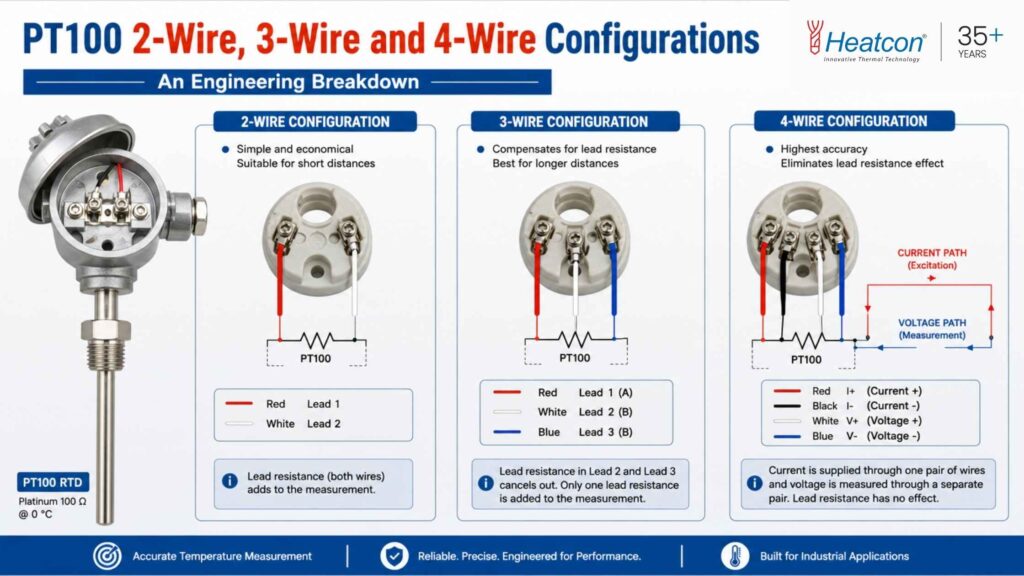
Understanding a pt100 wiring diagram is essential for correct installation and troubleshooting. Here’s a summary of what you’ll typically see:
- 2-Wire: One wire from each end of the RTD element.
- 3-Wire: Two wires on one side, one on the other.
- 4-Wire: Two wires attached to each end of the RTD element.
The diagram will also indicate the color coding (often red and white), showing how to connect each wire to the measuring instrument’s terminals.
| Configuration | No. of Wires | Accuracy | Best Use Case |
|---|---|---|---|
| 2-wire | 2 | Basic (subject to wire resistance error) | Short runs, non-critical |
| 3-wire | 3 | Improved (compensates for lead resistance) | Industrial/process control |
| 4-wire | 4 | Highest (virtually eliminates wire error) | Calibration, R&D, critical process |
What are the most common PT100 connection types?
The pt100 connection types refer to how the wires are connected to both the sensor and the measuring instrument, often determined by terminal blocks, connectors, or direct soldering. Heatcon Sensors offers custom PT100 solutions with various connection options, ensuring seamless integration with your process hardware—whether you need spring-loaded terminals, plug connectors, or high-integrity welds.
Why choose Heatcon Sensors for your PT100 and industrial temperature monitoring needs?
Heatcon Sensors is a leading manufacturer of customized PT100 RTDs, thermocouples, and advanced temperature sensors tailored to industrial requirements. With a pan-India presence and the capability to manufacture and export to the US, UAE, Indonesia, Germany, South Korea, Saudi Arabia, Russia, Bahrain, Kuwait, and beyond, Heatcon Sensors ensures you receive not just a sensor, but a solution engineered for your unique application.
Beyond RTDs, Heatcon Sensors also manufactures a wide range of heat-generating equipment, including:
- Industrial Furnaces (electric, muffle, box type)
- Ovens (hot air, curing, drying, batch)
- Hot Air Blowers
- Electric Furnaces
- High Density Cartridge Heaters
- Immersion Heaters and Circulation Heaters
- Customized Heating Elements for process and laboratory use
This breadth of offerings allows Heatcon Sensors to deliver complete temperature management solutions—sensors, controls, and heat sources—all engineered to your specifications.
How to select the right PT100 wire configuration for your process?
Choosing the right wire configuration depends on:
- Distance between sensor and measurement device
- Required measurement accuracy
- Environmental conditions (temperature, vibration, electrical noise)
- Budget and installation complexity
- Regulatory or industry-specific requirements
For most industrial applications, the 3-wire configuration offers the best balance. For extreme precision or long cable runs, the 4-wire setup is preferred. Consult with Heatcon Sensors’ experts to analyze your application and specify the optimal configuration.
What happens if you ignore lead wire resistance?
Failure to account for rtd lead wire resistance can result in:
- Systematic temperature errors
- Poor product quality and batch inconsistencies
- Regulatory non-compliance
- Costly troubleshooting and downtime
Investing in the right PT100 wire configuration upfront pays for itself in long-term accuracy and process reliability.
How can Heatcon Sensors help you stay ahead?
With over three decades of expertise, Heatcon Sensors combines engineering excellence with global reach. Their team supports you from specification to installation and after-sales support, ensuring every sensor meets your process, industry, and regulatory standards.
- Custom configuration for any PT100 application
- Rapid manufacturing and delivery across India and worldwide
- Compliance with international standards (IEC, ASTM, DIN)
- Robust after-sales technical support
Don’t risk the integrity of your process with generic sensors or suboptimal wiring. Partner with Heatcon Sensors for solutions that deliver reliable results, batch after batch, year after year.
Ready to elevate your temperature monitoring with the perfect PT100 wire configuration?
Contact Heatcon Sensors today:
- Submit your information on the contact form
- Leave a message on WhatsApp through the chat interface on our website
- Call us directly at +91 9164833027 or +91 9844233244 for immediate assistance
Don’t settle for less—choose Heatcon Sensors for proven accuracy, reliability, and global service.
About Heatcon Sensors
Heatcon Sensors is a renowned manufacturer and exporter of industrial temperature sensors and heating systems, based in India and serving clients globally. Specializing in PT100 RTDs, thermocouples, and a wide array of heating equipment, Heatcon Sensors is committed to engineering excellence, rigorous quality, and customer-centric solutions for every industry and application.
For more information, visit https://heatconsensors.com/
Frequently Asked Questions
What are the main differences between PT100 2-wire, 3-wire, and 4-wire configurations?
The primary difference between PT100 2-wire, 3-wire, and 4-wire configurations lies in how they compensate for the resistance of the sensor’s lead wires. The 2-wire setup is the simplest, using just two wires, but it does not compensate for rtd lead wire resistance, which can introduce measurement errors. The 3-wire configuration adds a third wire to help cancel out the resistance of the leads, making it suitable for most industrial applications. The 4-wire configuration uses four wires, completely eliminating the effect of lead resistance and offering the highest accuracy. Heatcon Sensors offers all PT100 connection types to match your accuracy and installation requirements.
When should I choose a PT100 2-wire, 3-wire, or 4-wire sensor?
Choose a 2-wire PT100 when short cable runs and basic accuracy are acceptable, like in HVAC or simple monitoring. Opt for a 3-wire configuration for most industrial applications, as it balances cost and accuracy well. For laboratory or highly precise measurements, or when using long lead wires, the 4-wire configuration is recommended. Heatcon Sensors provides expert guidance and custom solutions for all pt100 wire configuration needs, ensuring you select the right sensor for your application.
How does rtd lead wire resistance affect PT100 measurement accuracy?
Lead wire resistance adds to the resistance measured by the instrument, causing inaccuracies in temperature readings. In 2-wire sensors, this error is most pronounced, especially with longer cables. 3-wire and 4-wire setups are designed to compensate for or completely eliminate this error. Heatcon Sensors can help you interpret pt100 wiring diagram options to minimize errors due to lead resistance in your installation.
What is the difference between PT100 2 wire vs 3 wire setups?
The key difference between pt100 2 wire vs 3 wire is compensation for lead resistance. While 2-wire sensors are simple, they don’t correct for the extra resistance from the leads, leading to less precise readings. 3-wire configurations use a third wire and a differential measurement circuit to cancel out most of the lead resistance effect, offering better accuracy for industrial environments. Heatcon Sensors can supply both types, advising you on which suits your process best.
Why would you select a 4-wire PT100 over a 3-wire PT100?
The choice between pt100 3 wire vs 4 wire comes down to accuracy requirements. The 4-wire system completely eliminates lead resistance from the measurement, making it ideal for scientific, calibration, and high-precision applications. The 3-wire system compensates for most, but not all, of the lead resistance and is sufficient for standard industrial use. Heatcon Sensors’ experts can help you evaluate your measurement needs and recommend the right PT100 sensor configuration.
Can you show a typical pt100 wiring diagram for each configuration?
Yes! A 2-wire PT100 wiring diagram shows two wires connecting the sensor directly to the instrument. A 3-wire diagram includes a third wire, usually of the same length and type, to allow compensation of lead resistance. The 4-wire diagram uses two pairs of wires, enabling the instrument to measure and subtract the lead resistance completely. Heatcon Sensors provides detailed diagrams and installation guidance for all pt100 connection types.
How does Heatcon Sensors ensure quality and accuracy in PT100 sensors?
Heatcon Sensors manufactures PT100 sensors using premium materials, precise assembly, and rigorous testing. We offer all standard pt100 wire configuration options and custom designs as required. Each sensor is calibrated and verified to industry standards, and our technical team supports you with selection, wiring, and troubleshooting to ensure optimal measurement accuracy in your application.
Can I upgrade my system from 2-wire to 3-wire or 4-wire PT100 sensors?
In many cases, yes. Upgrading to 3-wire or 4-wire configurations may require running additional wires and ensuring your instrumentation supports the new pt100 connection types. Heatcon Sensors offers retrofit solutions and can guide you through the process, helping you improve accuracy and reliability without overhauling your entire system.
What support does Heatcon Sensors offer for PT100 selection and installation?
Heatcon Sensors provides end-to-end support, from helping you interpret pt100 wiring diagrams to selecting the ideal sensor type and assisting with installation and troubleshooting. Our engineering team ensures your sensors deliver the highest possible performance, tailored to your process and industry standards.