
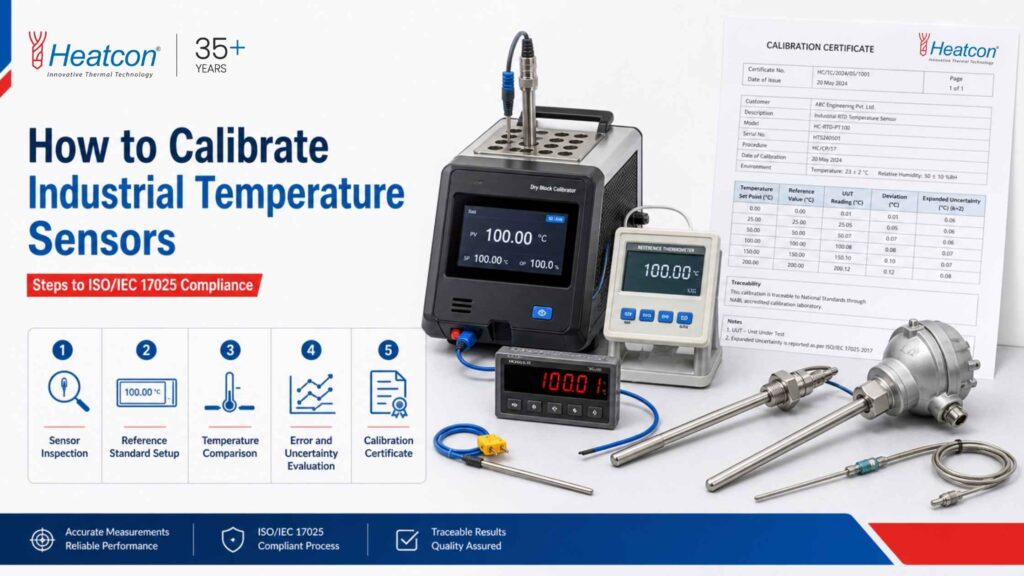
What Is Industrial Temperature Sensor Calibration And Why Is It Critical?
Industrial temperature sensor calibration is the systematic process of verifying and adjusting the accuracy of temperature measurement devices used in manufacturing, energy, pharmaceuticals, and more. According to the International Society of Automation (ISA), nearly 70% of critical process failures trace back to inaccurate sensor readings or improper calibration. This stark figure underscores why organizations worldwide, from India and the US to Germany and the Middle East, prioritize robust calibration practices.
The ramifications of neglected calibration span from compromised product quality and safety risks to regulatory non-compliance and avoidable downtime. To mitigate these risks, Heatcon Sensors, headquartered in India and exporting globally, offers end-to-end expertise and custom-manufactured temperature sensors—including RTDs, thermocouples, and specialty probes—tailored to precise industrial needs.
How Do You Perform A Temperature Sensor Calibration Procedure?
A temperature sensor calibration procedure typically involves comparing the output of the sensor under test to that of a traceable reference standard at defined temperature points. The process may be executed in a laboratory or in situ, and often follows these essential steps:
- Preparation: Document the sensor details, ensure cleanliness, and verify all equipment is within calibration validity.
- Stabilization: Immerse the sensor and reference probe in a stable thermal environment (such as a dry-block calibrator, oil bath, or furnace).
- Measurement: Record readings at multiple temperature points across the sensor’s operating range.
- Comparison: Calculate the deviation of the sensor from the known reference. If outside allowable limits, adjustments or corrections are applied.
- Documentation: Log all results, uncertainties, and corrective actions as per quality management standards.
At Heatcon Sensors, our calibration procedures are meticulously aligned with international best practices and can be customized for unique operational environments, whether your facility is in India, Saudi Arabia, or Germany.
What Are The ISO 17025 Calibration Requirements?
ISO 17025 calibration requirements form the backbone of laboratory competence and reliability worldwide. For industrial temperature sensor calibration, ISO/IEC 17025 compliance ensures that calibration labs demonstrate both technical competence and the ability to produce valid, traceable results.
- Traceability: All reference standards must be traceable to national or international standards (e.g., NIST, PTB, INMETRO).
- Uncertainty Evaluation: Measurement uncertainty must be quantified and reported.
- Quality Assurance: Procedures, documentation, and staff qualifications are regularly audited and assessed.
- Environmental Controls: Calibration environments must be stable and controlled to minimize external influences.
Heatcon Sensors partners with NABL-accredited laboratories and follows ISO 17025 calibration requirements to ensure your equipment is compliant, whether you’re in the UAE, Indonesia, or Russia.
How Is The Industrial RTD Calibration Process Performed?
Industrial RTD calibration is vital for processes demanding high precision, such as pharmaceuticals, petrochemicals, and food manufacturing. The process involves:
- Choosing a reference platinum RTD with a known, certified accuracy.
- Placing both the reference and the device-under-test in a calibration bath or dry-block calibrator.
- Allowing both RTDs to reach temperature equilibrium at several set points (e.g., 0°C, 100°C, 200°C).
- Recording the output resistance or temperature readings and comparing them with the reference.
- Documenting deviations, applying corrections, and generating a traceable calibration certificate.
At Heatcon Sensors, we manufacture customized RTDs to the highest industry specifications, ensuring seamless integration and reliable calibration for industrial clients in India, the US, and beyond.
What Is The Thermocouple Calibration Process?
The thermocouple calibration process is distinct due to the variety of thermocouple types (e.g., K, J, T, N, S, R, B types) and their wide temperature ranges. The calibration steps generally include:
- Preparing the thermocouple and a reference sensor of the same type.
- Immersing both in a precisely controlled temperature source (furnace, dry-block, or calibration bath).
- Allowing the system to stabilize, then measuring millivolt outputs at multiple temperatures.
- Comparing readings to the reference and standard thermocouple tables (ITS-90 or NIST).
- Adjusting for any offsets and documenting the calibration results.
Heatcon Sensors not only supplies high-quality thermocouples but also assists with the thermocouple calibration process, ensuring compliance and accuracy for clients from South Korea to Bahrain.
How To Ensure NABL Temperature Calibration Compliance?
NABL temperature calibration refers to calibration processes accredited by the National Accreditation Board for Testing and Calibration Laboratories (NABL), which is recognized internationally. To ensure compliance:
- Use only NABL-accredited labs or partners for calibrating your industrial temperature sensors.
- Verify that calibration certificates include full traceability, uncertainty statements, and lab accreditation details.
- Schedule regular recalibration intervals based on usage, environment, and criticality.
- Maintain detailed records for audits and regulatory reviews.
Heatcon Sensors can coordinate NABL temperature calibration services for your sensors anywhere in India, as well as manage international calibration logistics for clients in the Middle East, Europe, and Asia-Pacific regions.
What Are The Benefits Of Heatcon Sensors’ Custom Solutions?
Heatcon Sensors is a leading manufacturer of customized RTDs, thermocouples, and a comprehensive range of temperature sensors engineered for industrial requirements. Here’s why industries across India, the US, UAE, Germany, and beyond choose Heatcon:
- Global Reach: We can custom manufacture and supply sensors to any part of India or the world, including major cities and industrial hubs in the US, UAE, Indonesia, Germany, South Korea, Saudi Arabia, Russia, Bahrain, and Kuwait.
- Precision Manufacturing: Our sensors are designed to exact client specifications, ensuring seamless process integration and reliable calibration outcomes.
- Full Portfolio: In addition to sensors, Heatcon offers heat generating equipment such as furnaces, ovens, hot air blowers, electric furnaces, and high density cartridge heaters—catering to diverse industrial thermal applications.
- Expert Support: Our technical team provides complete guidance on sensor selection, calibration scheduling, and regulatory compliance.
- Calibration Assurance: We partner with leading labs to facilitate ISO 17025 and NABL calibration, ensuring your operations remain audit-ready and compliant.
Don’t risk costly process failures or regulatory penalties by choosing generic, off-the-shelf sensors. With Heatcon Sensors, you gain a partner invested in your operational excellence and peace of mind.
How To Get Immediate Support From Heatcon Sensors?
Ready to upgrade your temperature measurement accuracy or need urgent calibration support? Reach out to Heatcon Sensors experts through any of the following options:
- Submit your information on our contact form
- Leave a message on WhatsApp via the interface available on our website
- Call us directly at +91 9164833027 or +91 9844233244 for immediate assistance
Experience the assurance of working with India’s most trusted temperature sensor manufacturer, delivering tailored solutions anywhere in the world.
About Heatcon Sensors
Heatcon Sensors is a premier manufacturer and supplier of industrial temperature sensors, specializing in custom RTDs, thermocouples, and advanced heat generating equipment for global industries. With a proven track record of excellence, Heatcon delivers quality, precision, and compliance—meeting the needs of clients in India, the US, UAE, Indonesia, Germany, South Korea, Saudi Arabia, Russia, Bahrain, Kuwait, and beyond.
For more information, visit https://heatconsensors.com.
Frequently Asked Questions
What is the importance of industrial temperature sensor calibration?
Industrial temperature sensor calibration is crucial for ensuring that measurement devices provide accurate and reliable readings. This is especially important in industries where even minor temperature deviations can impact product quality, safety, and regulatory compliance. Regular calibration reduces errors, prevents costly downtime, and extends the lifespan of sensors.
What steps are involved in the temperature sensor calibration procedure?
The temperature sensor calibration procedure typically involves selecting a stable reference standard, setting up the sensor in a controlled environment, applying known temperature points, recording the sensor’s responses, and comparing them to reference values. Any deviations are documented, and necessary adjustments or recalibrations are carried out to ensure compliance with required standards.
How does the industrial RTD calibration process work?
Industrial RTD calibration involves comparing the resistance output of a Resistance Temperature Detector (RTD) at specific temperatures with a traceable standard. The RTD is placed in a temperature-controlled bath, and its resistance is measured at various points. The results are then analyzed for deviations, and any necessary corrections are made to ensure accurate temperature measurement in your processes.
Can you explain the thermocouple calibration process?
The thermocouple calibration process involves exposing the thermocouple to known temperature points and measuring its voltage output. These readings are compared against standard reference values. Any discrepancies are noted, and calibration adjustments are performed as needed. This process ensures the thermocouple delivers precise temperature readings essential for industrial applications.
What are the ISO 17025 calibration requirements for temperature sensors?
ISO 17025 calibration requirements specify that laboratories must demonstrate competence, impartiality, and consistent operation. For temperature sensors, this means using traceable reference standards, maintaining proper documentation, employing validated methods, and ensuring staff are adequately trained. Calibration procedures and equipment must be regularly reviewed to maintain compliance and deliver trustworthy results.
How does NABL temperature calibration support quality assurance?
NABL temperature calibration provides recognition that calibration services meet national and international standards for quality and technical competence. By choosing NABL-accredited calibration, you ensure that your temperature sensors are calibrated using reliable methods and traceable references, supporting overall process quality, regulatory compliance, and product integrity.
How can Heatcon Sensors help with ISO/IEC 17025 compliance for temperature calibration?
Heatcon Sensors offers comprehensive calibration services aligned with ISO/IEC 17025 standards. Their expert technicians use state-of-the-art equipment and traceable reference standards to calibrate RTDs, thermocouples, and other temperature sensors. Heatcon also provides detailed calibration certificates and guidance on maintaining ongoing compliance for your industrial processes.
What is included in a typical calibration certificate from Heatcon Sensors?
A typical Heatcon Sensors calibration certificate includes the sensor’s details, calibration date, reference standards used, environmental conditions, measured results at each test point, uncertainties, and compliance statements with applicable standards. This documentation serves as evidence of traceability and supports audits or regulatory inspections.
How often should industrial temperature sensors be calibrated?
The calibration frequency depends on the sensor type, application criticality, manufacturer recommendations, and regulatory requirements. Generally, annual calibration is recommended for most industrial sensors. However, sensors in critical or harsh environments may require more frequent checks to ensure ongoing accuracy and compliance.