
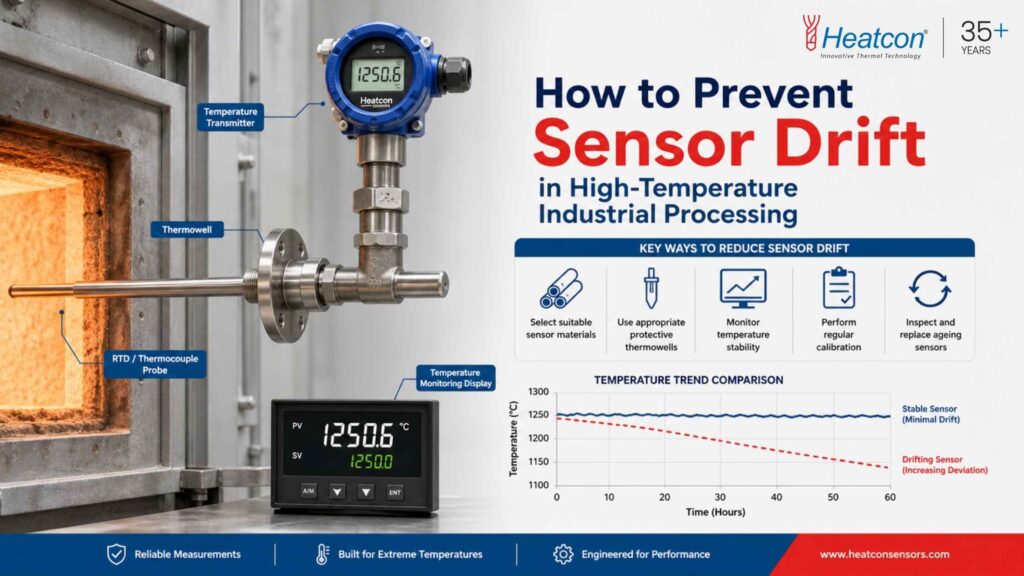
Preventing sensor drift is critical for maintaining reliable and accurate temperature measurements in high-temperature industrial environments. According to the International Society of Automation (ISA), up to 30% of process errors in critical industries are attributed to sensor inaccuracy, with sensor drift accounting for a substantial portion of these issues. For manufacturers, petrochemical plants, refineries, and other high-heat industries, sensor drift is not just a minor inconvenience—it can cause costly temperature measurement errors, product defects, safety incidents, and unscheduled downtime.
What Is Sensor Drift And Why Does It Matter?
Sensor drift refers to the gradual deviation of a temperature sensor’s output from its true value over time, especially when exposed to prolonged high temperatures. This phenomenon is particularly prevalent in environments where sensors such as thermocouples and RTDs (Resistance Temperature Detectors) are exposed to intense heat, vibration, and chemical contaminants. Sensor drift can result in inaccurate readings, leading to process inefficiencies, compromised product quality, and even hazardous situations.
- Thermocouple drift: Affects the accuracy of thermocouples as their reference junction and sensing wires degrade.
- RTD sensor drift: Occurs when RTDs undergo changes in their resistance characteristics due to thermal cycling.
- High temperature sensor accuracy: Is compromised as sensors age, leading to escalated errors.
The ability to prevent sensor drift is therefore central to any high-temperature industrial operation seeking to maintain consistent, compliant, and efficient processes.
How Does Sensor Drift Affect Industrial Processing?
Sensor drift in critical applications—such as steel manufacturing, glass production, petrochemical refining, and ceramic kilns—can have a domino effect:
- Compromised product quality due to inaccurate temperature control
- Increased rework and scrap rates
- Unexpected shutdowns and maintenance costs
- Compliance risks with international standards
- Potential safety hazards for personnel and equipment
For example, a drift of just 5°C in a furnace sensor can significantly alter the metallurgical properties of steel or the chemical reaction rates in a reactor, resulting in substandard or unsafe products.
What Causes Sensor Drift In High-Temperature Applications?
Understanding the root causes of sensor drift is essential for effective prevention. The most common factors include:
- Thermocouple degradation: Oxidation, contamination, and grain growth in thermocouple wires lead to drift.
- Thermal cycling: Repeated heating and cooling cycles cause mechanical and chemical changes in sensor materials.
- Mechanical stress: Vibration, expansion, and contraction damage sensor integrity.
- Chemical attack: Exposure to corrosive gases or process atmospheres accelerates sensor breakdown.
- Electrical noise and insulation failure: Disrupt signal stability, compounding measurement errors.
Each of these factors can contribute to a slow, but steady, shift in sensor readings—leading to a scenario where temperature measurement errors become the norm rather than the exception.
How Can You Prevent Sensor Drift?
The best way to prevent sensor drift is through a combination of careful sensor selection, robust installation, regular calibration, and expert support. At every step, partnering with a trusted manufacturer like Heatcon Sensors ensures your operation is equipped with the most suitable, reliable, and customized temperature measurement solutions.
- Choose high-quality, customized sensors:
Off-the-shelf sensors may not withstand harsh operating conditions. Heatcon Sensors custom manufactures RTDs, thermocouples, and other temperature sensors specifically engineered for unique industrial requirements. This includes specialized sensor alloys, protective sheaths, and robust construction for high-heat and corrosive environments.
- Use the right sensor type for each application:
Certain sensors are better suited to specific processes. For instance, noble metal thermocouples (such as type S, R, or B) excel in extreme temperatures, while mineral insulated thermocouples offer superior mechanical durability. Heatcon Sensors can guide you in selecting the optimal sensor for steel mills, glass plants, refineries, and beyond.
- Implement regular calibration and health checks:
Scheduled calibration and in-situ verification help detect drift early. Heatcon Sensors provides calibration services as well as recommendations for frequency based on your process criticality and sensor type.
- Choose advanced protective sheaths and coatings:
Materials like Inconel, ceramic, or silicon carbide can shield sensors from aggressive chemical attack and oxidation, mitigating thermocouple degradation.
- Monitor sensor performance with smart systems:
Modern process control systems can automatically flag anomalies, indicating the onset of rtd sensor drift or thermocouple drift before they affect production.
- Partner with a proven expert in sensor manufacturing and support:
Heatcon Sensors offers local and global support, ensuring you have access to technical expertise, prompt replacements, and custom engineering—wherever you operate.
Which Industries Rely On Sensor Accuracy—and How Does Heatcon Sensors Support Them?
Virtually every industry that depends on precise thermal control is vulnerable to sensor drift. This includes:
- Steel, glass, and aluminum manufacturing
- Ceramics and kiln operations
- Petrochemicals and refining
- Pharmaceuticals and food processing
- Electric furnaces, ovens, and thermal processing equipment
- Semiconductor fabrication
- Power generation
With a comprehensive portfolio—including high-density cartridge heaters, hot air blowers, electric and laboratory furnaces, and custom ovens—Heatcon Sensors not only supplies the sensors but also the very heating equipment that forms the backbone of India’s and the world’s industrial infrastructure.
How Does Heatcon Sensors Ensure High Temperature Sensor Accuracy?
Heatcon Sensors is a leading manufacturer of customized temperature sensors and heat-generating equipment, delivering solutions to all parts of India and worldwide—including major industrial hubs in the US, UAE, Indonesia, Germany, South Korea, Saudi Arabia, Russia, Bahrain, and Kuwait.
- Custom engineering for each process and temperature range
- Use of premium materials for maximum durability and minimal thermocouple degradation
- Stringent quality control and calibration protocols
- Comprehensive after-sales support and rapid response for replacements and troubleshooting
- Global shipping and technical assistance
Whether your operation is in Mumbai, Houston, Dubai, Jakarta, Berlin, Seoul, Riyadh, Moscow, Manama, or Kuwait City, Heatcon Sensors can design, manufacture, and deliver precision sensors and heating solutions to your doorstep.
How Can The Right Sensor Design Reduce Temperature Measurement Errors?
The design and specification of a sensor directly impacts its ability to resist drift and maintain accuracy. Heatcon Sensors’ engineering team collaborates with clients to deliver:
- Optimized sensor geometry and mounting for minimal mechanical stress
- Innovative insulation and shielding to block electrical noise
- Redundant sensing elements for critical systems
- Smart sensor integration for real-time health monitoring
- Industry-specific certifications and compliance
This results in significant reduction of long-term temperature measurement errors, improved process reliability, and lower total cost of ownership.
What Are The Steps To Address Sensor Drift For Your Facility?
To prevent sensor drift and ensure lasting sensor performance in your plant:
- Assess your current sensor inventory and identify high-risk applications.
- Consult with Heatcon Sensors for a process-specific evaluation and custom sensor design.
- Upgrade to sensors and protective equipment engineered for your thermal environment.
- Implement a calibration and monitoring program, leveraging our expert guidance.
- Establish a replacement schedule before drift-induced errors impact production.
Acting now to prevent sensor drift protects your process from avoidable inefficiencies, safety risks, and compliance issues.
About Heatcon Sensors
Heatcon Sensors is a globally recognized manufacturer of advanced temperature sensors—including RTDs, thermocouples, and specialized sensor assemblies—as well as heat-generating equipment such as furnaces, ovens, hot air blowers, and high-density cartridge heaters. Operating from India, Heatcon Sensors supplies custom-engineered solutions to customers worldwide, supporting industries across every continent with unmatched expertise, reliability, and rapid support.
Don’t let sensor drift compromise your process. Choose Heatcon Sensors for world-class sensor accuracy, durability, and custom solutions—from India to the US, UAE, Indonesia, Germany, South Korea, Saudi Arabia, Russia, Bahrain, Kuwait, and beyond.
Ready to upgrade your temperature measurement reliability?
Reach out today by:
- Submitting your information at https://heatconsensors.com/contact-us/
- Leaving a message on WhatsApp via our website
- Calling us directly on +91 9164833027 or +91 9844233244 for immediate assistance.
Protect your operation from costly temperature measurement errors—partner with Heatcon Sensors.
Frequently Asked Questions
What causes sensor drift in high-temperature industrial processes?
Sensor drift in high-temperature industrial environments is commonly caused by prolonged exposure to extreme heat, chemical contamination, mechanical stress, and oxidation. Over time, these factors can alter the properties of both thermocouple and RTD sensors, resulting in inaccurate readings. This phenomenon, known as thermocouple drift and rtd sensor drift, can compromise process control and product quality if not addressed proactively.
How can I prevent sensor drift in my high-temperature applications?
To prevent sensor drift, it is crucial to select sensors specifically designed for high-temperature stability, such as those provided by Heatcon Sensors. Regular calibration, protective sheathing, and ensuring proper installation can also help minimize drift. Heatcon Sensors offers solutions like mineral-insulated cables and custom sensor assemblies to enhance sensor longevity and high temperature sensor accuracy.
What is thermocouple degradation and how does it impact sensor accuracy?
Thermocouple degradation refers to the breakdown of thermocouple materials over time due to factors like oxidation, contamination, and mechanical wear. This leads to changes in the thermoelectric properties of the sensor, causing temperature measurement errors and reduced reliability. Heatcon Sensors combats this with high-purity materials, robust designs, and protective coatings tailored for harsh industrial environments.
How often should temperature sensors be calibrated in high-temperature settings?
The calibration frequency depends on the application, sensor type, and operating conditions. For critical high-temperature processes, Heatcon Sensors recommends scheduled calibration intervals based on industry standards and sensor usage history. Regular calibration helps detect and correct temperature measurement errors before they affect your process.
What distinguishes Heatcon Sensors’ products for high-temperature accuracy?
Heatcon Sensors utilizes advanced manufacturing processes and high-grade materials to ensure high temperature sensor accuracy. Our sensors are engineered with robust insulation, protective sheaths, and cutting-edge construction methods to withstand thermal cycling and harsh industrial conditions, reducing the risk of thermocouple drift and rtd sensor drift.
Can sensor drift be completely eliminated in industrial processing?
While it is nearly impossible to completely eliminate sensor drift, Heatcon Sensors’ innovative sensor designs, proper installation guidance, and ongoing calibration support significantly minimize its effects. By using quality sensors and following best practices, you can maintain reliable temperature data and process control.
How does Heatcon Sensors help in reducing temperature measurement errors?
Heatcon Sensors helps reduce temperature measurement errors by providing high-accuracy thermocouples and RTDs, offering calibration services, and supplying accessories like high-quality connectors and compensating cables. Our technical team also assists with sensor selection and installation to ensure optimal performance throughout your process.
What maintenance practices extend the life of high-temperature sensors?
Key maintenance practices include routine calibration, inspection for physical damage, periodic cleaning, and replacing worn or degraded components. Using Heatcon Sensors’ protective sheaths and following recommended installation procedures can also prolong sensor life and minimize the occurrence of thermocouple degradation.
Are there specific sensor types recommended for extreme high-temperature environments?
Yes, Heatcon Sensors recommends mineral-insulated thermocouples and platinum RTDs for extreme high-temperature environments. These sensors are engineered to resist thermocouple drift and rtd sensor drift, providing stable readings even under challenging industrial conditions.