
What Is The Seebeck Effect And How Does It Relate To Temperature Measurement?
Thermocouples are the backbone of industrial temperature measurement, with the global temperature sensor market estimated to exceed USD 6 billion by 2025, and thermocouples representing a significant share. But what makes thermocouples uniquely reliable? The secret lies in their harnessing of a fundamental scientific phenomenon: the Seebeck effect. In essence, how thermocouples measure temperature is rooted in this effect, which is the direct conversion of heat differences to electrical voltage.
By joining two different metals at one end and exposing them to temperature variations, thermocouples generate a measurable voltage. This voltage is directly proportional to the temperature difference, providing an accurate way to monitor and control industrial processes. The Seebeck effect is not just a fascinating scientific principle; it’s the cornerstone of countless applications across manufacturing, energy, and research.
How Does The Seebeck Effect Work In Thermocouples?
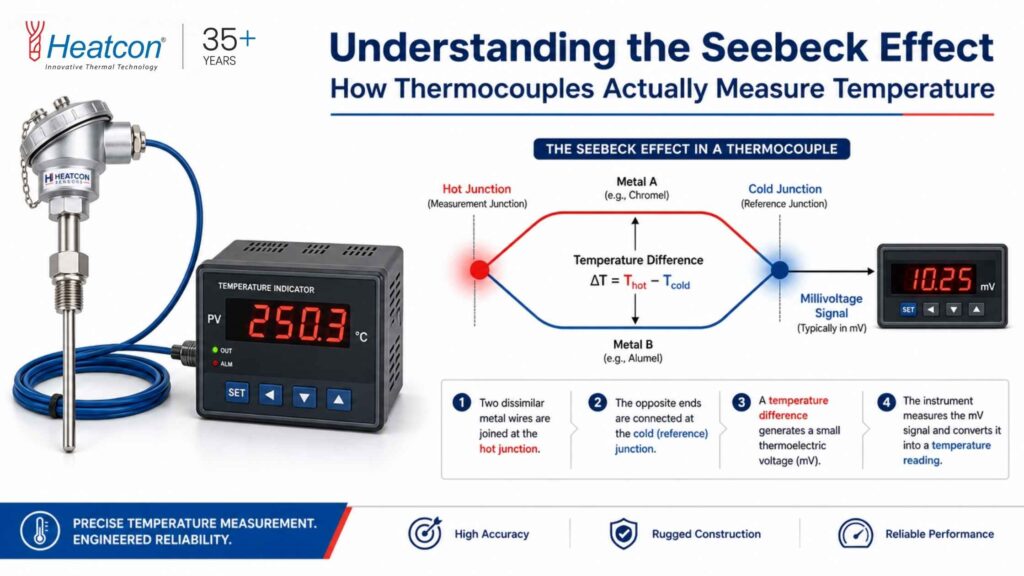
The seebeck effect explained simply: when two dissimilar metals are joined at two junctions, and those junctions are maintained at different temperatures, a voltage (known as the thermoelectric EMF) is produced. This voltage can be directly correlated to the temperature difference between the two junctions.
- Hot junction: The point where both metals meet and are exposed to the process temperature.
- Cold (reference) junction: The point where the metals are connected to the measuring instrument, usually at a known reference temperature.
- Voltage generation: The temperature difference causes electrons to migrate at different rates in each metal, resulting in a voltage that can be measured.
This fundamental behavior is at the heart of thermocouple working principle. The greater the temperature difference, the higher the voltage generated. This relationship is linear for small temperature differences and can be calibrated for high accuracy in industrial environments.
What Is The Thermoelectric Effect?
The thermoelectric effect encompasses three related phenomena: the Seebeck effect (generation of voltage by a temperature difference), the Peltier effect (heat absorption or emission at a junction due to current), and the Thomson effect (heat generation or absorption along a conductor with a temperature gradient). For thermocouples, the Seebeck effect is the most crucial, as it provides a direct, passive, and highly reliable method to transform heat into an electric signal.
In practice, this means thermocouples operate without any external power source, relying entirely on the physics of the materials used and the temperature gradient present. This makes thermocouples exceptionally robust and versatile, suitable for everything from laboratory experiments to harsh industrial furnaces.
How Thermocouples Measure Temperature In Real-World Applications
So, how are these principles applied in practical scenarios? In industries ranging from steel manufacturing in India and Germany to oil refining in Saudi Arabia and Kuwait, thermocouples are deployed to measure temperatures from -200°C to 1800°C.
- Selection of metals: Different thermocouple types (e.g., K, J, T, N, E, R, S, B) use specific metal combinations to target various temperature ranges and environments.
- Junction placement: The hot junction is positioned at the point of temperature measurement, while the cold junction is maintained at a reference temperature or electronically compensated.
- Measurement: The voltage generated is measured using precise instruments, and the temperature is calculated using established calibration tables.
This approach explains how thermocouples measure temperature across applications as diverse as aerospace, automotive, food processing, and energy production.
What Is The Type K Thermocouple Working Principle?
Among all thermocouple types, the Type K is the most widely used globally due to its broad temperature range (-200°C to +1260°C), stability, and affordability. The type k thermocouple working principle involves the pairing of Nickel-Chromium (NiCr) and Nickel-Aluminium (NiAl) alloys. When exposed to a temperature gradient, this combination reliably generates a voltage proportional to the temperature difference.
Type K thermocouples are especially valued in industries with high-temperature needs—such as furnaces, kilns, and power generation—where accurate and repeatable measurements are critical for safety and efficiency.
How Is Thermocouple Voltage Measurement Performed?
The heart of every thermocouple application is precise thermocouple voltage measurement. The voltage produced is in the microvolt to millivolt range, requiring high-sensitivity measurement instruments. Modern digital thermometers and industrial controllers are engineered to interpret these voltages and display the corresponding temperatures instantly.
- Advanced compensation techniques ensure accuracy despite environmental changes.
- Regular calibration against certified standards maintains long-term reliability.
Industrial facilities in the US, UAE, Indonesia, South Korea, and Russia rely on this accuracy for process optimization, product quality, and regulatory compliance.
Why Are Custom Temperature Sensors Important For Industry?
Every industrial process—from pharmaceutical manufacturing in Germany to petrochemical refining in the Middle East—has unique temperature measurement requirements. Off-the-shelf sensors often fail to meet demanding specifications for size, material compatibility, response time, and environmental resistance.
Heatcon Sensors stands out as a leader in custom temperature sensor manufacturing, offering:
- Custom-built RTDs and thermocouples for specialized applications.
- Sensor solutions for extreme temperatures and harsh environments.
- Rapid supply to any part of India or the world—including US, UAE, Indonesia, Germany, South Korea, Saudi Arabia, Russia, Bahrain, and Kuwait.
With decades of expertise, Heatcon Sensors delivers precision, durability, and reliability, ensuring your process temperature measurements are always on point.
What Other Heat Equipment Does Heatcon Sensors Manufacture?
Heatcon Sensors is not just a temperature sensor manufacturer. The company also designs and manufactures a broad range of heat generating equipment, including:
- Industrial furnaces
- Electric ovens
- Hot air blowers
- High density cartridge heaters
- Immersion heaters
- Circulation heaters
- Custom heating solutions for unique industrial needs
This comprehensive offering allows Heatcon Sensors to be a single-source partner for temperature measurement and thermal management, trusted by industries worldwide.
How To Get The Right Sensor For Your Application?
Selecting the right thermocouple or RTD sensor can be crucial for plant safety, product consistency, and operational efficiency. Here’s how you can ensure your facility benefits from Heatcon Sensors’ expertise:
- Submit your requirements on the contact form.
- Leave a message on WhatsApp via the interface available on Heatcon Sensors’ website.
- Call +91 9164833027 or +91 9844233244 for immediate assistance.
Experienced engineers will guide you in selecting, customizing, and deploying the optimal sensor solution for your unique process needs—no matter where you are in the world.
About Heatcon Sensors
Heatcon Sensors is a globally recognized manufacturer of temperature sensors and heat generating equipment, headquartered in India. The company specializes in custom-built RTDs, thermocouples, high density cartridge heaters, and a variety of industrial heating solutions. With a reputation for quality, innovation, and customer-centric service, Heatcon Sensors caters to industries across the US, India, UAE, Germany, South Korea, Indonesia, Russia, Bahrain, Kuwait, and beyond.
For world-class temperature measurement solutions and heat equipment, trust Heatcon Sensors—the partner that leading industries rely on to maintain safety, efficiency, and product quality.
Frequently Asked Questions
What is the Seebeck effect and why is it important in temperature measurement?
The Seebeck effect explained: When two different metals are joined and their junctions are held at different temperatures, a voltage is generated. This phenomenon, known as the thermoelectric effect, is the fundamental principle behind thermocouples. It allows for the direct conversion of thermal energy into electrical energy, making it essential for accurate temperature measurement in industrial and scientific applications.
How do thermocouples measure temperature using the thermoelectric effect?
Thermocouples measure temperature by exploiting the thermoelectric effect. When the two junctions of the thermocouple are at different temperatures, a voltage is created that is proportional to the temperature difference. This voltage is then measured and interpreted to determine the temperature at the sensing junction.
Can you explain the thermocouple working principle in simple terms?
The thermocouple working principle is straightforward: two dissimilar metals are joined at one end and exposed to different temperatures at the junctions. Due to the Seebeck effect, a voltage is generated, which can be measured and correlated to temperature. This makes thermocouples robust, reliable, and widely used for temperature sensing.
What is a thermocouple voltage measurement and how is it used?
A thermocouple voltage measurement refers to the process of detecting the small voltage produced between the two wires of a thermocouple when exposed to temperature differences. Instruments read this voltage and, using standard tables, convert it to an accurate temperature reading. This method is fast and effective for a broad range of industrial processes.
How does a type K thermocouple working principle differ from other types?
The type K thermocouple working principle is based on the use of Nickel-Chromium and Nickel-Alumel alloys. This combination offers a wide temperature range and good resistance to oxidation, making it suitable for many industrial environments. While all thermocouples operate on the thermoelectric effect, different metal pairs (such as those in type K) result in different sensitivities and temperature ranges.
What advantages do thermocouples from Heatcon Sensors provide?
Heatcon Sensors offers thermocouples that are manufactured with high-quality materials and precise calibration, ensuring accurate and repeatable temperature measurements. Their products are designed for durability, resistance to harsh environments, and are customizable to suit specific industry requirements, providing reliable solutions for temperature monitoring.
How does Heatcon Sensors ensure the accuracy of their thermocouples?
Heatcon Sensors uses stringent quality control processes, advanced calibration techniques, and compliance with international standards to guarantee that every thermocouple delivers precise temperature readings. Their expertise in material selection and sensor construction further enhances measurement reliability.
Are thermocouples suitable for extreme environments?
Yes, thermocouples are ideal for extreme environments due to their simple construction and robust performance. Heatcon Sensors offers a range of thermocouple types and protective sheaths to ensure optimal operation in high-temperature, corrosive, or high-pressure conditions.
What support does Heatcon Sensors offer for custom thermocouple solutions?
Heatcon Sensors works closely with clients to develop custom thermocouple assemblies tailored to specific process requirements. Their engineering team provides guidance on material selection, sensor configuration, and installation, ensuring every solution meets the client’s performance and application needs.