Cartridge heaters are indispensable in modern industry, and their global market value is projected to surpass USD 800 million by 2025, driven by the demand for precise temperature control in metal die insertion and industrial manufacturing. The heart of efficient die heating lies in the correct specification of cartridge heaters—especially understanding the nuances between high and low watt density limits. Whether you’re a process engineer in Germany, a production manager in India, or an OEM in the United States, the right choice can mean the difference between seamless production and costly downtime.
What Is Watt Density And Why Does It Matter In Cartridge Heaters?
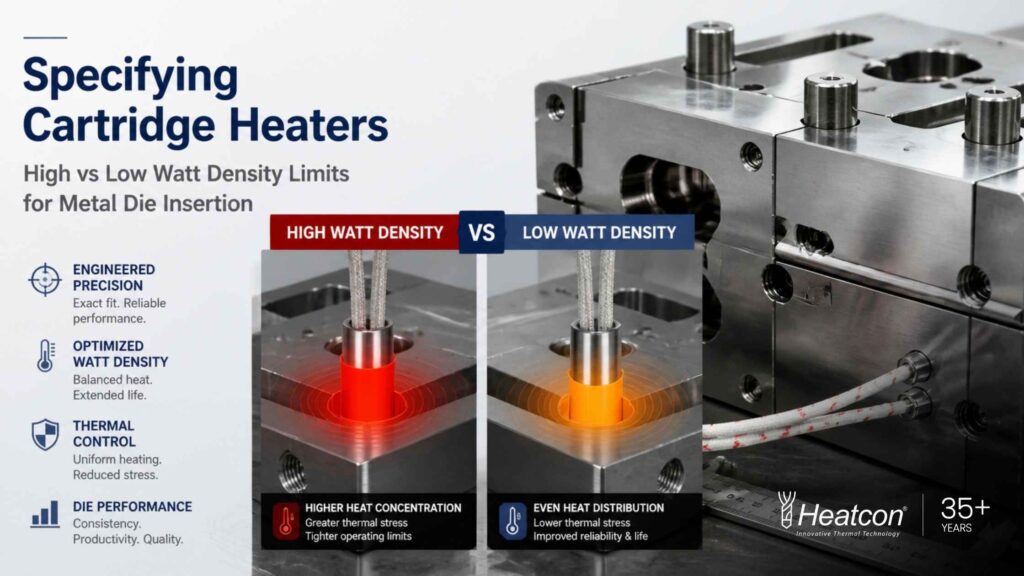
Watt density is the measure of power output per unit surface area of the heater, typically expressed in watts per square inch or square centimeter. In cartridge heaters, watt density directly impacts the rate and uniformity of heat transfer to the surrounding metal die, influencing heater lifespan, process consistency, and energy consumption.
- High watt density heaters deliver rapid, intense heat but require careful application to avoid localized overheating.
- Low watt density heaters provide gentler, more even heating, ideal for sensitive or temperature-critical processes.
Using a cartridge heater watt density calculator is essential to select the correct specification for your application, balancing performance with reliability and safety.
How To Determine High Vs Low Watt Density Limits For Metal Die Insertion?
The optimal watt density depends on several factors, including the type of metal die, thermal conductivity, operating temperature, and physical fit. Exceeding watt density limits can cause premature heater failure, while under-specifying leads to slow process cycles and inefficiency.
- Assess the die material and its thermal properties.
- Calculate the required heat load and temperature rise time.
- Apply the cartridge heater sizing methodology to determine length, diameter, and power rating.
- Utilize a cartridge heater watt density calculator to verify the design against recommended watt density limits.
For example, high density cartridge heaters might be suitable for robust steel dies where fast heat-up is required, while low watt density options are preferred for aluminum dies to prevent hot spots and warping.
Why Is Die Heating Element Specification Critical For Industrial Performance?
Accurate die heating element specification ensures uniform temperature distribution, minimal thermal gradients, and reliable operation. Incorrect specification can lead to uneven heating, material defects, or even catastrophic equipment failure.
Leading industrial cartridge heater supplier Heatcon Sensors specializes in custom die heating element specification, offering heaters tailored for each application. With decades of expertise in serving industries across India, the US, UAE, Indonesia, Germany, South Korea, Saudi Arabia, Russia, Bahrain, and Kuwait, Heatcon Sensors guarantees high performance, robust quality, and global delivery.
What Are The Key Parameters For Cartridge Heater Sizing?
Cartridge heater sizing is a multifactorial process that takes into account:
- Diameter and length of the bore in the die (cartridge heater bore fit)
- Desired temperature and heat-up time
- Material conductivity and thermal mass
- Available electrical power (voltage and current limits)
- Environmental factors, such as ambient temperature and airflow
The cartridge heater bore fit must be precise, typically within 0.05 mm, to maximize heat transfer and prevent air gaps. Heatcon Sensors uses advanced design tools and proprietary cartridge heater watt density calculator algorithms to ensure perfect fit and optimal performance in every application.
How Do Watt Density Limits Affect Heater Longevity And Performance?
Watt density limits are established to prevent overheating, oxidation, and wire burnout inside the cartridge heater. Operating above these limits can drastically shorten heater life, cause insulation breakdown, and compromise safety.
| Application | Recommended Watt Density (W/in²) |
|---|---|
| Steel Dies | 40-60 |
| Aluminum Dies | 20-35 |
| Plastic Molds | 10-25 |
| General Industrial Heating | 20-50 |
The expertise of an experienced industrial cartridge heater supplier like Heatcon Sensors is invaluable in navigating these watt density limits and ensuring compliance with industry best practices.
How To Achieve Optimal Cartridge Heater Bore Fit For Efficient Die Heating?
The cartridge heater bore fit is crucial for efficient die heating. A loose fit leads to poor heat transfer and localized overheating; a fit that is too tight can damage both the heater and the die. Proper machining and tolerance control, combined with the expertise of Heatcon Sensors, result in a bore fit that optimizes thermal transfer and maximizes heater lifespan.
For most applications, a bore-to-heater clearance of 0.05 mm to 0.13 mm is ideal. Heatcon Sensors employs advanced manufacturing techniques to achieve these precise tolerances, ensuring reliable die heating across a broad range of industries and geographic regions.
What Are The Benefits Of High Density Cartridge Heaters In Industrial Processes?
High density cartridge heaters offer several benefits:
- Extremely fast heat-up times for increased productivity
- Compact size with high power output
- Robust construction for harsh environments
- Longer operational life when correctly specified
Heatcon Sensors designs and supplies high density cartridge heaters for critical industrial applications worldwide, including metalworking, plastics, packaging, and food processing.
Die Heating Applications: Global Relevance And Local Expertise
Die heating is at the core of many manufacturing sectors, from injection molding in South Korea to forging in Germany and metal stamping in India. Heatcon Sensors stands as a trusted partner, offering not just cartridge heaters but also a comprehensive range of heat-generating equipment:
- Industrial and laboratory furnaces
- Bespoke ovens for process heating
- Hot air blowers for drying and curing
- Electric furnaces and immersion heaters
- High watt density heaters for specialized applications
All solutions are custom-engineered to meet the unique requirements of clients in every part of the world, from bustling cities in the US and UAE to the industrial hubs of Russia, Bahrain, and Kuwait.
Why Choose Heatcon Sensors As Your Industrial Cartridge Heater Supplier?
Choosing the right industrial cartridge heater supplier is pivotal for operational excellence. Heatcon Sensors is recognized for:
- Decades of manufacturing experience in customized RTDs and temperature sensors
- Global reach—serving customers in India and internationally
- End-to-end solutions, from design to after-sales support
- Unmatched quality standards and compliance
- Fast turnaround and reliable logistics
Customers who partner with Heatcon Sensors enjoy not only the assurance of high-performance products but also access to expert guidance and responsive support, ensuring that their die heating needs are met with precision and reliability.
How To Specify Your Cartridge Heater With Heatcon Sensors
Specifying your cartridge heater is easy with Heatcon Sensors’ consultative approach:
- Contact Heatcon Sensors with your die heating requirements using any of these methods:
- Submit your information on the form at https://heatconsensors.com/contact-us/
- Leave a message via WhatsApp through the website interface
- Or call directly: +91 9164833027 or +91 9844233244 for immediate assistance
- Share details about your process, die material, operating temperature, and dimensions.
- Receive expert recommendations on cartridge heater sizing, watt density limits, and bore fit.
- Get a tailored quote and rapid delivery, wherever you are in the world.
Don’t leave your production to chance—partner with the global experts in die heating and temperature sensing.
About Heatcon Sensors
Heatcon Sensors is a leading manufacturer and global supplier of custom RTDs, thermocouples, temperature sensors, and heat-generating equipment, including high density cartridge heaters, furnaces, ovens, and more. Based in India, Heatcon Sensors serves clients across the US, UAE, Germany, South Korea, Indonesia, Saudi Arabia, Russia, Bahrain, Kuwait, and beyond—delivering solutions that drive industrial innovation and operational efficiency.
For precision, reliability, and global reach, choose Heatcon Sensors. Visit https://heatconsensors.com/ to learn more or to request your custom solution today.
Frequently Asked Questions
What is watt density and why does it matter for cartridge heaters in metal die applications?
Watt density refers to the amount of wattage (power) generated per square inch of a cartridge heater’s heated surface area. In die heating, selecting the right watt density is crucial because it directly affects heater lifespan, heat transfer efficiency, and the risk of overheating the metal die. High watt density heaters can provide fast, intense heating but may risk localized overheating or premature failure if not matched to the die material and application. Low watt density heaters distribute heat more gently and are often preferred for sensitive or low-temperature die heating. Heatcon Sensors offers expert guidance and products to help you specify the optimal watt density for your application.
How do I determine the watt density limits for my cartridge heater in a metal die?
Watt density limits depend on the die material, operating temperature, and the ability of the die to dissipate heat. For example, aluminum dies can typically handle higher watt densities than steel dies due to better thermal conductivity. Using a cartridge heater watt density calculator, you can estimate the maximum safe watt density by inputting key parameters such as heater diameter, length, wattage, and die material. Heatcon Sensors’ engineering team can assist you with calculations and recommend appropriate high density cartridge heaters or lower density options for your specific die heating needs.
What are the risks of exceeding recommended watt density limits in cartridge heaters?
Exceeding watt density limits can cause localized overheating, heater element burnout, insulation degradation, and even damage to the metal die. It may also lead to inconsistent temperature control and reduced process reliability. This is especially critical in high watt density heaters, where thermal stress is greatest. Following proper die heating element specification with the support of an experienced industrial cartridge heater supplier like Heatcon Sensors can prevent these issues and extend equipment life.
How does cartridge heater bore fit affect performance and reliability?
Cartridge heater bore fit is the precision of the fit between the heater’s outer diameter and the bore of the metal die. A tight, proper fit ensures efficient heat transfer from the heater to the die, minimizes air gaps, and reduces the risk of hot spots or premature failure. Loose bore fits can lead to poor thermal contact, requiring lower watt densities or risking overheating. Heatcon Sensors provides guidance on optimal bore fit tolerances and offers custom machining services for exact cartridge heater sizing to maximize performance.
When should I choose high density cartridge heaters versus low density options for my die heating application?
High density cartridge heaters are ideal when rapid heat-up, compact size, or high temperature operation is required, provided the die material and bore fit can handle the elevated watt densities. Low density cartridge heaters are better suited for applications needing gentle, uniform heating or where the die material is sensitive to thermal stress. Heatcon Sensors can help you evaluate your process, calculate watt density requirements, and select the best heater type for your die heating goals.
What information do I need to specify a die heating element correctly?
For accurate die heating element specification, you should provide details such as die material, required operating temperature, available space (bore diameter and length), desired heat-up time, wattage, voltage, and environmental conditions. Sharing your process requirements with Heatcon Sensors allows us to recommend optimal cartridge heater sizing, watt density, and custom options to meet your precise needs.
Can Heatcon Sensors help with custom cartridge heater sizing and design for unique die heating challenges?
Absolutely! As a leading industrial cartridge heater supplier, Heatcon Sensors specializes in custom cartridge heater sizing and engineering. Whether you require special watt density profiles, unique diameters, or challenging bore fits for your metal die, our team delivers tailored solutions for high-performance die heating. Reach out to our technical experts to discuss your custom requirements.
How does Heatcon Sensors ensure quality and reliability in high watt density heaters?
Heatcon Sensors utilizes high-grade materials, advanced manufacturing processes, and rigorous quality control to ensure reliability in high watt density heaters. Our products are designed to withstand demanding thermal cycles and harsh industrial environments, with expert support for proper installation and performance monitoring. We also offer guidance on safe watt density limits and application-specific recommendations for long-lasting die heating solutions.